Non-degenerate pumping of superconducting resonator parametric amplifier with evidence of phase-sensitive amplification
Pith reviewed 2026-05-22 15:34 UTC · model grok-4.3
The pith
Non-degenerate pumping stabilizes superconducting resonator amplifiers and enables phase-sensitive squeezing.
A machine-rendered reading of the paper's core claim, the machinery that carries it, and where it could break.
Core claim
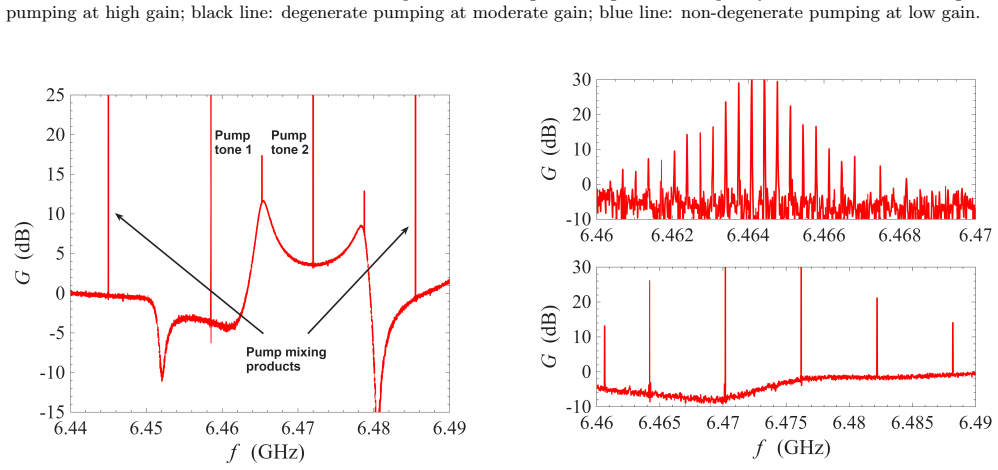
The non-degenerate pumping scheme, which applies two pump tones at frequencies separated from the peak-gain frequency by about ten times the amplifier bandwidth, produces parametric amplification with a peak gain of 26 dB and 3-dB bandwidth of 0.5 MHz in an NbN resonator. Gain drift over time decreases by a factor of four compared with degenerate pumping, and the two-tone drive permits phase-sensitive amplification with 23 dB gain and 6 dB squeezing when the signal and idler tones are degenerate.
What carries the argument
The non-degenerate pumping scheme, in which two pump tones at distinct frequencies drive the nonlinear resonator to generate gain while remaining well separated from the signal band.
If this is right
- Pump tones can be removed from the output with simpler filtering because they sit far from the amplification band.
- The amplifier continues to function reliably in a 4 K cryogenic environment without added complexity.
- The same hardware supports cross-harmonic amplification.
- Phase-sensitive operation with measurable squeezing becomes available simply by aligning the signal with the idler tone.
Where Pith is reading between the lines
- Longer integration times in quantum readout chains could become practical because recalibration intervals lengthen with reduced drift.
- Multiplexed readout of many resonators might require less hardware for pump rejection when tones are naturally offset.
- Adjusting the exact pump separation or adding a third tone could be tested to widen bandwidth while preserving stability.
Load-bearing premise
The two non-degenerate pump tones placed approximately ten bandwidths from the signal band produce no significant interference or mode mixing that would require extra filtering or data selection to obtain the reported gain, stability, and squeezing values.
What would settle it
Simultaneous application of both pump tones generates measurable spurious tones or sidebands inside the signal band, or the measured gain drift returns to the level seen with degenerate pumping.
Figures




read the original abstract
Superconducting resonator parametric amplifiers are potentially important components for a wide variety of fundamental physics experiments and utilitarian applications. We propose and realise an operating scheme that achieves amplification through the use of non-degenerate pumps, which addresses two key challenges in the design of parametric amplifiers: non-continuous gain across the amplification band and pump tone removal. We have experimentally demonstrated the non-degenerate pumping scheme using a half-wave resonator amplifier based on NbN thin-film, and measured a peak gain of 26 dB and 3-dB bandwidth of 0.5 MHz. The two non-degenerate pump tones were positioned ~10 bandwidths above and below the frequency at which peak gain occurs. We have found the non-degenerate pumping scheme to be more stable compared to the usual degenerate pumping scheme in terms of gain drift over time, by a factor of 4. This scheme also retains the usual flexibility of NbN resonator parametric amplifiers in terms of reliable amplification in a ~4 K environment, and is suitable for cross-harmonic amplification. The use of pump tones at different frequencies allows phase-sensitive amplification when the signal tone is degenerate with the idler tone. A gain of 23 dB and squeezing ratio of 6 dB were measured.
Editorial analysis
A structured set of objections, weighed in public.
Referee Report
Summary. The paper proposes and experimentally realizes a non-degenerate pumping scheme for a NbN thin-film half-wave resonator parametric amplifier. It reports a peak gain of 26 dB with a 3-dB bandwidth of 0.5 MHz using two pump tones placed approximately 10 bandwidths above and below the signal band, a fourfold reduction in gain drift relative to degenerate pumping, reliable operation near 4 K, and phase-sensitive amplification yielding 23 dB gain with 6 dB squeezing when signal and idler tones coincide.
Significance. If the measurements are robust, the non-degenerate scheme offers a practical route to improved gain stability and simplified pump filtering in superconducting parametric amplifiers, with direct relevance to quantum-limited readout, microwave quantum optics, and cryogenic signal processing.
major comments (2)
- [Results] Results section: The asserted fourfold reduction in gain drift and the overall stability advantage rest on the assumption that the non-degenerate pump tones (~5 MHz or ~10 bandwidths from the 0.5 MHz signal band) produce no measurable interference, cross-modulation, or resonator mode excitation through higher-order terms in the NbN kinetic inductance. Explicit spectra, cross-talk measurements, or controls ruling out such effects (or post-selection) are required to substantiate the central stability claim.
- [Abstract and Results] Abstract and Results: The reported peak gain (26 dB), bandwidth (0.5 MHz), squeezing (6 dB), and drift reduction are presented without error bars, uncertainty estimates, or details on averaging, thermal controls, or pump-leakage suppression; these omissions make it difficult to assess whether the quoted figures are statistically representative or sensitive to experimental artifacts.
minor comments (2)
- [Abstract] The abstract states the pumps are positioned '~10 bandwidths' but does not give the precise frequency offsets or resonator Q; adding these numbers would improve reproducibility.
- [Figures] Figure captions and text should consistently distinguish between power gain in dB and the squeezing ratio (also in dB) to avoid reader confusion.
Simulated Author's Rebuttal
We thank the referee for their careful and constructive review of our manuscript. We address each major comment point by point below and have revised the manuscript to strengthen the presentation of our results.
read point-by-point responses
-
Referee: [Results] Results section: The asserted fourfold reduction in gain drift and the overall stability advantage rest on the assumption that the non-degenerate pump tones (~5 MHz or ~10 bandwidths from the 0.5 MHz signal band) produce no measurable interference, cross-modulation, or resonator mode excitation through higher-order terms in the NbN kinetic inductance. Explicit spectra, cross-talk measurements, or controls ruling out such effects (or post-selection) are required to substantiate the central stability claim.
Authors: We agree that direct verification of negligible interference is necessary to fully substantiate the stability claim. In the revised manuscript we have added a supplementary figure displaying the output spectrum with both pump tones active, confirming that intermodulation products and any cross-talk fall below the measurement noise floor within the 0.5 MHz signal band. We also include a short discussion of the NbN kinetic inductance nonlinearity, showing that the pump powers used remain well within the linear regime of the resonator (verified by separate power-sweep measurements). The fourfold drift reduction was obtained from continuous time-series recordings under identical cryogenic and electronic conditions for both pumping schemes; these data are now presented with the new spectral controls. revision: yes
-
Referee: [Abstract and Results] Abstract and Results: The reported peak gain (26 dB), bandwidth (0.5 MHz), squeezing (6 dB), and drift reduction are presented without error bars, uncertainty estimates, or details on averaging, thermal controls, or pump-leakage suppression; these omissions make it difficult to assess whether the quoted figures are statistically representative or sensitive to experimental artifacts.
Authors: We accept that the original manuscript lacked sufficient statistical and procedural detail. The revised version now reports error bars on all quoted performance metrics, derived from the standard deviation across at least five independent measurement runs. We have added explicit statements on the averaging protocol (1000-point averages over 10-minute intervals), active temperature stabilization to <10 mK at the 4 K stage, and the cryogenic filtering chain (including 20 dB of pump leakage suppression via low-pass filters and circulators). These additions allow readers to evaluate the robustness of the reported 26 dB gain, 0.5 MHz bandwidth, 6 dB squeezing, and fourfold drift improvement. revision: yes
Circularity Check
No circularity: experimental measurements are self-contained
full rationale
The paper reports direct experimental results from a NbN thin-film half-wave resonator parametric amplifier operated with non-degenerate pumps placed ~10 bandwidths from the signal band. Claims of 26 dB peak gain, 0.5 MHz 3-dB bandwidth, 4× reduction in gain drift versus degenerate pumping, and 23 dB gain with 6 dB squeezing in the phase-sensitive regime are presented as measured quantities. No derivation chain, equations, fitted parameters renamed as predictions, or self-citation load-bearing steps appear in the provided text; the work is self-contained against external benchmarks of amplifier performance.
Axiom & Free-Parameter Ledger
Lean theorems connected to this paper
-
IndisputableMonolith/Cost/FunctionalEquation.leanwashburn_uniqueness_aczel unclear?
unclearRelation between the paper passage and the cited Recognition theorem.
four-wave mixing … ω_s + ω_i = ω_p1 + ω_p2 … nonlinear kinetic inductance … L = L0 [1 + (I/I*)²]
-
IndisputableMonolith/Foundation/RealityFromDistinction.leanreality_from_one_distinction unclear?
unclearRelation between the paper passage and the cited Recognition theorem.
non-degenerate pumping … phase-sensitive amplification … 23 dB gain and 6 dB squeezing
What do these tags mean?
- matches
- The paper's claim is directly supported by a theorem in the formal canon.
- supports
- The theorem supports part of the paper's argument, but the paper may add assumptions or extra steps.
- extends
- The paper goes beyond the formal theorem; the theorem is a base layer rather than the whole result.
- uses
- The paper appears to rely on the theorem as machinery.
- contradicts
- The paper's claim conflicts with a theorem or certificate in the canon.
- unclear
- Pith found a possible connection, but the passage is too broad, indirect, or ambiguous to say the theorem truly supports the claim.
Reference graph
Works this paper leans on
-
[1]
B. H. Eom, P. K. Day, H. G. LeDuc, and J. Zmuidzinas, Nat. Phys.8, 623 (2012)
work page 2012
-
[2]
McCulloch, Low noise amplification with hemts and paramps, 2017
M. McCulloch, Low noise amplification with hemts and paramps, 2017
work page 2017
- [3]
-
[4]
E. A. Thol´ en,Intermodulation in microresonators, PhD thesis, KTH Royal Institute of Technology, 2009
work page 2009
-
[5]
W. Shan, Y. Sekimoto, and T. Noguchi, IEEE T. Appl. Supercon.26, 1 (2016)
work page 2016
-
[6]
S. Zhao,Physics of superconducting travelling-wave para- metric amplifiers, PhD thesis, University of Cambridge, 2021
work page 2021
-
[7]
N. S. Oblath, Journal of Physics: Conference Series 1468, 012178 (2020)
work page 2020
-
[8]
R. Saakyan, Determination of neutrino mass with quan- tum technologies, inUK HEP Forum 2020: Quantum 11 leaps to the dark side at Durham University, 2020
work page 2020
- [9]
- [10]
- [11]
- [12]
- [13]
-
[14]
M. P. Westig and T. M. Klapwijk, Phys. Rev. Appl.9, 064010 (2018)
work page 2018
-
[15]
M. H. Devoret and R. J. Schoelkopf, Science339, 1169 (2013), https://www.science.org/doi/pdf/10.1126/science.1231930
- [16]
- [17]
-
[18]
A. D. C´ orcoleset al., Nature Communications6, 6979 (2015)
work page 2015
-
[19]
Rist` eet al., Nature Communications6, 6983 (2015)
D. Rist` eet al., Nature Communications6, 6983 (2015)
work page 2015
-
[20]
A. N. Cleland, J. S. Aldridge, D. C. Driscoll, and A. C. Gossard, Applied Physics Letters 81, 1699 (2002), https://pubs.aip.org/aip/apl/article- pdf/81/9/1699/18569621/1699 1 online.pdf
work page 2002
-
[21]
J. D. Teufelet al., Nature475, 359 (2011)
work page 2011
-
[22]
Kokkoniemiet al., Communications Physics2, 124 (2019)
R. Kokkoniemiet al., Communications Physics2, 124 (2019)
work page 2019
- [23]
-
[24]
Malnouet al., PRX Quantum2, 010302 (2021)
M. Malnouet al., PRX Quantum2, 010302 (2021)
work page 2021
-
[25]
S. Zhao, S. Withington, and C. N. Thomas, Supercon- ductor Science and Technology36, 105010 (2023)
work page 2023
-
[26]
S. Zhao, S. Withington, and C. N. Thomas, Journal of Physics D: Applied Physics58, 035305 (2024)
work page 2024
-
[27]
M. R. Visserset al., Applied Physics Letters107, 062601 (2015), https://doi.org/10.1063/1.4927444
-
[28]
S. Zhao, S. Withington, D. J. Goldie, and C. N. Thomas, Journal of Physics D: Applied Physics53, 345301 (2020)
work page 2020
-
[29]
C. J. McKinstrie and S. Radic, Opt. Lett.27, 1138 (2002)
work page 2002
-
[30]
Radicet al., IEEE Photonics Technology Letters14, 1406 (2002)
S. Radicet al., IEEE Photonics Technology Letters14, 1406 (2002)
work page 2002
-
[31]
J. C. Longden and B.-K. Tan, Engineering Research Ex- press6, 015068 (2024)
work page 2024
-
[32]
C. N. Thomas, Using a non-linear resonator as a para- metric ampli er, 2021, Internal report - Quantum Sensors group at University of Cambridge
work page 2021
- [33]
- [34]
-
[35]
Anritsu Corporation,Rubidium RF/Microwave Signal Generator Technical Data Sheet, 2024
work page 2024
-
[36]
Keysight Technologies,M9484C VXG and V3080A Vec- tor signal generator and frequency extender, 2025
work page 2025
-
[37]
C. N. Thomas, S. Withington, and S. Zhao, Effects of reactive, dissipative and rate-limited nonlinearity on the behaviour of superconducting resonator parametric am- plifiers, 2022
work page 2022
-
[38]
C. N. Thomas, S. Withington, Z. Sun, T. Skyrme, and D. J. Goldie, New Journal of Physics22, 073028 (2020)
work page 2020
- [39]
-
[40]
P. Krantz,The Josephson parametric oscillator - From microscopic studies to single-shot qubit readout, PhD the- sis, Chalmers University of Technology, 2016
work page 2016
-
[41]
Irelandet al., Measurement Science and Technology 34, 015003 (2022)
J. Irelandet al., Measurement Science and Technology 34, 015003 (2022)
work page 2022
-
[42]
D. F. Walls, Nature306, 141 (1983)
work page 1983
-
[43]
R. E. Slusher, L. W. Hollberg, B. Yurke, J. C. Mertz, and J. F. Valley, Phys. Rev. Lett.55, 2409 (1985)
work page 1985
-
[44]
S. Zhao and S. Withington, Journal of Physics D: Ap- plied Physics54, 365303 (2021)
work page 2021
-
[45]
S. Chaudhuri, J. Gao, and K. Irwin, IEEE Transactions on Applied Superconductivity25, 1 (2015)
work page 2015
-
[46]
T. Royet al., Applied Physics Letters107, 262601 (2015), https://pubs.aip.org/aip/apl/article- pdf/doi/10.1063/1.4939148/14474789/262601 1 online.pdf
-
[47]
Duanet al., Applied Physics Express14, 042011 (2021)
P. Duanet al., Applied Physics Express14, 042011 (2021)
work page 2021
- [48]
discussion (0)
Sign in with ORCID, Apple, or X to comment. Anyone can read and Pith papers without signing in.