Coherent error induced phase transition
Pith reviewed 2026-05-19 11:44 UTC · model grok-4.3
The pith
Coherent unitary errors trigger a phase transition that alters the logical state of the syndrome in stabilizer codes above a critical threshold.
A machine-rendered reading of the paper's core claim, the machinery that carries it, and where it could break.
Core claim
The central claim is that coherent errors induce a phase transition: when a random unitary error is applied before stabilizer measurements, the resulting syndrome state preserves its logical value below a threshold pc but acquires a different logical value above pc. This change is typically accompanied by an effective unitary acting on the logical subspace and by clear shifts in the global and local statistics of the syndrome distribution. The transition therefore marks the point at which reliable recovery of the logical information becomes impossible under coherent noise.
What carries the argument
The syndrome-dependent post-measurement state that results from applying a random unitary error channel before stabilizer measurements; its logical content is tracked to detect the transition.
If this is right
- Below the threshold pc the original logical information survives in the syndrome state and can be recovered by standard error-correction protocols.
- Above pc the syndrome state moves to a different logical state, so efficient recovery fails.
- The transition frequently produces an effective unitary rotation inside the logical subspace.
- Both global and local features of the syndrome distribution change qualitatively exactly at the transition.
- The same transition appears in both the toric code and non-local random stabilizer codes.
Where Pith is reading between the lines
- The effective logical rotation above threshold might be harnessed to perform logical operations if the error process can be controlled.
- Coherent errors appear to affect logical stability differently from typical incoherent noise, suggesting the need for tailored correction strategies.
- Analogous transitions could arise in other measurement-based quantum protocols that involve coherent operations.
- Direct tests on small quantum devices could locate the threshold pc for concrete codes and error models.
Load-bearing premise
The random unitary error acts cleanly before the stabilizer measurements and produces a well-defined post-measurement state whose logical information can be followed without additional decoherence or measurement errors.
What would settle it
In a toric code simulation or experiment, compute the expectation value of a logical operator on the post-measurement state and check whether it remains unchanged for coherent error strengths below the predicted pc but jumps or rotates above pc.
Figures



read the original abstract
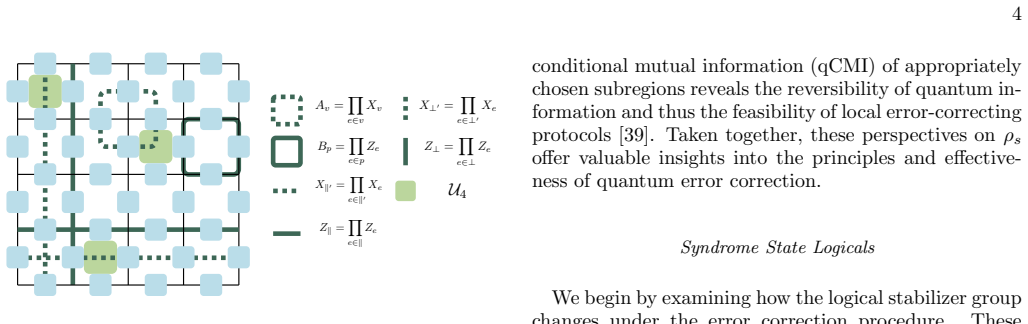
We investigate the stability of logical information in quantum stabilizer codes subject to coherent unitary errors. Beginning with a logical state, we apply a random unitary error channel and subsequently measure stabilizer checks, resulting in a syndrome-dependent post-measurement state. By examining both this syndrome state and the associated syndrome distribution, we identify a phase transition in the behavior of the logical state. Below a critical error threshold pc, the syndrome state remains in the same logical state, enabling successful recovery of the code's logical information via suitable error-correction protocols. Above pc, however, the syndrome state shifts to a different logical state, signaling the breakdown of efficient error correction. Notably, this process can often induce an effective unitary rotation within the logical space. This transition is accompanied by qualitative changes in both the global and local features of the syndrome distribution. We refer to this phenomenon as a coherent error induced phase transition. To illustrate this transition, we present two classes of quantum error correcting code models the toric code and non-local random stabilizer codes thereby shedding light on the design and performance limits of quantum error correction under coherent errors.
Editorial analysis
A structured set of objections, weighed in public.
Referee Report
Summary. The manuscript studies the stability of logical information in quantum stabilizer codes under coherent unitary errors. Starting from a logical state, a random unitary error channel is applied, followed by stabilizer measurements that yield a syndrome-dependent post-measurement state. The authors identify a phase transition at a critical error threshold pc: below pc the post-measurement state remains in the initial logical sector (permitting recovery), while above pc the logical state shifts, often accompanied by an effective logical-space rotation, with accompanying qualitative changes in global and local features of the syndrome distribution. The transition is illustrated numerically for the toric code and for ensembles of non-local random stabilizer codes.
Significance. If the reported transition is robust under realistic measurement imperfections, the result would be significant for quantum error correction because coherent (unitary) errors are more representative of hardware noise than purely stochastic Pauli channels. The work supplies a concrete diagnostic—preservation versus shift of the logical sector in the syndrome state—that could guide code design and threshold estimation for coherent-noise regimes. The explicit construction for both local (toric) and non-local random codes strengthens the claim that the phenomenon is not an artifact of a single code family.
major comments (2)
- [§2] §2 (model definition): the central claim that the logical content of the syndrome-dependent post-measurement state can be tracked without additional decoherence rests on the assumption of ideal, instantaneous stabilizer measurements performed after the unitary error channel. Because the errors are coherent, any back-action or finite-duration measurement circuit could rotate the logical operators or alter the effective syndrome statistics, potentially shifting or eliminating the reported transition. A concrete test (e.g., insertion of a small measurement-error model or Trotterized circuit) is needed to establish that the transition survives this realistic perturbation.
- [§4 and §5] §4 (toric-code numerics) and §5 (random-code ensemble): the location of pc is reported as an observed change in logical-sector occupation and syndrome statistics, yet the manuscript does not provide the precise fitting procedure, finite-size scaling ansatz, or statistical uncertainty on pc. Without these details it is unclear whether the quoted threshold is an intrinsic property of the coherent channel or an artifact of the chosen system size and sampling.
minor comments (2)
- Notation for the post-measurement logical projector is introduced without an explicit equation reference; adding a numbered equation would improve readability when the logical-sector occupation is later plotted.
- Figure captions for the syndrome-distribution plots should state the number of disorder realizations and the precise definition of the local and global observables used.
Simulated Author's Rebuttal
We thank the referee for their careful reading of our manuscript and for the constructive comments, which have helped us strengthen the presentation. We address each major comment below and indicate the revisions planned for the next version.
read point-by-point responses
-
Referee: §2 (model definition): the central claim that the logical content of the syndrome-dependent post-measurement state can be tracked without additional decoherence rests on the assumption of ideal, instantaneous stabilizer measurements performed after the unitary error channel. Because the errors are coherent, any back-action or finite-duration measurement circuit could rotate the logical operators or alter the effective syndrome statistics, potentially shifting or eliminating the reported transition. A concrete test (e.g., insertion of a small measurement-error model or Trotterized circuit) is needed to establish that the transition survives this realistic perturbation.
Authors: We agree that the assumption of ideal, instantaneous stabilizer measurements is central to isolating the effects of coherent unitary errors. This is a standard theoretical simplification that allows us to focus on the phase transition without confounding decoherence from the measurement process itself. We acknowledge that realistic back-action or finite-duration circuits could in principle modify the observed transition. In the revised manuscript we will add an explicit statement of this modeling choice in Section 2 together with a short discussion of its implications and the expected robustness in the fast-measurement limit. A full numerical test with Trotterized circuits lies beyond the scope of the present work but is noted as a natural direction for follow-up. revision: partial
-
Referee: §4 (toric-code numerics) and §5 (random-code ensemble): the location of pc is reported as an observed change in logical-sector occupation and syndrome statistics, yet the manuscript does not provide the precise fitting procedure, finite-size scaling ansatz, or statistical uncertainty on pc. Without these details it is unclear whether the quoted threshold is an intrinsic property of the coherent channel or an artifact of the chosen system size and sampling.
Authors: We thank the referee for pointing out the need for greater rigor in reporting the threshold pc. In the original manuscript pc was identified from the point at which the logical-sector occupation and global/local features of the syndrome distribution undergo qualitative change. In the revised version we will augment Sections 4 and 5 with a precise description of the fitting procedure, the finite-size scaling ansatz employed, and the statistical uncertainties obtained from ensemble sampling. These additions will make the determination of pc fully reproducible and clarify that it is not an artifact of finite system size. revision: yes
Circularity Check
No significant circularity in derivation of coherent error phase transition
full rationale
The paper applies a random unitary error channel before stabilizer measurements to produce a syndrome-dependent post-measurement state, then identifies the transition at pc by direct examination of logical-state preservation and changes in syndrome statistics for the toric code and random stabilizer codes. This chain relies on the stated model assumptions rather than any self-definitional loop, fitted parameter renamed as prediction, or load-bearing self-citation that reduces the claimed result to its own inputs. The derivation remains self-contained against external benchmarks of the error model and measurement process.
Axiom & Free-Parameter Ledger
free parameters (1)
- critical threshold pc
axioms (2)
- domain assumption Stabilizer measurements project the state onto a syndrome subspace while preserving logical information in the absence of errors.
- domain assumption Coherent errors can be modeled as random unitary operators applied to the physical qubits.
Lean theorems connected to this paper
-
IndisputableMonolith/Foundation/RealityFromDistinction.leanreality_from_one_distinction unclear?
unclearRelation between the paper passage and the cited Recognition theorem.
We identify a phase transition in the behavior of the logical state. Below a critical error threshold pc, the syndrome state remains in the same logical state... Above pc, however, the syndrome state shifts to a different logical state
-
IndisputableMonolith/Cost/FunctionalEquation.leanwashburn_uniqueness_aczel unclear?
unclearRelation between the paper passage and the cited Recognition theorem.
the coherent information of the associated quantum channel... I(ρQ,Ee)=S(ρQ′)−S(ρRQ′)
What do these tags mean?
- matches
- The paper's claim is directly supported by a theorem in the formal canon.
- supports
- The theorem supports part of the paper's argument, but the paper may add assumptions or extra steps.
- extends
- The paper goes beyond the formal theorem; the theorem is a base layer rather than the whole result.
- uses
- The paper appears to rely on the theorem as machinery.
- contradicts
- The paper's claim conflicts with a theorem or certificate in the canon.
- unclear
- Pith found a possible connection, but the passage is too broad, indirect, or ambiguous to say the theorem truly supports the claim.
Forward citations
Cited by 1 Pith paper
-
A Unified Framework for Locally Stable Phases
Locally stable states are equivalent to short-range correlated states and define phases invariant under locally reversible channels, with decay of nonlinear correlators and links to canonical purifications.
Reference graph
Works this paper leans on
-
[1]
Preskill, Quantum computing in the nisq era and be- yond, Quantum 2, 79 (2018)
J. Preskill, Quantum computing in the nisq era and be- yond, Quantum 2, 79 (2018)
work page 2018
-
[2]
M. A. Nielsen and I. L. Chuang, Quantum computation and quantum information (Cambridge university press, 2010)
work page 2010
-
[3]
D. Aharonov and M. Ben-Or, Fault-tolerant quantum computation with constant error, in Proceedings of the twenty-ninth annual ACM symposium on Theory of com- puting (1997) pp. 176–188
work page 1997
-
[4]
A. Y. Kitaev, Fault-tolerant quantum computation by anyons, Annals of physics 303, 2 (2003)
work page 2003
-
[5]
A. G. Fowler, M. Mariantoni, J. M. Martinis, and A. N. Cleland, Surface codes: Towards practical large-scale quantum computation, Physical Review A—Atomic, Molecular, and Optical Physics 86, 032324 (2012)
work page 2012
- [6]
-
[7]
J.-P. Tillich and G. Z´ emor, Quantum ldpc codes with positive rate and minimum distance proportional to the square root of the blocklength, IEEE Transactions on Information Theory 60, 1193 (2013)
work page 2013
-
[8]
A. Leverrier, J.-P. Tillich, and G. Z´ emor, Quantum ex- pander codes, in 2015 IEEE 56th Annual Symposium on Foundations of Computer Science (IEEE, 2015) pp. 810– 824
work page 2015
-
[9]
W. Brown and O. Fawzi, Short random circuits define good quantum error correcting codes, in 2013 IEEE In- ternational Symposium on Information Theory (IEEE,
work page 2013
- [10]
-
[11]
A. S. Darmawan, Y. Nakata, S. Tamiya, and H. Ya- masaki, Low-depth random clifford circuits for quantum coding against pauli noise using a tensor-network de- coder, Phys. Rev. Res. 6, 023055 (2024)
work page 2024
-
[12]
M. J. Gullans, S. Krastanov, D. A. Huse, L. Jiang, and S. T. Flammia, Quantum coding with low-depth random circuits, Phys. Rev. X 11, 031066 (2021)
work page 2021
- [13]
-
[14]
C. T. Chubb and S. T. Flammia, Statistical mechanical models for quantum codes with correlated noise, Annales de l’Institut Henri Poincar´ e D8, 269 (2021)
work page 2021
-
[15]
B. M. Terhal, Quantum error correction for quantum memories, Rev. Mod. Phys. 87, 307 (2015)
work page 2015
- [16]
- [17]
-
[18]
E. H. Chen, G.-Y. Zhu, R. Verresen, A. Seif, E. B¨ aumer, D. Layden, N. Tantivasadakarn, G. Zhu, S. Sheldon, A. Vishwanath, et al. , Nishimori transition across the error threshold for constant-depth quantum circuits, Na- ture Physics , 1 (2024)
work page 2024
-
[19]
G.-Y. Zhu, N. Tantivasadakarn, A. Vishwanath, S. Trebst, and R. Verresen, Nishimori’s cat: Stable long- range entanglement from finite-depth unitaries and weak measurements, Phys. Rev. Lett. 131, 200201 (2023)
work page 2023
-
[20]
J. Behrends and B. B´ eri, The surface code under generic x-error channels: Statistical mechanics, error thresholds, and errorfield double phenomenology, arXiv preprint arXiv:2412.21055 (2024)
-
[21]
´A. M´ arton and J. K. Asb´ oth, Coherent errors and readout errors in the surface code, Quantum 7, 1116 (2023)
work page 2023
-
[22]
F. Venn, J. Behrends, and B. B´ eri, Coherent-error thresh- old for surface codes from majorana delocalization, Phys. Rev. Lett. 131, 060603 (2023)
work page 2023
-
[23]
J. Behrends, F. Venn, and B. B´ eri, Surface codes, quan- tum circuits, and entanglement phases, Phys. Rev. Res. 6, 013137 (2024)
work page 2024
-
[24]
Phases of decodability in the surface code with unitary errors
Y. Bao and S. Anand, Phases of decodability in the surface code with unitary errors, arXiv preprint arXiv:2411.05785 (2024)
work page internal anchor Pith review arXiv 2024
- [25]
-
[26]
B. Skinner, J. Ruhman, and A. Nahum, Measurement- induced phase transitions in the dynamics of entangle- ment, Physical Review X 9, 031009 (2019)
work page 2019
-
[27]
M. J. Gullans and D. A. Huse, Dynamical purifica- tion phase transition induced by quantum measurements, Physical Review X 10, 041020 (2020)
work page 2020
-
[28]
Y. Li, X. Chen, and M. P. Fisher, Measurement-driven entanglement transition in hybrid quantum circuits, Physical Review B 100, 134306 (2019)
work page 2019
-
[29]
Y. Li, X. Chen, and M. P. Fisher, Quantum zeno ef- fect and the many-body entanglement transition, Physi- cal Review B 98, 205136 (2018)
work page 2018
- [30]
-
[31]
Y. Zhao and D. E. Liu, An analytic study of the indepen- dent coherent errors in the surface code, arXiv preprint arXiv:2112.00473 (2021)
-
[32]
H. Bombin and M. A. Martin-Delgado, Statistical me- chanical models and topological color codes, Phys. Rev. A 77, 042322 (2008)
work page 2008
-
[33]
S. Bravyi and R. Raussendorf, Measurement-based quan- tum computation with the toric code states, Phys. Rev. A 76, 022304 (2007)
work page 2007
- [34]
-
[35]
R. Koenig and J. A. Smolin, How to efficiently select an arbitrary clifford group element, Journal of Mathematical Physics 55 (2014)
work page 2014
-
[36]
B. Schumacher and M. A. Nielsen, Quantum data pro- cessing and error correction, Phys. Rev. A 54, 2629 (1996)
work page 1996
-
[37]
Lloyd, Capacity of the noisy quantum channel, Phys
S. Lloyd, Capacity of the noisy quantum channel, Phys. Rev. A 55, 1613 (1997)
work page 1997
-
[38]
L. Colmenarez, Z.-M. Huang, S. Diehl, and M. M¨ uller, Accurate optimal quantum error correction thresholds 19 from coherent information, Physical Review Research 6, L042014 (2024)
work page 2024
-
[39]
S. Sang and T. H. Hsieh, Stability of mixed-state quan- tum phases via finite markov length, arXiv preprint arXiv:2404.07251 (2024)
-
[40]
F. G. S. L. Brand˜ ao, A. W. Harrow, J. Oppenheim, and S. Strelchuk, Quantum conditional mutual information, reconstructed states, and state redistribution, Phys. Rev. Lett. 115, 050501 (2015)
work page 2015
-
[41]
O. Fawzi and R. Renner, Quantum conditional mutual information and approximate markov chains, Communi- cations in Mathematical Physics 340, 575 (2015)
work page 2015
-
[42]
B. Min, Y. Zhang, Y. Guo, D. Segal, and Y. Ashida, Mixed-state phase transitions in spin-holstein models, Phys. Rev. B 111, 115123 (2025)
work page 2025
-
[43]
Y. Zhang and S. Gopalakrishnan, Conditional mutual in- formation and information-theoretic phases of decohered gibbs states, arXiv preprint arXiv:2502.13210 (2025)
- [44]
-
[45]
A. D. Wyner, A definition of conditional mutual infor- mation for arbitrary ensembles, Information and Control 38, 51 (1978)
work page 1978
-
[46]
D. J. MacKay and R. M. Neal, Near shannon limit per- formance of low density parity check codes, Electronics letters 33, 457 (1997)
work page 1997
-
[47]
M. Mezard and A. Montanari, Information, physics, and computation (Oxford University Press, 2009)
work page 2009
discussion (0)
Sign in with ORCID, Apple, or X to comment. Anyone can read and Pith papers without signing in.