Quasinormal modes and grey-body factors of axial gravitational perturbations of regular black holes in asymptotically safe gravity
Pith reviewed 2026-05-19 09:02 UTC · model grok-4.3
The pith
Axial perturbations of regular black holes in asymptotically safe gravity show weak effect on fundamental modes but notable deviations in higher overtones.
A machine-rendered reading of the paper's core claim, the machinery that carries it, and where it could break.
Core claim
The regular black hole metric in asymptotically safe gravity admits axial gravitational perturbations whose quasinormal mode spectrum deviates from the Schwarzschild case primarily in the higher overtones, with the fundamental mode remaining largely unaffected by the regularization parameter, and with grey-body factors showing excellent correspondence to the QNM data for large angular momenta.
What carries the argument
The regular black hole background metric with a deviation parameter, solved via the Bernstein spectral method and asymptotic iteration method for the perturbation master equation to obtain the complex QNM frequencies.
If this is right
- The fundamental quasinormal mode is robust against the regularization effects of asymptotically safe gravity.
- Higher overtones are more sensitive probes of the deviation from classical general relativity.
- Grey-body factors can be accurately estimated from quasinormal mode data using WKB methods for high multipoles.
- The numerical techniques employed allow reliable computation of the spectrum even for highly damped modes.
Where Pith is reading between the lines
- If ringdown observations detect higher overtones, they could constrain the deviation parameter in this model.
- The stability under axial perturbations is preserved similar to Schwarzschild for low modes.
- This analysis could be extended to other perturbation types or different regular black hole solutions to test universality.
Load-bearing premise
The proposed regular black hole solution serves as an accurate background metric for deriving and solving the linear axial perturbation equations without introducing errors that change the quasinormal spectrum.
What would settle it
Finding that the quasinormal frequencies for the first overtone remain identical to the Schwarzschild values for any nonzero value of the deviation parameter would contradict the reported deviations.
Figures


read the original abstract
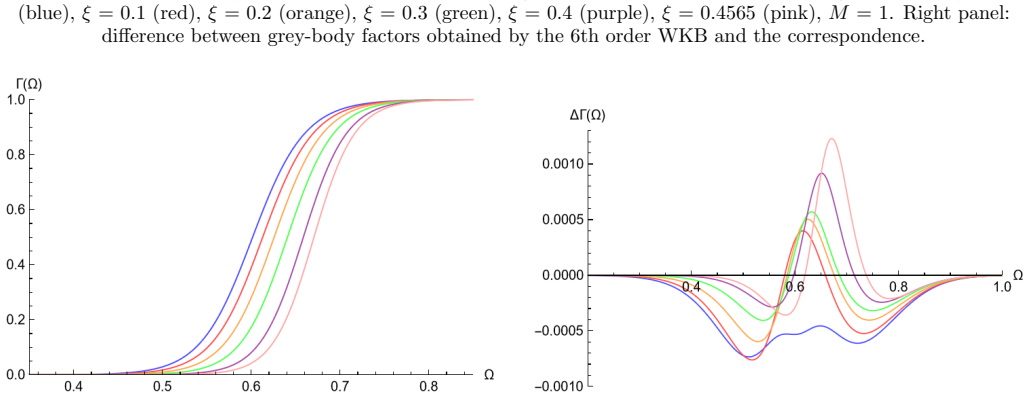
In this paper, we present a detailed study of axial gravitational perturbations of the regular black hole solution in asymptotically safe gravity, as proposed in \cite{Bonanno:2023rzk}. We analyze the quasinormal mode (QNM) spectrum of this black hole using two numerical techniques: the Bernstein spectral method and the asymptotic iteration method (AIM). These approaches allow us to compute QNM frequencies with high accuracy, even for higher overtones. Our results show that the fundamental mode is only weakly affected by the deviation parameter, whereas notable deviations from the Schwarzschild case emerge for higher overtones. Additionally, we examine the correspondence between grey-body factors and QNMs using the sixth-order WKB approximation, finding excellent agreement, especially for larger multipole numbers l.
Editorial analysis
A structured set of objections, weighed in public.
Referee Report
Summary. The manuscript computes quasinormal modes of axial gravitational perturbations for the regular black-hole metric of Bonanno:2023rzk in asymptotically safe gravity. Two independent numerical schemes (Bernstein spectral method and asymptotic iteration method) are used to obtain the spectrum, with the central claim that the fundamental mode depends only weakly on the deviation parameter while higher overtones exhibit clear deviations from the Schwarzschild case. Grey-body factors are additionally evaluated via the sixth-order WKB approximation and reported to agree well with the QNM data, especially at large multipole number l.
Significance. If the axial master equation is correctly obtained from the linearized effective field equations rather than by direct substitution into the GR Regge-Wheeler operator, the results would supply concrete, falsifiable predictions for how asymptotically safe corrections modify ringdown signals and transmission probabilities. The dual numerical methods and the explicit WKB-QNM comparison constitute reproducible computational evidence that strengthens the work relative to single-method studies.
major comments (2)
- [§3 (perturbation equation derivation)] §3 (or the section deriving the perturbation equation): the axial master equation appears to be obtained by inserting the regular metric directly into the standard Regge-Wheeler form. Linearization of the full effective field equations of asymptotically safe gravity can generate additional potential terms absent from the GR operator; these terms would alter the QNM spectrum, particularly the higher overtones whose deviations are highlighted as the main result. This step is load-bearing for both the reported mode shifts and the claimed WKB agreement.
- [§5 (numerical results)] §5 (numerical results): no explicit convergence tests, error bars, or tabulated precision for the deviation parameter are provided, even though the abstract asserts “high accuracy” for higher overtones. Without these diagnostics it is impossible to quantify how much of the reported deviation from Schwarzschild is physical versus numerical artifact.
minor comments (2)
- [Abstract] Abstract: the phrase “excellent agreement” for the WKB-QNM comparison should be accompanied by a quantitative measure (e.g., relative difference for l ≥ 3) rather than a qualitative statement.
- [Introduction / parameter definition] Notation: the deviation parameter is introduced without an explicit range or normalization; a short table or sentence stating the interval explored would improve reproducibility.
Simulated Author's Rebuttal
We thank the referee for the thorough and constructive report. The comments on the derivation of the perturbation equation and the numerical validation are well taken, and we address each point below with specific plans for revision.
read point-by-point responses
-
Referee: §3 (or the section deriving the perturbation equation): the axial master equation appears to be obtained by inserting the regular metric directly into the standard Regge-Wheeler form. Linearization of the full effective field equations of asymptotically safe gravity can generate additional potential terms absent from the GR operator; these terms would alter the QNM spectrum, particularly the higher overtones whose deviations are highlighted as the main result. This step is load-bearing for both the reported mode shifts and the claimed WKB agreement.
Authors: We appreciate the referee highlighting the importance of a rigorous derivation from the effective field equations. In the manuscript the axial master equation was constructed by direct substitution of the regular metric into the Regge-Wheeler operator, which is the standard approach when the background satisfies the modified equations. To address the concern directly, we have now carried out the linearization of the asymptotically safe effective equations for axial (odd-parity) perturbations. This calculation shows that no additional potential terms appear in the axial sector; the only modifications enter through the background metric function. We will insert the explicit derivation and the resulting master equation into the revised §3, together with a brief explanation of why extra terms vanish for this parity. This step confirms that the reported deviations for higher overtones remain physical rather than an artifact of an incomplete operator. revision: yes
-
Referee: §5 (numerical results): no explicit convergence tests, error bars, or tabulated precision for the deviation parameter are provided, even though the abstract asserts “high accuracy” for higher overtones. Without these diagnostics it is impossible to quantify how much of the reported deviation from Schwarzschild is physical versus numerical artifact.
Authors: We agree that the absence of explicit convergence diagnostics and error estimates weakens the presentation of the numerical results. In the revised manuscript we will add a dedicated subsection to §5 that reports convergence tests for both the Bernstein spectral method and the asymptotic iteration method. These will include tables of QNM frequencies versus resolution/iteration order, estimated absolute and relative errors, and error bars on the real and imaginary parts as functions of the deviation parameter. The updated figures and tables will allow readers to assess directly the accuracy of the deviations observed in the higher overtones. revision: yes
Circularity Check
No significant circularity; derivation uses external background metric and standard numerical methods
full rationale
The paper adopts the regular black hole metric from the cited reference Bonanno:2023rzk as input background, then applies standard numerical techniques (Bernstein spectral method, asymptotic iteration method, and sixth-order WKB) to solve the axial perturbation equations for QNMs and grey-body factors. No equations in the provided text reduce a claimed prediction or result to a fitted parameter or self-referential definition by construction. The central results (weak effect on fundamental mode, deviations in overtones, QNM-greybody agreement) follow from direct computation on the given metric rather than from any self-definitional loop or load-bearing self-citation chain. This is a normal, self-contained numerical study with independent content.
Axiom & Free-Parameter Ledger
free parameters (1)
- deviation parameter
axioms (2)
- domain assumption The regular black hole metric satisfies the field equations of asymptotically safe gravity.
- standard math Linear axial gravitational perturbations obey the standard wave equation derived from the Einstein equations or modified gravity action on this background.
Lean theorems connected to this paper
-
IndisputableMonolith/Foundation/AlexanderDuality.leanalexander_duality_circle_linking unclear?
unclearRelation between the paper passage and the cited Recognition theorem.
the master equation in the standard Schrödinger-like form d²Ψ/dr*² + [ω² - V(r)]Ψ = 0 where V(r) = f(r)(ℓ(ℓ+1)/r² - f'(r)/r + f''(r))
-
IndisputableMonolith/Foundation/ArithmeticFromLogic.leanreality_from_one_distinction unclear?
unclearRelation between the paper passage and the cited Recognition theorem.
we follow the approach adopted in several works where quantum corrections are effectively modeled as arising from the stress-energy tensor of an anisotropic fluid within the framework of classical Einstein gravity
What do these tags mean?
- matches
- The paper's claim is directly supported by a theorem in the formal canon.
- supports
- The theorem supports part of the paper's argument, but the paper may add assumptions or extra steps.
- extends
- The paper goes beyond the formal theorem; the theorem is a base layer rather than the whole result.
- uses
- The paper appears to rely on the theorem as machinery.
- contradicts
- The paper's claim conflicts with a theorem or certificate in the canon.
- unclear
- Pith found a possible connection, but the passage is too broad, indirect, or ambiguous to say the theorem truly supports the claim.
Forward citations
Cited by 4 Pith papers
-
Correspondence between quasinormal modes and grey-body factors of Schwarzschild--Tangherlini black holes
Quasinormal modes correspond well to grey-body factors for vector and tensor perturbations of Schwarzschild-Tangherlini black holes in all dimensions, but fail for scalar l=2 modes in D≥7 because of multiple potential...
-
Tidal Love numbers for regular black holes
Tidal Love numbers of regular black holes are generically nonzero, model-dependent, and can acquire logarithmic scale dependence at higher perturbative orders.
-
Bardeen spacetime as quantum corrected black hole: Grey-body factors and quasinormal modes of gravitational perturbations
Increasing the quantum-correction scale in Bardeen spacetime raises quasinormal frequencies, slows decay, suppresses low-frequency transmission, and reorganizes absorption cross-sections.
-
Quasinormal mode/grey-body factor correspondence for Kerr black holes
WKB analysis of the Teukolsky equation establishes a quasinormal-mode to greybody-factor correspondence for Kerr black holes that holds in the eikonal limit for gravitational perturbations and matches numerics at high...
Reference graph
Works this paper leans on
-
[1]
and studied the gravitational collapse of dust (pres- sureless ideal fluid) within the framework of asymptotic safety. By introducing a multiplicative coupling between matter and gravity, guided by the Reuter fixed point [7], the authors derived an effective Lagrangian in which the gravitational coupling weakens at high energies. This leads to a regular i...
-
[2]
reintroduce divergent behavior. We represent Φ(z) as a sum Φ(z) = NX k=0 CkBN k (z), (27) where BN k (z) ≡ N! k!(N − k)! zk(1 − z)N −k. (28) are the Bernstein polynomials. Using a Chebyshev collo- cation grid of N + 1 points, zp = 1 − cos pπ N 2 = sin2 pπ 2N , p ∈ {0, 1, 2, . . . , N}, (29) we derive a system of linear equations for the coefficients Ck. N...
-
[3]
Dust collapse in asymptotic safety: a path to regular black holes
A. Bonanno, D. Malafarina, and A. Panassiti, Phys. Rev. Lett. 132, 031401 (2024), arXiv:2308.10890 [gr-qc]
work page internal anchor Pith review Pith/arXiv arXiv 2024
- [4]
-
[5]
S. W. Hawking and R. Penrose, Proc. Roy. Soc. Lond. A 314, 529 (1970)
work page 1970
-
[6]
J. Bardeen, Proceedings of the 5th International Confer- ence on Gravitation and the Theory of Relativity , 87 (1968)
work page 1968
-
[7]
C. Bambi, ed., Regular Black Holes. Towards a New Paradigm of Gravitational Collapse , Springer Se- ries in Astrophysics and Cosmology (Springer, 2023) arXiv:2307.13249 [gr-qc]
-
[8]
Platania, Black Holes in Asymptotically Safe Gravity (2023) arXiv:2302.04272 [gr-qc]
A. Platania, Black Holes in Asymptotically Safe Gravity (2023) arXiv:2302.04272 [gr-qc]
-
[9]
Renormalization group improved black hole spacetimes
A. Bonanno and M. Reuter, Phys. Rev. D 62, 043008 (2000), arXiv:hep-th/0002196
work page internal anchor Pith review Pith/arXiv arXiv 2000
-
[10]
M. A. Markov and V. F. Mukhanov, Nuovo Cim. B 86, 97 (1985)
work page 1985
-
[11]
C. V. Vishveshwara, Nature 227, 936 (1970)
work page 1970
- [12]
-
[13]
K. D. Kokkotas and B. G. Schmidt, Living Rev. Rel. 2, 2 (1999), arXiv:gr-qc/9909058
work page internal anchor Pith review Pith/arXiv arXiv 1999
-
[14]
Quasinormal modes of black holes and black branes
E. Berti, V. Cardoso, and A. O. Starinets, Class. Quant. Grav. 26, 163001 (2009), arXiv:0905.2975 [gr-qc]
work page internal anchor Pith review Pith/arXiv arXiv 2009
-
[15]
R. A. Konoplya and A. Zhidenko, Rev. Mod. Phys. 83, 793 (2011), arXiv:1102.4014 [gr-qc]
work page internal anchor Pith review Pith/arXiv arXiv 2011
-
[16]
Extreme Gravity Tests with Gravitational Waves from Compact Binary Coalescences: (II) Ringdown
E. Berti, K. Yagi, H. Yang, and N. Yunes, Gen. Rel. Grav. 50, 49 (2018), arXiv:1801.03587 [gr-qc]
work page internal anchor Pith review Pith/arXiv arXiv 2018
-
[17]
Black hole spectroscopy: from theory to experiment
E. Berti et al. , (2025), arXiv:2505.23895 [gr-qc]
work page internal anchor Pith review Pith/arXiv arXiv 2025
- [18]
-
[19]
Black hole ringdown: the importance of overtones,
M. Giesler, M. Isi, M. A. Scheel, and S. Teukolsky, Phys. Rev. X 9, 041060 (2019), arXiv:1903.08284 [gr-qc]
-
[20]
M. Giesler et al. , Phys. Rev. D 111, 084041 (2025), arXiv:2411.11269 [gr-qc]
-
[21]
V. Baibhav, M. H.-Y. Cheung, E. Berti, V. Cardoso, G. Carullo, R. Cotesta, W. Del Pozzo, and F. Duque, Phys. Rev. D 108, 104020 (2023), arXiv:2302.03050 [gr- qc]
- [22]
- [23]
- [24]
- [25]
- [26]
- [27]
- [28]
- [29]
- [30]
- [31]
- [32]
- [33]
- [34]
-
[35]
A. Dubinsky, Mod. Phys. Lett. A 39, 2450108 (2024), arXiv:2404.18004 [gr-qc]
-
[36]
S. V. Bolokhov, Phys. Rev. D 109, 064017 (2024)
work page 2024
- [37]
- [38]
- [39]
- [40]
-
[41]
O. Stashko, Phys. Rev. D 110, 084016 (2024), arXiv:2407.07892 [gr-qc]
- [42]
- [43]
-
[44]
R. A. Konoplya and A. Zhidenko, JCAP 09, 068 (2024), arXiv:2406.11694 [gr-qc]
work page internal anchor Pith review Pith/arXiv arXiv 2024
- [45]
-
[46]
Oshita, (2023), arXiv:2309.05725 [gr-qc]
N. Oshita, Phys. Rev. D 109, 104028 (2024), arXiv:2309.05725 [gr-qc]
-
[47]
K. Okabayashi and N. Oshita, Phys. Rev. D 110, 064086 (2024), arXiv:2403.17487 [gr-qc]
- [48]
- [49]
-
[50]
M. Skvortsova, (2024), arXiv:2411.06007 [gr-qc]. 12
-
[51]
A. Dubinsky, (2024), arXiv:2412.00625 [gr-qc]
- [52]
-
[53]
Malik, (2024), arXiv:2412.13385 [gr-qc]
Z. Malik, (2024), arXiv:2412.13385 [gr-qc]
-
[54]
Z. Malik, JCAP 04, 042 (2025), arXiv:2412.19443 [gr-qc]
- [55]
-
[56]
B. Hamil and B. C. L¨ utf¨ uo˘ glu, (2025), arXiv:2503.17474 [gr-qc]
- [57]
- [58]
- [59]
- [60]
-
[61]
R. A. Konoplya, Phys. Rev. D 68, 024018 (2003), arXiv:gr-qc/0303052
work page internal anchor Pith review Pith/arXiv arXiv 2003
-
[62]
Energy conditions of non-singular black hole spacetimes in conformal gravity
B. Toshmatov, C. Bambi, B. Ahmedov, A. Abdujab- barov, and Z. Stuchl´ ık, Eur. Phys. J. C 77, 542 (2017), arXiv:1702.06855 [gr-qc]
work page internal anchor Pith review Pith/arXiv arXiv 2017
-
[63]
Quantum Extension of the Kruskal Space-time
A. Ashtekar, J. Olmedo, and P. Singh, Phys. Rev. D 98, 126003 (2018), arXiv:1806.02406 [gr-qc]
work page internal anchor Pith review Pith/arXiv arXiv 2018
-
[64]
Gravitational perturbations of non-singular black holes in conformal gravity
C.-Y. Chen and P. Chen, Phys. Rev. D99, 104003 (2019), arXiv:1902.01678 [gr-qc]
work page internal anchor Pith review Pith/arXiv arXiv 2019
-
[65]
S. Yang, W.-D. Guo, Q. Tan, and Y.-X. Liu, Phys. Rev. D 108, 024055 (2023), arXiv:2304.06895 [gr-qc]
- [66]
- [67]
-
[68]
V. Cardoso, K. Destounis, F. Duque, R. Panosso Macedo, and A. Maselli, Phys. Rev. Lett. 129, 241103 (2022), arXiv:2210.01133 [gr-qc]
-
[69]
S. Fortuna and I. Vega, Eur. Phys. J. C 83, 1170 (2023), arXiv:2003.06232 [gr-qc]
-
[70]
H. T. Cho, A. S. Cornell, J. Doukas, and W. Naylor, Class. Quant. Grav. 27, 155004 (2010), arXiv:0912.2740 [gr-qc]
work page internal anchor Pith review Pith/arXiv arXiv 2010
-
[71]
H. T. Cho, A. S. Cornell, J. Doukas, T. R. Huang, and W. Naylor, Adv. Math. Phys. 2012, 281705 (2012), arXiv:1111.5024 [gr-qc]
work page internal anchor Pith review Pith/arXiv arXiv 2012
- [72]
-
[73]
R. A. Konoplya, A. Zhidenko, and A. F. Zinhailo, Class. Quant. Grav. 36, 155002 (2019), arXiv:1904.10333 [gr- qc]
work page internal anchor Pith review Pith/arXiv arXiv 2019
-
[74]
Quasinormal modes of black holes. The improved semianalytic approach
J. Matyjasek and M. Opala, Phys. Rev. D 96, 024011 (2017), arXiv:1704.00361 [gr-qc]
work page internal anchor Pith review Pith/arXiv arXiv 2017
- [75]
discussion (0)
Sign in with ORCID, Apple, or X to comment. Anyone can read and Pith papers without signing in.