REVIEW 4 major objections 6 minor 21 references
Practice-Based Optimization for the Strategic Locomotive Assignment Problem
T0 review · 4 major / 6 minor · reviewed 2026-08-06 · deepseek-v4-flash
Pith's one-line read Two pruning rules make exact locomotive assignment solvable at full-network scale.
desk verdict A practical strategic LAP model with genuinely useful reduction rules, but the 'exact' claim is softer than the abstract suggests and depends on an untested cost-invariance assumption. read the letter →
The pith
A machine-rendered reading of the paper's core claim, the machinery that carries it, and where it could break.
The reading
What carries the argument
The engine is a cyclic space-time network whose nodes are train departures, arrivals, and ground inventory states, and whose arcs carry integer flows of identical locomotives. Light-travel arcs connect ground nodes where units become idle to ground nodes where they are next needed. The two reduction rules exploit the fact that all light-travel arcs between the same terminal pair share one cost: earliest reachability collapses many departure-time choices onto the first feasible arrival, and latest origin filtering removes earlier starts that would only add idle waiting. Work-event fixed charges are handled by binary variables that activate pick-up and set-out arcs, and the wrap-around arcs in $S$ make the weekly plan repeatable.
What would settle it
Take a small network with two terminals and one scheduled train, create two light-travel departure windows with different crew costs between the same terminal pair, run the full arc-set model and the reduced arc-set model, and compare optimal values; any gap shows the reduction is lossy. On real data, the same test is to extract historical light-travel costs by time of day and check for statistically meaningful within-pair variation.
Extended reading notes
Core claim
The central claim is that optimizing over the complete set of light travel arcs—previously considered computationally out of reach—is achievable through two reductions: earliest reachability, which connects each arrival-ground node only to the first reachable ground-departure node at each destination, and latest origin filtering, which keeps only the latest origin arc when several from the same terminal reach the same departure node. Because light-travel cost is constant for a terminal pair regardless of departure time, merging earlier departures into later ones cannot raise cost, so the reduced arc set contains at least one optimal solution. This makes it possible to solve the full LAP exactly and to report genuine optimality gaps for the standard minimum-cost-flow heuristic, whose true gap is about 3% on the test instances while the exact model's gap sits above 6% within the same time limit.
Load-bearing premise
The optimality of the reduction rules rests on the assumption that every light travel arc between the same two terminals costs the same regardless of departure time; if crew availability or congestion makes departure time matter, pruning earlier departures could cut off the true optimum.
Editorial extensions
If this is right
- If the reduction rules preserve optimality as claimed, then the exact model's solutions are valid for the full light-travel arc set, not just the pruned one.
- The exact model's lower bounds make it possible to compute true optimality gaps for the minimum-cost-flow heuristic and for any future heuristic, replacing the guessed gaps used in earlier work.
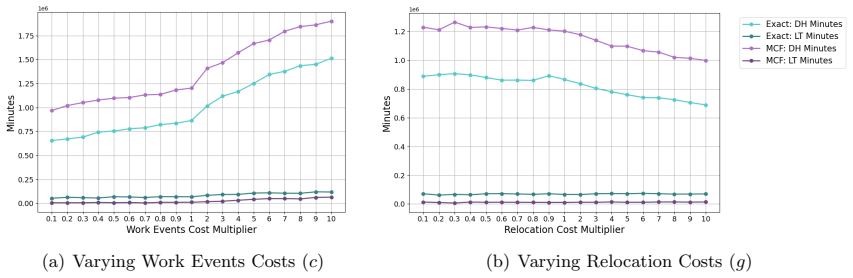
- Under high locomotive ownership costs, the exact model finds smaller fleets and up to 4% lower total cost than the MCF heuristic at cost factor 10, a regime that matters for capacity-constrained networks.
- The exact model systematically produces more decentralized repositioning—more active terminals, more work events with fewer locomotives—so decisions about fleet size, work-event flexibility, and light-travel optionality must be made jointly, not in isolation.
- Practice-based constraints (V1–V5) show that network redesign outperforms incremental expansion from the baseline plan, and that terminal-day-level flexibility beats terminal-level activation for cost savings.
Reading between the lines
- Beyond the paper, if light-travel costs vary with departure time—for instance due to crew schedules or congestion—the constant-cost premise fails, and the reductions could prune an optimal arc; a natural stress test is to rerun both the full and reduced models on instances with time-dependent light-travel costs.
- Beyond the paper, the same two-step reduction should transfer to other cyclic fleet-repositioning problems (shipping containers, empty railcars, aircraft) where repositioning cost depends only on the origin-destination pair, giving exact lower bounds for their heuristics.
- Beyond the paper, the reported true gap of MCF (~3%) is specific to the test set and cost configuration; a broader comparison across many cost scenarios would show how the heuristic's gap varies with demand imbalance and network density.
- Beyond the paper, the persistent backbone of terminals that recurs across all redesigns suggests a two-stage planning strategy: fix the high-impact core, then optimize the remaining 20–30% of choices that drive coordination gains.
Editorial analysis
A structured set of objections, weighed in public.
Referee Report
Summary. The paper studies the strategic Locomotive Assignment Problem (LAP) in a cyclic weekly setting, formulated as a single-commodity integer program on a space-time network. Its main contributions are claimed to be (i) an IP that jointly optimizes locomotive assignments and the placement of pick-up and set-out work events, (ii) reduction rules that prune the full set of light travel arcs while preserving optimality, enabling the first exact treatment of the full LAP light-travel arc set, and (iii) a real-world case study on data from a North American Class I railroad that compares the exact method with a common minimum-cost-flow (MCF) heuristic. The paper also introduces a family of work-event restriction extensions (V1–V5) and reports sensitivity analyses over cost parameters. Computationally, the exact method produces a valid lower bound but does not close its optimality gap below about 6% within eight hours, while the MCF heuristic reaches gaps near 3%.
Significance. If the central claims hold, the paper makes a useful contribution: it endogenizes work-event decisions, proposes reduction rules that could make optimization over a large light-travel arc set tractable, provides valid lower bounds for heuristic evaluation, and offers practical insights on work-event flexibility trade-offs from a substantial real-data case study. The strengths of the manuscript include the realistic model scope, the detailed computational studies, and the explicit handling of operational restrictions. However, the exactness claim is not demonstrated empirically, the optimality-preservation proof of the reduction rules is only sketched, and there is a modeling inconsistency concerning simultaneous pick-up and set-out. These issues affect the central claims and need to be addressed before the paper can be accepted as an exact-method contribution.
major comments (4)
- [Abstract & §4.2] The abstract and contributions state that the paper solves large-scale instances exactly for the first time and that the exact method guarantees convergence to the true optimum, but §4.2 reports that the exact method does not reduce its optimality gap below 6% within the 8-hour time limit (Figure 3). No instance is reported as solved to proven optimality. The exact method provides a valid lower bound, but the experimental evidence does not support a claim of exact solutions. Please either provide experiments in which the gap is closed for at least some instances, or rephrase the claims to describe an exact formulation with valid dual bounds rather than exact solutions.
- [§3.3.1 and §2.3] The central assertion that the reduced arc set AL "does not sacrifice optimality" is supported only by an informal one-sentence argument, and Appendix A (Figure 14) addresses wrap-around arc identification, not a dominance proof. A formal exchange argument is needed for both Earliest Reachability and Latest Origin Filtering. The argument also relies critically on the §2.3 assumption that all light travel arcs between the same terminal pair have identical costs regardless of departure time; if that assumption fails (e.g., crew costs or congestion vary by time of day), the earliest reachable node need not dominate later nodes, and the latest origin filtering can remove optimal arcs. This assumption is not validated by the data, and no sensitivity experiment varies light travel costs by departure time. Please supply a rigorous proof and either justify the time-invariance assumption or extend the model to time-dependent light-travel costs and re-test the reduction.
- [§3.1 and Model (1)] The text states that at most one of the pick-up or set-out arcs can be used to change the total number of locomotives between train legs, but Model (1) contains no constraint enforcing this. For a transition arc l=(i,j), the set-out arc l' and pick-up arc l* can both carry positive flow while satisfying flow conservation (1c) and bounds (1b). If simultaneous pick-up and set-out is operationally forbidden, add a disjunctive constraint such as yso_l' + ypu_l* <= 1 for each intermediate stop and include it in the appendix formulations; if simultaneous operation is allowed, correct the statement in §3.1.
- [§3.3.1] The generated light travel arc set is restricted to arcs from arrival-ground nodes NR to ground-departure nodes NE, although §3.1 defines light travel arcs between all ground nodes NG = NI ∪ NE ∪ NR. This restriction excludes light travel from initial nodes and from ground-departure nodes at the origin. It may be that cyclic ground waiting and wrap-around arcs make this restriction lossless, but this is not demonstrated. Please provide a proof that the NR-to-NE restriction preserves all feasible light-travel movements, or generate arcs from the full set of ground nodes.
minor comments (6)
- [Appendix A, Figure 14] In the description of the earliest ground-departure node, "at terminal k" should likely read "at terminal k′", since the destination terminal is k′.
- [Figure 3(a)] The label "True Optimality Gaps" is not accurate when the exact method has not closed its gap; these are valid lower-bound gaps and should be labeled as such.
- [§4.4.2] The statement that all variants eventually outperform the unconstrained V0 solution is only meaningful if V0 is solved to optimality or its gap is reported, because an unconstrained optimum cannot be worse than a constrained one when both are solved optimally.
- [§3.2, RC(y)] The RC(y) expression is dense; a short worked example or reorganized definition of the rso_l, rpu_l, rno_l, and rboth_l parameters would materially improve readability.
- [Table 1] The line for APU and ASO lists "Set of set-out and pick-up arcs" with symbols in the order APU ⊂ AE, ASO ⊂ AR; the wording and order are easy to confuse. Please rephrase to make clear that APU are pick-up arcs in AE and ASO are set-out arcs in AR.
- [§4.4.2] Warm-starting higher-α variants from lower-α solutions may bias the comparison between incremental and redesign models; the authors acknowledge this, but a brief discussion of the potential direction of the bias would strengthen the conclusion that redesigns outperform incremental approaches.
Circularity Check
No circular derivation: the exact-model claim rests on an explicit dominance argument over stated cost-invariance assumptions, not on a reduction to its own inputs.
full rationale
The central optimality claim is the assertion in Section 3.3.1 that the reduced light-travel arc set AL 'does not sacrifice optimality.' The supporting argument is a dominance step: because 'the fixed charge and variable cost for light travel are constant for arcs between the same terminals,' replacing later arrivals with the earliest reachable ground-departure node, and replacing earlier origins with the latest origin that reaches the same destination node, can only consolidate flows and never increase the objective. This is a conventional dominance proof, not a circular one. The key premise, stated in Section 2.3, that 'all light travel arcs between the same terminal pair share identical costs regardless of departure time,' is an explicit modeling assumption about the cost data, not a parameter fitted to the claimed result. It is load-bearing for the exactness argument, but using a stated assumption to prove a theorem is not circular reasoning. The exact optimization model is a direct integer-programming formulation over a space-time network, not an algebraic rewrite of the MCF heuristic, and the MCF heuristic is cited from prior literature rather than invented by the authors. The reported lower bounds and optimality gaps are derived from the exact model's solution process, not from a quantity that was itself fitted to make the comparison favorable. No self-citation chain, imported uniqueness theorem, or ansatz-via-citation is load-bearing. If the cost-invariance assumption fails, the reduction rules could remove optimal arcs, but that is a correctness risk under an explicit assumption, not a circularity.
Assumptions & free parameters
free parameters (3)
- MCF penalization factor alpha =
mean of oij (number of trains between terminal pair)
- MCF time window length =
8 hours
- MCF flow threshold =
>1
assumptions (4)
- domain assumption Locomotive fleet is homogeneous: all units have identical pulling capability.
- domain assumption The weekly train schedule repeats exactly each week, so the assignment plan must be cyclic.
- domain assumption All light travel arcs between the same terminal pair share identical fixed and variable costs regardless of departure time.
- domain assumption Idle waiting on ground is free, so reaching a destination earlier is never worse.
Cite this review
Pith. "Pith review of Practice-Based Optimization for the Strategic Locomotive Assignment Problem." pith.science (2026). https://pith.science/paper/IZSJSVY5
@misc{pith2026250722235,
  author       = {Pith},
  title        = {Pith review of: Practice-Based Optimization for the Strategic Locomotive Assignment Problem},
  year         = {2026},
  howpublished = {\url{https://pith.science/paper/IZSJSVY5}},
  note         = {Machine review of arXiv:2507.22235}
}
read the original abstract
This study addresses the challenge of efficiently assigning locomotives in large freight rail networks, where operational complexity and power imbalances make cost-effective planning difficult. It presents a strategic optimization framework for the Locomotive Assignment Problem (LAP), developed in collaboration with a major North American Class I Freight Railroad. The problem is formulated as a network-based integer program over a cyclic space-time network, producing a repeatable weekly locomotive assignment plan. The model captures a comprehensive set of real-world operational constraints and jointly optimizes the placement of pick-up and set-out locomotive work events, improving the effectiveness of downstream planning. To solve large-scale instances exactly for the first time, novel reduction rules are introduced to dramatically reduce the number of light travel arcs in the space-time network. Extensive computational experiments demonstrate the performance and trade-offs on real instances under a variety of practical constraints. Beyond delivering scalable, high-quality solutions, the proposed framework serves as a practical decision-support tool grounded in the operational realities of modern freight railroads.
Figures


Figures from the paper (16 more)




Reference graph
Works this paper leans on
-
[1]
Ahuja, R. K., Cunha, C. B., and S ahin, G. (2005a). Network Models in Railroad Planning and Scheduling . In Emerging Theory, Methods, and Applications , INFORMS TutORials in Operations Research, pages 54--101
work page 2005
-
[2]
Ahuja, R. K., Liu, J., Orlin, J. B., Sharma, D., and Shughart, L. A. (2005b). Solving Real-Life Locomotive-Scheduling Problems . Transportation Science , 39(4):503--517
work page 2005
-
[3]
Bouzaiene-Ayari, B., Cheng, C., Das, S., Fiorillo, R., and Powell, W. B. (2016). From Single Commodity to Multiattribute Models for Locomotive Optimization: A Comparison of Optimal Integer Programming and Approximate Dynamic Programming . Transportation Science , 50(2):366--389
work page 2016
-
[4]
Cordeau, J.-F., Soumis, F., and Desrosiers, J. (2000). A Benders Decomposition Approach for the Locomotive and Car Assignment Problem . Transportation Science , 34(2):133--149
work page 2000
-
[5]
Cordeau, J.-F., Soumis, F., and Desrosiers, J. (2001). Simultaneous Assignment of Locomotives and Cars to Passenger Trains . Operations Research , 49(4):531--548
work page 2001
-
[6]
Cordeau, J.-F., Toth, P., and Vigo, D. (1998). A Survey of Optimization Models for Train Routing and Scheduling . Transportation Science , 32(4):380--404
work page 1998
-
[7]
Florian, M., Bushell, G., Ferland, J., Gu \'e rin, G., and Nastansky, L. (1976). The Engine Scheduling Problem In A Railway Network . INFOR: Information Systems and Operational Research , 14(2):121--138
work page 1976
-
[8]
Frisch, S., Hungerl \"a nder, P., Jellen, A., Primas, B., Steininger, S., and Weinberger, D. (2021). Solving a real-world Locomotive Scheduling Problem with Maintenance Constraints . Transportation Research Part B: Methodological , 150:386--409
work page 2021
Show all 21 references
-
[9]
L., Cordeau, J.-F., and Frejinger, E
Miranda, P. L., Cordeau, J.-F., and Frejinger, E. (2022). A time-space formulation for the locomotive routing problem at the Canadian National Railways . Computers & Operations Research , 139:105629
2022
-
[10]
Nemani, A. K. and Ahuja, R. K. (2011). OR Models in Freight Railroad Industry . Wiley Encyclopedia of Operations Research and Management Science
2011
-
[11]
Ortiz-Astorquiza, C., Cordeau, J.-F., and Frejinger, E. (2021). The Locomotive Assignment Problem with Distributed Power at the Canadian National Railway Company . Transportation Science , 55(2):510--531
2021
-
[12]
P., Bierlaire, M., and Speranza, M
Piu, F., Kumar, V. P., Bierlaire, M., and Speranza, M. G. (2015). Introducing a preliminary consists selection in the locomotive assignment problem. Transportation Research Part E: Logistics and Transportation Review , 82:217--237
2015
-
[13]
and Speranza, M
Piu, F. and Speranza, M. G. (2014). The locomotive assignment problem: a survey on optimization models. International Transactions in Operational Research , 21(3):327--352
2014
-
[14]
B., Bouzaiene-Ayari, B., Lawrence, C., Cheng, C., Das, S., and Fiorillo, R
Powell, W. B., Bouzaiene-Ayari, B., Lawrence, C., Cheng, C., Das, S., and Fiorillo, R. (2014). Locomotive Planning at Norfolk Southern: An Optimizing Simulator Using Approximate Dynamic Programming . Interfaces , 44(6):567--578
2014
-
[15]
30 by 2030: Rail Freight strategy to boost modal shift
Rail Freight Forward (2018). 30 by 2030: Rail Freight strategy to boost modal shift
2018
-
[16]
S., and H \"o lscher, M
Scheffler, M., Neufeld, J. S., and H \"o lscher, M. (2020). An MIP-based heuristic solution approach for the locomotive assignment problem focussing on (dis-)connecting processes . Transportation Research Part B: Methodological , 139:64--80
2020
-
[17]
Department of Transportation (2022)
U.S. Department of Transportation (2022). Freight Facts & Figures: Moving Goods in the United States . https://data.bts.gov/stories/s/Moving-Goods-in-the-United-States/bcyt-rqmu
2022
-
[18]
K., Liu, J., and Shughart, L
Vaidyanathan, B., Ahuja, R. K., Liu, J., and Shughart, L. A. (2008a). Real-life locomotive planning: New formulations and computational results . Transportation Research Part B: Methodological , 42(2):147--168
2008
-
[19]
K., and Orlin, J
Vaidyanathan, B., Ahuja, R. K., and Orlin, J. B. (2008b). The Locomotive Routing Problem . Transportation Science , 42(4):492--507
2008
-
[20]
Ziarati, K., Soumis, F., Desrosiers, J., G \'e linas, S., and Saintonge, A. (1997). Locomotive assignment with heterogeneous consists at CN North America . European Journal of Operational Research , 97(2):281--292
1997
-
[21]
Ziarati, K., Soumis, F., Desrosiers, J., and Solomon, M. M. (1999). A Branch-First, Cut-Second Approach for Locomotive Assignment . Management Science , 45(8):1156--1168
1999
Reviewed August 6, 2026 · model on record in the stance chip above.
Discussion (0). Continue with ORCID to comment.