Proper-time functional renormalization in O(N) scalar models coupled to gravity
Pith reviewed 2026-05-19 01:15 UTC · model grok-4.3
The pith
Switching to a proper-time regulator in the functional renormalization group largely reproduces the scaling solutions and critical exponents previously found for O(N) scalars coupled to gravity.
A machine-rendered reading of the paper's core claim, the machinery that carries it, and where it could break.
Core claim
In the proper-time regulator framework the scaling solutions for the O(N) model coupled to gravity remain essentially the same as those obtained with the effective average action, both in d=4 and d=3, with only minor quantitative shifts that depend on the value of N and on which 'improved' scheme is selected in each formulation.
What carries the argument
The proper-time regulator applied to the Wilsonian functional renormalization group flow, using the same background-fluctuation splitting and gauge fixing as the effective-average-action calculation.
If this is right
- The existence and stability of the scaling solutions are robust against the choice between proper-time and effective-average-action regulators.
- Critical exponents extracted at finite N show only small scheme-dependent corrections.
- In the large-N limit the differences between the two regulator schemes remain visible but do not alter the overall qualitative picture.
- The use of improved schemes in either framework can produce modest quantitative shifts without destroying the fixed-point structure.
Where Pith is reading between the lines
- Results obtained with one common regulator choice may be trusted more when they reappear under a second, technically distinct regulator.
- The same truncation can now be tested in other gravity-matter systems by switching regulators without re-deriving the entire gauge-fixing machinery.
- Small scheme differences at large N suggest that large-N expansions in these models should be cross-checked with at least two regulator families.
Load-bearing premise
The background-fluctuation splitting and gauge-fixing procedure chosen in the earlier effective-average-action study remains valid when the regulator is changed to proper time.
What would settle it
A direct computation of the same critical exponents in the proper-time scheme that yields values differing by more than a few percent from the effective-average-action results at identical truncation order would undermine the reported agreement.
Figures




read the original abstract
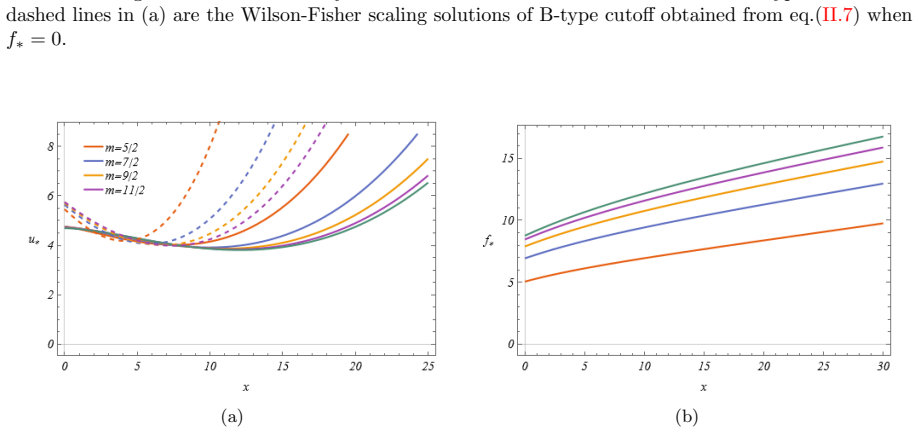
We focus on the use of the functional Wilsonian renormalization group framework characterized by a proper time regulator and test its use in the search of the scaling solutions and the critical properties of an O(N)-invariant scalar field multiplet coupled to gravity in d=4 and d=3 dimensions. We employ the same background-fluctuation splitting and gauge fixing procedure, already adopted in a previous study based, instead, on the effective average action framework and a similar truncation of the effective action. Our main goal is to compare the results for the scaling solutions and some of the associated critical exponents. In this analysis, performed in a different framework, most of the picture previously uncovered is confirmed both at qualitative and quantitative level. There are, neverthelss, few differences both at finite N and in its large value limit, depending also on the schemes which in both frameworks are called 'improved'
Editorial analysis
A structured set of objections, weighed in public.
Referee Report
Summary. The manuscript investigates scaling solutions and critical properties of O(N)-invariant scalar fields coupled to gravity in d=4 and d=3 using the proper-time functional renormalization group framework. It adopts the background-fluctuation splitting and gauge fixing from a prior effective average action study with a similar truncation, and compares the results for fixed points and critical exponents, claiming qualitative and quantitative confirmation with some differences at finite and large N depending on 'improved' schemes.
Significance. This work offers a valuable cross-check between the proper-time regulator and the effective average action approaches in the context of asymptotically safe gravity-matter systems. Confirming most results across frameworks would bolster confidence in the truncation's reliability and the existence of non-trivial fixed points. The explicit comparison at both finite N and in the large-N limit is a strength, as is the focus on scheme dependence.
major comments (1)
- [Setup section (background-fluctuation splitting and gauge fixing)] The paper reuses the identical background-fluctuation splitting (metric = background + fluctuation) and gauge-fixing procedure from the previous effective average action study without providing a re-derivation or explicit verification that diffeomorphism invariance and background independence are preserved under the proper-time flow equation. Since the proper-time regulator involves an integral over the proper-time parameter s rather than the Wetterich kernel, this transfer is not automatically guaranteed and could impact the treatment of gauge modes and the Hessian. This assumption is central to the comparability of results and thus to the claim of confirmation.
minor comments (2)
- [Abstract] There is a typo: 'neverthelss' should be 'nevertheless'.
- [Abstract] The abstract reports qualitative and quantitative agreement but supplies no explicit pointers to equations, tables, or error estimates in the main text; adding such references would improve clarity.
Simulated Author's Rebuttal
We thank the referee for the positive evaluation of our work and for the detailed comment, which helps improve the clarity of the manuscript. We address the point below.
read point-by-point responses
-
Referee: [Setup section (background-fluctuation splitting and gauge fixing)] The paper reuses the identical background-fluctuation splitting (metric = background + fluctuation) and gauge-fixing procedure from the previous effective average action study without providing a re-derivation or explicit verification that diffeomorphism invariance and background independence are preserved under the proper-time flow equation. Since the proper-time regulator involves an integral over the proper-time parameter s rather than the Wetterich kernel, this transfer is not automatically guaranteed and could impact the treatment of gauge modes and the Hessian. This assumption is central to the comparability of results and thus to the claim of confirmation.
Authors: We appreciate the referee drawing attention to this aspect of the setup. The background-fluctuation splitting and gauge-fixing were taken over from the earlier effective average action analysis precisely to enable a controlled comparison between the two renormalization-group frameworks. The proper-time flow equation is obtained by inserting a regulator that depends on the background metric into the functional integral; the resulting integral over the proper-time parameter s is a specific representation of the cutoff, but the underlying construction preserves the same background covariance and gauge-fixing structure as in the Wetterich case. Consequently, the treatment of the Hessian and the projection onto gauge modes follows identically within the truncation employed. Nevertheless, we acknowledge that the manuscript does not contain an explicit re-derivation of these properties for the proper-time regulator. In the revised version we will add a concise paragraph in the setup section, together with references to existing literature on proper-time FRG in curved backgrounds, to make this reasoning explicit and thereby strengthen the justification for the direct comparison. revision: yes
Circularity Check
No significant circularity; independent proper-time regulator computation
full rationale
The paper derives scaling solutions and critical exponents for the O(N) model coupled to gravity by applying the proper-time functional renormalization group flow equation in d=3 and d=4, using a truncation of the effective action. Although the background-fluctuation splitting and gauge-fixing procedure are adopted from a prior effective-average-action study, the flow equation itself is replaced by an integral over the proper-time parameter s, producing new numerical or approximate results for the fixed-point values and exponents. The comparison to the earlier framework is presented as an external check, with explicit differences noted at finite N and in the large-N limit; no equation or result in the present work reduces by construction to the inputs or outputs of the cited prior study. The derivation chain remains self-contained within the proper-time regulator and the chosen truncation.
Axiom & Free-Parameter Ledger
axioms (1)
- domain assumption Background-fluctuation splitting and gauge fixing procedure from prior study remains suitable for proper-time regulator
Lean theorems connected to this paper
-
IndisputableMonolith/Foundation/AlexanderDuality.leanalexander_duality_circle_linking unclear?
unclearRelation between the paper passage and the cited Recognition theorem.
We employ the same background-fluctuation splitting and gauge fixing procedure, already adopted in a previous study based, instead, on the effective average action framework and a similar truncation of the effective action.
-
IndisputableMonolith/Cost/FunctionalEquation.leanwashburn_uniqueness_aczel unclear?
unclearRelation between the paper passage and the cited Recognition theorem.
the PT RG flow equations were previously used in the literature but not obtained within a functional derivation. ... r(s, Λ²ZΛ) is a cutoff function
What do these tags mean?
- matches
- The paper's claim is directly supported by a theorem in the formal canon.
- supports
- The theorem supports part of the paper's argument, but the paper may add assumptions or extra steps.
- extends
- The paper goes beyond the formal theorem; the theorem is a base layer rather than the whole result.
- uses
- The paper appears to rely on the theorem as machinery.
- contradicts
- The paper's claim conflicts with a theorem or certificate in the canon.
- unclear
- Pith found a possible connection, but the passage is too broad, indirect, or ambiguous to say the theorem truly supports the claim.
Forward citations
Cited by 1 Pith paper
-
Fifth-Force Constraints from UV-Complete Scalar-Tensor Gravity
UV completeness in scalar-tensor gravity restricts the fifth-force Yukawa parameters α and λ to a narrow wedge in parameter space, ruling out its complement and part of the experimentally allowed domain.
Reference graph
Works this paper leans on
-
[1]
and [70], respectively. The critical properties of the gravitational-dressed Wilson-Fisher solution for general N de- pend strongly on ϵ. With ϵ = 0 and for all values of N we find only one non-trivial relevant direction whose value is very close to the classical case, while with ϵ = 1 we find three non-trivial relevant directions, where the value of the ...
-
[2]
The shooting method A scaling solutions of eq. (II.7) and eq. (II.8) must be defined for all non-negative real values of x, therefore it interpolates smoothly between the origin and infinity. For this reason, we use the ”shooting to a fitting point method” [102], here an inward integration from infinity and an outward integration from the origin are match...
-
[3]
The values of x0 and L have been chosen arbitrarily
The pseudospectral method In the pseudospectral method, which was used in [98], a split of the range [0 , +∞] in [0, +x0] ∪ [x0, +∞] had to be considered, and a compactification in [ x0, +∞] was introduced 36 with a parameter L. The values of x0 and L have been chosen arbitrarily. In this way, the pseudospectral system matches in x0 only the function and ...
-
[4]
The linearized equations The linearized equation for δu in d = 3 is given by 0 = (3 − θ)δu+ + 2(2m−3)(N−1) m+u′ m 32 −m m+u′ − x + Z 3 2−m 2f(2m−3) 8mx(f′)2+f(m+2xu′′+u′) + 8(3−2m)xϵf′(2f xf′′+f′(f−xf′)) (8x(f′)2+f)(8mx(f′)2+f(m+2xu′′+u′)) δu′+ + Z 5 2 −m 4f m(2m − 3)x 8x (f ′)2 + f 8mx (f ′)2 + f (m + 2xu′′ + u′) 2 + 16(3 − 2m)mx2ϵf ′ (2f xf′′...
-
[5]
(D.1) and (D.2) we use again the shooting and the pseudospectral method as a check
Shooting and pseudospectral method for the linearized system To solve eqs. (D.1) and (D.2) we use again the shooting and the pseudospectral method as a check. In the shooting, as numerical system, we use eqs. (D.1) and (D.2). The boundary conditions are given by the power series around x → 0 and x → ∞ along with their first derivatives evaluated at xmin a...
-
[6]
The most common polynomial truncations are computed around x = 0
The polynomial truncation around the minimum of u∗ Solutions of the flow equations by polynomial truncations are useful to obtain an approximate stability matrix from which the critical exponents can be found. The most common polynomial truncations are computed around x = 0. However, around the minimum κ of u∗ yield a better and more accurate stability ma...
-
[7]
M. Gell-Mann and F. E. Low, Phys. Rev. 95, 1300 (1954), URL https://link.aps.org/doi/10. 1103/PhysRev.95.1300
work page 1954
-
[8]
K. G. Wilson, Phys. Rev. 140, B445 (1965), URL https://link.aps.org/doi/10.1103/PhysRev. 140.B445
-
[9]
K. G. Wilson, Phys. Rev. D 2, 1438 (1970), URL https://link.aps.org/doi/10.1103/ PhysRevD.2.1438
work page 1970
-
[10]
K. G. Wilson and M. E. Fisher, Phys. Rev. Lett. 28, 240 (1972), URL https://link.aps.org/ doi/10.1103/PhysRevLett.28.240
-
[11]
K. G. Wilson, Phys. Rev. B 4, 3174 (1971), URL https://link.aps.org/doi/10.1103/ PhysRevB.4.3174
work page 1971
-
[12]
K. G. Wilson and J. B. Kogut, Phys. Rept. 12, 75 (1974)
work page 1974
-
[13]
L. P. Kadanoff, Physics Physique Fizika 2, 263 (1966), URL https://link.aps.org/doi/10. 1103/PhysicsPhysiqueFizika.2.263
work page 1966
-
[14]
F. J. Wegner and A. Houghton, Phys. Rev. A 8, 401 (1973), URL https://link.aps.org/doi/ 10.1103/PhysRevA.8.401
- [15]
-
[16]
O. J. Rosten, Phys. Rept. 511, 177 (2012), 1003.1366
work page internal anchor Pith review Pith/arXiv arXiv 2012
-
[17]
S. P. de Alwis, JHEP 03, 118 (2018), 1707.09298
work page internal anchor Pith review Pith/arXiv arXiv 2018
-
[18]
A. Bonanno, S. Lippoldt, R. Percacci, and G. P. Vacca, Eur. Phys. J. C 80, 249 (2020), 1912.08135
-
[19]
A. Bonanno, G. Oglialoro, and D. Zappal` a, Phys. Rev. D 112, 026002 (2025), 2504.07877
-
[20]
A. Bonanno and D. Zappala, Phys. Lett. B 504, 181 (2001), hep-th/0010095
work page internal anchor Pith review Pith/arXiv arXiv 2001
-
[21]
Proper time regulator and Renormalization Group flow
M. Mazza and D. Zappala, Phys. Rev. D 64, 105013 (2001), hep-th/0106230
work page internal anchor Pith review Pith/arXiv arXiv 2001
-
[22]
On the Connection Between Momentum Cutoff and Operator Cutoff Regularizations
S.-B. Liao, Phys. Rev. D 53, 2020 (1996), hep-th/9501124
work page internal anchor Pith review Pith/arXiv arXiv 2020
-
[23]
Operator Cutoff Regularization and Renormalization Group in Yang-Mills Theory
S.-B. Liao, Phys. Rev. D 56, 5008 (1997), hep-th/9511046
work page internal anchor Pith review Pith/arXiv arXiv 1997
-
[24]
Renormalization Group Flow and Equation of State of Quarks and Mesons
B.-J. Schaefer and H.-J. Pirner, Nucl. Phys. A 660, 439 (1999), nucl-th/9903003
work page internal anchor Pith review Pith/arXiv arXiv 1999
-
[25]
B. J. Schaefer, O. Bohr, and J. Wambach, Phys. Rev. D 65, 105008 (2002), hep-th/0112087
work page internal anchor Pith review Pith/arXiv arXiv 2002
-
[26]
O. Bohr, B. J. Schaefer, and J. Wambach, Int. J. Mod. Phys. A 16, 3823 (2001), hep-ph/0007098
work page internal anchor Pith review Pith/arXiv arXiv 2001
-
[27]
Improving the Renormalization Group approach to the quantum-mechanical double well potential
D. Zappala’, Phys. Lett. A 290, 35 (2001), quant-ph/0108019
work page internal anchor Pith review Pith/arXiv arXiv 2001
-
[28]
D. F. Litim and D. Zappala, Phys. Rev. D 83, 085009 (2011), 1009.1948
work page internal anchor Pith review Pith/arXiv arXiv 2011
-
[29]
A. Bonanno, A. Codello, and D. Zappala’, Annals Phys. 445, 169090 (2022), 2206.06917
-
[30]
T. R. Morris, Int. J. Mod. Phys. A 9, 2411 (1994), hep-ph/9308265
work page internal anchor Pith review Pith/arXiv arXiv 1994
-
[31]
C. Wetterich, Physics Letters B 301, 90 (1993), ISSN 0370-2693, URL https://www. sciencedirect.com/science/article/pii/037026939390726X
-
[32]
R. Percacci, An Introduction to Covariant Quantum Gravity and Asymptotic Safety (World Scien- 43 tific, 2017), ISBN 978-981-320-717-2
work page 2017
-
[33]
M. Reuter and F. Saueressig, Quantum Gravity and the Functional Renormalization Group: The Road towards Asymptotic Safety , Cambridge Monographs on Mathematical Physics (Cambridge University Press, 2019)
work page 2019
-
[34]
Nonperturbative Evolution Equation for Quantum Gravity
M. Reuter, Phys. Rev. D 57, 971 (1998), hep-th/9605030
work page internal anchor Pith review Pith/arXiv arXiv 1998
-
[35]
The Asymptotic Safety Scenario in Quantum Gravity -- An Introduction
M. Niedermaier, Class. Quant. Grav. 24, R171 (2007), gr-qc/0610018
work page internal anchor Pith review Pith/arXiv arXiv 2007
-
[36]
M. Reuter and F. Saueressig, New Journal of Physics 14, 055022 (2012), URL https://dx.doi. org/10.1088/1367-2630/14/5/055022
-
[37]
An asymptotically safe guide to quantum gravity and matter
A. Eichhorn, Front. Astron. Space Sci. 5, 47 (2019), 1810.07615
work page internal anchor Pith review Pith/arXiv arXiv 2019
- [38]
-
[39]
Status of the asymptotic safety paradigm for quantum gravity and matter
A. Eichhorn, Found. Phys. 48, 1407 (2018), 1709.03696
work page internal anchor Pith review Pith/arXiv arXiv 2018
-
[40]
A. Bonanno, A. Eichhorn, H. Gies, J. M. Pawlowski, R. Percacci, M. Reuter, F. Saueressig, and G. P. Vacca, Front. in Phys. 8, 269 (2020), 2004.06810
-
[41]
S. Weinberg, in 14th International School of Subnuclear Physics: Understanding the Fundamental Constitutents of Matter (1976)
work page 1976
-
[42]
S. Weinberg, Ultraviolet divergences in quantum theoris of gravitation (Cambridge University Press, 1980), pp. 790–831
work page 1980
-
[43]
Renormalization Group Flow of Quantum Gravity in the Einstein-Hilbert Truncation
M. Reuter and F. Saueressig, Phys. Rev. D 65, 065016 (2002), hep-th/0110054
work page internal anchor Pith review Pith/arXiv arXiv 2002
-
[44]
Flow Equation of Quantum Einstein Gravity in a Higher-Derivative Truncation
O. Lauscher and M. Reuter, Phys. Rev. D 66, 025026 (2002), hep-th/0205062
work page internal anchor Pith review Pith/arXiv arXiv 2002
-
[45]
Higher Derivative Quantum Gravity with Gauss-Bonnet Term
G. de Berredo-Peixoto and I. L. Shapiro, Phys. Rev. D 71, 064005 (2005), hep-th/0412249
work page internal anchor Pith review Pith/arXiv arXiv 2005
-
[46]
Higher Derivative Gravity and Asymptotic Safety in Diverse Dimensions
N. Ohta and R. Percacci, Class. Quant. Grav. 31, 015024 (2014), 1308.3398
work page internal anchor Pith review Pith/arXiv arXiv 2014
-
[47]
Ultraviolet Fixed Points in Conformal Gravity and General Quadratic Theories
N. Ohta and R. Percacci, Class. Quant. Grav. 33, 035001 (2016), 1506.05526
work page internal anchor Pith review Pith/arXiv arXiv 2016
-
[48]
Fixed Points of Higher Derivative Gravity
A. Codello and R. Percacci, Phys. Rev. Lett. 97, 221301 (2006), hep-th/0607128
work page internal anchor Pith review Pith/arXiv arXiv 2006
-
[49]
P. F. Machado and F. Saueressig, Phys. Rev. D 77, 124045 (2008), 0712.0445
work page internal anchor Pith review Pith/arXiv arXiv 2008
-
[50]
Ultraviolet properties of f(R)-Gravity
A. Codello, R. Percacci, and C. Rahmede, Int. J. Mod. Phys. A 23, 143 (2008), 0705.1769
work page internal anchor Pith review Pith/arXiv arXiv 2008
-
[51]
The local potential approximation in quantum gravity
D. Benedetti and F. Caravelli, JHEP 06, 017 (2012), [Erratum: JHEP 10, 157 (2012)], 1204.3541
work page internal anchor Pith review Pith/arXiv arXiv 2012
-
[52]
A bootstrap strategy for asymptotic safety
K. Falls, D. F. Litim, K. Nikolakopoulos, and C. Rahmede (2013), 1301.4191
work page internal anchor Pith review Pith/arXiv arXiv 2013
-
[53]
On the number of relevant operators in asymptotically safe gravity
D. Benedetti, EPL 102, 20007 (2013), 1301.4422
work page internal anchor Pith review Pith/arXiv arXiv 2013
-
[54]
Further evidence for asymptotic safety of quantum gravity
K. Falls, D. F. Litim, K. Nikolakopoulos, and C. Rahmede, Phys. Rev. D 93, 104022 (2016), 1410.4815
work page internal anchor Pith review Pith/arXiv arXiv 2016
-
[55]
Asymptotic safety of quantum gravity beyond Ricci scalars
K. Falls, C. R. King, D. F. Litim, K. Nikolakopoulos, and C. Rahmede, Phys. Rev. D 97, 086006 (2018), 1801.00162
work page internal anchor Pith review Pith/arXiv arXiv 2018
-
[56]
K. G. Falls, D. F. Litim, and J. Schr¨ oder, Phys. Rev. D 99, 126015 (2019), 1810.08550
work page internal anchor Pith review Pith/arXiv arXiv 2019
-
[57]
G. P. De Brito, N. Ohta, A. D. Pereira, A. A. Tomaz, and M. Yamada, Phys. Rev. D 98, 026027 (2018), 1805.09656. 44
work page internal anchor Pith review Pith/arXiv arXiv 2018
-
[58]
N. Ohta, R. Percacci, and G. P. Vacca, Phys. Rev. D 92, 061501 (2015), 1507.00968
work page internal anchor Pith review Pith/arXiv arXiv 2015
-
[59]
N. Ohta, R. Percacci, and G. P. Vacca, Eur. Phys. J. C 76, 46 (2016), 1511.09393
work page internal anchor Pith review Pith/arXiv arXiv 2016
-
[60]
H. Gies, B. Knorr, S. Lippoldt, and F. Saueressig, Phys. Rev. Lett. 116, 211302 (2016), 1601.01800
work page internal anchor Pith review Pith/arXiv arXiv 2016
-
[61]
Renormalization Group Equation for $f(R)$ gravity on hyperbolic spaces
K. Falls and N. Ohta, Phys. Rev. D 94, 084005 (2016), 1607.08460
work page internal anchor Pith review Pith/arXiv arXiv 2016
-
[62]
Four-Derivative Quantum Gravity Beyond Perturbation Theory
N. Christiansen (2016), 1612.06223
work page internal anchor Pith review Pith/arXiv arXiv 2016
-
[63]
T. Denz, J. M. Pawlowski, and M. Reichert, Eur. Phys. J. C 78, 336 (2018), 1612.07315
work page internal anchor Pith review Pith/arXiv arXiv 2018
- [64]
- [65]
- [66]
- [67]
-
[68]
Asymptotic safety in higher-derivative gravity
D. Benedetti, P. F. Machado, and F. Saueressig, Mod. Phys. Lett. A 24, 2233 (2009), 0901.2984
work page internal anchor Pith review Pith/arXiv arXiv 2009
-
[69]
Taming perturbative divergences in asymptotically safe gravity
D. Benedetti, P. F. Machado, and F. Saueressig, Nucl. Phys. B 824, 168 (2010), 0902.4630
work page internal anchor Pith review Pith/arXiv arXiv 2010
-
[70]
Asymptotic Safety of Gravity Coupled to Matter
R. Percacci and D. Perini, Phys. Rev. D 68, 044018 (2003), hep-th/0304222
work page internal anchor Pith review Pith/arXiv arXiv 2003
-
[71]
Renormalization Group Flow in Scalar-Tensor Theories. I
G. Narain and R. Percacci, Class. Quant. Grav. 27, 075001 (2010), 0911.0386
work page internal anchor Pith review Pith/arXiv arXiv 2010
-
[72]
Renormalization Group Flow in Scalar-Tensor Theories. II
G. Narain and C. Rahmede, Class. Quant. Grav. 27, 075002 (2010), 0911.0394
work page internal anchor Pith review Pith/arXiv arXiv 2010
-
[73]
G. P. Vacca and O. Zanusso, Phys. Rev. Lett. 105, 231601 (2010), 1009.1735
work page internal anchor Pith review Pith/arXiv arXiv 2010
-
[74]
Quantum-gravity-induced matter self-interactions in the asymptotic-safety scenario
A. Eichhorn, Phys. Rev. D 86, 105021 (2012), 1204.0965
work page internal anchor Pith review Pith/arXiv arXiv 2012
- [75]
-
[76]
Asymptotic safety in $O(N)$ scalar models coupled to gravity
P. Labus, R. Percacci, and G. P. Vacca, Phys. Lett. B 753, 274 (2016), 1505.05393
work page internal anchor Pith review Pith/arXiv arXiv 2016
-
[77]
Non-minimal coupling in Higgs-Yukawa model with asymptotically safe gravity
K.-y. Oda and M. Yamada, Class. Quant. Grav. 33, 125011 (2016), 1510.03734
work page internal anchor Pith review Pith/arXiv arXiv 2016
-
[78]
Asymptotic safety of higher derivative quantum gravity non-minimally coupled with a matter system
Y. Hamada and M. Yamada, JHEP 08, 070 (2017), 1703.09033
work page internal anchor Pith review Pith/arXiv arXiv 2017
-
[79]
Quantum gravity fluctuations flatten the Planck-scale Higgs potential
A. Eichhorn, Y. Hamada, J. Lumma, and M. Yamada, Phys. Rev. D 97, 086004 (2018), 1712.00319
work page internal anchor Pith review Pith/arXiv arXiv 2018
-
[80]
J. M. Pawlowski, M. Reichert, C. Wetterich, and M. Yamada, Phys. Rev. D 99, 086010 (2019), 1811.11706
work page internal anchor Pith review Pith/arXiv arXiv 2019
discussion (0)
Sign in with ORCID, Apple, or X to comment. Anyone can read and Pith papers without signing in.