Quantum-impurity sensing of altermagnetic order
Pith reviewed 2026-05-18 23:49 UTC · model grok-4.3
The pith
The relaxation rate of a nearby quantum impurity encodes the momentum-space anisotropy of altermagnetic order.
A machine-rendered reading of the paper's core claim, the machinery that carries it, and where it could break.
Core claim
The distance and orientation dependent relaxation rate of a nearby quantum impurity encodes signatures of momentum space anisotropy in the spin diffusion response, a hallmark of altermagnetic order. This directional sensitivity enables the distinction of altermagnets from conventional antiferromagnets via local, noninvasive measurements.
What carries the argument
Quantum relaxometry, in which the coupling between a nitrogen-vacancy center and the altermagnet's spin diffusion response translates the momentum-space anisotropy into an observable relaxation rate that varies with distance and orientation.
Load-bearing premise
The spin-diffusion response of the altermagnet is dominated by momentum-space anisotropy from its spin-polarized bands, with no significant contributions from other relaxation channels or disorder that could mask the directional signature.
What would settle it
Measure the relaxation rate of an NV center at varying distances and orientations above an altermagnetic sample and check whether the observed angular dependence matches the predicted pattern for momentum-space anisotropy but is absent in a conventional antiferromagnet.
Figures

read the original abstract
Quantum sensing with individual spin defects has emerged as a versatile platform to probe microscopic properties of condensed matter systems. Here we demonstrate that quantum relaxometry with nitrogen-vacancy (NV) centers in diamond can reveal the anisotropic spin dynamics of altermagnetic insulators together with their characteristic spin polarised bands. We show that the distance and orientation dependent relaxation rate of a nearby quantum impurity encodes signatures of momentum space anisotropy in the spin diffusion response, a hallmark of altermagnetic order. This directional sensitivity is unprecedented in the landscape of quantum materials sensing, and it enables the distinction of altermagnets from conventional antiferromagnets via local, noninvasive measurements. Our results could spark new NV-sensing experiments on spin transport and symmetry breaking in altermagnets, and highlight the role of NV orientation to probe anisotropic phenomena in condensed matter systems.
Editorial analysis
A structured set of objections, weighed in public.
Referee Report
Summary. The paper proposes using NV-center quantum relaxometry to detect altermagnetic order in insulators. It claims that the distance- and orientation-dependent relaxation rate Γ(r, θ) of a nearby quantum impurity directly encodes the momentum-space anisotropy of the spin diffusion response arising from the altermagnet's spin-polarized bands, providing a local, noninvasive signature that distinguishes altermagnets from conventional antiferromagnets.
Significance. If the central mapping holds, the work introduces a directional quantum-sensing protocol for anisotropic spin transport and symmetry breaking in altermagnets, a capability not previously demonstrated with NV centers. This could enable new experiments on spin-polarized bands without net magnetization and highlights the utility of NV orientation for probing momentum-space features in quantum materials.
major comments (2)
- [§3, Eq. (8)] §3 (Theoretical Framework), Eq. (8): The spin susceptibility χ(q, ω) is modeled in the clean diffusive limit to extract the q-anisotropy; however, no estimate is given for the disorder scattering rate or magnon-phonon damping relative to the anisotropy energy scale, leaving open whether the directional contrast in Γ(r, θ) survives under realistic conditions.
- [§4.1, Fig. 2] §4.1, Fig. 2: The plotted angular dependence of the relaxation rate assumes dominance of the altermagnetic band anisotropy over isotropic channels; without a quantitative bound or comparison calculation including finite scattering, the uniqueness of the signature versus conventional antiferromagnets remains unverified.
minor comments (2)
- [Figure 1] The definition of the NV orientation angle θ in the caption of Figure 1 should explicitly state the reference axis relative to the altermagnetic crystal axes.
- A brief comparison table or paragraph contrasting the predicted Γ(r, θ) for altermagnets versus standard antiferromagnets would improve clarity of the distinguishing claim.
Simulated Author's Rebuttal
We thank the referee for the positive evaluation and the detailed comments on the applicability of the clean-limit model and the robustness of the proposed signature. We address both major comments below and have revised the manuscript to incorporate quantitative estimates and comparisons.
read point-by-point responses
-
Referee: [§3, Eq. (8)] §3 (Theoretical Framework), Eq. (8): The spin susceptibility χ(q, ω) is modeled in the clean diffusive limit to extract the q-anisotropy; however, no estimate is given for the disorder scattering rate or magnon-phonon damping relative to the anisotropy energy scale, leaving open whether the directional contrast in Γ(r, θ) survives under realistic conditions.
Authors: We agree that explicit estimates are required to substantiate the clean diffusive approximation. In the revised manuscript we have added a dedicated paragraph in §3 that compiles literature values for disorder scattering rates (∼0.5–2 meV from transport data on MnTe and CrSb) and magnon-phonon damping (∼1–3 meV below 100 K from inelastic neutron scattering). These are compared to the altermagnetic anisotropy scale (∼10–20 meV). The analysis shows that for T ≲ 80 K and moderate disorder the anisotropy remains dominant, preserving the directional contrast in Γ(r, θ). Relevant references have been included. revision: yes
-
Referee: [§4.1, Fig. 2] §4.1, Fig. 2: The plotted angular dependence of the relaxation rate assumes dominance of the altermagnetic band anisotropy over isotropic channels; without a quantitative bound or comparison calculation including finite scattering, the uniqueness of the signature versus conventional antiferromagnets remains unverified.
Authors: We acknowledge that a direct comparison including finite scattering strengthens the uniqueness claim. We have carried out additional calculations that add a phenomenological isotropic scattering term to the susceptibility and have inserted a new panel (Fig. 2c) showing the angular dependence of Γ(r, θ) for scattering rates up to 25 % of the anisotropy energy. The contrast survives in this range for altermagnets while remaining absent for conventional antiferromagnets. The text in §4.1 has been updated to state the quantitative bound and to emphasize the symmetry-based distinction. revision: yes
Circularity Check
Minor self-citation to prior altermagnet models; central derivation remains independent
full rationale
The paper derives the orientation-dependent NV relaxation rate from standard spin-diffusion and susceptibility models applied to altermagnetic band anisotropy. No equation reduces a claimed prediction to a fitted parameter or self-defined input by construction. Self-citations to altermagnet literature (e.g., by co-authors Sinova and Smejkal) support the band-structure premise but are not load-bearing for the sensing calculation itself, which uses external NV-relaxometry formalism. The dominance assumption for anisotropic channels is an explicit physical approximation rather than a definitional loop. This yields a low circularity score consistent with self-contained modeling against external benchmarks.
Axiom & Free-Parameter Ledger
axioms (2)
- domain assumption Altermagnets possess momentum-space anisotropic spin diffusion arising from spin-polarized bands.
- domain assumption NV-center relaxation is dominated by magnetic noise from the nearby material's spin fluctuations.
Lean theorems connected to this paper
-
IndisputableMonolith/Cost/FunctionalEquation.leanwashburn_uniqueness_aczel (J(x) = ½(x + x⁻¹) − 1 is unique calibrated reciprocal cost) unclear?
unclearRelation between the paper passage and the cited Recognition theorem.
χ∥(ω,k) = ℏχ0 / [D1k² + 1/τs − D2² k⁴ cos²(2ϕk) − iω + …] (Eq. 5); contrast C[d] = (Γmax − Γmin)/(Γmax + Γmin) with D2 arising from Δ-split magnon bands on Lieb lattice
-
IndisputableMonolith/Foundation/RealityFromDistinction.leanreality_from_one_distinction unclear?
unclearRelation between the paper passage and the cited Recognition theorem.
relaxation rate Γ[ω] via magnetostatic Green's function C{Φ}(d,k) and momentum filter k²e^{-2kd} (Eq. 2)
What do these tags mean?
- matches
- The paper's claim is directly supported by a theorem in the formal canon.
- supports
- The theorem supports part of the paper's argument, but the paper may add assumptions or extra steps.
- extends
- The paper goes beyond the formal theorem; the theorem is a base layer rather than the whole result.
- uses
- The paper appears to rely on the theorem as machinery.
- contradicts
- The paper's claim conflicts with a theorem or certificate in the canon.
- unclear
- Pith found a possible connection, but the passage is too broad, indirect, or ambiguous to say the theorem truly supports the claim.
Forward citations
Cited by 2 Pith papers
-
Noise spectroscopy of insulating and itinerant altermagnets
Noise spectroscopy of charge fluctuations in itinerant altermagnets yields symmetry-protected signatures absent in antiferromagnets, enabling experimental identification and access to d-wave or g-wave orbital characte...
-
Correlated Quantum Dephasometry: Symmetry-Resolved Noise Spectroscopy of Two-Dimensional Superconductors and Altermagnets
Correlated dephasing of two spin qubits near materials isolates rotational symmetry in nonlocal noise correlations, enabling discrimination of s-, d-, and g-wave superconducting gaps and altermagnet types at nanoscale...
Reference graph
Works this paper leans on
-
[1]
+ 3D2 2 3D1(D1 − p D2 1 − D2
-
[2]
(9) In the case of an AFM, i.e
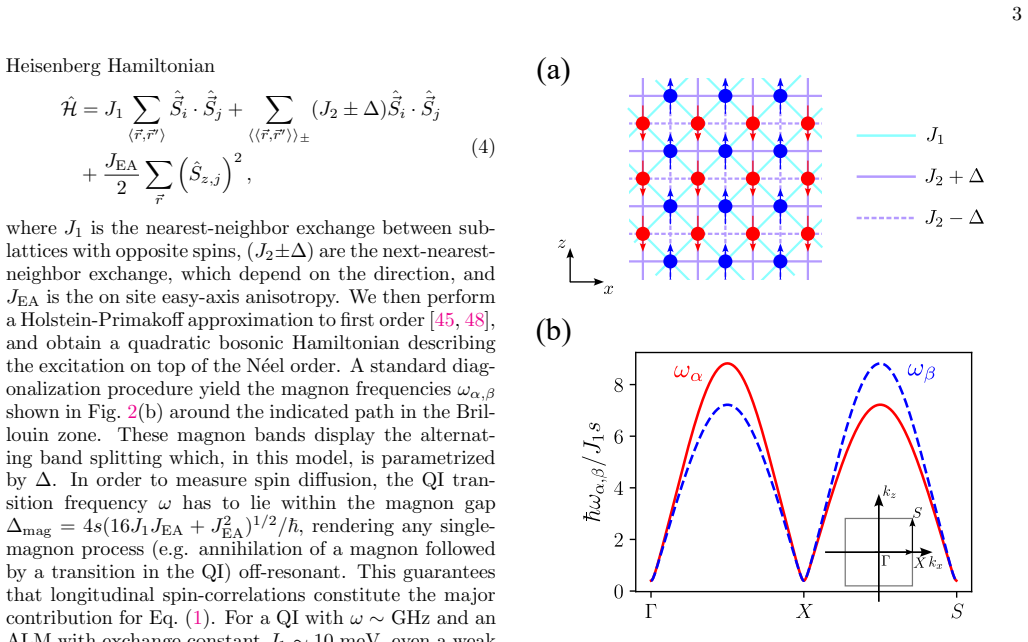
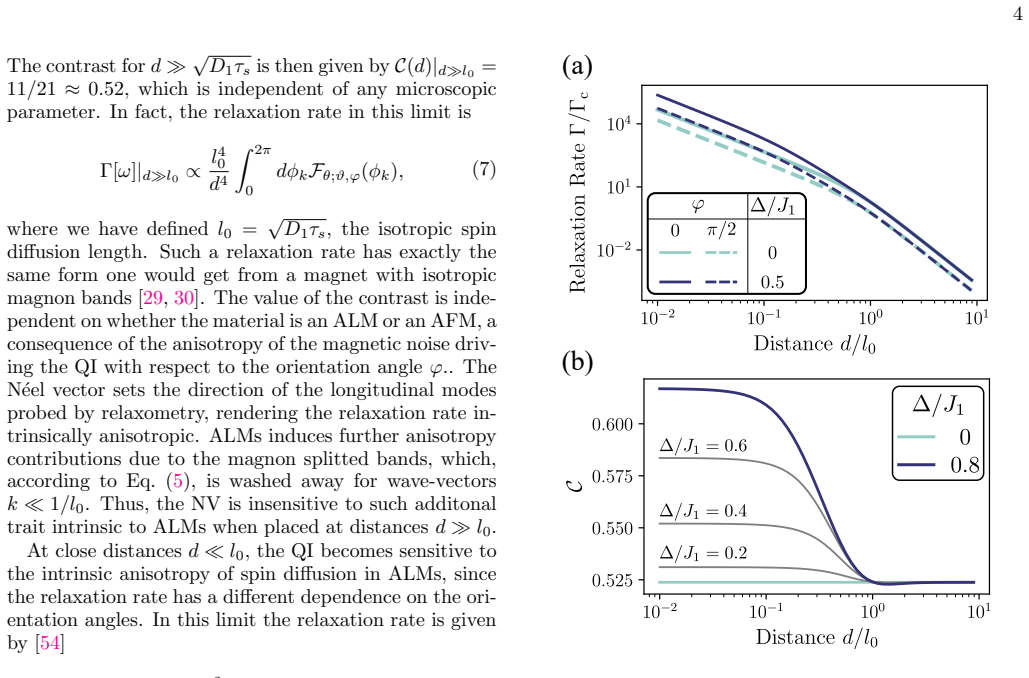
+ 9D2 2 . (9) In the case of an AFM, i.e. by setting D2 = 0, the contrast yields 11 /21, which is the same value it has at distances d ≫ l0. For an ALM, the contrast behaves non-trivially with distance, exhibiting a larger value at closer distances. For D2 ≈ D1 (its maximum value), the contrast at closer distances is 8/12 ≈ 0.67, which is an in- crease of...
-
[3]
The relaxation rate for an ALM, de- picted by the dark curves, exhibits a different curvature at the cross-over region d = l0 when compared to an usual AFM, depicted in light blue, due to the term ∝ k4 appearing in the susceptibility Eq. (5). Furthermore, as depicted in Fig. 3(b), the contrast increases as the dis- tance d is decreased, a trait that is un...
work page 2021
-
[6]
T. Jungwirth, R. M. Fernandes, E. Fradkin, A. H. MacDonald, J. Sinova, and L. ˇSmejkal, Altermagnetism: An unconven- tional spin-ordered phase of matter, Newton (2025)
work page 2025
-
[7]
Mazin (The PRX Editors), Editorial: Altermagnetism—a new punch line of fundamental magnetism, Phys
I. Mazin (The PRX Editors), Editorial: Altermagnetism—a new punch line of fundamental magnetism, Phys. Rev. X 12, 040002 (2022)
work page 2022
-
[8]
L. Bai, W. Feng, S. Liu, L. ˇSmejkal, Y. Mokrousov, and Y. Yao, Altermagnetism: Exploring new frontiers in magnetism and spintronics, Advanced Functional Materials 34, 2409327 (2024)
work page 2024
- [9]
-
[10]
L. ˇSmejkal, S. D’souza, M. Hajlaoui, G. Springholz, K. Uhl´ ıˇ rov´ a, F. Alarab, P. Constantinou, V. Strocov, D. Usanov,et al., Altermagnetic lifting of kramers spin degeneracy, Nature 626, 517 (2024)
work page 2024
-
[11]
O. Fedchenko, J. Min´ ar, A. Akashdeep, S. W. D’Souza, D. Vasilyev, O. Tkach, L. Odenbreit, Q. Nguyen, D. Kutnyakhov, N. Wind, et al. , Observation of time-reversal symmetry breaking in the band structure of altermagnetic ruo2, Science advances 10, eadj4883 (2024)
work page 2024
-
[12]
S. Reimers, L. Odenbreit, L. ˇSmejkal, V. N. Strocov, P. Constantinou, A. B. Hellenes, R. Jaeschke Ubiergo, W. H. Campos, V. K. Bharadwaj, A. Chakraborty, et al. , Direct observation of altermagnetic band splitting in crsb thin films, Nature Communications 15, 2116 (2024)
work page 2024
-
[13]
S. Lee, S. Lee, S. Jung, J. Jung, D. Kim, Y. Lee, B. Seok, J. Kim, B. G. Park, L. ˇSmejkal, C.-J. Kang, and C. Kim, Broken kramers degeneracy in altermagnetic mnte, Phys. Rev. Lett. 132, 036702 (2024)
work page 2024
- [14]
-
[15]
F. Zhang, X. Cheng, Z. Yin, C. Liu, L. Deng, Y. Qiao, Z. Shi, S. Zhang, J. Lin, Z. Liu, M. Ye, Y. Huang, X. Meng, C. Zhang, T. Okuda, K. Shimada, S. Cui, Y. Zhao, G.-H. Cao, S. Qiao, J. Liu, and C. Chen, Crystal-symmetry-paired spin–valley locking in a layered room-temperature metallic altermagnet candidate, Nature Physics 21, 760 (2025). 13
work page 2025
-
[16]
L. ˇSmejkal, R. Gonz´ alez-Hern´ andez, T. Jungwirth, and J. Sinova, Crystal time-reversal symmetry breaking and spontaneous hall effect in collinear antiferromagnets, Science Advances 6, eaaz8809 (2020)
work page 2020
-
[17]
I. I. Mazin, K. Koepernik, M. D. Johannes, R. Gonz´ alez-Hern´ andez, and L. ˇSmejkal, Prediction of unconventional mag- netism in doped fesb¡sub¿2¡/sub¿, Proceedings of the National Academy of Sciences 118, e2108924118 (2021)
work page 2021
-
[18]
Z. Feng, X. Zhou, L. ˇSmejkal, L. Wu, Z. Zhu, H. Guo, R. Gonz´ alez-Hern´ andez, X. Wang, H. Yan, P. Qin, X. Zhang, H. Wu, H. Chen, Z. Meng, L. Liu, Z. Xia, J. Sinova, T. Jungwirth, and Z. Liu, An anomalous hall effect in altermagnetic ruthenium dioxide, Nature Electronics 5, 735 (2022)
work page 2022
-
[19]
H. Reichlova, R. Lopes Seeger, R. Gonz´ alez-Hern´ andez, I. Kounta, R. Schlitz, D. Kriegner, P. Ritzinger, M. Lammel, M. Leivisk¨ a, A. Birk Hellenes,et al., Observation of a spontaneous anomalous hall response in the mn5si3 d-wave alter- magnet candidate, Nature Communications 15, 4961 (2024)
work page 2024
-
[20]
L. ˇSmejkal, A. B. Hellenes, R. Gonz´ alez-Hern´ andez, J. Sinova, and T. Jungwirth, Giant and tunneling magnetoresistance in unconventional collinear antiferromagnets with nonrelativistic spin-momentum coupling, Phys. Rev. X 12, 011028 (2022)
work page 2022
-
[21]
D. S. Antonenko, R. M. Fernandes, and J. W. F. Venderbos, Mirror chern bands and weyl nodal loops in altermagnets, Phys. Rev. Lett. 134, 096703 (2025)
work page 2025
-
[22]
X. Duan, J. Zhang, Z. Zhu, Y. Liu, Z. Zhang, I. ˇZuti´ c, and T. Zhou, Antiferroelectric altermagnets: Antiferroelectricity alters magnets, Phys. Rev. Lett. 134, 106801 (2025)
work page 2025
-
[23]
Šmejkal, Altermagnetic multiferroics and altermagne- toelectric effect, arXiv:2411.19928 (2024)
L. ˇSmejkal, Altermagnetic multiferroics and altermagnetoelectric effect, arXiv preprint arXiv:2411.19928 (2024)
-
[24]
M. Gu, Y. Liu, H. Zhu, K. Yananose, X. Chen, Y. Hu, A. Stroppa, and Q. Liu, Ferroelectric switchable altermagnetism, Phys. Rev. Lett. 134, 106802 (2025)
work page 2025
- [25]
- [26]
-
[27]
S. Hong, M. S. Grinolds, L. M. Pham, D. Le Sage, L. Luan, R. L. Walsworth, and A. Yacoby, Nanoscale magnetometry with nv centers in diamond, MRS bulletin 38, 155 (2013)
work page 2013
-
[28]
S. Kolkowitz, Q. P. Unterreithmeier, S. D. Bennett, and M. D. Lukin, Sensing distant nuclear spins with a single electron spin, Phys. Rev. Lett. 109, 137601 (2012)
work page 2012
-
[29]
Y. Dovzhenko, F. Casola, S. Schlotter, T. Zhou, F. B¨ uttner, R. Walsworth, G. Beach, and A. Yacoby, Magnetostatic twists in room-temperature skyrmions explored by nitrogen-vacancy center spin texture reconstruction, Nature Communications 9, 1 (2018)
work page 2018
- [30]
- [31]
-
[32]
B. Flebus and Y. Tserkovnyak, Quantum-impurity relaxometry of magnetization dynamics, Phys. Rev. Lett. 121, 187204 (2018)
work page 2018
-
[33]
H. Wang, S. Zhang, N. J. McLaughlin, B. Flebus, M. Huang, Y. Xiao, C. Liu, M. Wu, E. E. Fullerton, Y. Tserkovnyak, and C. R. Du, Noninvasive measurements of spin transport properties of an antiferromagnetic insulator, Science Advances 8, eabg8562 (2022)
work page 2022
-
[34]
R. C. Heitzer, F. Pinto, E. Rodr´ ıguez, R. Rodr´ ıguez-Su´ arez, and J. R. Maze, Characterization of antiferromagnetic magnons using nitrogen vacancy center relaxometry, Phys. Rev. B 110, 134431 (2024)
work page 2024
-
[35]
S. Chatterjee, J. F. Rodriguez-Nieva, and E. Demler, Diagnosing phases of magnetic insulators via noise magnetometry with spin qubits, Phys. Rev. B 99, 104425 (2019)
work page 2019
-
[36]
L. S. Langsjoen, A. Poudel, M. G. Vavilov, and R. Joynt, Qubit relaxation from evanescent-wave johnson noise, Phys. Rev. A 86, 010301 (2012)
work page 2012
-
[37]
K. Agarwal, R. Schmidt, B. Halperin, V. Oganesyan, G. Zar´ and, M. D. Lukin, and E. Demler, Magnetic noise spectroscopy as a probe of local electronic correlations in two-dimensional systems, Phys. Rev. B 95, 155107 (2017)
work page 2017
-
[38]
J. F. Rodriguez-Nieva, K. Agarwal, T. Giamarchi, B. I. Halperin, M. D. Lukin, and E. Demler, Probing one-dimensional systems via noise magnetometry with single spin qubits, Phys. Rev. B 98, 195433 (2018)
work page 2018
-
[39]
J. F. Rodriguez-Nieva, D. Podolsky, and E. Demler, Probing hydrodynamic sound modes in magnon fluids using spin magnetometers, Phys. Rev. B 105, 174412 (2022)
work page 2022
-
[40]
A. Mzyk, A. Sigaeva, and R. Schirhagl, Relaxometry with nitrogen vacancy (nv) centers in diamond, Accounts of Chemical Research 55, 3572 (2022)
work page 2022
-
[41]
L. ˇSmejkal, J. Sinova, and T. Jungwirth, Beyond conventional ferromagnetism and antiferromagnetism: A phase with nonrelativistic spin and crystal rotation symmetry, Phys. Rev. X 12, 031042 (2022)
work page 2022
-
[42]
L. ˇSmejkal, J. Sinova, and T. Jungwirth, Emerging research landscape of altermagnetism, Phys. Rev. X 12, 040501 (2022)
work page 2022
-
[43]
L. ˇSmejkal, A. Marmodoro, K.-H. Ahn, R. Gonz´ alez-Hern´ andez, I. Turek, S. Mankovsky, H. Ebert, S. W. D’Souza, O.ˇSipr, J. Sinova, and T. Jungwirth, Chiral magnons in altermagnetic RuO 2, Phys. Rev. Lett. 131, 256703 (2023)
work page 2023
- [44]
-
[45]
Kubo, The fluctuation-dissipation theorem, Reports on Progress in Physics 29 (1966)
R. Kubo, The fluctuation-dissipation theorem, Reports on Progress in Physics 29 (1966)
work page 1966
-
[46]
K. Y. Guslienko and A. N. Slavin, Magnetostatic green’s functions for the description of spin waves in finite rectangular magnetic dots and stripes, Journal of Magnetism and Magnetic Materials 323, 2418 (2011)
work page 2011
-
[47]
S. Rezende, R. Rodr´ ıguez-Su´ arez, R. Cunha, J. L´ opez Ortiz, and A. Azevedo, Bulk magnon spin current theory for the longitudinal spin seebeck effect, Journal of Magnetism and Magnetic Materials 400, 171 (2016), proceedings of the 20th 14 International Conference on Magnetism (Barcelona) 5-10 July 2015
work page 2016
-
[48]
S. M. Rezende, A. Azevedo, and R. L. Rodr´ ıguez-Su´ arez, Introduction to antiferromagnetic magnons, Journal of Applied Physics 126, 151101 (2019)
work page 2019
-
[49]
Flebus, Chemical potential of an antiferromagnetic magnon gas, Phys
B. Flebus, Chemical potential of an antiferromagnetic magnon gas, Phys. Rev. B 100, 064410 (2019)
work page 2019
-
[50]
H. Fang, S. Zhang, and Y. Tserkovnyak, Generalized model of magnon kinetics and subgap magnetic noise, Phys. Rev. B 105, 184406 (2022)
work page 2022
-
[51]
Detailed calculations of the magnon band structure, the diffusion response function, and explicit expressions for the relaxation rate can be found in the Supplementary Material
- [52]
-
[53]
Q. Cui, B. Zeng, P. Cui, T. Yu, and H. Yang, Efficient spin seebeck and spin nernst effects of magnons in altermagnets, Phys. Rev. B 108, L180401 (2023)
work page 2023
-
[54]
P. Das, V. Leeb, J. Knolle, and M. Knap, Realizing altermagnetism in fermi-hubbard models with ultracold atoms, Phys. Rev. Lett. 132, 263402 (2024)
work page 2024
-
[55]
A. Corticelli, R. Moessner, and P. A. McClarty, Spin-space groups and magnon band topology, Phys. Rev. B 105, 064430 (2022)
work page 2022
-
[56]
We nevertheless emphasize that the plots shown in the paper are for a finite ω = 1/τs
This approximation requires that ω ≪ D1l0/d2. We nevertheless emphasize that the plots shown in the paper are for a finite ω = 1/τs
-
[57]
and D2 = D1 is an artifact of the approximation ω ∼ 0 that was taken to write Eq
The singularity of the integrand at ϕk = 0, π/2, ... and D2 = D1 is an artifact of the approximation ω ∼ 0 that was taken to write Eq. (8). The frequency ω is never zero, and thus the integrand is always finite. All plots shown in the paper are generated with the full expression including a non-vanishing frequency, which is shown in the SI
-
[58]
C. Du, T. van der Sar, T. X. Zhou, P. Upadhyaya, F. Casola, H. Zhang, M. C. Onbasli, C. A. Ross, R. L. Walsworth, Y. Tserkovnyak, and A. Yacoby, Control and local measurement of the spin chemical potential in a magnetic insulator, Science 357, 195 (2017)
work page 2017
-
[59]
A. Rustagi, I. Bertelli, T. van der Sar, and P. Upadhyaya, Sensing chiral magnetic noise via quantum impurity relaxometry, Phys. Rev. B 102, 220403 (2020)
work page 2020
-
[60]
A. Finco and V. Jacques, Single spin magnetometry and relaxometry applied to antiferromagnetic materials, APL Materials 11, 100901 (2023)
work page 2023
-
[61]
M. C. Cambria, A. Norambuena, H. T. Dinani, G. Thiering, A. Gardill, I. Kemeny, Y. Li, V. Lordi, A. Gali, J. R. Maze, and S. Kolkowitz, Temperature-dependent spin-lattice relaxation of the nitrogen-vacancy spin triplet in diamond, Phys. Rev. Lett. 130, 256903 (2023)
work page 2023
- [62]
-
[63]
S. Han, X. Ye, X. Zhou, Z. Liu, Y. Guo, M. Wang, W. Ji, Y. Wang, and J. Du, Solid-state spin coherence time approaching the physical limit, Science Advances 11, eadr9298 (2025)
work page 2025
-
[64]
I. Arrazola, P. Bertet, Y. Chu, and P. Rabl, Engineering protected cavity-qed interactions through pulsed dynamical decoupling, arXiv:2505.02929[quant-ph] (2025)
-
[65]
S. Chatterjee, P. E. Dolgirev, I. Esterlis, A. A. Zibrov, M. D. Lukin, N. Y. Yao, and E. Demler, Single-spin qubit magnetic spectroscopy of two-dimensional superconductivity, Phys. Rev. Res. 4, L012001 (2022)
work page 2022
-
[66]
F. Machado, E. A. Demler, N. Y. Yao, and S. Chatterjee, Quantum noise spectroscopy of dynamical critical phenomena, Phys. Rev. Lett. 131, 070801 (2023)
work page 2023
- [67]
-
[68]
H. Hosseinabadi et al. , Theory of two-qubit t 2 spectroscopy of classical and quantum correlations, Under preparation (2025)
work page 2025
discussion (0)
Sign in with ORCID, Apple, or X to comment. Anyone can read and Pith papers without signing in.