A framework for continuous superradiant laser operation via sequential transport of atoms
Pith reviewed 2026-05-18 18:07 UTC · model grok-4.3
The pith
Synchronization of two atomic ensembles in a shared cavity produces a single narrow superradiant line at their weighted average frequency.
A machine-rendered reading of the paper's core claim, the machinery that carries it, and where it could break.
Core claim
In the two-site configuration, atoms within each ensemble share identical detunings and equal cavity couplings while the ensembles differ only in their common detuning value. Synchronization of the atomic dipoles then produces a single narrow spectral line whose central frequency equals the weighted average of the two ensemble frequencies, and this holds for both balanced and imbalanced atom numbers inside an identified parameter space.
What carries the argument
Synchronization of atomic dipoles across the two ensembles, which forces the combined system to emit at a single frequency given by the weighted average of the two detunings.
If this is right
- The laser reaches tens of picowatts output power together with sub-millihertz linewidth under the identified operating parameters.
- Superradiant emission stays robust against inhomogeneous frequency broadening and atom-cavity coupling variations because of dipole synchronization.
- Sequential loading of the two ensembles supports continuous superradiant emission suitable for metrology when the relative frequencies are controlled to the target stability.
- A single narrow line appears for both balanced and imbalanced atom numbers between the two ensembles.
Where Pith is reading between the lines
- The same synchronization could extend to three or more ensembles, enabling arbitrarily long continuous cycles by rotating through additional sites.
- The weighted-average frequency might itself become a stable reference point if the relative atom numbers are monitored in real time.
- An experiment could test the claim by fixing the population imbalance and scanning the detuning offset while recording whether the linewidth remains sub-millihertz.
- Continuous operation of this kind would directly cut dead time in optical-frequency standards that currently rely on intermittent interrogation.
Load-bearing premise
Atoms inside each ensemble share the same detuning and the same coupling strength to the cavity, with the two ensembles differing only in their common detuning value.
What would settle it
Measure the emitted spectrum while varying the detuning difference between the two ensembles; if two distinct lines appear instead of one merged line at the weighted-average frequency, the synchronization result is falsified.
Figures






read the original abstract
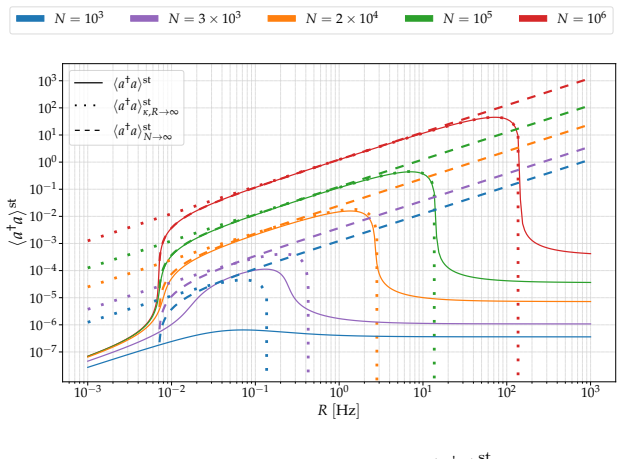
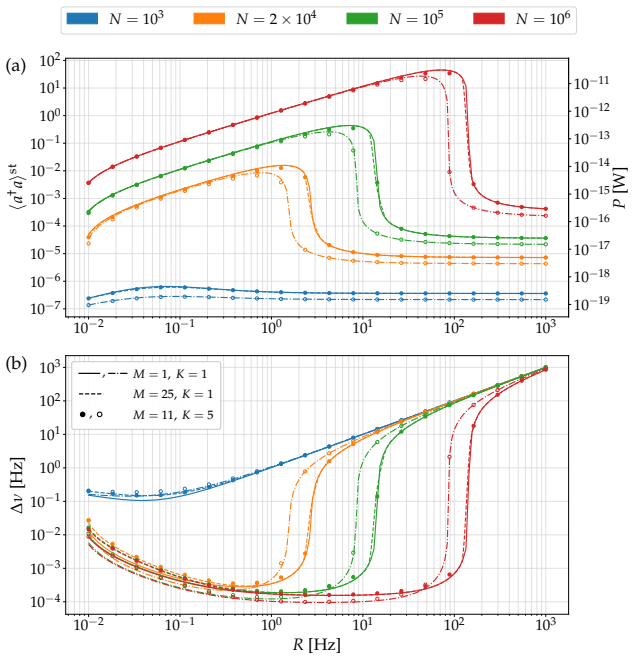
We perform a theoretical study of a continuous superradiant laser supporting its experimental realization at FEMTO-ST using two sequentially-emitting ensembles of ${}^{171}\mathrm{Yb}$ atoms coupled to the same Fabry-Perot cavity. Using an open quantum system approach, we identify for the simplest case the parameter space where the laser reaches tens of picowatts of power with a sub-millihertz linewidth. Studying the impact of inhomogeneous frequency broadening and variations in atom-cavity coupling on the superradiant emission, we find the laser properties robust with respect to such perturbations, also thanks to the occurrence of synchronization of the atomic dipoles. We then consider a two-site configuration, in which atoms in each site are equally coupled to the cavity and have equal detunings, with different values for the two ensembles. We find for balanced and imbalanced atom numbers that synchronization leads in a certain parameter space to a single narrow spectral line whose central frequency follows the weighted average frequency. This result indicates that sequential loading can enable continuous superradiant emission for metrological applications, provided that the relative frequencies of the two ensembles are controlled to the level required by the target stability.
Editorial analysis
A structured set of objections, weighed in public.
Referee Report
Summary. The paper claims to provide a theoretical framework for continuous superradiant laser operation using sequential transport of two ensembles of 171Yb atoms into a Fabry-Perot cavity. Using open quantum system modeling, it identifies parameters for tens of picowatts power and sub-millihertz linewidth. It shows robustness to inhomogeneous broadening and coupling variations due to synchronization. In the two-site model with equal intra-ensemble detunings and couplings (differing between ensembles), synchronization produces a single narrow spectral line at the weighted average frequency for balanced and imbalanced atom numbers, suggesting viability for metrological applications with appropriate frequency control.
Significance. If valid, this work could enable practical continuous superradiant lasers for precision metrology by demonstrating a synchronization mechanism that produces narrow linewidths and robustness to perturbations. The numerical solutions of the open-system equations offer concrete predictions. The finding that the central frequency follows the weighted average under synchronization is particularly useful. However, the idealized assumptions in the two-site model require further scrutiny for the robustness claims to fully support the central conclusions.
major comments (1)
- [Two-site configuration section] The central claim that synchronization leads to a single narrow spectral line whose central frequency follows the weighted average frequency for balanced and imbalanced atom numbers rests on the premise that atoms within each ensemble have identical detunings and equal coupling strengths to the cavity (stated for the two-site configuration). The robustness to inhomogeneous frequency broadening and variations in atom-cavity coupling is reported thanks to synchronization, but it is unclear if these checks were performed inside the two-ensemble synchronization dynamics or only for single-ensemble cases. This is load-bearing for the claim, as small intra-ensemble spreads might disrupt the locking, causing deviation from the weighted average or spectral splitting.
minor comments (2)
- [Abstract] The abstract mentions 'tens of picowatts' and 'sub-millihertz linewidth' without specifying exact parameter values or ranges (e.g., atom numbers or relative detuning); adding a brief indication would improve the summary.
- [Main text] Notation for the weighted-average frequency could be defined more explicitly when first introduced to avoid any ambiguity in the synchronization result.
Simulated Author's Rebuttal
We thank the referee for their careful reading of our manuscript and for the constructive feedback. We address the major comment point by point below. We agree that additional clarification and explicit checks are warranted to strengthen the robustness claims in the two-ensemble setting.
read point-by-point responses
-
Referee: [Two-site configuration section] The central claim that synchronization leads to a single narrow spectral line whose central frequency follows the weighted average frequency for balanced and imbalanced atom numbers rests on the premise that atoms within each ensemble have identical detunings and equal coupling strengths to the cavity (stated for the two-site configuration). The robustness to inhomogeneous frequency broadening and variations in atom-cavity coupling is reported thanks to synchronization, but it is unclear if these checks were performed inside the two-ensemble synchronization dynamics or only for single-ensemble cases. This is load-bearing for the claim, as small intra-ensemble spreads might disrupt the locking, causing deviation from the weighted average or spectral splitting.
Authors: We thank the referee for identifying this important clarification needed. The robustness analysis to inhomogeneous broadening and coupling variations (Section on impact of perturbations) was performed in the presence of synchronization for the superradiant regime, prior to introducing the two-site model. The two-site configuration then isolates the inter-ensemble synchronization by assuming identical intra-ensemble detunings and couplings, as explicitly stated. However, we acknowledge that explicit verification of small intra-ensemble spreads within the full two-ensemble dynamics was not included. To address this, we will add new numerical results in the revised manuscript demonstrating that modest intra-ensemble detuning spreads (up to a few Hz) and coupling variations preserve the single narrow line and weighted-average frequency locking for both balanced and imbalanced atom numbers. These will be presented as an extension of the two-site section. revision: yes
Circularity Check
No circularity: results from open-system dynamics
full rationale
The paper derives its central claims on synchronization yielding a single narrow line whose frequency follows the weighted average by solving the open quantum system equations for the two-site model. The equal intra-ensemble detunings and couplings are explicit modeling assumptions required for the setup, not outputs redefined as inputs. No step reduces by construction to a fitted parameter, self-citation, or ansatz smuggled from prior work; the weighted-average match is an observed outcome of the dynamics rather than a definitional tautology. The derivation remains self-contained against the stated model and numerical/analytic solutions.
Axiom & Free-Parameter Ledger
free parameters (3)
- atom numbers per ensemble
- relative detuning between ensembles
- inhomogeneous broadening width
axioms (2)
- domain assumption Atoms within each ensemble share identical detuning and coupling strength to the cavity.
- standard math Open quantum system dynamics governed by a standard Lindblad master equation for collective atom-cavity coupling.
Lean theorems connected to this paper
-
IndisputableMonolith/Cost/FunctionalEquation.leanwashburn_uniqueness_aczel unclear?
unclearRelation between the paper passage and the cited Recognition theorem.
We find for balanced and imbalanced atom numbers that synchronization leads in a certain parameter space to a single narrow spectral line whose central frequency follows the weighted average frequency.
-
IndisputableMonolith/Foundation/RealityFromDistinction.leanreality_from_one_distinction unclear?
unclearRelation between the paper passage and the cited Recognition theorem.
Using an open quantum system approach... second-order cumulant expansion
What do these tags mean?
- matches
- The paper's claim is directly supported by a theorem in the formal canon.
- supports
- The theorem supports part of the paper's argument, but the paper may add assumptions or extra steps.
- extends
- The paper goes beyond the formal theorem; the theorem is a base layer rather than the whole result.
- uses
- The paper appears to rely on the theorem as machinery.
- contradicts
- The paper's claim conflicts with a theorem or certificate in the canon.
- unclear
- Pith found a possible connection, but the passage is too broad, indirect, or ambiguous to say the theorem truly supports the claim.
discussion (0)
Sign in with ORCID, Apple, or X to comment. Anyone can read and Pith papers without signing in.