Transverse momentum dependent gluon density in a proton at low x in the Laplace transform method
Pith reviewed 2026-05-22 12:09 UTC · model grok-4.3
The pith
The Laplace transform technique yields compact analytical expressions for the gluon distribution in a proton at asymptotically small x.
A machine-rendered reading of the paper's core claim, the machinery that carries it, and where it could break.
Core claim
By applying the Laplace transform to the relevant evolution kernels and retaining leading plus main next-to-leading terms, the authors obtain compact analytical expressions for both the integrated and transverse-momentum-dependent gluon densities that remain valid as x tends to zero. These expressions reproduce the essential behavior found in other analytical and numerical approaches.
What carries the argument
The Laplace transform technique applied to the gluon evolution kernels, which converts the integro-differential equations into algebraic ones whose solutions are inverted back to x-space in the asymptotic limit.
If this is right
- Gluon densities at small x can be evaluated with elementary functions rather than repeated numerical integration.
- Both integrated and transverse-momentum-dependent distributions are obtained from the same compact expressions.
- The forms capture the main features of more elaborate calculations while remaining easy to implement in phenomenological studies.
- Asymptotic predictions become available for processes at future high-energy colliders where very low x values dominate.
Where Pith is reading between the lines
- These analytic forms could be inserted directly into Monte Carlo event generators to speed up low-x simulations.
- The method might extend to other parton distributions or to higher-order terms once the corresponding kernels are transformed.
- If the expressions remain accurate down to x approximately 10 to the minus 6, they would provide quick estimates for ultra-high-energy cosmic-ray interactions.
Load-bearing premise
The Laplace transform applied to the evolution kernels accurately reproduces the dominant low-x behavior without explicit higher-order resummation or complete numerical integration of the original equations.
What would settle it
A side-by-side numerical comparison of the derived analytical formulas against a full solution of the next-to-leading-order evolution equations for x values below 10 to the minus 4, checking whether the simple expressions deviate by more than a few percent.
Figures
read the original abstract
We investigate the gluon distribution in a proton at very low $x$, both integrated and transverse momentum dependent, using the Laplace transform technique. By accounting for leading and main next-to-leading contributions, we derive compact analytical expressions for the gluon densities valid in the asymptotic limit $x \to 0$. Our results closely match those from other analytical and numerical approaches, with the main advantage being the simplicity of the expressions, which capture the essential features of more complex calculations.
Editorial analysis
A structured set of objections, weighed in public.
Referee Report
Summary. The manuscript applies the Laplace transform method to the low-x DGLAP/BFKL evolution kernels, incorporating leading-order and selected next-to-leading-order terms, to derive compact analytical expressions for both the integrated gluon density and the transverse-momentum-dependent (TMD) gluon density in the proton in the asymptotic limit x → 0. The resulting expressions are shown to agree with independent analytical and numerical results from the literature.
Significance. If the central derivations hold, the work supplies a compact, analytically tractable parametrization of low-x gluon TMDs that could streamline phenomenological calculations in small-x physics at the LHC and future EIC. The explicit cross-checks against external approaches constitute a strength, as does the parameter-free character of the final expressions once the Laplace inversion is performed.
major comments (1)
- [§3.2] §3.2, Eq. (18): the inverse Laplace contour is chosen to lie to the right of all singularities, yet the paper does not demonstrate that this choice fully retains the double-logarithmic resummation that governs the k_T dependence of the TMD; a direct comparison of the resulting k_T slope against a full BFKL resummation at fixed x = 10^{-4} would strengthen the claim.
minor comments (2)
- The abstract states that 'main next-to-leading contributions' are included but does not specify which NLO splitting-function terms are retained; a one-sentence clarification would improve readability.
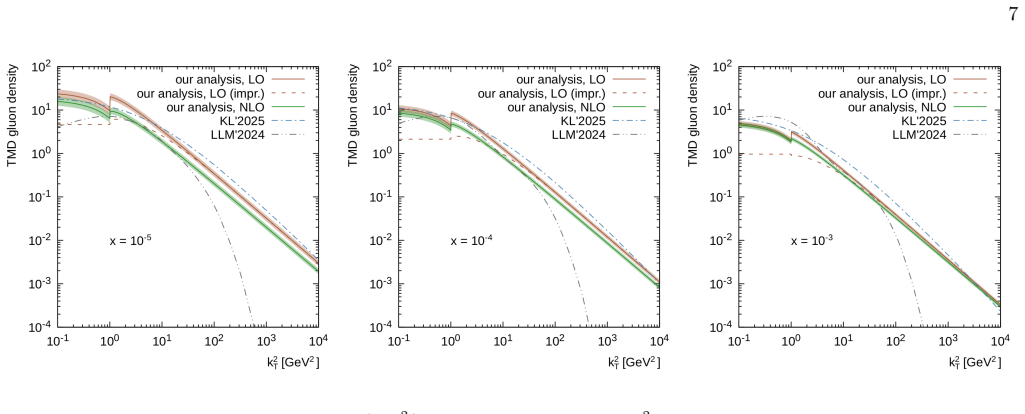
- [Figure 3] Figure 3: the legend should explicitly state the value of the factorization scale μ used for the TMD curves.
Simulated Author's Rebuttal
We thank the referee for the positive evaluation and the recommendation for minor revision. The single major comment is addressed point by point below.
read point-by-point responses
-
Referee: [§3.2] §3.2, Eq. (18): the inverse Laplace contour is chosen to lie to the right of all singularities, yet the paper does not demonstrate that this choice fully retains the double-logarithmic resummation that governs the k_T dependence of the TMD; a direct comparison of the resulting k_T slope against a full BFKL resummation at fixed x = 10^{-4} would strengthen the claim.
Authors: We appreciate this constructive remark. The Laplace-transform approach is formulated so that the Bromwich contour, positioned to the right of the branch points and poles generated by the low-x evolution kernel, automatically encodes the double-logarithmic resummation in the transverse-momentum dependence through the residue contributions at the relevant singularities. The resulting closed-form TMD expression reproduces the characteristic k_T slope obtained from independent BFKL-based analyses, as already verified by the agreement with literature results cited in the manuscript. Nevertheless, we agree that an explicit side-by-side comparison at a representative small-x value (e.g., x = 10^{-4}) would make this retention more transparent. We will add such a figure and accompanying discussion in the revised version. revision: yes
Circularity Check
No circularity: Laplace transform applied to external standard kernels with external cross-checks
full rationale
The paper applies the Laplace transform to leading and selected next-to-leading order evolution kernels for low-x gluon densities (both integrated and TMD), producing compact analytic expressions valid as x→0. These are then compared for agreement with independent analytic and numerical results from other groups. No derivation step reduces by construction to a fitted parameter, self-defined quantity, or load-bearing self-citation whose validity depends on the present work. The central expressions are obtained by direct transformation of established QCD kernels rather than being presupposed, and the paper explicitly positions its results as matching external benchmarks. This constitutes a self-contained methodological application rather than a tautological renaming or re-derivation of its own inputs.
Axiom & Free-Parameter Ledger
axioms (1)
- domain assumption Standard low-x evolution equations (DGLAP/BFKL-type) govern the gluon density
Reference graph
Works this paper leans on
-
[1]
can be obtained by the integration of (11) overk 2 T up toµ 2 0. Using the general expression (11) for initial gluon distribution, the inverse Laplace transform of (7) and/or (10) is straightforward and could be performed analytically in the high-energy region of the coefficientsh (n) gg (s). Here we employ the method developed [33–38]. In fact, letF(s) b...
-
[2]
+g 1(µ2 0) f1(x) tZ t0 as(t′)dt′ +f 2(x) tZ t0 a2 s(t′)dt′ + 1 2 f3(x) tZ t0 as(t′)dt′ 2 ,(16) fg(x,k 2 T ) k2 T ≥k2 0 = g1(k2 0) k2 T as k2 T f1(x) +a 2 s k2 T f2(x) +a s k2 T f3(x) tZ t0 as(t′)dt′ ,(17) where the gluon densityf g(x,k 2 T ) at lowk 2 T < k2 0 is given by (11) and f1(x) = 12 [B(1, a,1 +b)−B(x, a,1 +b)], f 2(x) =− 6...
-
[3]
Note that variablet involved to (17) is related with the gluon transverse momentumk 2 T
=x a(1−x) bg1(µ2 0), g 1(µ2) =N k 2 0 1−exp −µ2/k2 0 .(18) Here we use the approximationh (1) gg = 12/s, which gives the leading contribution atx→0. Note that variablet involved to (17) is related with the gluon transverse momentumk 2 T . This is in contrast with (16), where it is related with the hard scaleµ 2. Moreover, when we limit ourselves to a lowx...
work page 2020
- [4]
- [5]
- [6]
- [7]
- [8]
-
[9]
L.V. Gribov, E.M. Levin, M.G. Ryskin, Phys. Rep.100, 1 (1983); E.M. Levin, M.G. Ryskin, Yu.M. Shabelsky, A.G. Shuvaev, Sov. J. Nucl. Phys.53, 657 (1991)
work page 1983
-
[10]
R. Angeles-Martinez, A. Bacchetta, I.I. Balitsky, D. Boer, M. Boglione, R. Boussarie, F.A. Ceccopieri, I.O. Cherednikov, P. Connor, M.G. Echevarria, G. Ferrera, J. Grados Luyando, F. Hautmann, H. Jung, T. Kasemets, K. Kutak, J.P. Lansberg, A. Lelek, G.I. Lykasov, J.D. Madrigal Martinez, P.J. Mulders, E.R. Nocera, E. Petreska, C. Pisano, R. Placakyte, V. R...
work page 2015
-
[11]
A.V. Lipatov, S.P. Baranov, M.A. Malyshev, Phys. Part. Nucl.55, 256 (2024)
work page 2024
- [12]
-
[13]
A.V. Lipatov, G.I. Lykasov, M.A. Malyshev, JETP Lett.119, 828 (2024); A.V. Lipatov, G.I. Lykasov, M.A. Malyshev, Phys. Rev. D107, 014022 (2023)
work page 2024
-
[14]
L.S. Moriggi, G.S. Ramos, M.V.T. Machado, Phys. Rev. D110, 034005 (2024)
work page 2024
- [15]
-
[16]
A.V. Kotikov, A.V. Lipatov, Phys. Rev. D111, 094009 (2025); N.A. Abdulov, A.V. Kotikov, A.V. Lipatov, Particles5, 535 (2022); A.V. Kotikov, A.V. Lipatov, B.G. Shaikhatdenov, P. Zhang, JHEP02, 028 (2020)
work page 2025
- [17]
- [18]
- [19]
-
[20]
M. Ciafaloni, Nucl. Phys. B296, 49 (1988); S. Catani, F. Fiorani, G. Marchesini, Phys. Lett. B234, 339 (1990); S. Catani, F. Fiorani, G. Marchesini, Nucl. Phys. B336, 18 (1990); G. Marchesini, Nucl. Phys. B445, 49 (1995)
work page 1988
-
[21]
I. Balitsky, Nucl. Phys. B463, 99 (1996); 8 Y.V. Kovchegov, Phys. Rev. D60, 034008 (1999)
work page 1996
-
[22]
J. Jalilian-Marian, A. Kovner, A. Leonidov, H. Weigert, Phys. Rev. D59, 014014 (1998)
work page 1998
-
[23]
J. Jalilian-Marian, A. Kovner, A. Leonidov, H. Weigert, Phys. Rev. D59, 014015 (1998)
work page 1998
- [24]
- [25]
- [26]
-
[27]
E. Ferreiro, E. Iancu, A. Leonidov, L. McLerran, Nucl. Phys. A703, 489 (2002)
work page 2002
-
[28]
F. Hautmann, H. Jung, A. Lelek, V. Radescu, R. Zlebcik, Phys. Lett. B772, 446 (2017)
work page 2017
-
[29]
F. Hautmann, H. Jung, A. Lelek, V. Radescu, R. Zlebcik, JHEP1801, 070 (2018)
work page 2018
- [30]
-
[31]
A.D. Martin, M.G. Ryskin, G. Watt, Eur. Phys. J. C31, 73 (2003); A.D. Martin, M.G. Ryskin, G. Watt, Eur. Phys. J. C66, 163 (2010)
work page 2003
- [32]
- [33]
- [34]
- [35]
-
[36]
Block, Loyal Durand, Douglas W
Martin M. Block, Loyal Durand, Douglas W. McKay, Phys. Rev. D79, 014031 (2009)
work page 2009
-
[37]
Block, Loyal Durand, Phuoc Ha, Douglas W
Martin M. Block, Loyal Durand, Phuoc Ha, Douglas W. McKay, Phys. Rev. D83, 054009 (2011)
work page 2011
-
[38]
Block, Loyal Durand, Phuoc Ha, Douglas W
Martin M. Block, Loyal Durand, Phuoc Ha, Douglas W. McKay, Phys. Rev. D84, 094010 (2011)
work page 2011
-
[39]
Block, Loyal Durand, Phuoc Ha, Douglas W
Martin M. Block, Loyal Durand, Phuoc Ha, Douglas W. McKay, Phys. Rev. D88, 014006 (2013)
work page 2013
- [40]
- [41]
-
[42]
J. Bertrand, P. Bertrand, J. Ovarlez, “The Mellin Transform.” The Transforms and Applications Handbook: Second Edition. Ed. Alexander D. Poularikas Boca Raton: CRC Press LLC, 2000
work page 2000
-
[43]
A.V. Kotikov and G. Parente, Nucl. Phys. B549, 242-262 (1999); A.Y. Illarionov, A.V. Kotikov and G. Parente Bermudez, Phys. Part. Nucl.39, 307-347 (2008)
work page 1999
- [44]
-
[45]
S. Dulat, T.-J. Hou, J. Gao, M. Guzzi, J. Huston, P. Nadolsky, J. Pumplin, C. Schmidt, D. Stump, C.-P. Yuan, Phys. Rev. D93, 033006 (2016)
work page 2016
- [46]
-
[47]
NNPDF Collaboration, Eur. Phys. J. C82, 428 (2022)
work page 2022
- [48]
-
[49]
R. Wang, X. Chen, Chin. Phys. C41, 053103 (2017)
work page 2017
-
[50]
A. Devoto, D.W. Duke, Riv. Nuovo Cim.76, 1 (1984). Appendix. Analytic results for the Sudakov form factor Here we present the analytic results for the Sudakov form factor given by (20). After some algebra, we obtain the the following expression for lnT a(k2 T , µ2) with angular ordering condition, ∆ =k/(k+µ): lnT a(k2 T , µ2) =− 4Ca β0 " s1Ra(x0) +I a(x0)...
work page 1984
discussion (0)
Sign in with ORCID, Apple, or X to comment. Anyone can read and Pith papers without signing in.