Evidence of dynamical dark energy found via the DESI DR2 Lymanα forest
Pith reviewed 2026-05-18 04:05 UTC · model grok-4.3
The pith
DESI DR2 Lyman-alpha forest measurements favor dynamical dark energy that crosses the phantom divide.
A machine-rendered reading of the paper's core claim, the machinery that carries it, and where it could break.
Core claim
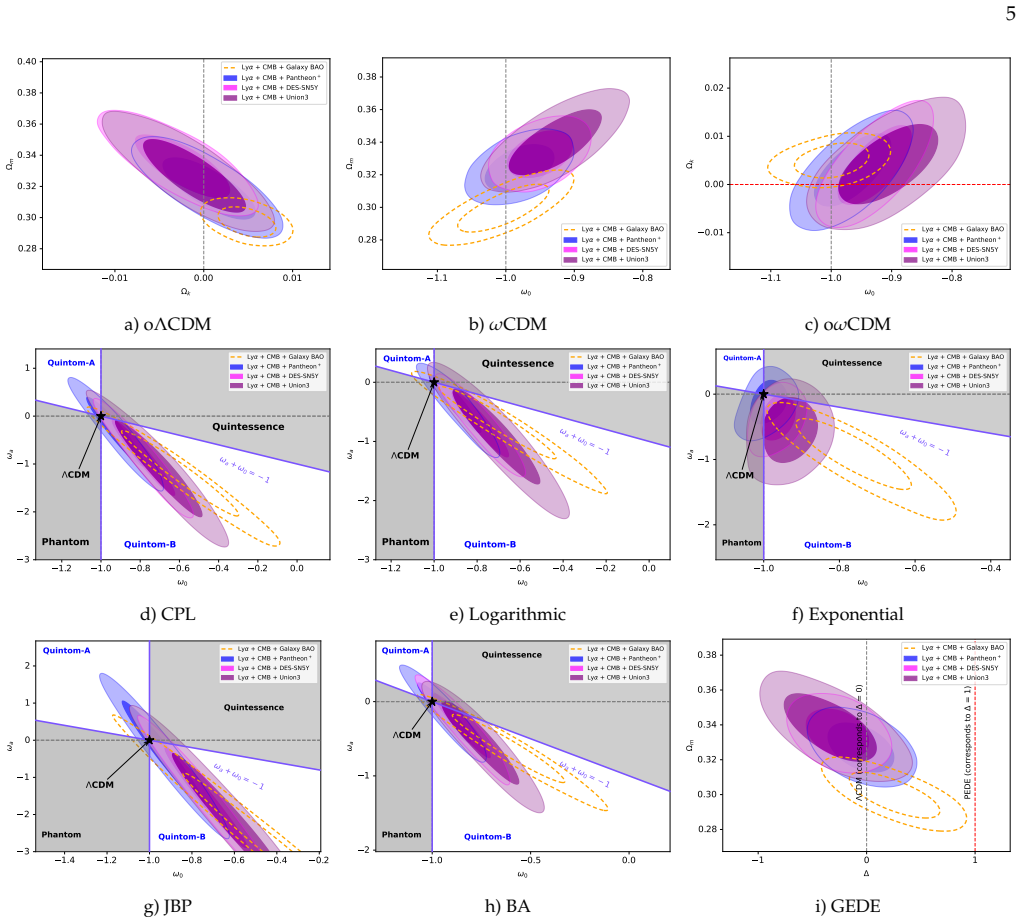
Using Metropolis-Hastings MCMC sampling across Chevallier-Polarski-Linder, logarithmic, exponential, Jassal-Bagla-Padmanabhan, Barboza-Alcaniz, and generalized emergent dark-energy forms, together with the wCDM and non-flat extensions, the analysis of DESI DR2 Lyman-alpha forest BAO plus complementary probes yields w0 greater than minus one, wa less than zero, and w0 plus wa less than minus one in every case. This Quintom-B signature produces a moderate preference for dynamical dark energy, reaching up to 3.10 sigma relative to LambdaCDM for the Lyman-alpha plus CMB plus galaxy BAO data set, while Bayes factors show dataset-dependent evidence that weakens when supernova samples are included.
What carries the argument
Dark-energy equation-of-state parameterizations (CPL, logarithmic, exponential, JBP, BA, generalized emergent) fitted via MCMC to extract constraints and Bayesian evidence from the combined DESI Lyman-alpha forest, galaxy BAO, CMB, and supernova data.
If this is right
- Non-flat extensions of both LambdaCDM and wCDM remain consistent with spatial flatness.
- The degree of preference for dynamical dark energy depends strongly on which data sets are combined.
- Inclusion of Pantheon+ or DES-Dovekie supernova samples reduces the deviation from LambdaCDM to less than or equal to 2 sigma.
- Bayesian evidence favors wCDM and its non-flat version moderately for the Lyman-alpha plus CMB plus galaxy BAO combination and shows stronger support for o wCDM when certain supernova samples are added.
Where Pith is reading between the lines
- Confirmation would encourage development of theoretical models that naturally allow the equation of state to cross minus one from above to below.
- Next-generation surveys with tighter Lyman-alpha forest measurements could test whether the different parameterizations converge on the same Quintom-B region or diverge.
- An evolving dark energy component would alter long-term forecasts for the universe's expansion rate and ultimate fate.
Load-bearing premise
Any departure of dark energy from a constant value must be described by one of the chosen functional forms for its time evolution.
What would settle it
Future data that tightly constrain the dark energy equation of state to remain exactly equal to minus one at all measured redshifts would remove the reported preference for the dynamical models.
Figures
read the original abstract
We present a comprehensive analysis of the cosmological implications of the Dark Energy Spectroscopic Instrument (DESI) Data Release 2 (DR2) Lyman-$\alpha$ forest baryon acoustic oscillation (BAO) measurements, combined with DESI DR2 galaxy BAO, Type Ia supernova samples (Pantheon$^+$, DES-Dovekie, and Union3), and the cosmic microwave background CamSpec likelihood. We consider several dark-energy parameterizations, including Chevallier-Polarski-Linder, logarithmic, exponential, Jassal-Bagla-Padmanabhan, Barboza-Alcaniz, and generalized emergent dark energy, as well as the $w$CDM model and non-flat extensions of $\Lambda$CDM and $w$CDM. Using the Metropolis-Hastings MCMC algorithm, we constrain cosmological parameters and compute Bayesian evidence with \texttt{MCEvidence}. We find that non-flat extensions remain consistent with spatial flatness, with $\Omega_k \approx 0$. All parameterizations favor a dynamical dark-energy scenario with $w_0 > -1$, $w_a < 0$, and $w_0 + w_a < -1$, consistent with a Quintom-B behavior. A moderate preference for dynamical dark-energy models is found relative to $\Lambda$CDM, reaching up to $\sim3.10\sigma$ for Ly$\alpha$ + CMB + galaxy BAO. When combined with SNe~Ia datasets, the deviations decrease to $\lesssim2\sigma$, corresponding to inconclusive preference. The Bayes factor ($\ln B_{ij}$) shows that model preference depends strongly on the dataset combination: $w$CDM and o$w$CDM exhibit moderate evidence for Ly$\alpha$ + CMB + galaxy BAO, while most other models show weak or inconclusive evidence. With Pantheon$^{+}$ or DES-Dovekie, o$w$CDM shows strong evidence, whereas other models remain moderately favored.
Editorial analysis
A structured set of objections, weighed in public.
Referee Report
Summary. The manuscript analyzes DESI DR2 Lyman-alpha forest BAO measurements in combination with DESI galaxy BAO, CMB (CamSpec), and several Type Ia supernova samples. It constrains multiple two-parameter dark-energy equation-of-state forms (CPL, logarithmic, exponential, JBP, BA, generalized emergent) plus wCDM and non-flat extensions, using Metropolis-Hastings MCMC and MCEvidence for Bayesian evidence. All parameterizations are reported to favor a Quintom-B region (w0 > -1, wa < 0, w0 + wa < -1), with a moderate preference over LambdaCDM reaching ~3.1 sigma for the Ly-alpha + CMB + galaxy-BAO combination; the preference weakens below 2 sigma once supernovae are added. Non-flat models remain consistent with Omega_k = 0.
Significance. If the reported posterior preferences and Bayes factors prove robust, the work would add timely constraints from the new DESI DR2 Lyman-alpha data to the ongoing debate on dynamical dark energy. The systematic exploration of six distinct two-parameter families and the explicit computation of Bayesian evidence are positive features that allow direct comparison of model support across dataset combinations.
major comments (3)
- [Methods] Methods section: the manuscript provides no information on prior ranges or choices for the dark-energy parameters (w0, wa and equivalents), nor any MCMC convergence diagnostics (e.g., Gelman-Rubin R-hat, effective sample sizes, or trace plots). These details are required to substantiate the quoted posterior constraints and the ln B_ij values that underpin the claimed model preferences.
- [Results] Results section: every parameterization is forced to explore the same three-dimensional (w0, wa) region, so the uniform preference for w0 > -1, wa < 0, w0 + wa < -1 may be an artifact of the restricted model space rather than independent evidence. The paper should demonstrate that the data prefer this region even when more flexible or non-parametric w(z) reconstructions are allowed.
- [Abstract and Discussion] Abstract and Discussion: the ~3.10 sigma preference for dynamical dark energy in the Ly-alpha + CMB + galaxy-BAO combination falls below 2 sigma once any supernova sample is included. This strong dataset dependence, together with the absence of a dedicated systematic-error budget for the Lyman-alpha forest BAO measurements, weakens the load-bearing claim that the data favor dynamical dark energy.
minor comments (2)
- [Abstract] The abstract states that 'most other models show weak or inconclusive evidence' but does not quote the actual ln B_ij ranges; adding these numerical values would improve clarity.
- [Throughout] Notation for the dark-energy parameters should be unified across the six parameterizations to avoid reader confusion when comparing posterior contours.
Simulated Author's Rebuttal
We thank the referee for the constructive and detailed comments. We address each major comment point by point below and indicate the revisions made to the manuscript.
read point-by-point responses
-
Referee: [Methods] Methods section: the manuscript provides no information on prior ranges or choices for the dark-energy parameters (w0, wa and equivalents), nor any MCMC convergence diagnostics (e.g., Gelman-Rubin R-hat, effective sample sizes, or trace plots). These details are required to substantiate the quoted posterior constraints and the ln B_ij values that underpin the claimed model preferences.
Authors: We agree that these details are important for reproducibility. In the revised manuscript we have added a new subsection to the Methods section that explicitly lists the prior ranges adopted for all dark-energy parameters (w0, wa and the equivalent parameters in the other five forms). We have also included MCMC convergence diagnostics (Gelman-Rubin R-hat < 1.01 for all chains and effective sample sizes) in a new appendix, together with a brief statement on the number of steps and burn-in used. revision: yes
-
Referee: [Results] Results section: every parameterization is forced to explore the same three-dimensional (w0, wa) region, so the uniform preference for w0 > -1, wa < 0, w0 + wa < -1 may be an artifact of the restricted model space rather than independent evidence. The paper should demonstrate that the data prefer this region even when more flexible or non-parametric w(z) reconstructions are allowed.
Authors: We acknowledge the concern that all two-parameter families ultimately map onto a similar (w0, wa) plane. However, the six distinct functional forms (CPL, logarithmic, exponential, JBP, BA, and generalized emergent) impose different priors and different redshift dependencies, so the repeated appearance of the Quintom-B region across these forms is not trivially an artifact of a single parameterization. We have added a paragraph in the Results section discussing this point and noting that a fully non-parametric reconstruction lies outside the present scope but would be a valuable follow-up study. revision: partial
-
Referee: [Abstract and Discussion] Abstract and Discussion: the ~3.10 sigma preference for dynamical dark energy in the Ly-alpha + CMB + galaxy-BAO combination falls below 2 sigma once any supernova sample is included. This strong dataset dependence, together with the absence of a dedicated systematic-error budget for the Lyman-alpha forest BAO measurements, weakens the load-bearing claim that the data favor dynamical dark energy.
Authors: The manuscript already states in both the abstract and the discussion that the preference reaches ~3.1 sigma only for the Ly-alpha + CMB + galaxy-BAO combination and drops below 2 sigma when any supernova sample is added; we have further emphasized this dataset dependence in the revised text. Regarding the Lyman-alpha forest BAO systematic budget, the DESI DR2 measurements incorporate the collaboration's published error budget (including both statistical and systematic contributions); we have added an explicit reference to the relevant DESI DR2 papers and a short paragraph summarizing the main systematic checks performed by the DESI team. revision: yes
Circularity Check
No significant circularity in the derivation chain
full rationale
The paper selects standard dark-energy equation-of-state parameterizations (CPL, logarithmic, exponential, JBP, BA, generalized emergent), performs Metropolis-Hastings MCMC fits to external datasets (DESI DR2 Lyα forest BAO, galaxy BAO, Pantheon+, DES-Dovekie, Union3, CamSpec CMB), and computes Bayesian evidence via MCEvidence. The reported Quintom-B preference and model comparisons are direct outputs of these posterior constraints and Bayes factors on the supplied data. No quoted step reduces by construction to a self-definition, a fitted parameter renamed as a prediction, or a load-bearing self-citation chain; the analysis remains self-contained against the external cosmological observables.
Axiom & Free-Parameter Ledger
free parameters (2)
- w0, wa (and equivalents in other parameterizations)
- Omega_k
axioms (2)
- standard math FLRW metric and standard Boltzmann equations for CMB and BAO
- domain assumption BAO scale remains a reliable standard ruler across the probed redshifts
Lean theorems connected to this paper
-
IndisputableMonolith/Cost/FunctionalEquation.leanwashburn_uniqueness_aczel unclear?
unclearRelation between the paper passage and the cited Recognition theorem.
We consider several dark-energy parameterizations, including Chevallier-Polarski-Linder, logarithmic, exponential, Jassal-Bagla-Padmanabhan, Barboza-Alcaniz, and generalized emergent dark energy... all parameterizations favor a dynamical dark-energy scenario with w0 > -1, wa < 0, and w0 + wa < -1
-
IndisputableMonolith/Foundation/DimensionForcing.leanreality_from_one_distinction unclear?
unclearRelation between the paper passage and the cited Recognition theorem.
Using the Metropolis-Hastings MCMC algorithm... compute Bayesian evidence with MCEvidence
What do these tags mean?
- matches
- The paper's claim is directly supported by a theorem in the formal canon.
- supports
- The theorem supports part of the paper's argument, but the paper may add assumptions or extra steps.
- extends
- The paper goes beyond the formal theorem; the theorem is a base layer rather than the whole result.
- uses
- The paper appears to rely on the theorem as machinery.
- contradicts
- The paper's claim conflicts with a theorem or certificate in the canon.
- unclear
- Pith found a possible connection, but the passage is too broad, indirect, or ambiguous to say the theorem truly supports the claim.
discussion (0)
Sign in with ORCID, Apple, or X to comment. Anyone can read and Pith papers without signing in.