Sensitive detection of the Rydberg transition in trapped electrons on liquid helium using radio-frequency reflectometry
Pith reviewed 2026-05-22 12:41 UTC · model grok-4.3
The pith
RF reflectometry reveals that Rydberg resonance response in helium electrons comes from lateral collective motion.
A machine-rendered reading of the paper's core claim, the machinery that carries it, and where it could break.
Core claim
The response to the Rydberg resonance observed in radio-frequency reflectometry must be attributed to the lateral motion of the many-electron system rather than the vertical displacement of the individually excited electrons.
What carries the argument
Comparison of rf reflectometry data with electrostatic impedance modulation measurements and Green's function method simulations to identify the contribution from lateral collective electron motion.
If this is right
- The rf response to Rydberg resonance can be strongly enhanced by a resonant mode of the electron collective motion.
- Impedance changes are dominated by lateral dynamics in the many-electron ensemble on the helium surface.
- Theoretical analysis shows that vertical displacement of individual electrons would yield a distinct and weaker response signature.
Where Pith is reading between the lines
- Similar rf reflectometry could probe collective excitations in other two-dimensional electron systems.
- The technique may support non-invasive readout schemes in electron-on-helium platforms for quantum information experiments.
- Matching the drive frequency to collective resonance modes could further increase detection speed and sensitivity.
Load-bearing premise
The numerical simulation using the Green's function method together with the independent electrostatic modulation measurement accurately isolates the lateral collective motion contribution to the impedance changes.
What would settle it
Direct measurement of vertical electron displacements during Rydberg excitation that fails to match the observed rf impedance change magnitude, or a simulation limited to vertical effects that cannot reproduce the experimental data.
Figures



read the original abstract
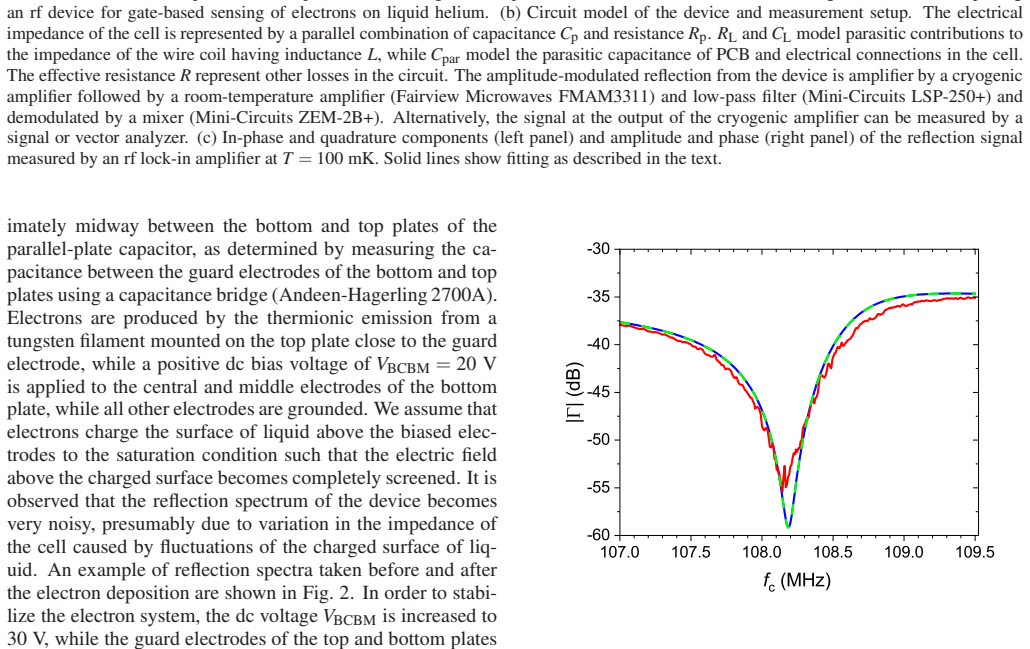
Radio-frequency reflectometry, which probes small changes in the electrical impedance of a device, provides a useful method for sensitive and fast detection of dynamic processes in quantum systems. We use this method to detect excitation of the quantized motional (Rydberg) states of trapped electrons on liquid helium. The Rydberg transition in an ensemble of electrons is detected by a change in the impedance of an rf circuit coupled to the microwave-excited electrons. To elucidate the origin of the observed response, the result is compared with an independent impedance measurement on the same electron system modulated by an electrostatic potential and with a numerical simulation using the Green's function method. Additionally, it is found that the rf response to the Rydberg resonance can be strongly enhanced by a resonant mode of the electron collective motion. Our results suggest that the observed response to the Rydberg resonance must be attributed to the lateral motion of the many-electron system rather than the vertical displacement of the individually excited electrons, as was explicate earlier. A theoretical analysis of the expected response due to the vertical displacement is given.
Editorial analysis
A structured set of objections, weighed in public.
Referee Report
Summary. The manuscript describes the application of radio-frequency reflectometry to detect Rydberg transitions in electrons trapped on liquid helium. The observed impedance changes at resonance are compared to results from an independent electrostatic modulation experiment performed on the same electron system and to numerical simulations based on the Green's function method. The authors conclude that the RF response originates from lateral collective motion of the many-electron ensemble rather than vertical displacements of individually excited electrons, supported by a theoretical analysis showing the vertical contribution to be negligible. The work also notes enhancement of the response by a resonant mode of collective electron motion.
Significance. If the central attribution to lateral motion holds after the requested clarifications, the result would establish RF reflectometry as a sensitive probe for Rydberg states in this system and would shift the interpretation of prior experiments toward collective lateral dynamics. This has potential relevance for quantum sensing and information platforms using electrons on helium, where readout of motional states is essential. The combination of independent modulation data and Green's function simulation provides a useful cross-check, though the isolation of lateral versus vertical contributions remains the key point requiring further substantiation.
major comments (2)
- [§4] §4 (Green's function simulation): the simulation of impedance change due to lateral motion must explicitly demonstrate that boundary conditions at the helium surface, electrode geometry, and possible density inhomogeneities do not introduce residual vertical or other impedance contributions that could mimic the observed signal; without this, the claim that vertical displacement is negligible does not fully follow from the comparison.
- [§3] §3 (electrostatic modulation experiment): quantitative matching between the modulation-induced lateral shift and the Rydberg-induced impedance change is required, including reported amplitudes, frequencies, error bars, and explicit exclusion of extraneous effects such as local heating or unintended vertical components; the current description leaves open whether the two experiments probe equivalent lateral displacements.
minor comments (2)
- [Abstract] Abstract: the clause 'as was explicate earlier' contains a grammatical error and should read 'as was explained earlier'.
- Figure captions and text should consistently define all symbols used in the impedance and Green's function expressions to avoid ambiguity for readers unfamiliar with the prior literature on electron-on-helium systems.
Simulated Author's Rebuttal
We thank the referee for the careful reading of our manuscript and the constructive comments. We address each major comment below and will revise the manuscript accordingly to provide the requested clarifications and quantitative details.
read point-by-point responses
-
Referee: [§4] §4 (Green's function simulation): the simulation of impedance change due to lateral motion must explicitly demonstrate that boundary conditions at the helium surface, electrode geometry, and possible density inhomogeneities do not introduce residual vertical or other impedance contributions that could mimic the observed signal; without this, the claim that vertical displacement is negligible does not fully follow from the comparison.
Authors: We agree that additional explicit checks would strengthen the argument. In the revised manuscript we will expand §4 with new simulation results that systematically vary the boundary conditions at the helium surface and the electrode geometry. We will also incorporate density inhomogeneities into the model and show that these do not produce impedance changes that could be mistaken for the observed lateral-motion signal. These additions will be presented in an extended discussion or supplementary section to confirm that the vertical contribution remains negligible, consistent with our existing theoretical analysis. revision: yes
-
Referee: [§3] §3 (electrostatic modulation experiment): quantitative matching between the modulation-induced lateral shift and the Rydberg-induced impedance change is required, including reported amplitudes, frequencies, error bars, and explicit exclusion of extraneous effects such as local heating or unintended vertical components; the current description leaves open whether the two experiments probe equivalent lateral displacements.
Authors: We accept that a more quantitative comparison is needed. In the revised §3 we will report the specific amplitudes, frequencies, and error bars (obtained from repeated measurements) for both the electrostatic modulation and the Rydberg-induced impedance changes. We will add an explicit discussion ruling out local heating (based on the low applied powers and monitored temperature stability) and unintended vertical components (by reference to the electrode geometry and electrostatic modeling). A normalized comparison of the impedance responses will be included to demonstrate that the two experiments address equivalent lateral displacements. revision: yes
Circularity Check
No significant circularity; central attribution rests on independent modulation experiment and Green's function simulation
full rationale
The paper's key step attributes the RF impedance shift at the Rydberg resonance to lateral collective motion by direct comparison with a separate electrostatic modulation measurement on the same system and a numerical Green's function simulation. These are presented as independent checks that isolate lateral effects from the calculated vertical-displacement response. No equation reduces to a fitted parameter renamed as a prediction, no self-citation is invoked as a uniqueness theorem to forbid alternatives, and the derivation does not define the target quantity in terms of itself. The analysis therefore remains self-contained against external benchmarks rather than circular.
Axiom & Free-Parameter Ledger
Lean theorems connected to this paper
-
IndisputableMonolith/Foundation/RealityFromDistinction.leanreality_from_one_distinction unclear?
unclearRelation between the paper passage and the cited Recognition theorem.
Our results suggest that the observed response to the Rydberg resonance must be attributed to the lateral motion of the many-electron system rather than the vertical displacement of the individually excited electrons, as was explicated earlier.
-
IndisputableMonolith/Cost/FunctionalEquation.leanwashburn_uniqueness_aczel unclear?
unclearRelation between the paper passage and the cited Recognition theorem.
the result is compared with an independent impedance measurement ... and with a numerical simulation using the Green’s function method
What do these tags mean?
- matches
- The paper's claim is directly supported by a theorem in the formal canon.
- supports
- The theorem supports part of the paper's argument, but the paper may add assumptions or extra steps.
- extends
- The paper goes beyond the formal theorem; the theorem is a base layer rather than the whole result.
- uses
- The paper appears to rely on the theorem as machinery.
- contradicts
- The paper's claim conflicts with a theorem or certificate in the canon.
- unclear
- Pith found a possible connection, but the passage is too broad, indirect, or ambiguous to say the theorem truly supports the claim.
Reference graph
Works this paper leans on
-
[1]
Image-potential- induced Surface Bands in Insulators,
Milton W. Cole and Morrel H. Cohen, “Image-potential- induced Surface Bands in Insulators,” Phys. Rev. Lett. 23, 1238 (1969)
work page 1969
-
[2]
Motion of helium ions near a vapor-liquid sur face,
V . Shikin, “Motion of helium ions near a vapor-liquid sur face,” Sov. Phys. JETP 5, 936 (1970)
work page 1970
-
[3]
Quantum electronic s on quantum liquids and solids,
W. Guo, D. Konstantinov, and D. Jin, “Quantum electronic s on quantum liquids and solids,” Progress in Quantum Electroni cs 99, 100552 (2025)
work page 2025
-
[4]
Quantum computing with electrons floating on liquid helium,
P . M. Platzman and M. I. Dykman, “Quantum computing with electrons floating on liquid helium,” Science 284, 1967 (1999)
work page 1967
-
[5]
Qubits with electrons on liquid helium,
M. I. Dykman, P . M. Platzman, and P . Seddighrad, “Qubits with electrons on liquid helium,” Phys. Rev. B 67, 155402 (2003)
work page 2003
-
[6]
Spin-based quantum computing using electro ns on liquid helium,
S. A. Lyon, “Spin-based quantum computing using electro ns on liquid helium,” Phys. Rev. A 74, 052338 (2006)
work page 2006
-
[7]
D. I. Schuster, A. Fragner, M. I. Dykman, S. A. Lyon, and R. J. Schoelkopf, “Proposal for manipulating and detecting spin and orbital states of trapped electrons on helium using cavity q uan- tum electrodynamics,” Phys. Rev. Lett. 105, 040503 (2010)
work page 2010
-
[8]
Coupli ng a single electron on superfluid helium to a superconducting re s- onator,
Gerwin Koolstra, Ge Yang, and David I. Schuster, “Coupli ng a single electron on superfluid helium to a superconducting re s- onator,” Nat. Commun. 10, 5323 (2019)
work page 2019
-
[9]
Single ele c- trons on solid neon as a solid-state qubit platform,
Xianjing Zhou, Gerwin Koolstra, Xufeng Zhang, Ge Yang, Xu Han, Brennan Dizdar, Xinhao Li, Ralu Divan, Wei Guo, Kater W. Murch, David I. Schuster, and Dafei Jin, “Single ele c- trons on solid neon as a solid-state qubit platform,” Nature 605, 46–50 (2022). 19
work page 2022
-
[10]
Electron charge qubit with 0.1 millisecond coherence time,
Xianjing Zhou, Xinhao Li, Qianfan Chen, Gerwin Koolstr a, Ge Yang, Brennan Dizdar, Yizhong Huang, Christopher S. Wang, Xu Han, Xufeng Zhang, David I. Schuster, and Dafei Jin, “Electron charge qubit with 0.1 millisecond coherence time,” Nat. Phys. 20, 116 (2024)
work page 2024
-
[11]
Blueprint for quantum computing using electrons on helium ,
E. Kawakami, J. Chen, M. Benito, and D. Konstantinov, “Blueprint for quantum computing using electrons on helium ,” Phys. Rev. Appl. 20, 054022 (2023)
work page 2023
-
[12]
Quantum computing using floating electrons on cryogenic substrates: Potential and challenges,
A. Jennings, X. Zhou, I. Grytsenko, and E. Kawakami, “Quantum computing using floating electrons on cryogenic substrates: Potential and challenges,” Appl. Phys. Lett. 124, 120501 (2024)
work page 2024
-
[13]
Millimeter-wave four-wave mixing via kinetic in duc- tance for quantum devices,
A. Anferov, A. Suleymanzade, A. Oriani, J. Simon, and D. I. Shuster, “Millimeter-wave four-wave mixing via kinetic in duc- tance for quantum devices,” Phys. Rev. Applied 13, 024056 (2020)
work page 2020
-
[14]
Low-loss millimeter-wave resonators with an improved cou - pling structure,
A. Anferov, S. P . Harvey, K. H. Lee, J. Simon, and D. I. Shuster, “Low-loss millimeter-wave resonators with an improved cou - pling structure,” Supercond. Sci. Technol. 37, 035013 (2024)
work page 2024
-
[15]
The radio-frequency single-electron tra nsis- tor (rf-set): A fast and ultrasensitive electrometer,
R. J. Schoelcopf, P . Wanlgren, A. A. Kozhevnikov, P . Del sing, and D. E. Prober, “The radio-frequency single-electron tra nsis- tor (rf-set): A fast and ultrasensitive electrometer,” Sci ence 280, 1238–1242 (1998)
work page 1998
-
[16]
Sensitive radio-frequency measurements of a quantum dot by tuning to perfect impedance matching,
N. Ares, F. J. Schupp, A. Mavalankar, J. Rogers, G. Griffi ths, G. A. C. Jones, I. Farrer, D. A. Ritchie, C. G. Smith, A. Cottet , G. A. D. Briggs, and E. A. Laird, “Sensitive radio-frequency measurements of a quantum dot by tuning to perfect impedance matching,” Phys. Rev. Applied 5, 034011 (2016)
work page 2016
-
[17]
Probing quan- tum devices with radio-frequency reflectrometry,
F. Vigneau, F. Fedele, A. Chatterjee, D. Reilly, F. Kuem meth, M. F. Gonzalez-Zalba, A. Laird, and N. Ares, “Probing quan- tum devices with radio-frequency reflectrometry,” Appl. Ph ys. Rev. 10, 021305 (2023)
work page 2023
-
[18]
Fast single-charge sensing with a rf quantum point contact ,
D. J. Reilly, C. M. Marcus, M. P . Hanson, and A. C. Gossard , “Fast single-charge sensing with a rf quantum point contact ,” Appl. Phys. Lett. 91, 162101 (2007)
work page 2007
-
[19]
Single shot charge detection using a radio-frequency quantum point con - tact,
M. C. Cassidy, A. S. Dzurak, R. G. Clark, K. D. Petter- son, I. Farrer, D. A. Ritchie, and C. G. Smith, “Single shot charge detection using a radio-frequency quantum point con - tact,” Appl. Phys. Lett. 91, 222104 (2007)
work page 2007
-
[20]
Rapid gate-based spin read-out in silicon using an on-chip resonator,
G. Zheng, N. Samkharadze, M. L. Noordam, N. Kalhor, D. Brousse, A. Sammak, G. Scappucci, and L. M. K. V an- dersypen, “Rapid gate-based spin read-out in silicon using an on-chip resonator,” Nat. Nanotechnol. 14, 742 (2019)
work page 2019
-
[21]
Gate-based high fidelity spin readout in a cmos device,
M. Urdampilleta, D. J. Niegemann, E. Chanrion, B. Jadot , C. Spence, P . A. Mortemousque, C. B auerle, L. Hutin, B. Bertrand, S. Barraud, R. Maurand, M. Sanquer, X. Jehl, S. De Franceschi, M. Vinet, and Meunier. T, “Gate-based high fidelity spin readout in a cmos device,” Nat. Nanotechnol. 14, 737 (2019)
work page 2019
-
[22]
Obsrevation of quantum capacitance in the Cooper-pair transistor,
T. Duty, G. Johansson, K. Bladh, D. Gunnarsson, C. Wilso n, and P . Delsing, “Obsrevation of quantum capacitance in the Cooper-pair transistor,” Phys. Rev. Lett. 95, 206807 (2005)
work page 2005
-
[23]
Fast quan tum limited readout of a superconducting qubit using a slow osci l- lator,
Johansson. G., L. Tornberg, and C. M. Wilson, “Fast quan tum limited readout of a superconducting qubit using a slow osci l- lator,” Phys. Rev. B 74, 100504(R) (2006)
work page 2006
-
[24]
Microwave spectroscopy of a Cooper-pair transistor coupled to a lumpe d- element resonator,
M. T. Bell, L. B. Ioffe, and M. E. Gershenson, “Microwave spectroscopy of a Cooper-pair transistor coupled to a lumpe d- element resonator,” Phys. Rev. B 86, 144512 (2012)
work page 2012
-
[25]
Efficient and sensitive capacitive readout of nano me- chanical resonator arrays,
P . A. Truitt, J. B. Hertzberg, C. Huang, K. L. Ekinci, and K. C. Schwab, “Efficient and sensitive capacitive readout of nano me- chanical resonator arrays,” Nano Lett. 7, 120–126 (2007)
work page 2007
-
[26]
Resonant optomechanics with a vibrating carbon nanotube and a radio-frequency cavi ty,
N. Ares, T. Pei, A. Mavalankar, M. Mergenthaler, J. H. Wa rner, G. A. D. Briggs, and E. A. Laird, “Resonant optomechanics with a vibrating carbon nanotube and a radio-frequency cavi ty,” Phys. Rev. Lett. 117, 170801 (2016)
work page 2016
-
[27]
Nanoscale radio- frequency thermometry,
D. Schmidt, C. Y ung, and A Cleland, “Nanoscale radio- frequency thermometry,” App. Phys. Lett. 83, 1002–1004 (2003)
work page 2003
-
[28]
B. Karimi and J. P . Pekola, “Noninvasive thermometer ba sed on the zero-bias anomaly of a superconducting junction for ult ra- sensitive calorimetry,” Phys. Rev. Appl. 10, 054048 (2018)
work page 2018
-
[29]
Probing the limits of gate-based charge sensing,
M. F. Gonzales-Zalba, S. Barraud, A. J. Ferguson, and A. C. Betz, “Probing the limits of gate-based charge sensing,” Na t. Commun. 6, 6084 (2015)
work page 2015
-
[30]
Radio-frequency capacitive gat e- based sensing,
I. Ahmed, S. Haigh, J. A. Schaal, S. Barraud, Y . Zhu, C.-M . Lee, M. Amado, J. W. A. Robinson, A. Rossi, J. J. L. Morton, and M. F. Gonzalez-Zalba, “Radio-frequency capacitive gat e- based sensing,” Phys. Rev. Appl. 10, 054048 (2018)
work page 2018
-
[31]
Image-charge detection of the rydberg states of surface el ec- trons on liquid helium,
Erika Kawakami, Asem Elarabi, and Denis Konstantinov, “Image-charge detection of the rydberg states of surface el ec- trons on liquid helium,” Phys. Rev. Lett. 123, 086801 (2019)
work page 2019
-
[32]
Sensing and control of single trapped electrons abov e 1 Kelvin,
K. E. Castoria, N. A. Beysengulov, G. Koolstra, B. Byeon , E. O. Glen, M. Sammon, S. A. Lyon, J. Pollanen, and D. G. Rees, “Sensing and control of single trapped electrons abov e 1 Kelvin,” Phys. Rev. X 15, 041002 (2025)
work page 2025
-
[33]
Mobility of electrons o n the surface of liquid 4he,
W. T. Sommer and David J Tanner, “Mobility of electrons o n the surface of liquid 4he,” Phys. Rev. Lett. 27, 1345 (1971)
work page 1971
-
[34]
C. C. Grimes and G Adams, “Evidence for a liquid-to-crys tal phase transtion in a classical two-dimensional sheet of ele c- trons,” Phys. Rev. Lett. 42, 795 (1979)
work page 1979
-
[35]
Dynamical Hall effect in a two-dimension al classical plasma,
D. C. Glattli, E. Y . Andrei, G Deville, J Poitrenaud, and Williams F. I. B., “Dynamical Hall effect in a two-dimension al classical plasma,” Phys. Rev. Lett. 54, 1710 (1985)
work page 1985
-
[36]
An incompressible state of a photo-exciet d electron gas,
A D Chepelianskii, M Watanab, K Nasyedkin, K Kono, and D Konstantinov, “An incompressible state of a photo-exciet d electron gas,” Nat. Commun. 6, 7210 (2015)
work page 2015
-
[37]
Stik-slip motion of the Wigner solid on liquid helium ,
D. G. Rees, N. R. Beysengulov, Juhn-Jong Lin, and Kimito shi Kono, “Stik-slip motion of the Wigner solid on liquid helium ,” Phys. Rev. Lett. 116, 206801 (2016)
work page 2016
-
[38]
A. Jenning, I. Grytsenko, Y . Tian, O. Rybalco, J. Wang, I . J. Barabash, and E. Kawakami, “Probing the quantum capaci- tance of Rydberg transtions of surface electrons on liquid h e- lium via micrwave frequency modulation,” Phys. Rev. Lett. 135, 087001 (2025)
work page 2025
-
[39]
Impedance method for surfac e state electrons,
L. Wilen and R. Giannetta, “Impedance method for surfac e state electrons,” J. Low Temp. Phys. 72, 353 (1988)
work page 1988
-
[40]
Efficient and robust analysis of complex scattering da ta under noise in microwave resonators,
S. Probst, F. B. Song, P . A. Bushev, A. V . Ustinov, and M. Wei- des, “Efficient and robust analysis of complex scattering da ta under noise in microwave resonators,” Rev. Sci. Instrum. 86, 024706 (2015)
work page 2015
-
[41]
Microwave satu- ration of the Rydberg states of electrons on helium,
E. Collin, W. Bailey, P . Fozooni, P . G. Frayne, P . Glasso n, K. Harrabi, M. J. Lea, and Papageorgiou. G, “Microwave satu- ration of the Rydberg states of electrons on helium,” Phys. R ev. Lett. 89, 245301 (2002)
work page 2002
-
[42]
Cry o- genic resonant amplifier for electron-on-helium image char ge readout,
M. Belianchikov, J. A. Kraus, and D. Konstantinov, “Cry o- genic resonant amplifier for electron-on-helium image char ge readout,” J. Low Temp. Phys. 215, 312 (2024)
work page 2024
-
[43]
Principles of the stor ed ion calorimeter,
D. J. Wineland and H. G. Dehmelt, “Principles of the stor ed ion calorimeter,” J. App. Phys. 46, 919 (1975)
work page 1975
-
[44]
Observation of spin flips with a single trapped proton,
S. Ulmer, C. C. Rodegheri, K. Blaum, H. Kracke, A. Mooser , W. Quint, and J. Walz, “Observation of spin flips with a single trapped proton,” Phys. Rev. Lett. 106, 253001 (2011)
work page 2011
-
[45]
Spin readout of trapped electron qubit,
P . Peng, C. Matthiesen, and H. H affner, “Spin readout of trapped electron qubit,” Phys. Rev. A 95, 012312 (2017)
work page 2017
-
[46]
Hybrid quantum systems with trapped charged particles,
S. Kotler, R. W. Simmonds, D. Leibfried, and D. J. Winela nd, “Hybrid quantum systems with trapped charged particles,” Phys. Rev. B 95, 022327 (2017)
work page 2017
-
[47]
Image 20 chrage detection of electrons on liquid helium in an on-chip trapping device,
M. Belianchikov, N. Morais, and D Konstantinov, “Image 20 chrage detection of electrons on liquid helium in an on-chip trapping device,” Phys. Rev. Applied 23, 054026 (2025)
work page 2025
-
[48]
Quantum and tunneling capacitance in chrage and spin qubit s,
R. Mizuta, R. M. Otxoa, A. C. Berz, and M. F. Gonzalez-Zal ba, “Quantum and tunneling capacitance in chrage and spin qubit s,” Phys. Rev. B 95, 045414 (2017)
work page 2017
-
[49]
H. J. Carmichael, Statistical methods in quatum optics 1: master equations and F okker-Plank equations(Springer-V erlag Berlin Heidelberg, 1999)
work page 1999
-
[50]
Relaxati on of the excited rydberg states of surface electrons on liquid helium,
E. Kawakam, A. Elarabi, and D. Konstantinov, “Relaxati on of the excited rydberg states of surface electrons on liquid helium,” Phys. Rev. Lett. 126, 106802 (2021)
work page 2021
-
[51]
Theory of hot electrons on the liq uid 4He surface,
M. Saitoh and T. Aoki, “Theory of hot electrons on the liq uid 4He surface,” J. Phys. Soc. Jpn. 44, 71 (1978)
work page 1978
-
[52]
D. Konstantinov, H. Isshiki, Y u. Monarkha, H. Akimoto, K. Shirahama, and K Kono, “Microwave-resoance-induced re- sistivity: evodence of ultrahot surface-state electrons o n liquid 4He,” Phys. Rev. Lett. 98, 235302 (2007)
work page 2007
-
[53]
Thermoelectric transport in a correlated elec tron system on the surface of liquid helium,
Ivan Kostylev, A. A. Zadorozhko, M Hatifi, and Denis Kon- stantinov, “Thermoelectric transport in a correlated elec tron system on the surface of liquid helium,” Phys. Rev. Lett. 127, 186801 (2021)
work page 2021
-
[54]
Transport prop- erties of overheatied electrons trapped on a helium surface ,
F. Closa, E. Raph¨ ael, and A. D. Chepelianskii, “Transport prop- erties of overheatied electrons trapped on a helium surface ,” Eur. Phys. J. B 87, 190 (2014)
work page 2014
-
[55]
Ev- idance for a new dissipationless effects in 2D electronic tr ans- port,
M. A. Zudov, R. R. Du, L. N. Pfieiffer, and K. W. West, “Ev- idance for a new dissipationless effects in 2D electronic tr ans- port,” Phys. Rev. Lett. 90, 046807 (2003)
work page 2003
-
[56]
R. Mani, J. H. Smet, K. von Klitzing, V . Narayanamurti, W . B. Johnson, and V . Umansky, “Zero-resistance states induced b y electromagnetic wave exciation in GaAs/AlGaAs heterosctr uc- tures,” Nature 420, 646 (2002)
work page 2002
-
[57]
Random telegraph photosignals in a microwave- exposed two-dimensional electron system,
S. I. Dorozhkin, L. Pfieiffer, K. West, K. von Klitzing, a nd Smet. J. H., “Random telegraph photosignals in a microwave- exposed two-dimensional electron system,” Nature Phys. 7, 336 (2011)
work page 2011
-
[58]
Photo-induced vanishing of magnetoconductnace in 2D electrons on liquid helium,
D. Konstantinov and K. Kono, “Photo-induced vanishing of magnetoconductnace in 2D electrons on liquid helium,” Phys . Rev. Lett. 105, 226801 (2010)
work page 2010
-
[59]
Incompressible states of a photo-exc ited electron gas,
A. D. Chepelianskii, M. Watanabe, K. Nasyedkin, K. Kono , and K. Konstantinov, “Incompressible states of a photo-exc ited electron gas,” Nature Commun. 6, 7210 (2015)
work page 2015
discussion (0)
Sign in with ORCID, Apple, or X to comment. Anyone can read and Pith papers without signing in.