Disentangling Internal Tides from Balanced Motions with Deep Learning and Surface Field Synergy
Pith reviewed 2026-05-18 00:57 UTC · model grok-4.3
The pith
Combining surface velocity with height and temperature lets deep learning better separate internal tides from balanced ocean motions.
A machine-rendered reading of the paper's core claim, the machinery that carries it, and where it could break.
Core claim
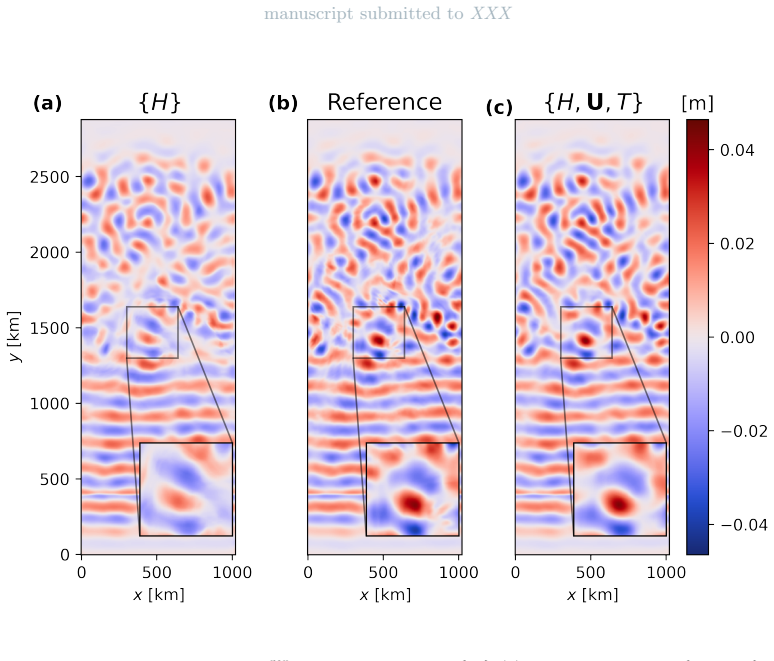
We develop a deep learning method to extract internal tide signatures from surface observations in an idealized simulation of ocean turbulence. Testing input combinations reveals that sea surface height, temperature, and velocity all help disentangle internal tides from balanced motions, with velocity contributing the most information. The model benefits from both direct wave signatures and indirect information about the scattering medium, but requires non-local processing to capture larger-scale effects.
What carries the argument
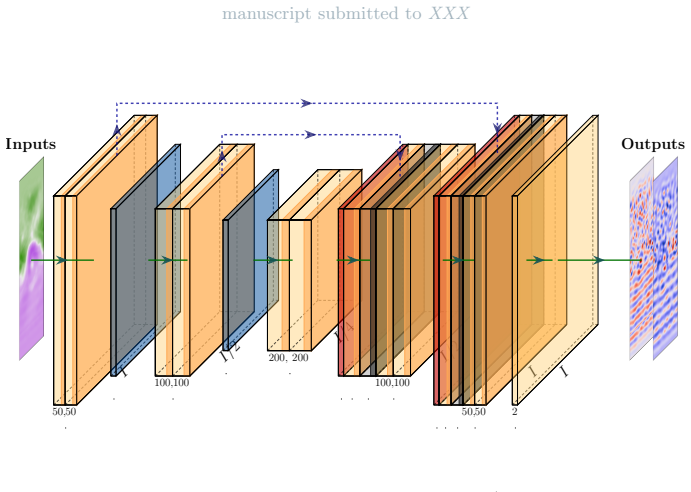
A deep neural network performing image-to-image translation from multi-channel surface fields to internal tide fields, trained with annealed learning rates to match more complex models while being simpler and cheaper.
If this is right
- Coordinated multi-platform observations gain value for separating balanced motions and internal waves.
- Surface velocity observations stand out as especially important for this separation.
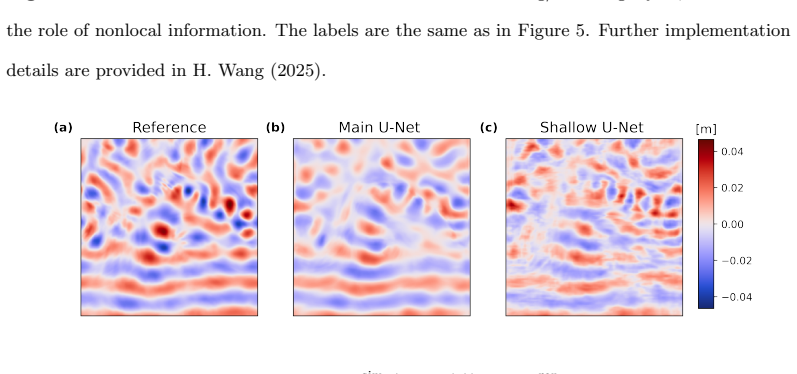
- Algorithms must operate in a highly non-local manner to use large-scale mesoscale information effectively.
- Residual errors tend to appear at small spatial scales close to mode-2 tidal wavelengths.
Where Pith is reading between the lines
- Prioritizing surface velocity measurements in future ocean monitoring could enhance global internal tide estimates.
- Applying this deep learning method to actual satellite datasets would test its performance under real-world conditions including Doppler shifts.
- Non-local deep learning techniques developed here could help disentangle other types of waves in geophysical fluid simulations.
Load-bearing premise
The reference internal tide fields from the simulation are taken as accurate ground truth and are not significantly affected by Doppler shifts from the background flow.
What would settle it
Direct comparison of the model's output internal tide fields with independent in-situ measurements from instruments that can detect Doppler effects would show if the relative contributions of input fields hold.
Figures






read the original abstract
A fundamental challenge in ocean dynamics is disentangling balanced motions and internal waves. Extracting internal tidal (IT) imprints from surface data is a central part of this challenge. Traditional harmonic analysis can fail under strong incoherence and poor temporal sampling, as in global satellite observations. New wide-swath satellites provide two-dimensional spatial coverage, allowing IT extraction to be reformulated as image translation. Building on our earlier deep-learning approach for extracting IT signatures from sea surface height (SSH) in an idealized turbulent simulation, we show that a simpler, computationally cheaper algorithm performs comparably in our experiments when the learning rate is annealed during training. Using this algorithm, we test different combinations of surface inputs: SSH, surface temperature, and surface velocity. All fields contribute synergistically to disentanglement in our deterministic benchmark, with surface velocity by far the most informative. These findings underscore the value of coordinated multi-platform observations and highlight the importance of surface velocity for separating balanced motions and internal waves. Additional analysis shows that both wave-signature information and scattering-medium information aid IT extraction. To exploit large-scale, mesoscale-reaching information in the scattering medium, the algorithm must be highly non-local. Residual errors concentrate at small spatial scales near mode-2 tidal wavelengths, likely reflecting incomplete input information, uncertainty in the simulation-derived reference fields, including possible Doppler-shift contamination, and limitations of the present deterministic architecture.
Editorial analysis
A structured set of objections, weighed in public.
Referee Report
Summary. The manuscript develops a deep-learning image-translation approach to extract internal-tide signatures from surface fields in an idealized turbulent simulation. It compares input combinations of sea-surface height, surface temperature, and surface velocity, reports synergistic gains with velocity dominant, emphasizes the need for non-local architectures to capture scattering-medium information, and attributes residual errors at mode-2 scales to incomplete inputs, simulation uncertainties (including possible Doppler-shift contamination), and deterministic-model limitations.
Significance. If the reference fields prove sufficiently clean, the work supplies a controlled benchmark demonstrating that coordinated multi-platform surface observations can improve internal-tide extraction beyond single-field methods and that surface velocity carries the largest signal. The empirical synergy tests and non-locality requirement offer concrete guidance for future wide-swath altimetry and in-situ velocity campaigns, though the simulation-only setting limits immediate transfer to real-world data.
major comments (1)
- [Abstract and residual-error discussion] Abstract and final paragraph on residual errors: the headline claims of synergistic disentanglement and surface-velocity dominance are evaluated exclusively against simulation-derived reference IT fields. The text itself lists “possible Doppler-shift contamination” from the background balanced flow as one source of residual error at mode-2 scales. Because every ablation metric and every ranking of input fields is computed against this same reference, contamination would cause the reported performance gains to reflect recovery of an already-mixed signal rather than clean separation. A quantitative estimate of the contamination level or a sensitivity test that perturbs the reference would be required to support the central interpretation.
minor comments (2)
- [Abstract] The abstract states that “all fields contribute synergistically” and that velocity is “by far the most informative,” yet provides no numerical values, error bars, or explicit ablation table; adding these quantities would make the synergy claim immediately verifiable.
- [Methods] Notation for the annealed learning-rate schedule and the precise definition of the deterministic benchmark loss should be introduced earlier so that the claim of “comparably” performing simpler algorithm can be assessed without back-referencing.
Simulated Author's Rebuttal
We thank the referee for the constructive review and for highlighting an important interpretive caveat. We address the major comment below and have revised the manuscript to clarify limitations while preserving the controlled-benchmark nature of the study.
read point-by-point responses
-
Referee: [Abstract and residual-error discussion] Abstract and final paragraph on residual errors: the headline claims of synergistic disentanglement and surface-velocity dominance are evaluated exclusively against simulation-derived reference IT fields. The text itself lists “possible Doppler-shift contamination” from the background balanced flow as one source of residual error at mode-2 scales. Because every ablation metric and every ranking of input fields is computed against this same reference, contamination would cause the reported performance gains to reflect recovery of an already-mixed signal rather than clean separation. A quantitative estimate of the contamination level or a sensitivity test that perturbs the reference would be required to support the central interpretation.
Authors: We agree that all performance metrics are computed against simulation-derived reference fields and that the manuscript already flags possible Doppler-shift contamination as one contributor to residual error. Because the ablation experiments hold the reference fixed while varying only the surface inputs, the reported synergistic gains and velocity dominance demonstrate relative improvements in recovering that reference signal. We have revised the abstract and the final paragraph to state explicitly that the results quantify performance within this idealized simulation benchmark rather than claiming absolute clean separation from balanced motions. We have also added a brief discussion noting that a full quantitative estimate of contamination would require additional reference-perturbation experiments that lie beyond the present scope; such tests are identified as a natural direction for follow-on work. revision: partial
- A quantitative estimate of Doppler-shift contamination or a reference-perturbation sensitivity test would require new simulations and analysis not performed in the current study.
Circularity Check
No circularity in empirical deep-learning disentanglement
full rationale
The paper trains a neural network on simulation outputs to map surface fields (SSH, temperature, velocity) to internal-tide reference fields, then evaluates ablation studies on input combinations. All quantitative claims derive from held-out performance metrics against fixed simulation references rather than from any equation or parameter that is defined in terms of the target quantity. The brief reference to prior work simply describes the baseline architecture; the new synergy and velocity-dominance results are obtained from fresh experiments and do not reduce to that citation. The manuscript itself flags possible Doppler-shift contamination in the references, confirming the analysis remains externally falsifiable and self-contained.
Axiom & Free-Parameter Ledger
axioms (1)
- domain assumption The idealized turbulent simulation provides a valid benchmark whose reference internal tide fields accurately represent the target signals.
Reference graph
Works this paper leans on
-
[1]
Araujo, A., Norris, W., & Sim, J. (2019). Computing receptive fields of convolu- –32– manuscript submitted toXXX tional neural networks.Distill. (https://distill.pub/2019/computing-receptive- fields) doi: 10.23915/distill.00021 Azad, R., Aghdam, E. K., Rauland, A., Jia, Y., Avval, A. H., Bozorgpour, A., . . . Merhof, D. (2024). Medical image segmentation ...
-
[2]
Gill, A. E. (2016).Atmosphere—ocean dynamics. Elsevier. Hauser, D., Abdalla, S., Ardhuin, F., Bidlot, J.-R., Bourassa, M., Cotton, D., . . . others (2023). Satellite remote sensing of surface winds, waves, and currents: Where are we now?Surveys in Geophysics,44(5), 1357–1446. He, J., & Mahadevan, A. (2024, mar). Vertical Velocity Diagnosed From Surface Da...
-
[3]
Lapo, K., Ichinaga, S. M., & Kutz, J. N. (2025). A method for unsupervised learn- ing of coherent spatiotemporal patterns in multiscale data.Proceedings of the National Academy of Sciences,122(7), e2415786122. Larra˜ naga, M., Renault, L., Wineteer, A., Contreras, M., Arbic, B. K., Bourassa, M. A., & Rodriguez, E. (2025). Assessing the future odysea satel...
work page 2025
-
[4]
Le Guillou, F., Lahaye, N., Ubelmann, C., Metref, S., Cosme, E., Ponte, A., . . . Vi- dard, A. (2021). Joint Estimation of Balanced Motions and Internal Tides From Future Wide-Swath Altimetry.Journal of Advances in Modeling Earth Systems,13(12), 1–17. doi: 10.1029/2021MS002613 Lenain, L., Srinivasan, K., Barkan, R., & Pizzo, N. (2025). An unprecedented vi...
-
[5]
SGDR: Stochastic Gradient Descent with Warm Restarts
avail- able at Research Square. doi: 10.21203/rs.3.rs-7055642/v1 Li, B., Wang, Y., Wei, Z., Pan, H., Xu, T., & Lv, X. (2023). Changing the unpre- dictable nature of internal tides through deep learning.Geophysical Research Letters,50(8), e2022GL102227. Liu, Z. (2022). Super convergence cosine annealing with warm-up learning rate. In Caibda 2022; 2nd inter...
work page internal anchor Pith review Pith/arXiv arXiv doi:10.21203/rs.3.rs-7055642/v1 2023
-
[6]
Ronneberger, O., Fischer, P., & Brox, T. (2015). U-net: Convolutional networks for biomedical image segmentation. InMedical image computing and computer- assisted intervention–miccai 2015: 18th international conference, munich, germany, october 5-9, 2015, proceedings, part iii 18(pp. 234–241). Savva, M. A., Kafiabad, H. A., & Vanneste, J. (2021, jun). Ine...
work page doi:10.1017/jfm 2015
-
[7]
Wagner, G. L., Ferrando, G., & Young, W. R. (2017, oct). An asymptotic model for the propagation of oceanic internal tides through quasi-geostrophic flow.Journal of Fluid Mechanics,828, 779–811. Retrieved fromhttps:// www.cambridge.org/core/product/identifier/S0022112017005092/type/ journal articledoi: 10.1017/jfm.2017.509 Wang, C., Liu, Z., & Lin, H. (20...
discussion (0)
Sign in with ORCID, Apple, or X to comment. Anyone can read and Pith papers without signing in.