Search for Dark Particles in K⁰_L to γ X at the KOTO Experiment
Pith reviewed 2026-05-17 23:53 UTC · model grok-4.3
The pith
KOTO finds no evidence for an invisible dark particle X in KL to gamma X decays and sets upper limits on the branching ratio from 10 to the minus 7 up to 10 to the minus 3.
A machine-rendered reading of the paper's core claim, the machinery that carries it, and where it could break.
Core claim
The KOTO data set contains no statistically significant excess of events above the predicted background in the signal region for KL to gamma X, allowing the experiment to set mass-dependent upper limits on the branching ratio of this decay for X masses between 0 and 425 MeV per c squared, with the strongest bound of 3.4 times 10 to the minus 7 at 90 percent for massless X.
What carries the argument
Single-photon event selection with missing energy in the KOTO calorimeter and veto systems, compared against Monte Carlo predictions for background and hypothetical signal efficiencies.
If this is right
- Theoretical models of dark photons or other invisible particles must respect these branching ratio bounds for masses below 425 MeV per c squared.
- Improved data sets from continued KOTO running would tighten the limits further by reducing statistical uncertainty.
- The result provides a direct experimental constraint that can be compared with predictions from other kaon decay searches or collider experiments.
Where Pith is reading between the lines
- These limits can be translated into bounds on the coupling strength between the standard model and a dark sector for specific models of X.
- Similar searches at other kaon facilities could cross-check the KOTO result and extend coverage to higher masses.
- If a future excess appears, it would require re-examination of both background modeling and possible new physics contributions.
Load-bearing premise
The predicted background rate from standard processes and the detector efficiencies for both signal and background are modeled correctly with no large unaccounted biases or uncertainties.
What would settle it
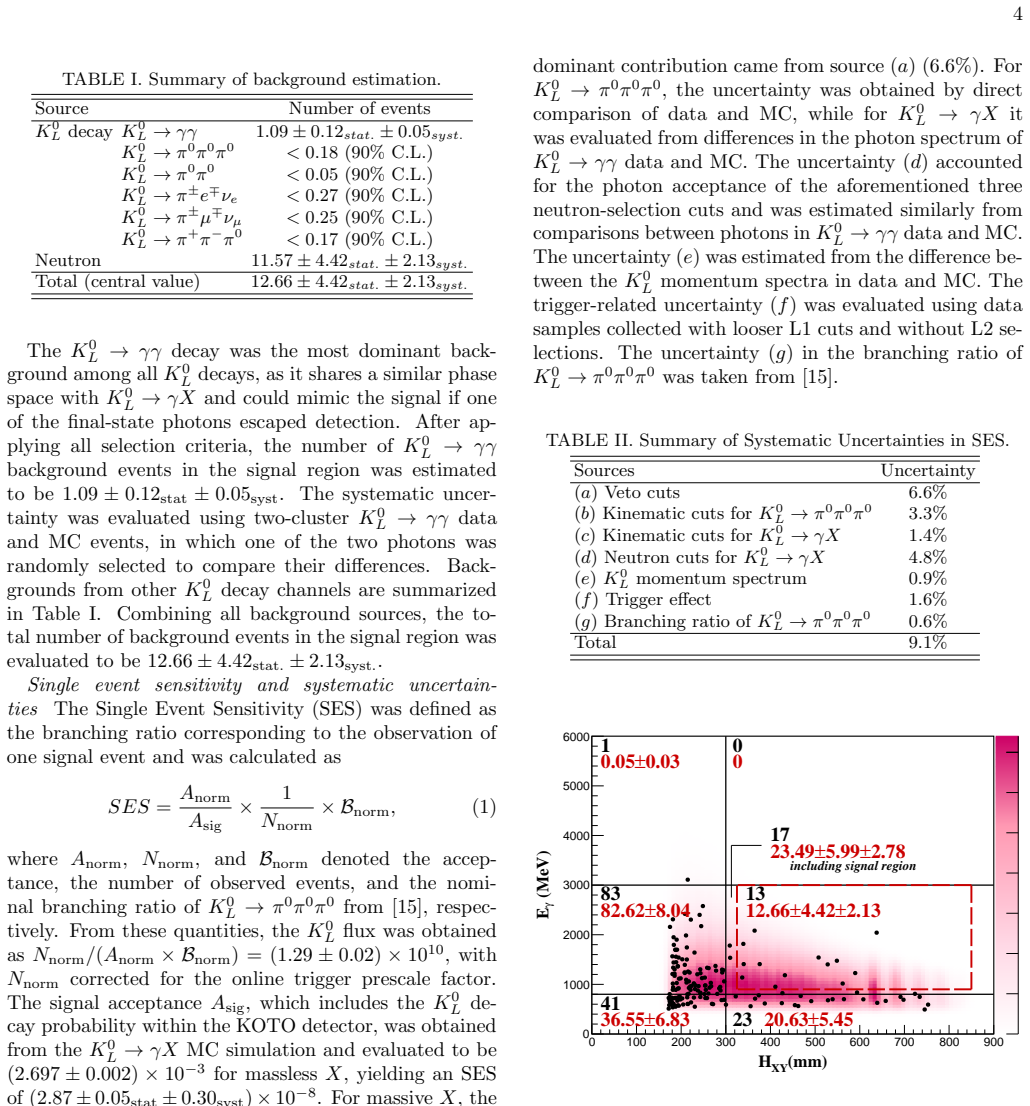
Observation of a clear excess of events significantly above the predicted 12.66 background in the signal region would indicate the presence of X.
Figures



read the original abstract
We report a search for an invisible particle $X$ in the decay $K^0_L\rightarrow \gamma X$ ($X \to \text{invisible}$), where $X$ can be interpreted as a massless or massive dark photon. No evidence for $X$ was found, based on 13 candidate events consistent with a predicted background of $12.66 \pm 4.42_{\text{stat.}} \pm 2.13_{\text{syst.}}$ events. Upper limits on the branching ratio of $K^0_L\rightarrow \gamma X$ were set for the $X$ mass range $0 \leq m_X \leq 425$ MeV/$c^2$. For massless $X$, the upper limit was $3.4\times10^{-7}$ at the $90\%$ confidence level, while for massive $X$, the upper limits in the searched mass region ranged from $O(10^{-7})$ to $O(10^{-3})$.
Editorial analysis
A structured set of objections, weighed in public.
Referee Report
Summary. The manuscript reports results from the KOTO experiment on a search for an invisible particle X in the decay K_L^0 → γX, where X is interpreted as a possible dark photon candidate. With 13 observed candidate events in the signal region, consistent with a predicted background of 12.66 ± 4.42_stat ± 2.13_syst events, no evidence for X is claimed. Upper limits on the branching ratio are derived for X masses in the range 0 ≤ m_X ≤ 425 MeV/c², including a 90% CL limit of 3.4 × 10^{-7} for the massless case.
Significance. If the background modeling and signal efficiencies hold, the result provides competitive constraints on light dark-sector particles in a mass range accessible to kaon decays but not fully covered by previous experiments. The close agreement between data and background prediction, combined with the reported systematic evaluation, supports setting meaningful upper limits that can be used to test specific dark photon models.
major comments (2)
- [Section 4.3] Section 4.3 (Background Estimation): The central background value of 12.66 events and its ±2.13 systematic uncertainty must be shown to fully account for potential contributions from K_L → γγ with one photon escaping detection, beam-related neutrons, and cosmic-ray overlays. Without an explicit breakdown or data-driven validation cross-check in this section, the quoted consistency with 13 observed events cannot be fully assessed for robustness.
- [Section 5.1] Section 5.1 (Efficiency and Limit Setting): The mass-dependent signal efficiency, which enters the upper-limit calculation and varies from O(10^{-7}) to O(10^{-3}) across 0–425 MeV/c², requires a tabulated or plotted presentation (e.g., Table 2 or Figure 7) with associated uncertainties. The current description leaves unclear how low-energy photon response and the invisible X hypothesis are modeled in the efficiency.
minor comments (2)
- [Figure 3] Figure 3: The signal-region definition in the E_γ vs. missing-mass plane should include explicit numerical boundaries for the selection cuts to allow independent reproduction of the 13-event count.
- The abstract states the background as 12.66 ± 4.42_stat ± 2.13_syst; the main text should clarify whether the statistical uncertainty is from the sideband fit or Poisson statistics on the control sample.
Simulated Author's Rebuttal
We thank the referee for the careful review and constructive comments on our manuscript. We address each major comment below and have prepared revisions accordingly.
read point-by-point responses
-
Referee: [Section 4.3] Section 4.3 (Background Estimation): The central background value of 12.66 events and its ±2.13 systematic uncertainty must be shown to fully account for potential contributions from K_L → γγ with one photon escaping detection, beam-related neutrons, and cosmic-ray overlays. Without an explicit breakdown or data-driven validation cross-check in this section, the quoted consistency with 13 observed events cannot be fully assessed for robustness.
Authors: We thank the referee for highlighting the need for additional transparency. The background estimation in Section 4.3 already incorporates Monte Carlo simulations for K_L → γγ (with photon escape), beam-related neutrons, and cosmic-ray overlays, with the total systematic uncertainty of ±2.13 events derived from variations in these components. To strengthen the presentation, we will add an explicit table breaking down each contribution and include a data-driven cross-check using sideband regions in the revised manuscript. revision: yes
-
Referee: [Section 5.1] Section 5.1 (Efficiency and Limit Setting): The mass-dependent signal efficiency, which enters the upper-limit calculation and varies from O(10^{-7}) to O(10^{-3}) across 0–425 MeV/c², requires a tabulated or plotted presentation (e.g., Table 2 or Figure 7) with associated uncertainties. The current description leaves unclear how low-energy photon response and the invisible X hypothesis are modeled in the efficiency.
Authors: We agree that explicit presentation of the efficiencies will improve clarity. In the revised manuscript we have added Table 2 with efficiencies and uncertainties at representative mass points and updated Figure 7 to show the full mass dependence with uncertainty bands. The low-energy photon response is modeled in GEANT4 simulations validated against data from K_L → γγ and other control samples; the invisible X is implemented by generating kinematics with no additional visible energy deposits, matching the signal selection. revision: yes
Circularity Check
No circularity detected in experimental counting analysis
full rationale
This is a standard particle-physics counting experiment that compares 13 observed candidate events in the signal region against an independently estimated background of 12.66 ± 4.42_stat ± 2.13_syst events, then sets frequentist upper limits on the branching ratio for K_L^0 → γX. No mathematical derivation, ansatz, or parameter fit is presented whose output is forced to equal its input by construction; the background prediction and efficiencies are obtained from simulation and control samples external to the final data count. No self-citation chain is invoked to justify a uniqueness theorem or to rename a known result. The analysis is therefore self-contained against external benchmarks and receives the default non-finding.
Axiom & Free-Parameter Ledger
axioms (1)
- domain assumption Background predictions from known kaon decay processes and detector simulation are accurate to within stated uncertainties
invented entities (1)
-
Invisible particle X (dark photon candidate)
no independent evidence
Reference graph
Works this paper leans on
- [1]
-
[2]
Ahnet al.(KOTO Collaboration), Phys
J. Ahnet al.(KOTO Collaboration), Phys. Rev. Lett. 134, 081802 (2025)
work page 2025
-
[3]
Linet al.(KOTO Collaboration), Phys
C. Linet al.(KOTO Collaboration), Phys. Rev. Lett. 130, 111801 (2023)
work page 2023
-
[4]
The physics of the dark photon: A primer,
M. Fabbrichesi, E. Gabrielli, and G. Lanfranchi, SpringerBriefs in Physics, 10.1007/978-3-030-62519-1 (2021)
-
[5]
B. A. Dobrescu, Phys. Rev. Lett.94, 151802 (2005)
work page 2005
-
[6]
J. F. Kamenik and C. Smith, J. High Energy Phys.03, 090 (2012)
work page 2012
- [7]
- [8]
-
[9]
T. Shimogawa, Nucl. Instrum. Methods Phys. Res., Sect. A623, 585 (2010)
work page 2010
-
[10]
K. Satoet al., Nucl. Instrum. Methods Phys. Res., Sect. A982, 164527 (2020)
work page 2020
- [11]
-
[12]
J. Allison, K. Amako, J. Apostolakis, H. Araujo, P. Duboiset al.(Geant4Collaboration), IEEE Trans. Nucl. Sci53, 270 (2006)
work page 2006
-
[13]
Agostinelliet al.(Geant4Collaboration), Nucl
S. Agostinelliet al.(Geant4Collaboration), Nucl. In- strum. Methods Phys. Res., Sect. A506, 250 (2003)
work page 2003
-
[14]
Y.-C. Tunget al., Nucl. Instrum. Methods Phys. Res., Sect. A1059, 169010 (2024)
work page 2024
-
[15]
Navaset al.(Particle Data Group), Phys
S. Navaset al.(Particle Data Group), Phys. Rev. D110, 030001 (2024)
work page 2024
-
[16]
G. J. Feldman and R. D. Cousins, Phys. Rev. D57, 3873 (1998)
work page 1998
discussion (0)
Sign in with ORCID, Apple, or X to comment. Anyone can read and Pith papers without signing in.