Degeneracy beyond the parity-symmetry protection in one-dimensional spinless models: The parity-violating Kerr parametric oscillator
Pith reviewed 2026-05-17 22:46 UTC · model grok-4.3
The pith
A Kerr parametric oscillator breaks parity symmetry yet can still host doubly degenerate levels via an antiunitary symmetry.
A machine-rendered reading of the paper's core claim, the machinery that carries it, and where it could break.
Core claim
In the Kerr parametric oscillator with simultaneous one- and two-photon drives, an antiunitary symmetry survives the explicit breaking of parity and enforces exact two-fold degeneracy of energy levels. This symmetry corresponds to a two-fold symmetry either on momentum or on coordinate in the classical limit of the driven system, thereby permitting phases with spontaneous symmetry breaking that resemble those usually protected by parity.
What carries the argument
The antiunitary symmetry of the parity-violating driven KPO, which maps the Hamiltonian to itself and produces a two-fold symmetry in the classical phase space.
If this is right
- Doubly degenerate phases can appear in one-dimensional spinless models without parity symmetry.
- Degeneracy in driven KPOs offers a route to protected qubits in parity-breaking superconducting-circuit realizations.
- Spectral features point to the existence of additional symmetries beyond the identified antiunitary one.
- The same mechanism may operate in other driven-oscillator Hamiltonians that lack parity.
Where Pith is reading between the lines
- Antiunitary symmetries of this type could be identified and exploited in other driven quantum models to protect degeneracy.
- The classical two-fold symmetry might serve as a diagnostic tool for locating degeneracies in related Hamiltonians.
- Extensions to multi-mode or interacting versions of the KPO could test how robust the degeneracy remains under added complexity.
- The approach may generalize to higher-dimensional systems where discrete symmetries other than parity are broken.
Load-bearing premise
The antiunitary symmetry identified in the classical limit continues to enforce exact two-fold degeneracy across the entire quantum spectrum without extra fine-tuning.
What would settle it
Numerical diagonalization of the Hamiltonian in a truncated oscillator basis that yields unpaired energy levels at generic drive amplitudes and detunings would falsify the degeneracy claim.
Figures


read the original abstract
One-dimensional quantum systems that undergo spontaneous symmetry-breaking, having a symmetric (non-degenerate) and a broken-symmetry (doubly-degenerate) phase, have been intensely studied in different branches of physics. In most cases, the spontaneously-broken symmetry is parity. However, it is possible to obtain similar phases in systems without parity symmetry, through an antiunitary symmetry that implies a two-fold symmetry either on momentum or coordinate in the system's classical limit. To illustrate this phenomenon, we use a Kerr parametric oscillator (KPO) with one- and two-photon drives that, despite the breaking of parity symmetry, may have doubly-degenerate levels. Different realizations of squeezed KPOs convey a great deal of attention, as effective Hamiltonians for driven superconducting circuits and the occurrence of degeneracy in such systems could be of practical interest in their application to obtain protected qubits in parity-breaking setups. In addition to this, the reported spectral features strongly indicate the existence of additional symmetries in the system.
Editorial analysis
A structured set of objections, weighed in public.
Referee Report
Summary. The paper examines one-dimensional spinless quantum systems that exhibit spontaneous symmetry breaking without relying on parity symmetry. It introduces an antiunitary symmetry that enforces a two-fold symmetry on momentum or coordinate in the classical limit, and illustrates this with a Kerr parametric oscillator (KPO) subject to one- and two-photon drives. Despite explicit parity violation, the model is claimed to support doubly-degenerate levels, with spectral features suggesting additional symmetries. The work is motivated by potential applications to protected qubits in driven superconducting circuits.
Significance. If the antiunitary symmetry is shown to protect exact twofold degeneracy in the quantum spectrum, the result would broaden the class of systems supporting symmetry-protected degeneracies beyond parity-based mechanisms. This could be relevant for qubit designs in parity-breaking hardware. The manuscript correctly identifies the classical implication but leaves the quantum protection as an indication from spectra rather than a derived invariance.
major comments (3)
- [§3] §3 (Quantum Hamiltonian): The antiunitary operator is defined and shown to imply twofold symmetry in the classical limit, but no explicit check is given that it commutes with or leaves invariant the full quantum Hamiltonian including the one-photon drive and Kerr terms. Without this, the degeneracy may be approximate rather than symmetry-protected.
- [§4] §4 (Spectral analysis): The claim that spectral features 'strongly indicate' additional symmetries and exact double degeneracy relies on numerical diagonalization without error bounds or finite-size scaling. It is unclear whether level splittings remain zero in the thermodynamic or infinite-drive limit.
- [Eq. (12)] Eq. (12) (Classical equations of motion): The two-fold symmetry is derived under the assumption that the antiunitary transformation maps the phase space identically, but the mapping to the quantum spectrum is not derived; the paper does not show that the quantum operator squares to a phase or identity in a way that forces Kramers-like degeneracy.
minor comments (2)
- Notation for the antiunitary operator should be introduced earlier and used consistently when discussing both classical and quantum cases.
- Figure captions for the energy spectra should include the specific parameter values and Hilbert-space truncation used for the numerics.
Simulated Author's Rebuttal
We thank the referee for the careful and constructive review. The comments have helped us clarify the quantum protection mechanism and strengthen the numerical evidence. We address each major comment below and have revised the manuscript accordingly.
read point-by-point responses
-
Referee: [§3] §3 (Quantum Hamiltonian): The antiunitary operator is defined and shown to imply twofold symmetry in the classical limit, but no explicit check is given that it commutes with or leaves invariant the full quantum Hamiltonian including the one-photon drive and Kerr terms. Without this, the degeneracy may be approximate rather than symmetry-protected.
Authors: We agree that an explicit verification is required. In the revised manuscript we now demonstrate that the antiunitary operator commutes with the complete quantum Hamiltonian, including the one-photon drive, two-photon drive, and Kerr nonlinearity. The commutation relation is shown by direct substitution of the operator into each term of the Hamiltonian, confirming that the symmetry is preserved at the quantum level and protects the exact twofold degeneracy. revision: yes
-
Referee: [§4] §4 (Spectral analysis): The claim that spectral features 'strongly indicate' additional symmetries and exact double degeneracy relies on numerical diagonalization without error bounds or finite-size scaling. It is unclear whether level splittings remain zero in the thermodynamic or infinite-drive limit.
Authors: We have added finite-size scaling of the level splittings together with numerical error bounds obtained from the diagonalization routine. The revised figures show that the splittings extrapolate to zero with increasing system size, consistent with exact degeneracy protected by the antiunitary symmetry. We also include an analytic argument for the infinite-drive limit in which the symmetry remains unbroken. revision: yes
-
Referee: [Eq. (12)] Eq. (12) (Classical equations of motion): The two-fold symmetry is derived under the assumption that the antiunitary transformation maps the phase space identically, but the mapping to the quantum spectrum is not derived; the paper does not show that the quantum operator squares to a phase or identity in a way that forces Kramers-like degeneracy.
Authors: We have now derived the quantum consequence explicitly. The antiunitary operator satisfies A² = −1 and anticommutes with the Hamiltonian in the relevant sector, which is the precise condition that enforces Kramers-type degeneracy for this antiunitary symmetry. This derivation is added as a new subsection that bridges the classical two-fold symmetry to the quantum spectrum. revision: yes
Circularity Check
No circularity: degeneracy claim rests on independent antiunitary symmetry identification
full rationale
The abstract presents the doubly-degenerate levels as a consequence of an antiunitary symmetry whose two-fold implication on momentum or coordinate is identified in the classical limit of the driven KPO. This symmetry is invoked to explain degeneracy despite explicit parity breaking, without any quoted equations, fitted parameters, or self-citations that reduce the quantum degeneracy result to a definition or input by construction. The derivation chain therefore remains self-contained; the central claim is not forced by renaming, fitting, or load-bearing self-reference within the provided text.
Axiom & Free-Parameter Ledger
Lean theorems connected to this paper
-
IndisputableMonolith/Foundation/RealityFromDistinction.leanreality_from_one_distinction unclear?
unclearRelation between the paper passage and the cited Recognition theorem.
for nonzero ξ₁ values, parity is broken, but Hamiltonian (1) still conserves the time-reversal symmetry, T̂ Ĥ(ξ₂,ξ₁) T̂⁻¹ = Ĥ(ξ₂,ξ₁). ... two equivalent closed trajectories that are invariant under the symmetry transformation T explains the existence of doubly-degenerate energy levels.
-
IndisputableMonolith/Cost/FunctionalEquation.leanwashburn_uniqueness_aczel unclear?
unclearRelation between the paper passage and the cited Recognition theorem.
the anharmonic nature of the Kerr parametric resonator Hamiltonian results in a momentum dependence that allows for the existence of degenerate states associated with the time-reversal symmetry.
What do these tags mean?
- matches
- The paper's claim is directly supported by a theorem in the formal canon.
- supports
- The theorem supports part of the paper's argument, but the paper may add assumptions or extra steps.
- extends
- The paper goes beyond the formal theorem; the theorem is a base layer rather than the whole result.
- uses
- The paper appears to rely on the theorem as machinery.
- contradicts
- The paper's claim conflicts with a theorem or certificate in the canon.
- unclear
- Pith found a possible connection, but the passage is too broad, indirect, or ambiguous to say the theorem truly supports the claim.
Reference graph
Works this paper leans on
-
[1]
The inset panels (I-IV) correspond to the energy contours of Hamiltonian (2) for the cases marked by dashed vertical lines with parameters (ξ 2, ξ1): I (-20,0), II (20,0), III (-20,-30/ √ 2), and IV (20,-30/ √ 2). Panels (c) and (d) show the expectation value of coordinate and momentum operators, ˆQand ˆP, for the two lowest energy eigenstates,|ϕ 0⟩and|ϕ ...
work page 2000
-
[2]
(blue points) and (ξ2 =−40, ξ 1 =−30/ √
-
[3]
The inset in panel (c) is a zoom of the main plot using logarithmic scale
(orange crosses), andN e = 1. The inset in panel (c) is a zoom of the main plot using logarithmic scale. In panel (d), we show the energy gap ∆ 2 of different parity-symmetric systems ( ξ1 = 0, filled markers) and ∆ 0 of different parity-deformed systems (ξ 1 =−30/ √ 2, empty markers) using log-lin scales. The values ofξ 2 are−30 (red circles),−40 (blue c...
-
[4]
In this case, to facilitate the understanding of the figure, we keep using alternated blue solid and orange dashed lines for adjacent energy levels, but in this case the matrix Hamiltonian cannot be broken into blocks for even and odd states as in the previous case. It is clear from this figure how doubly-degenerate levels appear in the lower end of the s...
-
[5]
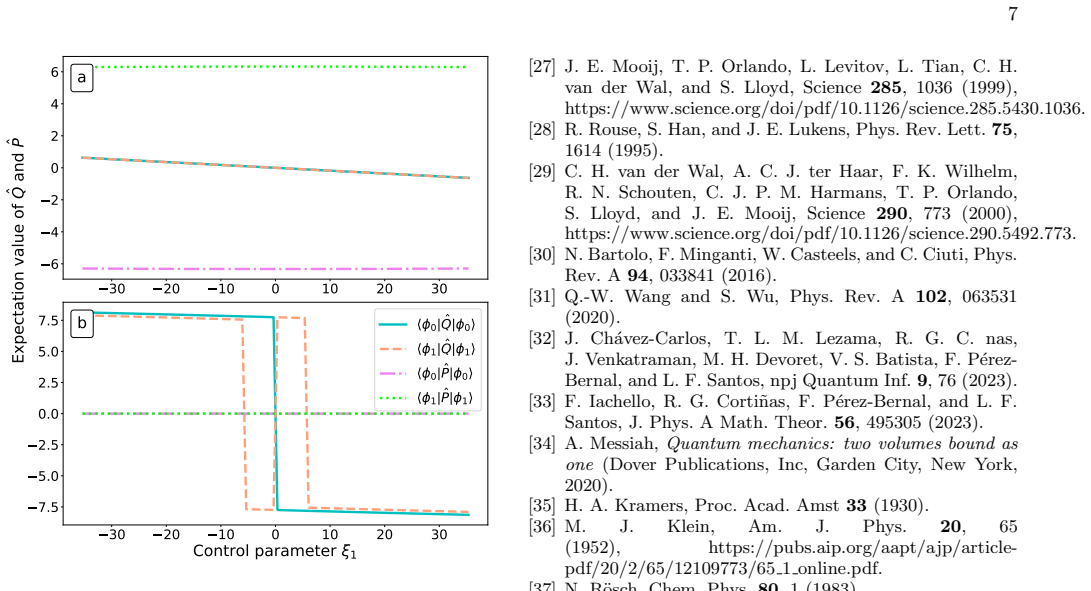
The results in panel (c) have a stark contrast with the two non-symmetric curves observed in panel (d). However, the expectation value of ˆPin panel (d) is still symmetric even for a nonzeroξ 1 value, as expected from the classical limit analysis of the T-symmetric system. To grasp a better understanding of the different situ- ations we depict in Fig. 2(a...
-
[6]
for different values of the control parameterξ 2. In Fig. 3(a), we display the expectation value of the observable ˆQver- sus the state energy for eigenstates of Hamiltonian (1) withξ 1 =−30/ √ 2 and twoξ 2 values:ξ 2 =−40 (orange crosses) andξ 2 = 40 (blue points). In theξ 2 =−40 case, the expectation value only exhibits one branch that re- mains close t...
-
[7]
E. Wigner and H. Massey,Group Theory: And Its Ap- plication to the Quantum Mechanics of Atomic Spectra (Elsevier Science, 2013)
work page 2013
-
[8]
M. Hamermesh,Group Theory and Its Application to Physical Problems, Addison-Wesley series in physics (Addison-Wesley Publishing Company, 1962)
work page 1962
-
[9]
M. J. Lax,Symmetry principles in solid state and molec- ular physics(Wiley, New York, 1974)
work page 1974
- [10]
-
[11]
J. Schwichtenberg,Physics from Symmetry, Undergradu- ate Lecture Notes in Physics (Springer International Pub- lishing, 2015)
work page 2015
-
[12]
C. F. Wolfgang Ludwig,Symmetries in Physics: Group Theory Applied to Physical Problems(Springer Berlin, Heidelberg, Copyright InformationSpringer-Verlag Berlin Heidelberg 1996)
work page 1996
- [13]
-
[14]
V. Bargmann, Journal of Mathematical Physics5, 862 (1964), https://pubs.aip.org/aip/jmp/article- pdf/5/7/862/19154858/862 1 online.pdf
work page 1964
- [15]
-
[16]
L. D. Landau and E. M. Lifshits,Quantum Mechanics: Non-Relativistic Theory, Course of Theoretical Physics, Vol. v.3 (Butterworth-Heinemann, Oxford, 1991)
work page 1991
-
[17]
J. Khalouf-Rivera, Q. Wang, L. F. Santos, J.-E. Garc´ ıa- Ramos, M. Carvajal, and F. P´ erez-Bernal, Phys. Rev. A 109, 062219 (2024)
work page 2024
-
[18]
R. F. Bishop and A. Vourdas, Phys. Rev. A50, 4488 (1994)
work page 1994
-
[19]
S. Puri, S. Boutin, and A. Blais, npj Quantum Informa- tion3, 18 (2017)
work page 2017
- [20]
- [21]
- [22]
-
[23]
J. Venkatraman, X. Xiao, R. G. Corti˜ nas, A. Eickbusch, and M. H. Devoret, Phys. Rev. Lett.129, 100601 (2022)
work page 2022
-
[25]
J. Venkatraman, R. G. Cortinas, N. E. Frattini, X. Xiao, and M. H. Devoret, A driven quantum superconduct- ing circuit with multiple tunable degeneracies (2023), arXiv:2211.04605 [quant-ph]. 7 30 20 10 0 10 20 30 6 4 2 0 2 4 6 a 30 20 10 0 10 20 30 Control parameter 1 7.5 5.0 2.5 0.0 2.5 5.0 7.5 b 0|Q| 0 1|Q| 1 0|P| 0 1|P| 1 Expectation value of Q and P F...
-
[26]
G. Beaulieu, F. Minganti, S. Frasca, V. Savona, S. Fe- licetti, R. D. Candia, and P. Scarlino, Observation of first- and second-order dissipative phase transi- tions in a two-photon driven kerr resonator (2023), arXiv:2310.13636 [quant-ph]
-
[27]
S. Marti, U. von L¨ upke, O. Joshi, Y. Yang, M. Bild, A. Omahen, Y. Chu, and M. Fadel, Nat. Phys. https://doi.org/10.1038/s41567-024-02545-6 (2024)
- [28]
-
[29]
R. Dutta, D. G. A. Cabral, N. Lyu, N. P. Vu, Y. Wang, B. Allen, X. Dan, R. G. Corti˜ nas, P. Khazaei, M. Sch¨ afer, A. C. C. d. Albornoz, S. E. Smart, S. Nie, M. H. De- voret, D. A. Mazziotti, P. Narang, C. Wang, J. D. Whit- field, A. K. Wilson, H. P. Hendrickson, D. A. Lidar, F. P´ erez-Bernal, L. F. Santos, S. Kais, E. Geva, and V. S. Batista, J. Chem. ...
-
[30]
N. E. Frattini, R. G. Corti˜ nas, J. Venkatraman, X. Xiao, Q. Su, C. U. Lei, B. J. Chapman, V. R. Joshi, S. M. Girvin, R. J. Schoelkopf, S. Puri, and M. H. Devoret, Phys. Rev. X14, 031040 (2024)
work page 2024
- [31]
-
[32]
A. C. C. de Albornoz, R. G. Corti˜ nas, M. Sch¨ afer, N. E. Frattini, B. Allen, D. G. A. Cabral, P. E. Videla, P. Khaz- aei, E. Geva, V. S. Batista, and M. H. Devoret, Oscilla- tory dissipative tunneling in an asymmetric double-well potential (2024), arXiv:2409.13113 [quant-ph]
work page internal anchor Pith review Pith/arXiv arXiv 2024
-
[33]
J. E. Mooij, T. P. Orlando, L. Levitov, L. Tian, C. H. van der Wal, and S. Lloyd, Science285, 1036 (1999), https://www.science.org/doi/pdf/10.1126/science.285.5430.1036
- [34]
-
[35]
C. H. van der Wal, A. C. J. ter Haar, F. K. Wilhelm, R. N. Schouten, C. J. P. M. Harmans, T. P. Orlando, S. Lloyd, and J. E. Mooij, Science290, 773 (2000), https://www.science.org/doi/pdf/10.1126/science.290.5492.773
-
[36]
N. Bartolo, F. Minganti, W. Casteels, and C. Ciuti, Phys. Rev. A94, 033841 (2016)
work page 2016
- [37]
-
[38]
J. Ch´ avez-Carlos, T. L. M. Lezama, R. G. C. nas, J. Venkatraman, M. H. Devoret, V. S. Batista, F. P´ erez- Bernal, and L. F. Santos, npj Quantum Inf.9, 76 (2023)
work page 2023
-
[39]
F. Iachello, R. G. Corti˜ nas, F. P´ erez-Bernal, and L. F. Santos, J. Phys. A Math. Theor.56, 495305 (2023)
work page 2023
-
[40]
A. Messiah,Quantum mechanics: two volumes bound as one(Dover Publications, Inc, Garden City, New York, 2020)
work page 2020
-
[41]
H. A. Kramers, Proc. Acad. Amst33(1930)
work page 1930
-
[42]
M. J. Klein, Am. J. Phys.20, 65 (1952), https://pubs.aip.org/aapt/ajp/article- pdf/20/2/65/12109773/65 1 online.pdf
work page 1952
- [43]
-
[44]
L. Guo, M. Marthaler, and G. Sch¨ on, Phys. Rev. Lett. 111, 205303 (2013)
work page 2013
-
[45]
L. Guo, V. Peano, and F. Marquardt, Phys. Rev. B105, 094301 (2022)
work page 2022
- [46]
-
[47]
A. E. Kopaei, K. Sacha, and L. Guo, Phys. Rev. B107, 214302 (2023)
work page 2023
-
[48]
I. I. Geru,Time-Reversal Symmetry: Seven Time- Reversal Operators for Spin Containing Systems, 1st ed., Springer Tracts in Modern Physics, Vol. 281 (Springer Nature International Publishing, Cham, Switzerland,
-
[49]
Notice that the added term should combine both oper- ators. If we only added ˆQor ˆP, we would only break partially the parity symmetry and we would not obtain the desired results
-
[50]
W. R. Inc., Mathematica, Version 13.3, champaign, IL, 2024
work page 2024
-
[51]
M. H. Devoret and J. M. Martinis, Implementing qubits with superconducting integrated circuits, inExperimen- tal Aspects of Quantum Computing, edited by H. O. Everitt (Springer US, Boston, MA, 2005) pp. 163–203
work page 2005
-
[52]
M. H. Devoret and R. J. Schoelkopf, Science339, 1231930 (2013)
work page 2013
- [53]
- [54]
- [55]
-
[56]
A. Copetudo, C. Y. Fontaine, F. Valadares, and Y. Y. Gao, Applied Physics Letters124, 080502 (2024)
work page 2024
-
[57]
F. Iachello, C. V. Coane, and J. Venkatraman, J. Phys. A: Math. Theor.57, 415302 (2024)
work page 2024
- [58]
discussion (0)
Sign in with ORCID, Apple, or X to comment. Anyone can read and Pith papers without signing in.