Indirect forces in disc-planet interaction
Pith reviewed 2026-05-17 21:48 UTC · model grok-4.3
The pith
Indirect forces from stellar reflex motion affect surface density patterns and require inclusion for angular momentum conservation in disc-planet torques.
A machine-rendered reading of the paper's core claim, the machinery that carries it, and where it could break.
Core claim
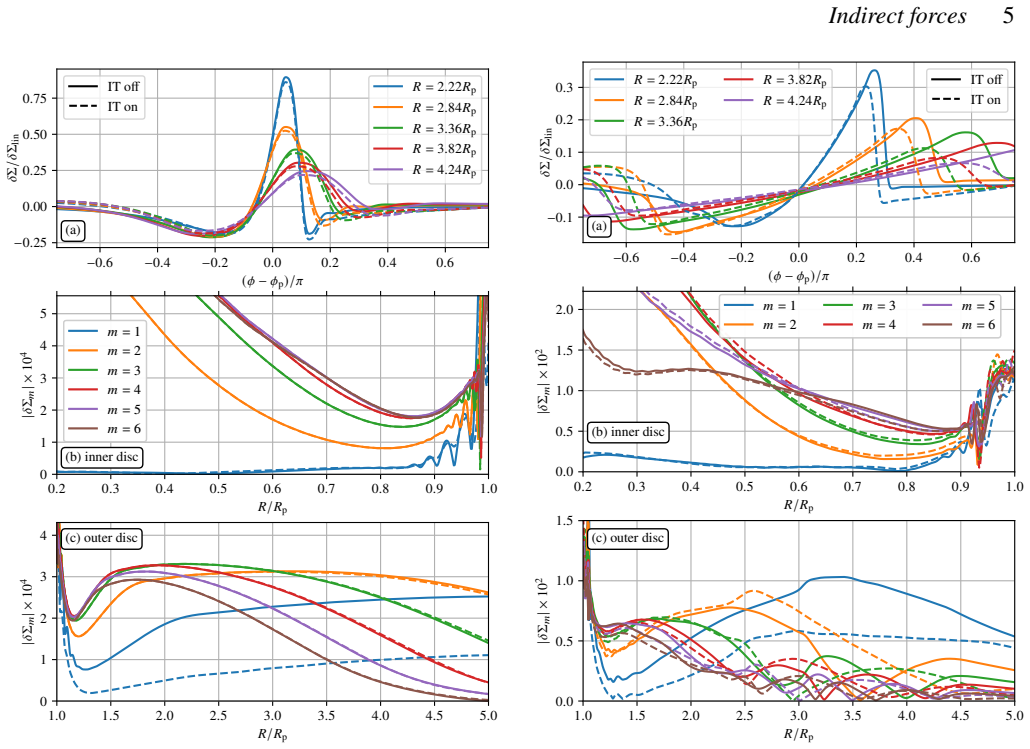
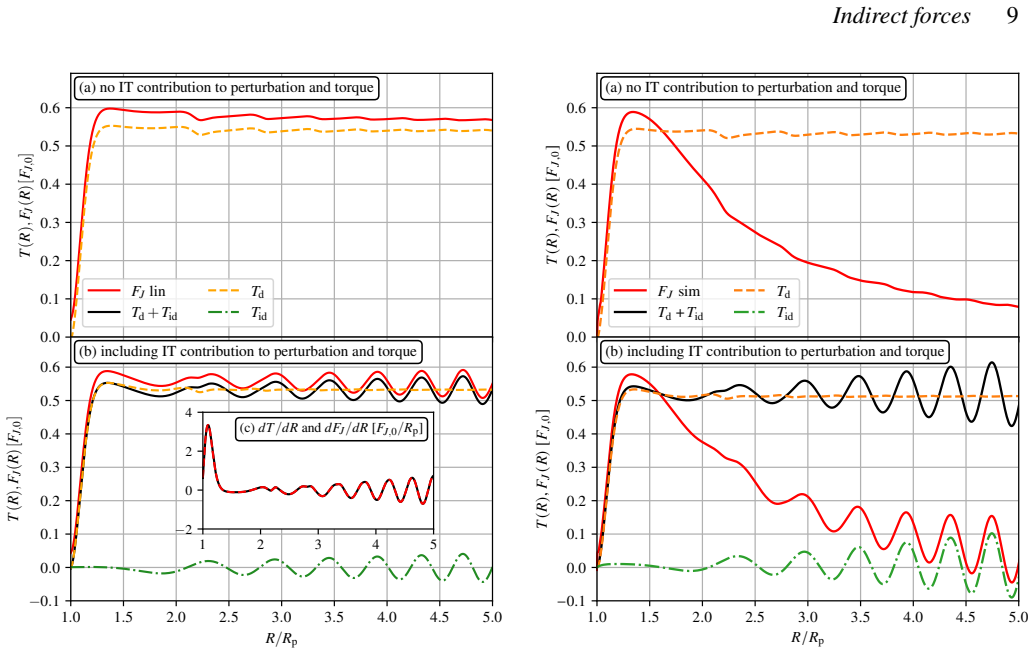
When indirect forces are neglected, the surface density perturbation differs primarily in its m=1 azimuthal harmonic for low-mass planets, with amplitude growing with distance from the star. Planetary torque and disc deposition torque density remain largely unaffected in the linear regime. For higher-mass planets, indirect forces impact a wider range of harmonics and have stronger effects on torque and Type II migration. Including the planetary indirect force is essential for the torque on the disc to conserve angular momentum.
What carries the argument
The planetary indirect force arising from the non-inertial frame due to stellar reflex motion, which ensures angular momentum conservation in torque calculations on the disc.
If this is right
- For low-mass planets, differences in surface density perturbation are confined to the m=1 azimuthal harmonic whose amplitude increases with radial distance.
- Both the torque exerted on the planet by the disc and the deposition torque density in the disc are only weakly affected by the omission of indirect forces in the linear regime.
- For higher-mass planets, indirect forces affect a broader range of azimuthal harmonics and exert stronger influence on planetary torque and Type II migration.
- Including the planetary indirect force when calculating the torque on the disc guarantees conservation of angular momentum carried by planet-driven density waves.
Where Pith is reading between the lines
- Simulations of planet-disc interactions that neglect indirect forces may still be reliable for low-mass planet migration rates but could introduce errors in disc evolution models.
- Observational signatures of disc gaps or spirals around higher-mass planets might differ if indirect forces are accounted for in interpretations.
- Extending this analysis to include disc viscosity or self-gravity could reveal how these interact with indirect forces in realistic protoplanetary discs.
Load-bearing premise
The analysis assumes that distinctions in linear regime and torque comparisons are not significantly altered by numerical resolution, boundary conditions, or unmodeled effects like viscosity and self-gravity.
What would settle it
A high-resolution simulation measuring the total torque on the disc with and without the planetary indirect force, checking whether angular momentum is conserved only when the indirect torque is included.
Figures




read the original abstract
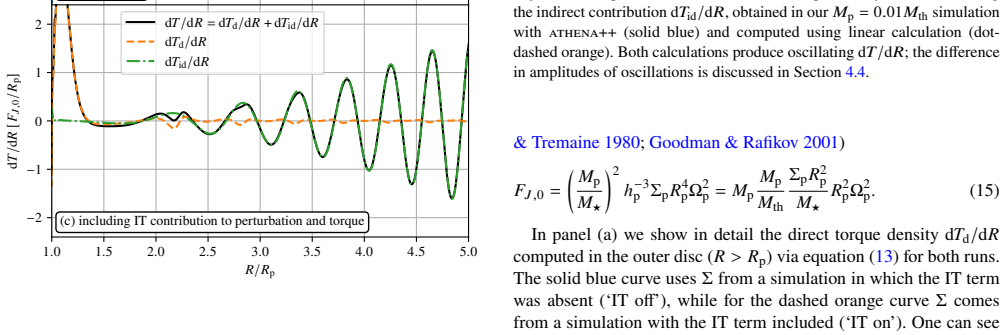
Gravitational coupling between a protoplanetary disc and an embedded planet is often studied in a frame attached to a central star. This frame is non-inertial because of the stellar reflex motion, leading to indirect forces arising in the star-planet-disc system. Here we examine the impact produced by these forces on several aspects of disc-planet coupling using analytical and numerical means. We explore how neglecting indirect forces changes (1) the spatial pattern of the surface density perturbation in the disc, (2) the calculation of the torque exerted on the disc by the planet, and (3) the torque on the planet exerted by the disc. For low-mass planets, in the linear regime, the differences in the perturbation pattern are only in its $m=1$ azimuthal harmonic, with an amplitude increasing with the distance from the star. In this regime both the torque on the planet and the deposition torque density in the disc are only weakly affected by non-inclusion of indirect forces, corroborating some results of studies neglecting indirect forces altogether. For higher mass planets, a broader range of azimuthal harmonics of the perturbation are affected. Also, indirect forces have a stronger effect on the planetary torque and on planet migration in the Type II regime. We highlight the importance of including the planetary indirect force in the calculation of the torque on the disc (if disc evolution accounts for indirect force) to ensure conservation of angular momentum carried by the planet-driven density waves. The corresponding indirect torque has an oscillatory, radially-diverging character.
Editorial analysis
A structured set of objections, weighed in public.
Referee Report
Summary. The manuscript examines the effects of indirect forces arising in the non-inertial frame attached to the central star on disc-planet gravitational coupling. Using analytical and numerical approaches, it reports that for low-mass planets in the linear regime, indirect forces alter primarily the m=1 azimuthal harmonic of the surface density perturbation (with amplitude increasing with radial distance), while planetary torque and disc deposition torque density remain only weakly affected. For higher-mass planets, a broader range of harmonics is impacted, producing stronger effects on torque and Type II migration. The work stresses that the planetary indirect force must be included when computing the torque exerted on the disc (if the disc evolution includes indirect forces) to ensure conservation of angular momentum carried by planet-driven density waves; this indirect torque is characterized as oscillatory and radially diverging.
Significance. If the central claims hold, the paper offers a useful regime-dependent clarification on when indirect forces can be neglected in protoplanetary disc simulations without compromising torque calculations or migration rates. The combination of analytical treatment of the m=1 mode with numerical verification of torque differences provides concrete guidance for modelers, particularly highlighting the necessity of proper force accounting for angular momentum conservation in the Type II regime. This could help standardize practices in the field and reduce systematic errors in long-term disc evolution studies.
major comments (2)
- [Abstract and torque analysis] Abstract and torque conservation discussion: The indirect torque is stated to possess an 'oscillatory, radially-diverging character' whose inclusion is required for angular momentum conservation. Given this radial divergence, the integrated contribution over a finite computational domain with typical wave-damping or open outer boundaries may depend on domain size or boundary implementation. Please supply an explicit test (e.g., comparison of net integrated torque for two different outer radii) or analytic argument demonstrating that the cumulative indirect torque remains finite and independent of the outer boundary, as this is load-bearing for the conservation result.
- [Numerical methods and results] Numerical methods and results sections: The distinction between linear-regime (weak torque effect) and higher-mass (stronger torque and migration effect) outcomes relies on simulation data, yet no resolution tests, convergence checks, or quantitative error estimates are referenced. This is especially pertinent for claims that torque differences are 'only weakly affected' in the linear case versus 'stronger' at higher masses, as numerical artifacts could contaminate the regime separation.
minor comments (2)
- [Abstract] Abstract: The phrase 'corroborating some results of studies neglecting indirect forces altogether' would benefit from a specific citation to those prior works for clarity.
- [Figures] Figure captions and text: Ensure all torque density plots explicitly label the with/without indirect force cases and include radial extent of the domain to allow readers to assess the diverging character directly.
Simulated Author's Rebuttal
We thank the referee for their careful and constructive review of our manuscript on indirect forces in disc-planet interactions. We address each major comment below in detail and will revise the manuscript accordingly to incorporate additional tests and clarifications that strengthen the presentation of our results.
read point-by-point responses
-
Referee: Abstract and torque conservation discussion: The indirect torque is stated to possess an 'oscillatory, radially-diverging character' whose inclusion is required for angular momentum conservation. Given this radial divergence, the integrated contribution over a finite computational domain with typical wave-damping or open outer boundaries may depend on domain size or boundary implementation. Please supply an explicit test (e.g., comparison of net integrated torque for two different outer radii) or analytic argument demonstrating that the cumulative indirect torque remains finite and independent of the outer boundary, as this is load-bearing for the conservation result.
Authors: We agree that an explicit demonstration of boundary independence is important to support the angular momentum conservation argument. Our analytical analysis shows that the indirect torque density is oscillatory with a radial dependence that permits cancellations upon integration. In the revised manuscript we will add both a concise analytic derivation establishing that the cumulative indirect torque converges to a finite, domain-size-independent value (due to the oscillatory cancellation dominating over the radial growth) and a numerical test comparing the net integrated indirect torque for two different outer radii (with identical wave-damping zones). These additions will confirm that the conservation result holds robustly within standard computational setups. revision: yes
-
Referee: Numerical methods and results sections: The distinction between linear-regime (weak torque effect) and higher-mass (stronger torque and migration effect) outcomes relies on simulation data, yet no resolution tests, convergence checks, or quantitative error estimates are referenced. This is especially pertinent for claims that torque differences are 'only weakly affected' in the linear case versus 'stronger' at higher masses, as numerical artifacts could contaminate the regime separation.
Authors: We acknowledge that the current manuscript does not present explicit resolution or convergence tests. The simulations were performed at standard resolutions used in the field for these problems, and the reported regime-dependent differences are consistent with the transition from linear to nonlinear dynamics. To address the referee's valid concern and rule out numerical contamination, we will include a new subsection in the revised manuscript with convergence checks. This will report planetary and disc torques at multiple grid resolutions for both the low-mass linear case and the higher-mass case, together with quantitative error estimates showing that the weak versus stronger effects exceed numerical uncertainties. revision: yes
Circularity Check
No significant circularity; derivation self-contained via standard mechanics
full rationale
The paper examines indirect forces using analytical derivations from non-inertial frame mechanics and numerical simulations. No equations, torque calculations, or conservation statements reduce by construction to fitted inputs, self-citations, or prior ansatzes from the same authors. The m=1 harmonic distinction, torque comparisons, and angular momentum conservation argument follow directly from the physical inclusion of stellar reflex motion without tautological redefinition. Claims rest on external numerical verification and standard gravitational coupling, making the derivation independent of its own outputs.
Axiom & Free-Parameter Ledger
axioms (1)
- domain assumption The reference frame attached to the central star is non-inertial because of stellar reflex motion induced by the planet.
Forward citations
Cited by 2 Pith papers
-
$\alpha\beta q_\mathrm{th}$-mapping of planet-induced density wave damping in protoplanetary discs
Nonlinear shock formation dominates angular momentum deposition from planet-induced density waves, cooling matches it for sub-thermal planets, and viscosity only matters at unrealistically high values.
-
Conservation laws in non-inertial frames and non-conservation of energy of relative motion in two-body problem
Redefining indirect acceleration to be uniform across bodies in non-inertial frames shows that energy of relative motion is not conserved due to work done by the indirect force.
Reference graph
Works this paper leans on
-
[1]
M., 2018, MNRAS, 475, 3201 Baruteau C., Masset F., 2008, ApJ, 672, 1054 Bate M
Arzamasskiy L., Zhu Z., Stone J. M., 2018, MNRAS, 475, 3201 Baruteau C., Masset F., 2008, ApJ, 672, 1054 Bate M. R., Lubow S. H., Ogilvie G. I., Miller K. A., 2003, MNRAS, 341, 213 Brown J. J., Ogilvie G. I., 2025, arXiv e-prints, p. arXiv:2510.24839 Cimerman N. P., Rafikov R. R., 2021, MNRAS, 508, 2329 Cimerman N. P., Rafikov R. R., 2023, MNRAS, 519, 208...
-
[2]
Notethattheshapeofthewaveinthe(𝑅, 𝜙)planeisirrelevant,since |𝛿Σ 𝑚 (𝑅)|does not depend on𝜙0 (𝑅)
As the profile width𝑤(𝑅)increases with𝑅, 𝛿Σ𝑚 must exhibit radial oscillations with higher (radial) frequency forhigher𝑚.For𝑚𝑤𝑧 0 ≫1,𝜓 0 →𝜋/2andthenullsof𝛿Σ 𝑚 would lie at radii where𝑚𝑤(𝑅)𝑧 0 =𝜋(𝑘+1/2), with𝑘being an integer. Notethattheshapeofthewaveinthe(𝑅, 𝜙)planeisirrelevant,since |𝛿Σ 𝑚 (𝑅)|does not depend on𝜙0 (𝑅). We illustrate this behavior in Figur...
work page 2025
-
[3]
with 𝑏 (𝑚) 1/2 (𝛼)= 1 𝜋 2𝜋∫ 0 cos(𝑚𝜃)d𝜃 (1+𝛼 2 −2𝛼cos𝜃) 1/2 (B5) being the Laplace coefficients (e.g. Murray & Dermott 1999), equa- tion (B3) becomes d𝑇d (𝑅) d𝑅 =𝜋𝐺 𝑀 p𝛼𝜁 ∞∑︁ 𝑚=1 𝑚 𝑏 (𝑚) 1/2 (𝛼)Σ 𝑠 𝑚 (𝑅) =−2𝜋𝐺 𝑀 p𝛼𝜁 ∞∑︁ 𝑚=1 𝑚 𝑏 (𝑚) 1/2 (𝛼)ImΣ 𝑚 (𝑅).(B6) Here we introduced an indicator exponent𝜁= Θ(𝑅 p −𝑅)with Θ(𝑧)beingtheHeavysidestep-function,makingtheex...
work page 1999
-
[4]
Thus, in this case we assign the full indirect torque due to the disc to𝑇L,id
for the lack of corotation torque in a𝑝=1.5disc, which has no vortensity gradient. Thus, in this case we assign the full indirect torque due to the disc to𝑇L,id. Figure C1 also clearly shows that in the framework of our linear calculationtheinnerdiscprovidesessentiallynocontributionto𝑇 p,id, consistent with analytical expectations. Indeed,𝑇p,id is determi...
work page 2025
-
[5]
and can again be traced to the global structure of the𝑚=1perturbation in the disc (see Figure 1). C2 Direct𝑚=1Lindblad torque𝑇 L,d Next,wedemonstratehowtoobtainanalyticalestimatesof𝑇 L,id and 𝑇L,d by separating the Lindblad torque into the indirect and direct components.Wedothisforadiscwith𝑝=1.5,forwhichthereisno ambiguity in separating the torque into th...
work page 2012
-
[6]
This is in agreement with the classical theory (Goldreich & Tremaine 1979,
throughΣ p and enable comparison in Figure C2) and𝑅L =𝑅 1 = 22/3𝑅p, we obtain 𝑇L,d ≈3.78𝐹 𝐽 ,0ℎ3 p ,(C3) which is independent ofℎp, in lieu of the definition (15). This is in agreement with the classical theory (Goldreich & Tremaine 1979,
work page 1979
-
[7]
predicting that the torque excited at an individual Lindblad resonance should be independent of𝑐s andℎ p. C3 Indirect Lindblad torque𝑇L,id To find𝑇 L,id we cannot use the symmetry property of the direct torques that we exploited for computing𝑇L,d, see the discussion around equations (31) and (32). Instead, we note that our equation (36)looksidenticaltothe...
work page 1979
discussion (0)
Sign in with ORCID, Apple, or X to comment. Anyone can read and Pith papers without signing in.