Recognition: 2 theorem links
· Lean TheoremNew Ground State in {}¹⁴⁹La Removes Two-Neutron-Separation-Energy Anomaly in Lanthanum Isotopes
Pith reviewed 2026-05-17 22:47 UTC · model grok-4.3
The pith
A lighter ground state in 149La removes the two-neutron separation energy anomaly in lanthanum isotopes.
A machine-rendered reading of the paper's core claim, the machinery that carries it, and where it could break.
Core claim
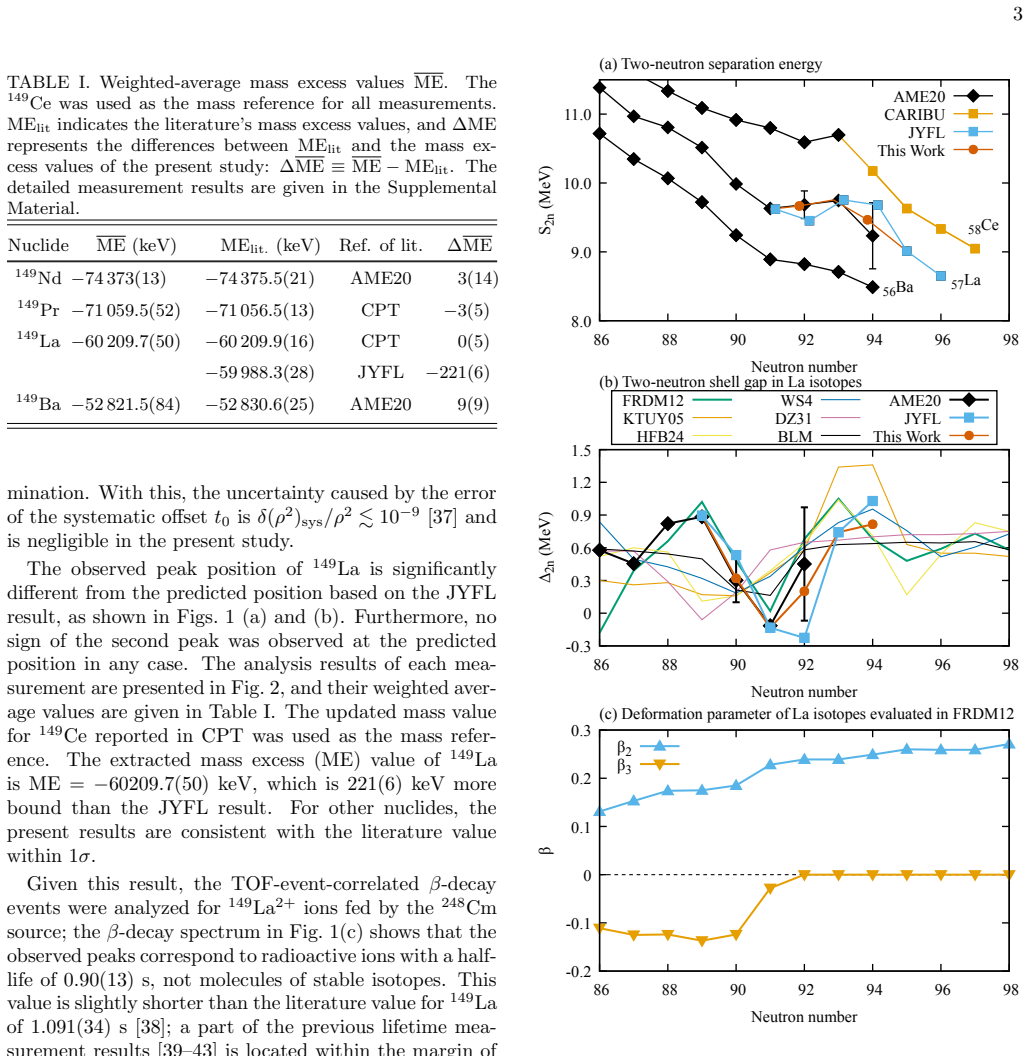
The peak corresponding to a beta-decaying state was observed in the time-of-flight spectra at a position of 221(6) keV/c² lighter than the reported 149La mass in one study but agrees with the other measurement. This peak is concluded to be the ground state of 149La. With this identification the previously reported distinct prominence in the two-neutron separation energies disappears, while a new kink structure similar to that in the cerium isotopes appears. Comparison with theoretical models suggests that a nuclear shape transition from octupole deformation to another type of deformation occurs around N=91.
What carries the argument
Multi-reflection time-of-flight mass spectrograph combined with a β-TOF detector for simultaneous mass-lifetime measurement that distinguishes the ground state from possible isomers.
Load-bearing premise
The observed beta-decaying peak at 221 keV lighter is the true ground state of 149La rather than a long-lived isomer, and earlier mass differences arose from systematic experimental variations.
What would settle it
An independent experiment that measures the 149La ground-state mass significantly heavier than this value or identifies an even lower-lying state with inconsistent decay properties would falsify the ground-state assignment.
Figures


read the original abstract
Nuclear mass is a key indicator of how the nuclear shell structure evolves. The recent mass measurement study of neutron-rich lanthanum isotopes [A. Jaries, $et~al$., Phys. Rev. Lett. {\bf 134}, 042501(2025)] reveals the presence of a distinct prominence in their two-neutron separation energies. However, its presence has been called into question based on the results of another mass determination [B. Liu, Ph.D. thesis, University of Notre Dame (2025)]. In this letter, we report an effort to clarify these contradictory results through the use of the simultaneous mass-lifetime measurement of the neutron-rich lanthanum isotope ${}^{149}$La using a multi-reflection time-of-flight mass spectrograph combined with a $\beta$-TOF detector. The peak corresponding to a $\beta$-decaying state was observed in the time-of-flight spectra at a position of $221(6)~{\rm keV/c^2}$ lighter than the reported ${}^{149}$La mass in A. Jaries, $et~al$., but our measured result is in excellent agreement with the mass value reported in B. Liu. We have concluded that this peak is the ground state of ${}^{149}$La. With this, the previously reported distinct prominence in the two-neutron separation energies disappears, while a new kink structure, similar to that in the cerium isotopes, appears. Comparison with theoretical models suggests that a nuclear shape transition from octupole deformation to another type of deformation occurs around $N=91$ and is likely the cause of this kink structure.
Editorial analysis
A structured set of objections, weighed in public.
Referee Report
Summary. The manuscript reports a new mass measurement of neutron-rich 149La using a multi-reflection time-of-flight mass spectrograph combined with a β-TOF detector. A β-decaying peak is observed at a position 221(6) keV/c² lighter than the value from Jaries et al. (Phys. Rev. Lett. 134, 042501, 2025), in agreement with the mass from Liu's 2025 thesis. The authors conclude this peak is the ground state of 149La, which removes the reported prominence in two-neutron separation energies for La isotopes and instead reveals a new kink structure around N=91, interpreted as a nuclear shape transition from octupole deformation.
Significance. If the ground-state assignment holds, the result resolves a recent discrepancy between two mass measurements of 149La and clarifies the evolution of shell structure and deformation in the neutron-rich lanthanum region. The appearance of a kink similar to that in cerium isotopes provides new experimental input on shape transitions near N=91, with potential implications for nuclear models of octupole and other deformations. The simultaneous mass-lifetime technique is a methodological strength that directly ties the observed state to β decay.
major comments (2)
- [Results section describing the TOF peak and ground-state conclusion] The central claim that the observed β-decaying TOF peak is the ground state (rather than a long-lived isomer) rests on its mass agreement with the Liu thesis and the fact that it is β-decaying. However, the manuscript provides no explicit excitation-energy upper limits, gamma-ray coincidence data, or decay-scheme constraints demonstrating the absence of a lower-lying state. This assignment is load-bearing for the conclusion that the S2n prominence disappears and a new kink appears.
- [Discussion and comparison with theoretical models] The interpretation of the new kink in S2n as evidence for a shape transition from octupole deformation around N=91 is presented qualitatively. The manuscript should specify which theoretical models were compared, their key parameters, and quantitative measures of agreement (e.g., rms deviations or predicted vs. observed kink positions) to support the claim.
minor comments (2)
- [Experimental method and data analysis] The abstract states the peak is '221(6) keV/c² lighter' but the full uncertainty budget (statistical vs. systematic contributions from TOF calibration, magnetic field stability, and isomer discrimination) is not detailed in the visible text; this should be expanded for reproducibility.
- [Figures and captions] Figure captions for the TOF spectra should explicitly label the reference ions used for calibration and indicate the time window for β coincidence to aid reader assessment of background and peak fitting.
Simulated Author's Rebuttal
We thank the referee for the careful and constructive review. We appreciate the recognition of the significance of our mass measurement in resolving the discrepancy for 149La and clarifying the S2n behavior near N=91. We address the major comments point by point below, indicating the revisions we will make to strengthen the manuscript.
read point-by-point responses
-
Referee: [Results section describing the TOF peak and ground-state conclusion] The central claim that the observed β-decaying TOF peak is the ground state (rather than a long-lived isomer) rests on its mass agreement with the Liu thesis and the fact that it is β-decaying. However, the manuscript provides no explicit excitation-energy upper limits, gamma-ray coincidence data, or decay-scheme constraints demonstrating the absence of a lower-lying state. This assignment is load-bearing for the conclusion that the S2n prominence disappears and a new kink appears.
Authors: We agree that a clearer justification of the ground-state assignment is warranted. The conclusion rests on the single β-decaying TOF peak appearing 221(6) keV/c² below the Jaries et al. value and in agreement with the independent Liu thesis result, with no additional lower-mass peaks observed in the β-gated spectra. While gamma-ray coincidence data were not collected in this mass-spectroscopy experiment, the simultaneous mass-lifetime technique directly associates the observed state with β decay. In the revised manuscript we will add a dedicated paragraph in the Results section that discusses the isomer possibility, notes the non-observation of any lower-lying state within the achieved mass resolution, and provides an implied upper limit on excitation energy derived from that resolution and the absence of other peaks. This constitutes a partial revision focused on improved presentation rather than new data. revision: partial
-
Referee: [Discussion and comparison with theoretical models] The interpretation of the new kink in S2n as evidence for a shape transition from octupole deformation around N=91 is presented qualitatively. The manuscript should specify which theoretical models were compared, their key parameters, and quantitative measures of agreement (e.g., rms deviations or predicted vs. observed kink positions) to support the claim.
Authors: We thank the referee for this recommendation. The current Discussion compares the experimental S2n trend with theoretical calculations that incorporate octupole degrees of freedom and shows that the kink near N=91 is consistent with a transition away from octupole deformation. To make this more rigorous, we will revise the Discussion to name the specific models employed, list the relevant parameters (including the octupole deformation strength), and add quantitative metrics such as the rms deviation between measured and calculated S2n values in the N=88–94 region together with the predicted versus observed kink position. These additions will be included in the next version of the manuscript. revision: yes
Circularity Check
No circularity: direct experimental mass measurement with independent evidence
full rationale
This is a direct experimental report of a multi-reflection time-of-flight mass measurement combined with beta coincidence detection. The central claim—that the observed beta-decaying peak at 221(6) keV/c² below the Jaries value is the 149La ground state—rests on the measured TOF position agreeing with the independent Liu thesis mass value and on the beta-decay signature. No equations, fitted parameters, or derivations are presented; the result does not reduce to any self-referential definition, renamed empirical pattern, or self-citation chain. The paper is self-contained against external benchmarks (prior mass values) and contains no load-bearing theoretical steps that could exhibit circularity.
Axiom & Free-Parameter Ledger
axioms (1)
- domain assumption Standard assumptions in multi-reflection time-of-flight mass spectrometry for ion identification and calibration hold.
Lean theorems connected to this paper
-
IndisputableMonolith/Foundation/RealityFromDistinction.leanreality_from_one_distinction unclear?
unclearRelation between the paper passage and the cited Recognition theorem.
The peak corresponding to a β-decaying state was observed ... at a position of 221(6) keV/c² lighter than the reported 149La mass ... We have concluded that this peak is the ground state of 149La. With this, the previously reported distinct prominence in the two-neutron separation energies disappears, while a new kink structure ... appears.
-
IndisputableMonolith/Cost/FunctionalEquation.leanwashburn_uniqueness_aczel unclear?
unclearRelation between the paper passage and the cited Recognition theorem.
Comparison with theoretical models suggests that a nuclear shape transition from octupole deformation to another type of deformation occurs around N=91
What do these tags mean?
- matches
- The paper's claim is directly supported by a theorem in the formal canon.
- supports
- The theorem supports part of the paper's argument, but the paper may add assumptions or extra steps.
- extends
- The paper goes beyond the formal theorem; the theorem is a base layer rather than the whole result.
- uses
- The paper appears to rely on the theorem as machinery.
- contradicts
- The paper's claim conflicts with a theorem or certificate in the canon.
- unclear
- Pith found a possible connection, but the passage is too broad, indirect, or ambiguous to say the theorem truly supports the claim.
Reference graph
Works this paper leans on
-
[1]
New Ground State in ${}^{149}$La Removes Two-Neutron-Separation-Energy Anomaly in Lanthanum Isotopes
(hereafter denoted as “JYFL”); this study reveals the presence of a prominent bump in theS 2n plot of the neutron-rich lanthanum isotope series. The authors claimed that this prominence is unlike that in the cerium isotope series, and the evolution inS 2n fromN= 94 to 95 is the strongest change in the chart of nuclides in the region away from shell closur...
work page internal anchor Pith review Pith/arXiv arXiv 2025
- [2]
-
[3]
F. Wienholtz, D. Beck, K. Blaum, C. Borgmann, M. Breitenfeldt, R. B. Cakirli, S. George, F. Her- furth, J. D. Holt, M. Kowalska, S. Kreim, D. Lunney, 5 V. Manea, J. Men´ endez, D. Neidherr, M. Rosenbusch, L. Schweikhard, A. Schwenk, J. Simonis, J. Stanja, R. N. Wolf, and K. Zuber, Nature498, 346 (2013)
work page 2013
-
[4]
A. Huck, G. Klotz, A. Knipper, C. Mieh´ e, C. Richard- Serre, G. Walter, A. Poves, H. L. Ravn, and G. Marguier, Phys. Rev. C31, 2226 (1985)
work page 1985
-
[5]
M. Rosenbusch, P. Ascher, D. Atanasov, C. Barbieri, D. Beck, K. Blaum, C. Borgmann, M. Breitenfeldt, R. B. Cakirli, A. Cipollone, S. George, F. Herfurth, M. Kowal- ska, S. Kreim, D. Lunney, V. Manea, P. Navr´ atil, D. Nei- dherr, L. Schweikhard, V. Som` a, J. Stanja, F. Wienholtz, R. N. Wolf, and K. Zuber, Phys. Rev. Lett.114, 202501 (2015)
work page 2015
-
[6]
S. Michimasa, M. Kobayashi, Y. Kiyokawa, S. Ota, D. S. Ahn, H. Baba, G. P. A. Berg, M. Dozono, N. Fukuda, T. Furuno, E. Ideguchi, N. Inabe, T. Kawabata, S. Kawase, K. Kisamori, K. Kobayashi, T. Kubo, Y. Kub- ota, C. S. Lee, M. Matsushita, H. Miya, A. Mizukami, H. Nagakura, D. Nishimura, H. Oikawa, H. Sakai, Y. Shimizu, A. Stolz, H. Suzuki, M. Takaki, H. T...
work page 2018
-
[7]
Z. Meisel, S. George, S. Ahn, D. Bazin, B. A. Brown, J. Browne, J. F. Carpino, H. Chung, R. H. Cyburt, A. Estrad´ e, M. Famiano, A. Gade, C. Langer, M. Matoˇ s, W. Mittig, F. Montes, D. J. Morrissey, J. Pereira, H. Schatz, J. Schatz, M. Scott, D. Shapira, K. Smith, J. Stevens, W. Tan, O. Tarasov, S. Towers, K. Wimmer, J. R. Winkelbauer, J. Yurkon, and R. ...
work page 2020
-
[8]
E. Leistenschneider, E. Dunling, G. Bollen, B. A. Brown, J. Dilling, A. Hamaker, J. D. Holt, A. Jacobs, A. A. Kwiatkowski, T. Miyagi, W. S. Porter, D. Puentes, M. Redshaw, M. P. Reiter, R. Ringle, R. Sandler, C. S. Sumithrarachchi, A. A. Valverde, and I. T. Yandow (The LEBIT Collaboration and the TITAN Collaboration), Phys. Rev. Lett.126, 042501 (2021)
work page 2021
-
[9]
S. Michimasa, M. Kobayashi, Y. Kiyokawa, S. Ota, R. Yokoyama, D. Nishimura, D. S. Ahn, H. Baba, G. P. A. Berg, M. Dozono, N. Fukuda, T. Furuno, E. Ideguchi, N. Inabe, T. Kawabata, S. Kawase, K. Kisamori, K. Kobayashi, T. Kubo, Y. Kubota, C. S. Lee, M. Matsushita, H. Miya, A. Mizukami, H. Na- gakura, H. Oikawa, H. Sakai, Y. Shimizu, A. Stolz, H. Suzuki, M....
work page 2020
-
[10]
S. Iimura, M. Rosenbusch, A. Takamine, Y. Tsunoda, M. Wada, S. Chen, D. S. Hou, W. Xian, H. Ishiyama, S. Yan, P. Schury, H. Crawford, P. Doornenbal, Y. Hi- rayama, Y. Ito, S. Kimura, T. Koiwai, T. M. Kojima, H. Koura, J. Lee, J. Liu, S. Michimasa, H. Miyatake, J. Y. Moon, S. Naimi, S. Nishimura, T. Niwase, A. Oda- hara, T. Otsuka, S. Paschalis, M. Petri, ...
work page 2023
-
[11]
S. Rinta-Antila, S. Kopecky, V. S. Kolhinen, J. Hakala, J. Huikari, A. Jokinen, A. Nieminen, J. ¨Ayst¨ o, and J. Sz- erypo, Phys. Rev. C70, 011301 (2004)
work page 2004
- [12]
-
[13]
S. Rahaman, U. Hager, V.-V. Elomaa, T. Eronen, J. Hakala, A. Jokinen, A. Kankainen, P. Karvonen, I. D. Moore, H. Penttil¨ a, S. Rinta-Antila, J. Rissanen, A. Saas- tamoinen, T. Sonoda, and J. ¨Ayst¨ o, The European Phys- ical Journal A32, 87 (2007)
work page 2007
- [14]
-
[15]
V. V. Simon, T. Brunner, U. Chowdhury, B. Eberhardt, S. Ettenauer, A. T. Gallant, E. Man´ e, M. C. Simon, P. Delheij, M. R. Pearson, G. Audi, G. Gwinner, D. Lun- ney, H. Schatz, and J. Dilling, Phys. Rev. C85, 064308 (2012)
work page 2012
-
[16]
R. Klawitter, A. Bader, M. Brodeur, U. Chowdhury, A. Chaudhuri, J. Fallis, A. T. Gallant, A. Grossheim, A. A. Kwiatkowski, D. Lascar, K. G. Leach, A. Lennarz, T. D. Macdonald, J. Pearkes, S. Seeraji, M. C. Simon, V. V. Simon, B. E. Schultz, and J. Dilling, Phys. Rev. C 93, 045807 (2016)
work page 2016
-
[17]
D. Lunney, V. Manea, M. Mougeot, L. Nies, N. A. Althubiti, D. Atanasov, K. Blaum, A. Herlert, W.-J. Huang, J. Karthein, I. Kulikov, Y. A. Litvinov, D. Neid- herr, T. R. Rodr´ ıguez, M. Rosenbusch, L. Schweikhard, T. Steinsberger, A. Welker, F. Wienholtz, and R. N. Wolf, Phys. Rev. C112, 034307 (2025)
work page 2025
-
[18]
J. Van Schelt, D. Lascar, G. Savard, J. A. Clark, S. Cald- well, A. Chaudhuri, J. Fallis, J. P. Greene, A. F. Levand, G. Li, K. S. Sharma, M. G. Sternberg, T. Sun, and B. J. Zabransky, Phys. Rev. C85, 045805 (2012)
work page 2012
- [19]
- [20]
-
[21]
R. Orford, N. Vassh, J. A. Clark, G. C. McLaugh- lin, M. R. Mumpower, D. Ray, G. Savard, R. Surman, F. Buchinger, D. P. Burdette, M. T. Burkey, D. A. Gorelov, J. W. Klimes, W. S. Porter, K. S. Sharma, A. A. Valverde, L. Varriano, and X. L. Yan, Phys. Rev. C105, L052802 (2022)
work page 2022
- [22]
-
[23]
D. Ray, N. Vassh, B. Liu, A. A. Valverde, M. Brodeur, J. A. Clark, G. C. McLaughlin, M. R. Mumpower, R. Or- ford, W. S. Porter, G. Savard, K. S. Sharma, R. Surman, F. Buchinger, D. P. Burdette, N. Callahan, A. T. Gallant, D. E. M. Hoff, K. Kolos, F. G. Kondev, G. E. Morgan, F. Rivero, D. Santiago-Gonzalez, N. D. Scielzo, L. Var- riano, C. M. Weber, G. E. ...
-
[24]
A. Sp˘ ataru, G. Kripk´ o-Koncz, T. Dickel, C. Hornung, W. R. Plaß, P. Constantin, D. Amanbayev, S. Ayet San Andr´ es, D. L. Balabanski, S. Beck, J. Bergmann, H. Geissel, N. Kalantar-Nayestanaki, J. Kehat, I. Mar- dor, N. Minkov, A. Mollaebrahimi, C. Scheidenberger, M. Wasserheß, H. Wilsenach, and J. Zhao, Phys. Rev. C 6 111, 054307 (2025)
work page 2025
-
[25]
P. A. Butler, Journal of Physics G: Nuclear and Particle Physics43, 073002 (2016)
work page 2016
- [26]
- [27]
- [28]
-
[29]
¨Ayst¨ o, Nuclear Physics A693, 477 (2001)
J. ¨Ayst¨ o, Nuclear Physics A693, 477 (2001)
work page 2001
- [30]
-
[31]
T. Niwase, M. Wada, P. Schury, H. Haba, S. Ishizawa, Y. Ito, D. Kaji, S. Kimura, H. Miyatake, K. Morimoto, K. Morita, M. Rosenbusch, H. Wollnik, T. Shanley, and Y. Benari, Nuclear Instruments and Methods in Physics Research Section A: Accelerators, Spectrometers, Detec- tors and Associated Equipment953, 163198 (2020)
work page 2020
-
[32]
T. Niwase, W. Xian, M. Wada, M. Rosenbusch, S. Chen, A. Takamine, J. Liu, S. Iimura, D. Hou, S. Yan, H. Ishiyama, H. Miyatake, S. Nishimura, D. Kaji, K. Mo- rimoto, Y. Hirayama, Y. X. Watanabe, S. Kimura, P. Schury, and H. Wollnik, Progress of Theoretical and Experimental Physics2023, 031H01 (2023)
work page 2023
-
[33]
P. Schury, T. Niwase, M. Wada, P. Brionnet, S. Chen, T. Hashimoto, H. Haba, Y. Hirayama, D. S. Hou, S. Iimura, H. Ishiyama, S. Ishizawa, Y. Ito, D. Kaji, S. Kimura, H. Koura, J. J. Liu, H. Miyatake, J.-Y. Moon, K. Morimoto, K. Morita, D. Nagae, M. Rosenbusch, A. Takamine, Y. X. Watanabe, H. Wollnik, W. Xian, and S. X. Yan, Phys. Rev. C104, L021304 (2021)
work page 2021
-
[34]
T. Niwase, M. Wada, P. Schury, P. Brionnet, S. D. Chen, T. Hashimoto, H. Haba, Y. Hirayama, D. S. Hou, S. Iimura, H. Ishiyama, S. Ishizawa, Y. Ito, D. Kaji, S. Kimura, J. Liu, H. Miyatake, J. Y. Moon, K. Morimoto, K. Morita, D. Nagae, M. Rosenbusch, A. Takamine, T. Tanaka, Y. X. Watanabe, H. Woll- nik, W. Xian, and S. X. Yan, Phys. Rev. C104, 044617 (2021)
work page 2021
- [35]
- [36]
-
[37]
Y. Ito, P. Schury, M. Wada, S. Naimi, T. Sonoda, H. Mita, F. Arai, A. Takamine, K. Okada, A. Ozawa, and H. Wollnik, Phys. Rev. C88, 011306(R) (2013)
work page 2013
-
[38]
S. Kimura, Y. Ito, D. Kaji, P. Schury, M. Wada, H. Haba, T. Hashimoto, Y. Hirayama, M. MacCormick, H. Miy- atake, J. Y. Moon, K. Morimoto, M. Mukai, I. Mur- ray, A. Ozawa, M. Rosenbusch, H. Schatz, A. Takamine, T. Tanaka, Y. X. Watanabe, and H. Wollnik, High pre- cision mass measurements of intermediate-mass neutron- deficient nuclei via mrtof-ms, inProce...
work page 2021
-
[39]
Evaluated Nuclear Structure Data File
- [40]
-
[41]
R. A. Warner and P. L. Reeder, Radiation Effects94, 27 (1986)
work page 1986
-
[42]
P. L. Reeder, R. A. Warner, M. D. Edmiston, R. L. Gill, and A. Piotrowski, New delayed-neutron precursors from tristan (American Chemical Society, 1986) pp. 171–176, 0
work page 1986
-
[43]
G. Rudstam, K. Aleklett, and L. Sihver, Atomic Data and Nuclear Data Tables53, 1 (1993)
work page 1993
-
[44]
J. Wu, S. Nishimura, G. Lorusso, P. M¨ oller, E. Ideguchi, P.-H. Regan, G. S. Simpson, P.-A. S¨ oderstr¨ om, P. M. Walker, H. Watanabe, Z. Y. Xu, H. Baba, F. Browne, R. Daido, P. Doornenbal, Y. F. Fang, N. Fukuda, G. Gey, T. Isobe, Z. Korkulu, P. S. Lee, J. J. Liu, Z. Li, Z. Patel, V. Phong, S. Rice, H. Sakurai, L. Sin- clair, T. Sumikama, M. Tanaka, A. Y...
work page 2017
-
[45]
S. Agostinelliet al., Nuclear Instruments and Methods in Physics Research Section A: Accelerators, Spectrometers, Detectors and Associated Equipment506, 250 (2003)
work page 2003
-
[46]
P. M¨ oller, A. Sierk, T. Ichikawa, and H. Sagawa, Atomic Data and Nuclear Data Tables109-110, 1 (2016)
work page 2016
- [47]
- [48]
-
[49]
N. Wang, M. Liu, X. Wu, and J. Meng, Physics Letters B734, 215 (2014)
work page 2014
- [50]
-
[51]
Z. M. Niu and H. Z. Liang, Phys. Rev. C106, L021303 (2022)
work page 2022
- [52]
-
[53]
R. Lic˘ a, G. Benzoni, T. R. Rodr´ ıguez, M. J. G. Borge, L. M. Fraile, H. Mach, A. I. Morales, M. Madurga, C. O. Sotty, V. Vedia, H. De Witte, J. Benito, R. N. Bernard, T. Berry, A. Bracco, F. Camera, S. Ceruti, V. Charviakova, N. Cieplicka-Ory´ nczak, C. Costache, F. C. L. Crespi, J. Creswell, G. Fernandez-Mart´ ınez, H. Fynbo, P. T. Greenlees, I. Homm,...
work page 2018
-
[54]
A. Syntfeld, H. Mach, W. P l´ ociennik, W. Kurcewicz, and B. Fogelberg, The European Physical Journal A - Hadrons and Nuclei20, 359 (2004)
work page 2004
- [55]
-
[56]
A. Syntfeld, H. Mach, R. Kaczarowski, W. Kurcewicz, W. P l´ ociennik, W. Urban, B. Fogelberg, and P. Hoff, Nuclear Physics A710, 221 (2002). SUPPLEMENT AL MA TERIALS The measured square of the TOF ratioρ 2 of each mea- surement is tabulated in Table II. 8 TABLE II. Measured square of time-of-flight ratioρ 2 and the extracted mass excess values ME. The ion...
work page 2002
discussion (0)
Sign in with ORCID, Apple, or X to comment. Anyone can read and Pith papers without signing in.