Self-gravitating baryonic tubes supported by π- and ω-mesons and its flat limit
Pith reviewed 2026-05-17 22:13 UTC · model grok-4.3
The pith
Self-gravitating baryonic tubes exist for arbitrary N in the SU(N) Einstein non-linear sigma model with omega mesons, and binding energy decreases as the number of flavors rises.
A machine-rendered reading of the paper's core claim, the machinery that carries it, and where it could break.
Core claim
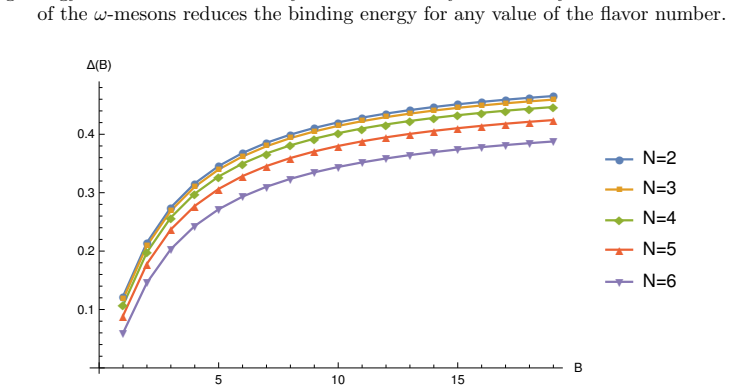
By employing the maximal embedding Ansatz of SU(2) into SU(N) in the exponential representation, regular self-gravitating baryonic tubes free of curvature singularities are constructed in the Einstein non-linear sigma model coupled to omega-vector mesons for arbitrary N. The topological charge scales proportionally to N and is identified with the baryon number. In the flat-space limit, corresponding to an array of baryonic tubes within a finite volume, the total energy of the solitons is an increasing function of N while the binding energy decreases as the number of flavors increases.
What carries the argument
The maximal embedding Ansatz of SU(2) into SU(N) in the exponential representation, which reduces the SU(N) fields to an effective SU(2) problem while multiplying the topological charge by N.
If this is right
- Topological charge of each tube scales linearly with the number of flavors N.
- Regular solutions without curvature singularities exist for every positive integer N.
- In the flat-space limit the total energy of the finite-volume tube array grows with N.
- Binding energy per unit topological charge falls as N increases.
- Inclusion of more than two flavors improves the model's physical predictions.
Where Pith is reading between the lines
- The flat-space array provides a controlled setup for studying dense baryonic matter in a box, which could be compared with finite-density calculations in related models.
- The trend of decreasing binding energy supplies a concrete reason to explore whether multi-flavor versions yield better matches to observed nuclear binding energies.
Load-bearing premise
The maximal embedding Ansatz remains valid and produces regular, singularity-free solutions for arbitrary N, with the topological charge directly identifiable as physical baryon number.
What would settle it
Numerical construction of a solution for some N greater than 2 that develops a curvature singularity, or computation showing that binding energy stops decreasing and begins to rise with further increase in N.
Figures


read the original abstract
In this paper, we construct self-gravitating topological solitons in the $SU(N)$ Einstein non-linear sigma model coupled to $\omega$-vector mesons in four space-time dimensions. These solutions represent tube-like configurations free of curvature singularities, carrying a non-vanishing topological charge that is identified as the baryon number. We show that by employing the maximal embedding Ansatz of $SU(2)$ into $SU(N)$ in the exponential representation, these tubes can be constructed for an arbitrary number of flavors, $N$, with the topological charge scaling proportionally to this number. The flat-space limit of the solutions, corresponding to an array of baryonic tubes within a finite volume, is analyzed in detail. Remarkably, while the total energy of the solitons at a finite volume is an increasing function of $N$, the binding energy decreases as the number of flavors increases. This analysis reaffirms that the inclusion of more than two flavors to the model systematically improves the physical predictions.
Editorial analysis
A structured set of objections, weighed in public.
Referee Report
Summary. The manuscript constructs self-gravitating topological solitons in the SU(N) Einstein non-linear sigma model coupled to ω-vector mesons in four dimensions. Using the maximal embedding Ansatz of SU(2) into SU(N) in the exponential representation, regular tube-like solutions free of curvature singularities are obtained for arbitrary N, with topological charge scaling proportionally to N and identified with baryon number. The flat-space limit is analyzed in detail, showing that total energy increases with N while binding energy decreases.
Significance. If the regularity and scaling claims hold under explicit verification, the work offers a systematic extension of baryonic soliton models to arbitrary flavor number in a gravitational setting. The flat-limit analysis of finite-volume tube arrays provides a concrete framework for studying multi-baryon configurations, and the reported improvement in binding energy with N could inform effective descriptions of dense matter.
major comments (3)
- [§3] §3 (Ansatz reduction): The central claim that the maximal embedding Ansatz produces regular, singularity-free solutions for arbitrary N rests on the reduced field equations and metric functions remaining well-behaved. The manuscript does not display the explicit form of the resulting ODE system after embedding, making it impossible to confirm that no curvature singularities or derivative blow-ups appear as N increases.
- [§4] §4 (Numerical construction): The assertion of existence and regularity for arbitrary N requires numerical evidence (e.g., profiles of metric functions and fields at the axes and boundaries). No such profiles or convergence tests with increasing N are provided to substantiate that the solutions remain regular beyond small N.
- [§5] §5 (Binding energy): The claim that binding energy decreases monotonically with N is load-bearing for the conclusion that more flavors improve physical predictions. Without reported error estimates, grid-resolution checks, or the precise definition of binding energy in the gravitational case, the trend cannot be assessed for robustness.
minor comments (2)
- [Abstract] The abstract refers to support by both π- and ω-mesons, yet the model description emphasizes the non-linear sigma model plus ω; a brief clarification of the π-meson role would improve readability.
- [§5] Figure captions in the flat-limit section could explicitly state the range of N values plotted and the volume parameter used.
Simulated Author's Rebuttal
We thank the referee for the detailed and constructive report. The comments highlight areas where additional explicit derivations, numerical evidence, and error analysis would strengthen the presentation. We address each major comment below and will incorporate the requested clarifications and supporting material in a revised version of the manuscript.
read point-by-point responses
-
Referee: [§3] §3 (Ansatz reduction): The central claim that the maximal embedding Ansatz produces regular, singularity-free solutions for arbitrary N rests on the reduced field equations and metric functions remaining well-behaved. The manuscript does not display the explicit form of the resulting ODE system after embedding, making it impossible to confirm that no curvature singularities or derivative blow-ups appear as N increases.
Authors: We agree that the explicit reduced ODE system after the maximal SU(2) embedding into SU(N) should be displayed to allow direct verification of regularity. The reduced equations consist of a coupled system for the metric functions and the profile functions of the sigma-model field and the ω-meson, obtained by substituting the exponential-map Ansatz into the Einstein equations and the matter field equations. In the revised manuscript we will present the full set of ODEs and demonstrate analytically that the curvature invariants remain finite for arbitrary N, with no derivative blow-ups at the axes or boundaries. revision: yes
-
Referee: [§4] §4 (Numerical construction): The assertion of existence and regularity for arbitrary N requires numerical evidence (e.g., profiles of metric functions and fields at the axes and boundaries). No such profiles or convergence tests with increasing N are provided to substantiate that the solutions remain regular beyond small N.
Authors: We accept that explicit numerical profiles and convergence tests are necessary to substantiate regularity for large N. In the revised version we will add figures displaying the metric components, the sigma-model profile, and the ω-meson field along the axes and at the boundaries for representative values of N up to at least N=10. We will also include convergence tests with respect to grid resolution and shooting-parameter tolerance, confirming that the solutions remain regular and that the topological charge scales linearly with N. revision: yes
-
Referee: [§5] §5 (Binding energy): The claim that binding energy decreases monotonically with N is load-bearing for the conclusion that more flavors improve physical predictions. Without reported error estimates, grid-resolution checks, or the precise definition of binding energy in the gravitational case, the trend cannot be assessed for robustness.
Authors: We agree that the definition of binding energy in the presence of gravity must be stated precisely and that quantitative error control is required. Binding energy is defined as the difference between the total ADM mass of the soliton and N times the mass of a single flat-space baryon, normalized by the volume of the finite box in the flat-space limit. In the revision we will provide the exact formula, report the numerical error estimates obtained from grid-refinement studies, and show that the monotonic decrease with N persists within the estimated uncertainties. revision: yes
Circularity Check
No significant circularity; ansatz-driven construction remains independent
full rationale
The paper explicitly adopts the maximal embedding Ansatz of SU(2) into SU(N) as the starting point for reducing the field equations and constructing tube solutions for arbitrary N. The proportional scaling of topological charge with N follows directly from the structure of this chosen embedding and is presented as a feature enabled by the ansatz rather than an independent first-principles derivation. Binding-energy decrease with N is reported as a computed outcome from the energy functional in the flat-space limit after solving the reduced system. No load-bearing self-citations, uniqueness theorems, or fitted parameters are invoked to force these outcomes; the regularity claims rest on the explicit solutions under the ansatz. The derivation chain is therefore self-contained against external benchmarks and does not reduce to its inputs by construction.
Axiom & Free-Parameter Ledger
axioms (1)
- domain assumption The non-linear sigma model coupled to omega mesons in Einstein gravity admits regular, singularity-free solutions under the maximal embedding ansatz.
Forward citations
Cited by 1 Pith paper
-
(Super-)renormalizable hairy meronic black holes
Analytical black hole solutions are constructed in Einstein-Maxwell-Yang-Mills theory with conformally coupled scalars, generalizing MTZ and AC solutions by including non-Abelian gauge fields determined by horizon curvature.
Reference graph
Works this paper leans on
-
[1]
Quantum field theory: A modern perspective
P. Nair, (2005) “Quantum field theory: A modern perspective.” doi: 10.1007/B106781. (Springer, New York, 2005)
-
[2]
J. Gasser and H. Leutwyler, Nucl. Phys. B250(1985), 465-516 doi:10.1016/0550-3213(85)90492-4
- [3]
-
[4]
A. Balachandran, G. Marmo, B. Skagerstam, A. Stern,Classical Topology and Quantum States, World Scientific, Singapore, (1991)
work page 1991
-
[5]
T. Skyrme,Proc. Roy. Soc. London,A260, 127 (1961) ;Proc. Roy Soc.A262, 233 (1961);Nucl. Phys.31, 556 (1962)
work page 1961
- [6]
- [7]
- [8]
-
[9]
A.P. Balachandran, A. Barducci, F. Lizzi, V.G.J. Rodgers, and A. Stern,Phys. Rev. Lett.52, 887 (1984)
work page 1984
-
[10]
A.P. Balachandran, F. Lizzi, V.G.J. Rodgers, and A. Stern,Nucl. Phys.,B256, 525 (1985)
work page 1985
- [11]
- [12]
- [13]
-
[14]
G. S. Adkins and C. R. Nappi, Phys. Lett. B137, 251-256 (1984)
work page 1984
-
[15]
U. G. Meißner and I. Zahed, Phys. Rev. Lett.56, 1035 (1986)
work page 1986
-
[16]
U. G. Meißner and I. Zahed, Physik A - Atomic Nuclei 327, 5–15 (1987)
work page 1987
- [17]
- [18]
-
[19]
E. E. Jenkins, A. V. Manohar and M. B. Wise, Phys. Rev. Lett.75, 2272-2275 (1995)
work page 1995
-
[20]
J. Bijnens, P. Gosdzinsky and P. Talavera, Nucl. Phys. B501, 495-517 (1997)
work page 1997
-
[21]
B. Y. Park, M. Rho and V. Vento, Nucl. Phys. A736, 129-145 (2004)
work page 2004
- [22]
-
[23]
Y. L. Ma and M. Rho, Phys. Rev. D97, no.9, 094017 (2018)
work page 2018
-
[24]
S. B. Gudnason and J. M. Speight, JHEP07, 184 (2020)
work page 2020
- [25]
- [26]
- [27]
-
[28]
G. Barriga, F. Canfora, M. Lagos, M. Torres and A. Vera, Nucl. Phys. B983, 115913 (2022)
work page 2022
- [29]
- [30]
- [31]
- [32]
-
[33]
F. Canfora, S. Carignano, M. Lagos, M. Mannarelli and A. Vera, Phys. Rev. D103, no.7, 076003 (2021)
work page 2021
-
[34]
F. Canfora, D. Hidalgo, M. Lagos, E. Meneses and A. Vera, Phys. Rev. D106, no.10, 105016 (2022)
work page 2022
- [35]
-
[36]
S. Bertini, S. L. Cacciatori and B. L. Cerchiai, J. Math. Phys.47, 043510 (2006)
work page 2006
-
[37]
S. L. Cacciatori, F. Dalla Piazza and A. Scotti, Trans. Am. Math. Soc.369, no.7, 4709-4724 (2017)
work page 2017
-
[38]
S. L. Cacciatori, F. Canfora, M. Lagos, F. Muscolino and A. Vera, JHEP12, 150 (2021)
work page 2021
-
[39]
S. L. Cacciatori, F. Canfora, M. Lagos, F. Muscolino and A. Vera, Nucl. Phys. B976, 115693 (2022)
work page 2022
-
[40]
S. L. Cacciatori and A. Scotti, Universe8, no.10, 492 (2022)
work page 2022
- [41]
- [42]
-
[43]
E. Ayon-Beato, F. Canfora, M. Lagos, J. Oliva and A. Vera,Eur. Phys. J. C80, no. 5, 384 (2020)
work page 2020
-
[44]
F. Canfora, A. Paliathanasis, T. Taves and J. Zanelli,Phys. Rev.D95, 065032 (2017)
work page 2017
-
[45]
M. Astorino, F. Canfora, M. Lagos and A. Vera,Phys. Rev.,D97, 124032 (2018). 12
work page 2018
-
[46]
F. Canfora, A. Gomberoff, M. Lagos and A. Vera, Phys. Rev. D105, no.8, 084045 (2022)
work page 2022
-
[47]
C. Henr´ ıquez-B´ aez, M. Lagos and A. Vera, Phys. Rev. D106, no.6, 064027 (2022)
work page 2022
- [48]
-
[49]
C. Henr´ ıquez-Baez, M. Lagos, E. Rodr´ ıguez and A. Vera, Phys. Rev. D111, no.10, 104016 (2025)
work page 2025
- [50]
- [51]
-
[52]
F. Canfora, A. Giacomini, M. Lagos, S. H. Oh and A. Vera, Eur. Phys. J. C81, no.1, 55 (2021)
work page 2021
- [53]
-
[54]
G. E. Sneddon,Class. Quantum Grav.3, 1031 (1986)
work page 1986
- [55]
- [56]
-
[57]
W. A. Hiscock,Phys. Rev.D313288 (1985)
work page 1985
- [58]
- [59]
- [60]
-
[61]
Cosmic Strings and Other Cosmological Defects
A. Vilenkin, and E.P.S Shellard, “Cosmic Strings and Other Cosmological Defects ”, Cambridge University Press (1994)
work page 1994
- [62]
- [63]
- [64]
- [65]
- [66]
- [67]
discussion (0)
Sign in with ORCID, Apple, or X to comment. Anyone can read and Pith papers without signing in.