Accessing the homogeneity scale with 21 cm intensity mapping surveys
Pith reviewed 2026-05-17 20:12 UTC · model grok-4.3
The pith
Beam convolution in 21 cm intensity mapping erases the homogeneity scale beyond a redshift-dependent maximum beam width.
A machine-rendered reading of the paper's core claim, the machinery that carries it, and where it could break.
Core claim
The homogeneity scale R_H cannot be recovered from 21 cm intensity mapping data once the beam width exceeds σ_max(z) at redshift z, because convolution with the beam suppresses the clustering signal in a way that erases the transition to homogeneity as measured by the correlation dimension.
What carries the argument
The maximum beam width σ_max(z), defined as the point where beam smoothing makes the correlation dimension D2(r) no longer show the expected approach to homogeneity.
Load-bearing premise
The intrinsic clustering signal before beam convolution can be accurately modeled using the two-point correlation function and correlation dimension so that the beam suppression effect is cleanly separable.
What would settle it
A measurement that recovers the homogeneity scale from a survey whose beam exceeds the calculated σ_max at the observed redshift, or a simulation in which beam convolution alters the recovered scale differently from the model's prediction.
Figures


read the original abstract
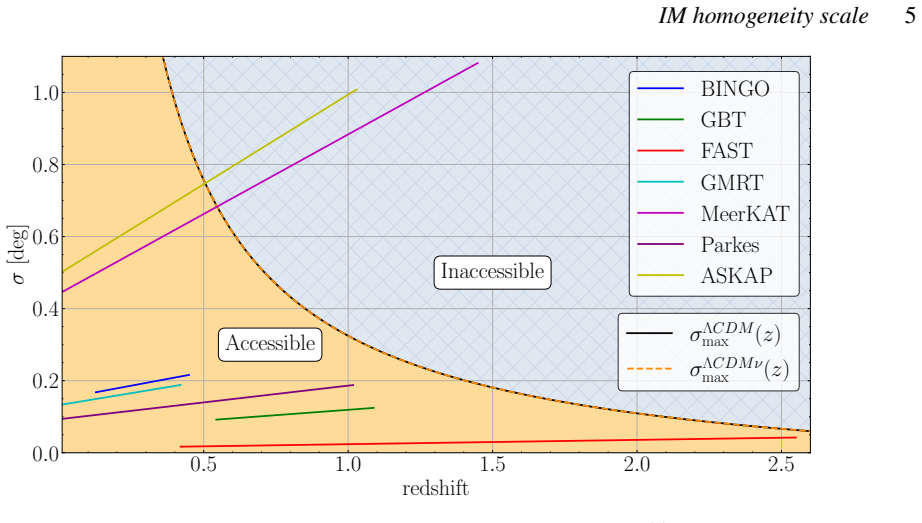
The homogeneity scale, $R_{\rm H}$, offers a fundamental test of the Cosmological Principle, yet it has not yet been measured with 21cm intensity mapping surveys. A key limitation for such a measurement is the telescope beam, which artificially smooths the observed signal. We quantify this effect using the two-point correlation function and the correlation dimension, $\mathcal{D}_2(r)$, to model how beam convolution suppresses intrinsic clustering. For any given redshift $z$, we identify a maximum beam width, $\sigma_{\rm max}(z)$, beyond which the homogeneity scale cannot be recovered. This limit defines an inaccessible region in the $\sigma \times z$ parameter space, where $R_{\rm H}$ is erased by beam smoothing. Applying this framework to several current and upcoming radio telescopes, we assess their ability to probe $R_{\rm H}$. Our results provide the first quantitative forecast of the instrumental requirements for measuring the cosmic homogeneity scale with 21cm IM, and establish a theoretical basis for future observational applications.
Editorial analysis
A structured set of objections, weighed in public.
Referee Report
Summary. The manuscript develops an analytic framework to quantify the impact of Gaussian beam smoothing on the recovery of the cosmic homogeneity scale R_H in 21 cm intensity mapping surveys. Using the two-point correlation function and the correlation dimension D2(r), the authors derive a redshift-dependent maximum beam width σ_max(z) beyond which beam convolution erases the transition of D2(r) to 3, rendering R_H unrecoverable. They map the resulting inaccessible region in the σ-z plane and evaluate it for several current and future radio telescopes.
Significance. If the modeling assumptions hold, the work supplies the first quantitative forecast of instrumental requirements for a homogeneity-scale measurement with 21 cm IM, directly informing survey design for tests of the Cosmological Principle. The use of D2(r) to track the suppression is a clear methodological contribution, though the absence of mock validation leaves the precise location of the inaccessible region provisional.
major comments (2)
- [§3.1, Eq. (8)] §3.1, Eq. (8): the convolved correlation function is written as a direct integral of the intrinsic ξ(r) with a Gaussian kernel; this separability is load-bearing for the monotonic shift of the D2(r)→3 transition with σ, yet the manuscript provides no demonstration that redshift-space distortions or survey-window effects preserve the assumed functional form.
- [§4.3] §4.3: the numerical criterion used to declare R_H 'unrecoverable' (i.e., the tolerance on how close D2(r) must approach 3 within the survey volume) is not stated explicitly; without it, the boundary σ_max(z) remains sensitive to an arbitrary threshold and the inaccessible region cannot be reproduced independently.
minor comments (2)
- [Abstract] The abstract lists 'several current and upcoming radio telescopes' without naming them; the introduction or §5 should provide the explicit list and the corresponding σ values adopted for each instrument.
- [Figure 2] Figure 2 caption should clarify whether the plotted σ_max(z) curves include or exclude the effects of finite survey volume.
Simulated Author's Rebuttal
We thank the referee for their careful reading of the manuscript and for the constructive comments, which help clarify key aspects of our analytic framework. We respond to each major comment below.
read point-by-point responses
-
Referee: [§3.1, Eq. (8)] the convolved correlation function is written as a direct integral of the intrinsic ξ(r) with a Gaussian kernel; this separability is load-bearing for the monotonic shift of the D2(r)→3 transition with σ, yet the manuscript provides no demonstration that redshift-space distortions or survey-window effects preserve the assumed functional form.
Authors: Our derivation in §3.1 isolates the effect of Gaussian beam smoothing on the transverse plane under the assumption of a real-space correlation function. We acknowledge that redshift-space distortions and survey-window effects are not included and could in principle affect the exact separability. The manuscript focuses on providing an analytic estimate of the beam-induced limit; a complete treatment with RSD would require mocks and is noted as future work. In the revision we will add an explicit statement of these modeling assumptions in §3.1 together with a brief discussion of their expected impact, making clear that the reported σ_max(z) serves as a conservative bound on the beam effect alone. revision: partial
-
Referee: [§4.3] the numerical criterion used to declare R_H 'unrecoverable' (i.e., the tolerance on how close D2(r) must approach 3 within the survey volume) is not stated explicitly; without it, the boundary σ_max(z) remains sensitive to an arbitrary threshold and the inaccessible region cannot be reproduced independently.
Authors: We agree that an explicit statement of the numerical tolerance is necessary for reproducibility. The definition of σ_max(z) relies on the scale at which the convolved D2(r) ceases to approach 3 within the survey volume, but the precise threshold was not written out. In the revised manuscript we will state the criterion explicitly (including the numerical tolerance on D2(r) and its relation to the maximum comoving scale set by the survey volume) so that the inaccessible region can be reproduced independently. revision: yes
Circularity Check
No circularity: forward model of beam convolution on standard D2(r) is self-contained
full rationale
The paper applies the established two-point correlation function and correlation dimension D2(r) to quantify Gaussian beam smoothing effects on the homogeneity scale RH. It derives σ_max(z) as the beam width at which the transition of D2(r) to 3 is erased, using standard convolution in Fourier space. This is a direct forward calculation from the model's equations rather than a fit to data or a self-referential definition. No load-bearing self-citations, uniqueness theorems, or renamings of known results are invoked in the derivation chain. The inaccessible region in the σ-z plane follows from the separability assumption in the model, which is stated explicitly and does not reduce to the target result by construction.
Axiom & Free-Parameter Ledger
axioms (2)
- domain assumption The correlation dimension D2(r) approaches 3 at the homogeneity scale in an intrinsically homogeneous universe.
- domain assumption Beam convolution acts as a linear smoothing operator that can be modeled separately from intrinsic clustering.
Forward citations
Cited by 1 Pith paper
-
The velocity coherence scale: a novel probe of cosmic homogeneity and a potential standard ruler
The velocity coherence scale R_v marks the onset of statistical homogeneity, is redshift-independent in comoving coordinates, and connects directly to the matter-radiation equality scale k_eq in standard cosmology.
Reference graph
Works this paper leans on
-
[1]
P., Bernui A., de Carvalho E., 2018, J
Abdalla E., et al., 2022, Journal of High Energy Astrophysics, 34, 49 Aghanim N., et al., 2020, A&A, 641, A6 Akrami Y., et al., 2020, A&A, 641, A7 Amiri M., et al., 2023, ApJ, 947, 16 Amiri M., et al., 2024, ApJ, 963, 23 Anderson C., et al., 2018, MNRAS, 476, 3382 Avila F., Novaes C. P., Bernui A., de Carvalho E., 2018, J. Cosmology Astropart. Phys., 2018...
discussion (0)
Sign in with ORCID, Apple, or X to comment. Anyone can read and Pith papers without signing in.