Periodic orbits and their gravitational wave radiations in γ-metric
Pith reviewed 2026-05-17 21:24 UTC · model grok-4.3
The pith
Deviations from γ=1 shift periodic orbit radii and alter their gravitational waveforms in the γ-metric.
A machine-rendered reading of the paper's core claim, the machinery that carries it, and where it could break.
Core claim
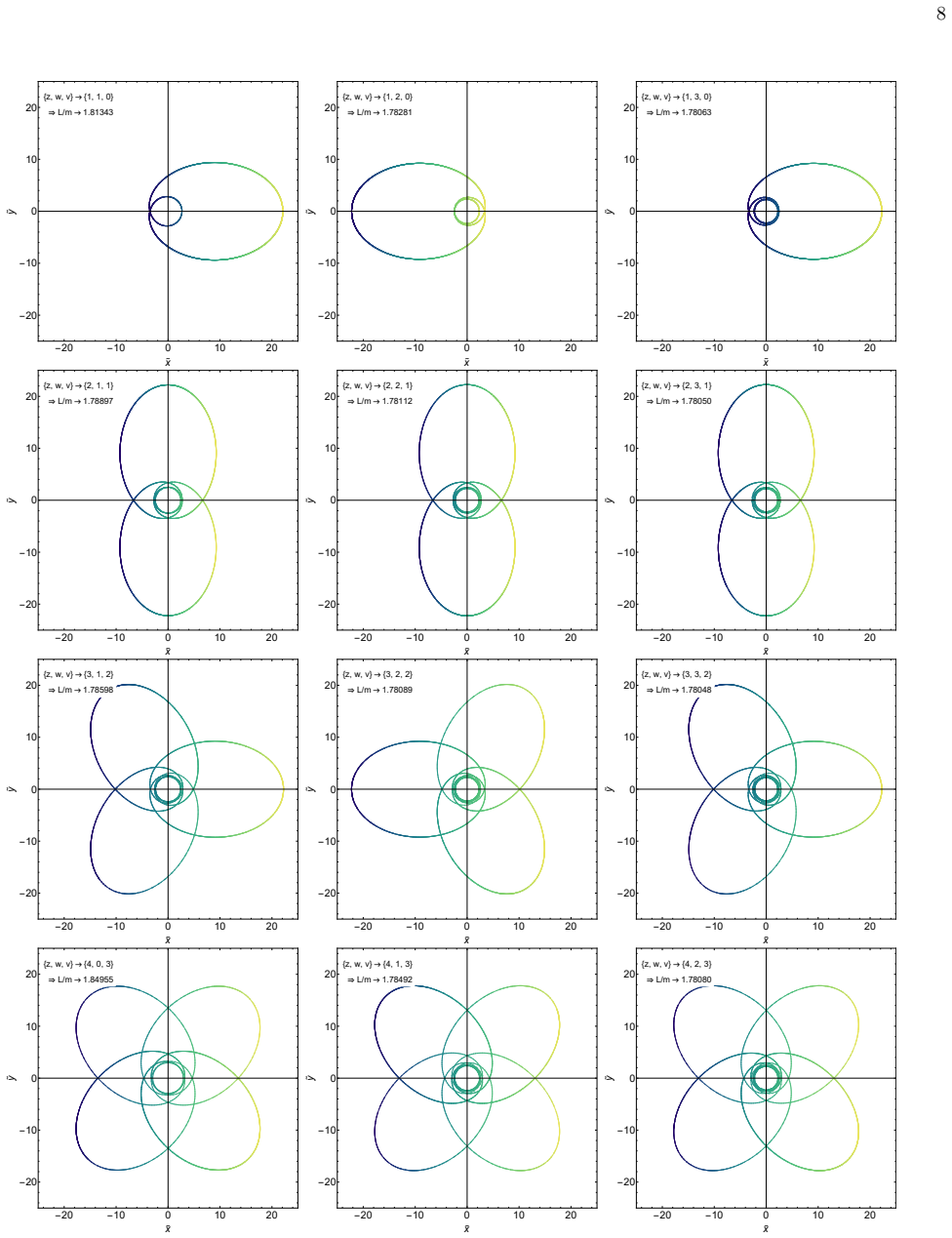
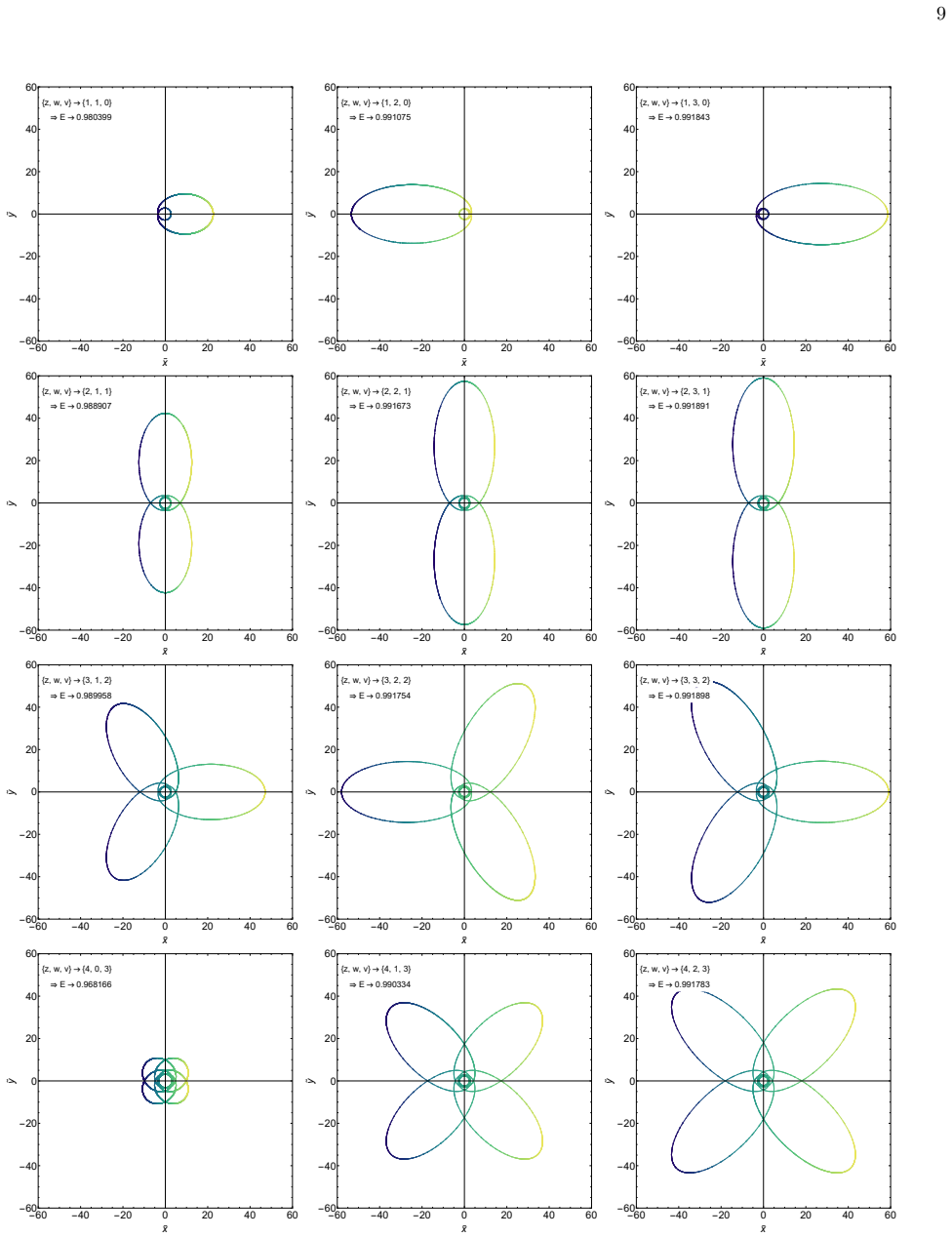
In the γ-metric, bound periodic orbits receive a (z, w, v) classification based on their zoom-whirl topology. When γ departs from one the radii and angular momenta of these orbits move, shifting the taxonomy, and the gravitational waveforms acquire corresponding phase shifts and amplitude modulations whose complexity increases with larger zoom numbers.
What carries the argument
The (z, w, v) topological classification that assigns each periodic orbit its zoom-whirl structure and thereby fixes the detailed morphology of its gravitational waveform.
Load-bearing premise
The (z, w, v) labeling and its associated zoom-whirl structure remain well-defined and directly comparable for any γ without extra instabilities or geodesic incompleteness appearing in the deformed spacetime.
What would settle it
A direct integration of the geodesic equations for some γ not equal to one that shows an orbit previously assigned a given (z, w, v) triple loses periodicity or stability would falsify the claim that the taxonomy applies uniformly.
Figures



read the original abstract
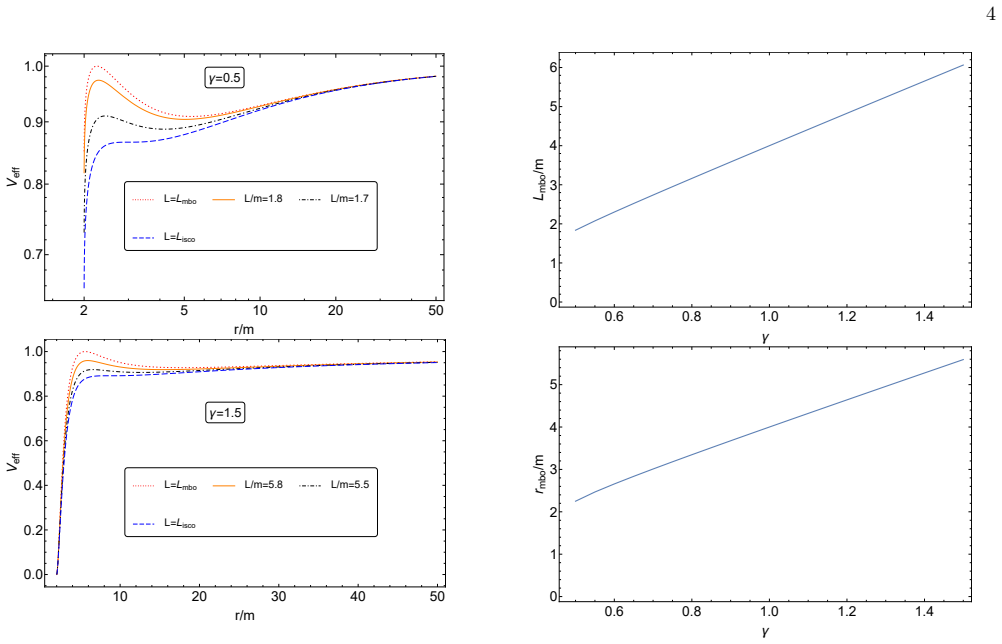
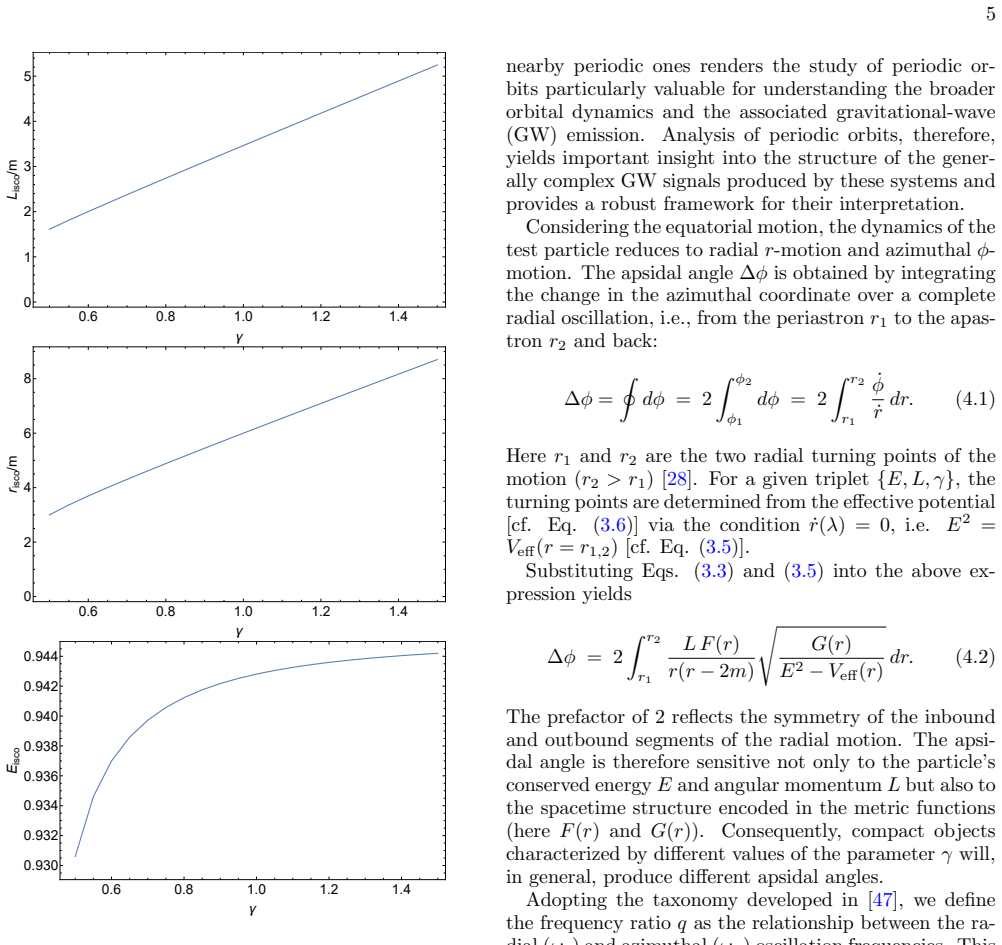
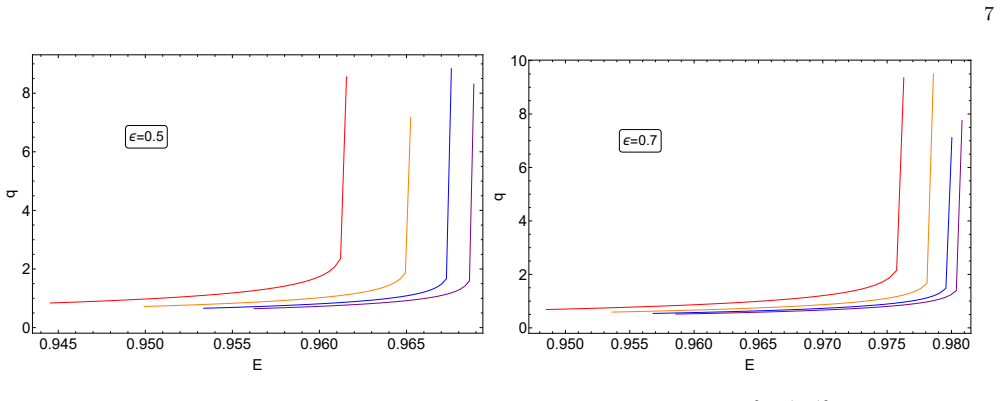
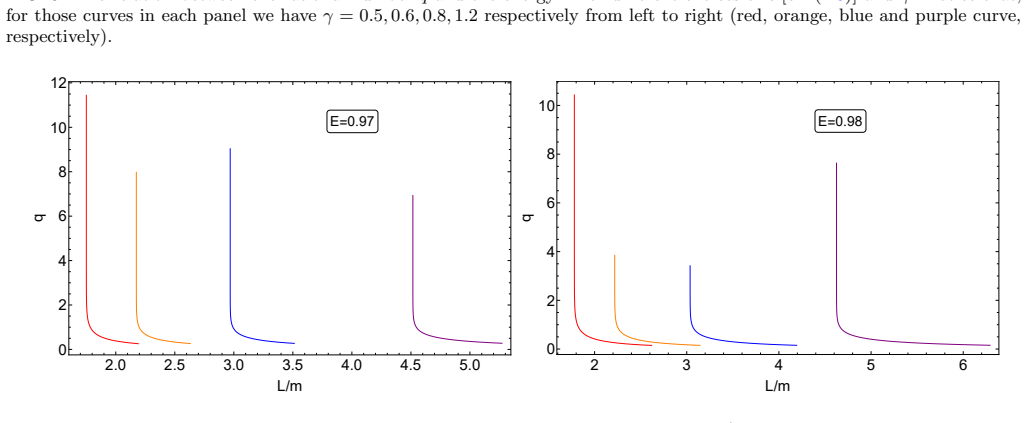
The $\gamma$-metric, also known as Zipoy-Voorhees spacetime, is a static, axially symmetric vacuum solution to Einstein's field equations characterized by two parameters: mass and the deformation parameter $\gamma$. It reduces to the Schwarzschild metric when $\gamma = 1$. In this paper, we explore potential signatures of the $\gamma$-metric on periodic orbits and their gravitational-wave radiation. Periodic orbits are classified by a rotational number specified by three topological numbers $(z, w, v)$, each triple corresponding to characteristic zoom-whirl behavior. We show that deviations from $\gamma=1$ alter the radii and angular momentum of bound orbits and thereby shift the $(z, w, v)$ taxonomy. We also compute representative gravitational waveforms for certain periodic orbits and demonstrate that $\gamma \neq 1$ can induce phase shifts and amplitude modulations correlated with changes in the zoom-whirl structure. In particular, larger zoom numbers lead to increasingly complex substructures in the waveforms, and finite deviations from $\gamma=1$ can significantly modify these features. Our results indicate that precise measurements of waveform morphology from extreme-mass-ratio inspirals may constrain deviations from spherical symmetry encoded in $\gamma$.
Editorial analysis
A structured set of objections, weighed in public.
Referee Report
Summary. The paper investigates periodic orbits in the γ-metric (Zipoy-Voorhees spacetime), a static axially symmetric vacuum solution reducing to Schwarzschild at γ=1. Orbits are classified by topological numbers (z, w, v) corresponding to zoom-whirl behavior. The authors show that γ ≠ 1 shifts orbit radii, angular momenta, and the (z, w, v) taxonomy, and compute representative gravitational waveforms exhibiting phase shifts and amplitude modulations correlated with these changes. They conclude that precise EMRI waveform morphology measurements may constrain deviations from spherical symmetry encoded in γ.
Significance. If the results on taxonomy shifts and correlated waveform modifications hold, the work offers a concrete, falsifiable approach to testing deviations from Schwarzschild geometry via periodic-orbit signatures in extreme-mass-ratio inspirals. The direct integration of geodesics and wave equations in the deformed metric, without post-hoc fitting, is a methodological strength that supports potential observational constraints.
major comments (1)
- [bound equatorial geodesics / effective potential] The section deriving bound equatorial geodesics via the effective potential: the central claim that deviations in γ shift the (z, w, v) taxonomy while preserving a well-defined zoom-whirl structure requires explicit verification that reported periodic orbits remain complete, avoid the γ-dependent curvature singularity, and retain the same radial-to-azimuthal period ratio interpretation. Without this check, the taxonomy shifts and associated waveform modulations lack foundation.
minor comments (2)
- [periodic orbits classification] Clarify the precise definition of the rotational number and how (z, w, v) are extracted numerically from the integrated geodesics for γ ≠ 1.
- [gravitational waveforms] Specify the truncation criteria and multipole content used in the waveform computation to allow reproducibility of the reported phase shifts and amplitude modulations.
Simulated Author's Rebuttal
We thank the referee for their careful reading and constructive feedback on our manuscript. The major comment identifies a need for explicit verification of key orbit properties to support our claims on taxonomy shifts, which we address directly below by outlining additions to the revised version.
read point-by-point responses
-
Referee: The section deriving bound equatorial geodesics via the effective potential: the central claim that deviations in γ shift the (z, w, v) taxonomy while preserving a well-defined zoom-whirl structure requires explicit verification that reported periodic orbits remain complete, avoid the γ-dependent curvature singularity, and retain the same radial-to-azimuthal period ratio interpretation. Without this check, the taxonomy shifts and associated waveform modulations lack foundation.
Authors: We agree that explicit verification is required to firmly ground the taxonomy shifts and waveform results. In the revised manuscript we have added a new verification subsection to the bound geodesics section. We numerically integrate the geodesic equations for the reported periodic orbits at representative γ values (including 0.8, 1.0 and 1.2) over multiple radial periods and confirm closure after the expected azimuthal revolutions, establishing completeness. The effective-potential analysis shows that the chosen periapsis radii lie safely outside the curvature singularity at r=0 for γ≠1; we now include a table of minimum radii versus γ to document this avoidance explicitly. Finally, we recompute the radial and azimuthal periods from the conserved quantities and verify that the ratio continues to furnish the standard (z,w,v) interpretation, even though the absolute radii and angular momenta shift with γ. These additions supply the requested foundation without altering the original conclusions. revision: yes
Circularity Check
No significant circularity; results from direct integration of geodesics and wave equations in the deformed metric
full rationale
The derivation proceeds by solving the geodesic equations and effective potential for bound equatorial orbits in the γ-metric, classifying them with the imported (z, w, v) topological numbers, and then integrating the wave equations to obtain waveforms. These steps are explicit computations for varying γ rather than any parameter fitting to the same data or self-referential definitions. The (z, w, v) taxonomy is applied from prior literature on Schwarzschild orbits and extended via calculation; no load-bearing self-citation chain or ansatz smuggling is present in the provided derivation. The central claims about taxonomy shifts and waveform modulations therefore retain independent content from the metric deformation itself.
Axiom & Free-Parameter Ledger
free parameters (1)
- deformation parameter γ
axioms (2)
- standard math The γ-metric is a static, axially symmetric vacuum solution of Einstein's equations
- domain assumption Periodic orbits can be classified by the same three topological numbers (z, w, v) when γ ≠ 1
Lean theorems connected to this paper
-
IndisputableMonolith/Foundation/AlexanderDuality.leanalexander_duality_circle_linking unclear?
unclearRelation between the paper passage and the cited Recognition theorem.
Periodic orbits are classified by a rotational number specified by three topological numbers (z, w, v), each triple corresponding to characteristic zoom-whirl behavior... q = ωϕ/ωr − 1 = w + v/z
-
IndisputableMonolith/Cost/FunctionalEquation.leanwashburn_uniqueness_aczel unclear?
unclearRelation between the paper passage and the cited Recognition theorem.
Veff = F [1 + L² F / r(r−2m)] ... Δϕ = 2 ∫ ...
What do these tags mean?
- matches
- The paper's claim is directly supported by a theorem in the formal canon.
- supports
- The theorem supports part of the paper's argument, but the paper may add assumptions or extra steps.
- extends
- The paper goes beyond the formal theorem; the theorem is a base layer rather than the whole result.
- uses
- The paper appears to rely on the theorem as machinery.
- contradicts
- The paper's claim conflicts with a theorem or certificate in the canon.
- unclear
- Pith found a possible connection, but the passage is too broad, indirect, or ambiguous to say the theorem truly supports the claim.
Forward citations
Cited by 3 Pith papers
-
An open-source numerical tool for rational orbits and gravitational radiation in static spherically symmetric spacetimes
Open-source numerical package for rational orbits and gravitational waves in static spherically symmetric spacetimes, validated on Schwarzschild and applied to an IMBH-Sgr A* EMRI.
-
Equatorial periodic orbits and gravitational wave signatures in Euler-Heisenberg black holes surrounded by perfect fluid dark matter
Periodic orbits in Euler-Heisenberg black holes surrounded by perfect fluid dark matter produce burst-like gravitational wave signals whose amplitude and frequency content are modified by both dark matter density and ...
-
Gravitational radiations from periodic orbits around a black hole in the effective field theory extension of general relativity
Periodic orbits around EFTGR black holes produce gravitational waveforms whose substructures increase in complexity with higher zoom numbers.
Reference graph
Works this paper leans on
-
[1]
Topology of Some Spheroidal Metrics,
D. M. Zipoy, “Topology of Some Spheroidal Metrics,” J. Math. Phys.7, no.6, 1137 (1966) doi:10.1063/1.1705005
-
[2]
Static axially symmetric gravita- tional fields,
B. H. Voorhees, “Static axially symmetric gravita- tional fields,” Phys. Rev. D2, 2119-2122 (1970) doi:10.1103/PhysRevD.2.2119
-
[3]
Charged particle motion and electromagnetic field in $\gamma$ spacetime
C. A. Benavides-Gallego, A. Abdujabbarov, D. Mala- farina, B. Ahmedov and C. Bambi, “Charged par- ticle motion and electromagnetic field inγspace- time,” Phys. Rev. D99, no.4, 044012 (2019) doi:10.1103/PhysRevD.99.044012 [arXiv:1812.04846 [gr- qc]]
work page internal anchor Pith review Pith/arXiv arXiv doi:10.1103/physrevd.99.044012 2019
-
[4]
The non-integrability of the Zipoy-Voorhees metric
G. Lukes-Gerakopoulos, “The non-integrability of the Zipoy-Voorhees metric,” Phys. Rev. D86, 044013 (2012) doi:10.1103/PhysRevD.86.044013 [arXiv:1206.0660 [gr- qc]]
work page internal anchor Pith review Pith/arXiv arXiv doi:10.1103/physrevd.86.044013 2012
-
[5]
Global structure of the Zipoy-Voorhees-Weyl spacetime and the delta=2 Tomimatsu-Sato spacetime
H. Kodama and W. Hikida, “Global structure of the Zipoy-Voorhees-Weyl spacetime and the delta=2 Tomimatsu-Sato spacetime,” Class. Quant. Grav. 20, 5121-5140 (2003) doi:10.1088/0264-9381/20/23/011 [arXiv:gr-qc/0304064 [gr-qc]]
work page internal anchor Pith review Pith/arXiv arXiv doi:10.1088/0264-9381/20/23/011 2003
-
[6]
D. Saito and D. Yoshida, “Removing naked sin- gularities in static axially symmetric spacetimes by patching with flat spacetimes,” Phys. Rev. D111, no.2, 024031 (2025) doi:10.1103/PhysRevD.111.024031 [arXiv:2409.18520 [gr-qc]]
-
[7]
Spinning test particles in theγspacetime,
B. Toshmatov and D. Malafarina, “Spinning test particles in theγspacetime,” Phys. Rev. D100, no.10, 104052 (2019) doi:10.1103/PhysRevD.100.104052 [arXiv:1910.11565 [gr-qc]]
-
[8]
Charged Zipoy–Voorhees metric in string theory,
O. Yunusov, B. Turimov, Y. Khamroev, S. Usanov, F. Turaev and M. Kuliyeva, “Charged Zipoy–Voorhees metric in string theory,” Annals Phys.481, 170151 (2025) doi:10.1016/j.aop.2025.170151
-
[9]
Con- straining quadrupole deformations with relativistic ef- fects,
D. Utepova, K. Boshkayev, S. Momynov, A. Idrissov, G. Baimbetova, H. Quevedo and A. Urazalina, “Con- straining quadrupole deformations with relativistic ef- fects,” Eur. Phys. J. C85, no.9, 987 (2025) doi:10.1140/epjc/s10052-025-14664-2 [arXiv:2506.10437 [gr-qc]]
-
[10]
P. Heidmann and G. Patashuri, Phys. Rev. D112, no.6, 066020 (2025) doi:10.1103/k1br-81hm [arXiv:2506.05463 [hep-th]]
-
[11]
Observable Properties of Thin Accretion Disk in theγSpacetime,
B. Turimov and B. Ahmedov, “Observable Properties of Thin Accretion Disk in theγSpacetime,” Symmetry15, 14 no.10, 1858 (2023) doi:10.3390/sym15101858
-
[12]
Prob- ing naked singularities in the charged and uncharged γ−metricswith quantum wave packets,
O. Gurtug, M. Halilsoy and M. Mangut, “Prob- ing naked singularities in the charged and uncharged γ−metricswith quantum wave packets,” Gen. Rel. Grav.55, no.9, 98 (2023) doi:10.1007/s10714-023-03146- z [arXiv:2307.08292 [gr-qc]]
-
[13]
γ-Metrics in higher dimensions,
A. Hajibarat, B. Mirza and A. Azizallahi, “γ-Metrics in higher dimensions,” Nucl. Phys. B978, 115739 (2022) doi:10.1016/j.nuclphysb.2022.115739 [arXiv:2110.06667 [gr-qc]]
-
[14]
The impact of compact object deformation on thin accretion disk properties,
S. Faraji, “The impact of compact object deformation on thin accretion disk properties,” Eur. Phys. J. C 85, no.2, 148 (2025) doi:10.1140/epjc/s10052-025-13794- x [arXiv:2505.17924 [gr-qc]]
-
[15]
S. Momynov, K. Boshkayev, H. Quevedo, F. Belis- sarova, A. Dalelkhankyzy, A. Taukenova, A. Urazalina and D. Utepova, Gen. Rel. Grav.57, no.6, 91 (2025) doi:10.1007/s10714-025-03426-w [arXiv:2412.06598 [gr- qc]]
-
[16]
F. D. Lora-Clavijo, G. D. Prada-M´ endez, L. M. Be- cerra and E. A. Becerra-Vergara, “The q-metric naked singularity: a viable explanation for the nature of the central object in the Milky Way,” Class. Quant. Grav. 40, no.24, 245012 (2023) doi:10.1088/1361-6382/ad0b9e [arXiv:2311.06653 [gr-qc]]
-
[17]
Motion of test particles in the field of a naked singularity
K. Boshkayev, E. Gasperin, A. C. Gutierrez-Pineres, H. Quevedo and S. Toktarbay, “Motion of test particles in the field of a naked singularity,” Phys. Rev. D93, no.2, 024024 (2016) doi:10.1103/PhysRevD.93.024024 [arXiv:1509.03827 [gr-qc]]
work page internal anchor Pith review Pith/arXiv arXiv doi:10.1103/physrevd.93.024024 2016
-
[18]
K. Destounis, F. Angeloni, M. Vaglio and P. Pani, “Extreme-mass-ratio inspirals into rotating bo- son stars: Nonintegrability, chaos, and transient resonances,” Phys. Rev. D108, no.8, 8 (2023) doi:10.1103/PhysRevD.108.084062 [arXiv:2305.05691 [gr-qc]]
-
[19]
Slowly-rotating com- pact objects: the nonintegrability of Hartle–Thorne par- ticle geodesics,
K. Destounis and K. D. Kokkotas, “Slowly-rotating com- pact objects: the nonintegrability of Hartle–Thorne par- ticle geodesics,” Gen. Rel. Grav.55, no.11, 123 (2023) doi:10.1007/s10714-023-03170-z [arXiv:2305.18522 [gr- qc]]
-
[20]
Geodesics in the gamma space-time,
L. Herrera, F. M. Paiva and N. O. Santos, “Geodesics in the gamma space-time,” Int. J. Mod. Phys. D9, 649- 660 (2000) doi:10.1142/S021827180000061X [arXiv:gr- qc/9812023 [gr-qc]]
-
[21]
Magnetized Particle Motion inγ- Spacetime in a Magnetic Field,
A. Abdujabbarov, J. Rayimbaev, F. Atamurotov and B. Ahmedov, “Magnetized Particle Motion inγ- Spacetime in a Magnetic Field,” Galaxies8, no.4, 76 (2020) doi:10.3390/galaxies8040076
-
[22]
Quasinormal Modes of a Black Hole with Quadrupole Moment
A. Allahyari, H. Firouzjahi and B. Mashhoon, “Quasi- normal Modes of a Black Hole with Quadrupole Moment,” Phys. Rev. D99, no.4, 044005 (2019) doi:10.1103/PhysRevD.99.044005 [arXiv:1812.03376 [gr- qc]]
work page internal anchor Pith review Pith/arXiv arXiv doi:10.1103/physrevd.99.044005 2019
-
[23]
The Levi-Civita spacetime as a limiting case of the Gamma spacetime
L. Herrera, F. M. Paiva and N. O. Santos, “The Levi- Civita space-time as a limiting case of the gamma space-time,” J. Math. Phys.40, 4064-4071 (1999) doi:10.1063/1.532943 [arXiv:gr-qc/9810079 [gr-qc]]
work page internal anchor Pith review Pith/arXiv arXiv doi:10.1063/1.532943 1999
-
[24]
Harmonic oscillations of neutral particles in the γ-metric,
B. Toshmatov, D. Malafarina and N. Dadhich, “Harmonic oscillations of neutral particles in the γ-metric,” Phys. Rev. D100, no.4, 044001 (2019) doi:10.1103/PhysRevD.100.044001 [arXiv:1905.01088 [gr-qc]]
-
[25]
Effects of gravitational lensing on neutrino oscillation inγ-spacetime,
H. Chakrabarty, D. Borah, A. Abdujabbarov, D. Mala- farina and B. Ahmedov, “Effects of gravitational lensing on neutrino oscillation inγ-spacetime,” Eur. Phys. J. C 82, no.1, 24 (2022) doi:10.1140/epjc/s10052-021-09982-0 [arXiv:2109.02395 [gr-qc]]
-
[26]
Status of the scalar singlet dark matter model
R. Shaikh, S. Paul, P. Banerjee and T. Sarkar, “Shadows and thin accretion disk images of theγ-metric,” Eur. Phys. J. C82, no.8, 696 (2022) doi:10.1140/epjc/s10052- 022-10664-8 [arXiv:2105.12057 [gr-qc]]
-
[27]
Observation of Gravitational Waves from a Binary Black Hole Merger
B. P. Abbottet al.[LIGO Scientific and Virgo], “Ob- servation of Gravitational Waves from a Binary Black Hole Merger,” Phys. Rev. Lett.116, no.6, 061102 (2016) doi:10.1103/PhysRevLett.116.061102 [arXiv:1602.03837 [gr-qc]]
work page internal anchor Pith review Pith/arXiv arXiv doi:10.1103/physrevlett.116.061102 2016
-
[28]
Z. Y. Tu, T. Zhu and A. Wang, “Periodic orbits and their gravitational wave radiations in a polymer black hole in loop quantum gravity,” Phys. Rev. D 108, no.2, 2 (2023) doi:10.1103/PhysRevD.108.024035 [arXiv:2304.14160 [gr-qc]]
-
[29]
Gravitational waves from eccentric extreme mass- ratio inspirals as probes of scalar fields,
C. Zhang, Y. Gong, D. Liang and B. Wang, “Gravitational waves from eccentric extreme mass- ratio inspirals as probes of scalar fields,” JCAP 06, 054 (2023) doi:10.1088/1475-7516/2023/06/054 [arXiv:2210.11121 [gr-qc]]
-
[30]
Im- prints of dark matter on gravitational ringing of su- permassive black holes,
C. Zhang, T. Zhu, X. Fang and A. Wang, “Im- prints of dark matter on gravitational ringing of su- permassive black holes,” Phys. Dark Univ.37, 101078 (2022) doi:10.1016/j.dark.2022.101078 [arXiv:2201.11352 [gr-qc]]
-
[31]
Gravitational axial perturbations of Schwarzschild-like black holes in dark matter halos,
C. Zhang, T. Zhu and A. Wang, “Gravitational axial perturbations of Schwarzschild-like black holes in dark matter halos,” Phys. Rev. D104, no.12, 124082 (2021) doi:10.1103/PhysRevD.104.124082 [arXiv:2111.04966 [gr-qc]]
-
[32]
Ana- lytical models of supermassive black holes in galax- ies surrounded by dark matter halos,
Z. Shen, A. Wang, Y. Gong and S. Yin, “Ana- lytical models of supermassive black holes in galax- ies surrounded by dark matter halos,” Phys. Lett. B 855, 138797 (2024) doi:10.1016/j.physletb.2024.138797 [arXiv:2311.12259 [gr-qc]]
-
[33]
First M87 Event Horizon Telescope Results. I. The Shadow of the Supermassive Black Hole
K. Akiyamaet al.[Event Horizon Telescope], “First M87 Event Horizon Telescope Results. I. The Shadow of the Supermassive Black Hole,” Astrophys. J. Lett.875, L1 (2019) doi:10.3847/2041-8213/ab0ec7 [arXiv:1906.11238 [astro-ph.GA]]
work page internal anchor Pith review Pith/arXiv arXiv doi:10.3847/2041-8213/ab0ec7 2019
-
[34]
K. Akiyamaet al.[Event Horizon Telescope], “First Sagittarius A* Event Horizon Telescope Results. I. The Shadow of the Supermassive Black Hole in the Center of the Milky Way,” Astrophys. J. Lett.930, no.2, L12 (2022) doi:10.3847/2041-8213/ac6674 [arXiv:2311.08680 [astro-ph.HE]]
work page internal anchor Pith review Pith/arXiv arXiv doi:10.3847/2041-8213/ac6674 2022
-
[35]
LISA: An ESA cornerstone mission for a gravitational wave observatory,
K. Danzmann, “LISA: An ESA cornerstone mission for a gravitational wave observatory,” Class. Quant. Grav.14, 1399-1404 (1997) doi:10.1088/0264-9381/14/6/002
-
[37]
Event rate estimates for LISA extreme mass ratio capture sources
J. R. Gair, L. Barack, T. Creighton, C. Cutler, S. L. Larson, E. S. Phinney and M. Vallisneri, “Event rate estimates for LISA extreme mass ratio capture sources,” Class. Quant. Grav.21, S1595-S1606 (2004) doi:10.1088/0264-9381/21/20/003 [arXiv:gr-qc/0405137 [gr-qc]]
work page internal anchor Pith review Pith/arXiv arXiv doi:10.1088/0264-9381/21/20/003 2004
-
[38]
Laser Interferometer Space Antenna
P. Amaro-Seoaneet al.[LISA], “Laser Interferometer Space Antenna,” [arXiv:1702.00786 [astro-ph.IM]]. 15
work page internal anchor Pith review Pith/arXiv arXiv
-
[39]
Science with the TianQin observatory: Preliminary results on stellar-mass binary black holes,
S. Liu, Y. M. Hu, J. d. Zhang and J. Mei, “Science with the TianQin observatory: Preliminary results on stellar-mass binary black holes,” Phys. Rev. D101, no.10, 103027 (2020) doi:10.1103/PhysRevD.101.103027 [arXiv:2004.14242 [astro-ph.HE]]
-
[40]
C. Shi, J. Bao, H. Wang, J. d. Zhang, Y. Hu, A. Sesana, E. Barausse, J. Mei and J. Luo, “Science with the Tian- Qin observatory: Preliminary results on testing the no- hair theorem with ringdown signals,” Phys. Rev. D100, no.4, 044036 (2019) doi:10.1103/PhysRevD.100.044036 [arXiv:1902.08922 [gr-qc]]
-
[41]
2020, International Journal of Modern Physics A, 35, 2050075, doi: 10.1142/S0217751X2050075X
W. H. Ruan, Z. K. Guo, R. G. Cai and Y. Z. Zhang, “Taiji program: Gravitational-wave sources,” Int. J. Mod. Phys. A35, no.17, 2050075 (2020) doi:10.1142/S0217751X2050075X [arXiv:1807.09495 [gr-qc]]
-
[42]
Concepts and status of Chinese space gravitational wave detection projects,
Y. Gong, J. Luo and B. Wang, “Concepts and status of Chinese space gravitational wave detection projects,” Na- ture Astron.5, no.9, 881-889 (2021) doi:10.1038/s41550- 021-01480-3 [arXiv:2109.07442 [astro-ph.IM]]
-
[43]
Dynamics of Black Hole Pairs I: Periodic Tables
J. Levin and B. Grossman, “Dynamics of Black Hole Pairs. I. Periodic Tables,” Phys. Rev. D 79, 043016 (2009) doi:10.1103/PhysRevD.79.043016 [arXiv:0809.3838 [gr-qc]]
work page internal anchor Pith review Pith/arXiv arXiv doi:10.1103/physrevd.79.043016 2009
-
[44]
Energy Level Diagrams for Black Hole Orbits
J. Levin, “Energy Level Diagrams for Black Hole Orbits,” Class. Quant. Grav.26, 235010 (2009) doi:10.1088/0264- 9381/26/23/235010 [arXiv:0907.5195 [gr-qc]]
work page internal anchor Pith review Pith/arXiv arXiv doi:10.1088/0264- 2009
-
[45]
Precession of timelike bound orbits in Kerr spacetime,
P. Bambhaniya, D. N. Solanki, D. Dey, A. B. Joshi, P. S. Joshi and V. Patel, “Precession of timelike bound orbits in Kerr spacetime,” Eur. Phys. J. C81, no.3, 205 (2021) doi:10.1140/epjc/s10052-021-08997-x [arXiv:2007.12086 [gr-qc]]
-
[46]
Astrophysically relevant bound trajectories around a Kerr black hole
P. Rana and A. Mangalam, “Astrophysically rele- vant bound trajectories around a Kerr black hole,” Class. Quant. Grav.36, 045009 (2019) doi:10.1088/1361- 6382/ab004c [arXiv:1901.02730 [gr-qc]]
work page internal anchor Pith review Pith/arXiv arXiv doi:10.1088/1361- 2019
-
[47]
A Periodic Table for Black Hole Orbits
J. Levin and G. Perez-Giz, “A Periodic Table for Black Hole Orbits,” Phys. Rev. D77, 103005 (2008) doi:10.1103/PhysRevD.77.103005 [arXiv:0802.0459 [gr- qc]]
work page internal anchor Pith review Pith/arXiv arXiv doi:10.1103/physrevd.77.103005 2008
-
[48]
Periodic orbits around a spherically symmetric naked singularity
G. Z. Babar, A. Z. Babar and Y. K. Lim, “Pe- riodic orbits around a spherically symmetric naked singularity,” Phys. Rev. D96, no.8, 084052 (2017) doi:10.1103/PhysRevD.96.084052 [arXiv:1710.09581 [gr- qc]]
work page internal anchor Pith review Pith/arXiv arXiv doi:10.1103/physrevd.96.084052 2017
-
[49]
Periodic orbits around Kerr Sen black holes,
C. Liu, C. Ding and J. Jing, “Periodic orbits around Kerr Sen black holes,” Commun. Theor. Phys.71, no.12, 1461 (2019) doi:10.1088/0253-6102/71/12/1461 [arXiv:1804.05883 [gr-qc]]
-
[50]
Precessing and peri- odic orbits around hairy black holes in Horndeski’s Theory,
H. Y. Lin and X. M. Deng, “Precessing and peri- odic orbits around hairy black holes in Horndeski’s Theory,” Eur. Phys. J. C83, no.4, 311 (2023) doi:10.1140/epjc/s10052-023-11487-x
-
[51]
Closed orbits in axial sym- metric Finslerian extension of a Schwarzschild black hole,
J. T. Yao and X. Li, “Closed orbits in axial sym- metric Finslerian extension of a Schwarzschild black hole,” Phys. Rev. D108, no.8, 084067 (2023) doi:10.1103/PhysRevD.108.084067
-
[52]
H. Y. Lin and X. M. Deng, “Bound Orbits and Epicyclic Motions around Renormalization Group Im- proved Schwarzschild Black Holes,” Universe8, no.5, 278 (2022) doi:10.3390/universe8050278
-
[53]
Periodic orbits of neutral test particles in Reissner–Nordstr¨ om naked singularities,
Z. C. S. Chan and Y. K. Lim, “Periodic orbits of neutral test particles in Reissner–Nordstr¨ om naked singularities,” Gen. Rel. Grav.57, no.2, 35 (2025) doi:10.1007/s10714-025-03368-3 [arXiv:2502.03082 [gr- qc]]
-
[54]
Periodic orbits around a static spherically symmetric black hole surrounded by quintessence,
R. Wang, F. Gao and H. Chen, “Periodic orbits around a static spherically symmetric black hole surrounded by quintessence,” Annals Phys.447, no.1, 169167 (2022) doi:10.1016/j.aop.2022.169167
-
[55]
Dynamics of test particles around hairy black holes in Horndeski’s theory,
H. Y. Lin and X. M. Deng, “Dynamics of test particles around hairy black holes in Horndeski’s theory,” Annals Phys.455, 169360 (2023) doi:10.1016/j.aop.2023.169360
-
[56]
Periodic orbits and their gravitational wave radiations in a black hole with a dark matter halo,
S. Haroon and T. Zhu, “Periodic orbits and their gravitational wave radiations in a black hole with a dark matter halo,” Phys. Rev. D112, no.4, 4 (2025) doi:10.1103/ckdt-wtsl [arXiv:2502.09171 [gr-qc]]
-
[57]
Bound orbits around charged black strings,
A. S. Habibina and H. S. Ramadhan, “Bound orbits around charged black strings,” Annals Phys.448, 169169 (2023) doi:10.1016/j.aop.2022.169169 [arXiv:2205.14635 [gr-qc]]
-
[58]
J. Zhang and Y. Xie, “Probing a self-complete and Generalized-Uncertainty-Principle black hole with pre- cessing and periodic motion,” Astrophys. Space Sci.367, no.2, 17 (2022) doi:10.1007/s10509-022-04046-5
-
[59]
Precessing and periodic orbits around Lee–Wick black holes,
H. Y. Lin and X. M. Deng, “Precessing and periodic orbits around Lee–Wick black holes,” Eur. Phys. J. Plus137, no.2, 176 (2022) doi:10.1140/epjp/s13360-022- 02391-6
-
[60]
Bound orbits around modified Hayward black holes,
B. Gao and X. M. Deng, “Bound orbits around modified Hayward black holes,” Mod. Phys. Lett. A36, no.33, 2150237 (2021) doi:10.1142/S0217732321502370
-
[61]
Rational orbits around 4 DEinstein–Lovelock black holes,
H. Y. Lin and X. M. Deng, “Rational orbits around 4 DEinstein–Lovelock black holes,” Phys. Dark Univ.31, 100745 (2021) doi:10.1016/j.dark.2020.100745
-
[62]
Geodesics and periodic orbits around quantum-corrected black holes,
X. M. Deng, “Geodesics and periodic orbits around quantum-corrected black holes,” Phys. Dark Univ.30, 100629 (2020) doi:10.1016/j.dark.2020.100629
-
[63]
Precessing and peri- odic motions around a black-bounce/traversable worm- hole,
T. Y. Zhou and Y. Xie, “Precessing and peri- odic motions around a black-bounce/traversable worm- hole,” Eur. Phys. J. C80, no.11, 1070 (2020) doi:10.1140/epjc/s10052-020-08661-w
-
[64]
Bound orbits around Bardeen black holes,
B. Gao and X. M. Deng, “Bound orbits around Bardeen black holes,” Annals Phys.418, 168194 (2020) doi:10.1016/j.aop.2020.168194
-
[65]
Periodic orbits around brane-world black holes,
X. M. Deng, “Periodic orbits around brane-world black holes,” Eur. Phys. J. C80, no.6, 489 (2020) doi:10.1140/epjc/s10052-020-8067-7
-
[66]
M. Azreg-A¨ ınou, Z. Chen, B. Deng, M. Jamil, T. Zhu, Q. Wu and Y. K. Lim, “Orbital mechan- ics and quasiperiodic oscillation resonances of black holes in Einstein-Æther theory,” Phys. Rev. D102, no.4, 044028 (2020) doi:10.1103/PhysRevD.102.044028 [arXiv:2004.02602 [gr-qc]]
-
[67]
S. W. Wei, J. Yang and Y. X. Liu, “Geodesics and periodic orbits in Kehagias-Sfetsos black holes in de- formed Hoˇ rava-Lifshitz gravity,” Phys. Rev. D99, no.10, 104016 (2019) doi:10.1103/PhysRevD.99.104016 [arXiv:1904.03129 [gr-qc]]
work page internal anchor Pith review Pith/arXiv arXiv doi:10.1103/physrevd.99.104016 2019
-
[68]
General classification of charged test particle circular orbits in Reissner--Nordstr\"om spacetime
D. Pugliese, H. Quevedo and R. Ruffini, “General classification of charged test particle circular orbits in Reissner–Nordstr¨ om spacetime,” Eur. Phys. J. C 77, no.4, 206 (2017) doi:10.1140/epjc/s10052-017-4769-x [arXiv:1304.2940 [gr-qc]]
work page internal anchor Pith review Pith/arXiv arXiv doi:10.1140/epjc/s10052-017-4769-x 2017
-
[69]
J. Zhang and Y. Xie, “Probing a black-bounce- Reissner–Nordstr¨ om spacetime with precessing and pe- riodic motion,” Eur. Phys. J. C82, no.10, 854 (2022) doi:10.1140/epjc/s10052-022-10846-4 16
-
[70]
Zoom-Whirl Orbits in Black Hole Binaries
J. Healy, J. Levin and D. Shoemaker, “Zoom-Whirl Orbits in Black Hole Binaries,” Phys. Rev. Lett. 103, 131101 (2009) doi:10.1103/PhysRevLett.103.131101 [arXiv:0907.0671 [gr-qc]]
work page internal anchor Pith review Pith/arXiv arXiv doi:10.1103/physrevlett.103.131101 2009
-
[71]
C. H. Wang, Y. P. Zhang, T. Zhu and S. W. Wei, “A new type of multi-branch periodic orbits in dyonic black holes,” [arXiv:2508.20558 [gr-qc]]
-
[72]
Regular black hole’s impact on the gravitational wave- forms from periodic orbits,
M. Alloqulov, S. Shaymatov, B. Ahmedov and T. Zhu, “Regular black hole’s impact on the gravitational wave- forms from periodic orbits,” [arXiv:2508.05245 [gr-qc]]
-
[73]
Probing a one-loop quantum-corrected Schwarzschild spacetime with precessing and periodic motion,
Z. L. Wei, J. Zhang, Y. Xie and P. L. Yin, “Probing a one-loop quantum-corrected Schwarzschild spacetime with precessing and periodic motion,” Eur. Phys. J. C 85, no.6, 698 (2025) doi:10.1140/epjc/s10052-025-14437- x
-
[74]
Gravitational waveforms from periodic or- bits around a quantum-corrected black hole,
S. Yang, Y. P. Zhang, T. Zhu, L. Zhao and Y. X. Liu, “Gravitational waveforms from periodic or- bits around a quantum-corrected black hole,” JCAP 01, 091 (2025) doi:10.1088/1475-7516/2025/01/091 [arXiv:2407.00283 [gr-qc]]
-
[75]
Peri- odic orbits and their gravitational wave radiations around the Schwarzschild-MOG black hole,
O. Shabbir, M. Jamil and M. Azreg-A¨ ınou, “Peri- odic orbits and their gravitational wave radiations around the Schwarzschild-MOG black hole,” Phys. Dark Univ.47, 101816 (2025) doi:10.1016/j.dark.2025.101816 [arXiv:2501.04367 [gr-qc]]
-
[76]
Periodical orbits and wave- forms with spontaneous Lorentz symmetry-breaking in Kalb–Ramond gravity,
E. L. B. Junior, J. T. S. S. Junior, F. S. N. Lobo, M. E. Rodrigues, D. Rubiera-Garcia, L. F. D. da Silva and H. A. Vieira, “Periodical orbits and wave- forms with spontaneous Lorentz symmetry-breaking in Kalb–Ramond gravity,” Eur. Phys. J. C85, no.5, 557 (2025) doi:10.1140/epjc/s10052-025-14299-3 [arXiv:2412.00769 [gr-qc]]
-
[77]
H. Jiang, M. Alloqulov, Q. Wu, S. Shaymatov and T. Zhu, “Periodic orbits and plasma effects on grav- itational weak lensing by self-dual black hole in loop quantum gravity,” Phys. Dark Univ.46, 101627 (2024) doi:10.1016/j.dark.2024.101627
-
[78]
Constraining polymerized black holes with quasi- circular extreme mass-ratio inspirals*,
S. Yang, Y. P. Zhang, T. Zhu, L. Zhao and Y. X. Liu, “Constraining polymerized black holes with quasi- circular extreme mass-ratio inspirals*,” Chin. Phys. 49, no.11, 115107 (2025) doi:10.1088/1674-1137/adef1a [arXiv:2412.04302 [gr-qc]]
-
[79]
Y. Z. Li, X. M. Kuang and Y. Sang, “Precessing and periodic timelike orbits and their potential appli- cations in Einsteinian cubic gravity,” Eur. Phys. J. C 84, no.5, 529 (2024) doi:10.1140/epjc/s10052-024-12895- 3 [arXiv:2401.16071 [gr-qc]]
-
[80]
Q. Qi, X. M. Kuang, Y. Z. Li and Y. Sang, “Timelike bound orbits and pericenter precession around black hole with conformally coupled scalar hair,” Eur. Phys. J. C 84, no.6, 645 (2024) doi:10.1140/epjc/s10052-024-12989- y [arXiv:2407.01958 [gr-qc]]
-
[81]
C. H. Wang, X. C. Meng, Y. P. Zhang, T. Zhu and S. W. Wei, “Equatorial periodic orbits and gravitational waveforms in a black hole free of Cauchy horizon,” doi:10.1088/1475-7516/2025/07/021 [arXiv:2502.08994 [gr-qc]]
discussion (0)
Sign in with ORCID, Apple, or X to comment. Anyone can read and Pith papers without signing in.