Multiplexed SiPM Readout of Plastic Scintillating Fiber Detector for Muon Tomography
Pith reviewed 2026-05-17 20:58 UTC · model grok-4.3
The pith
A diode-based multiplexing circuit reads out 21 SiPM channels with only 7 electronics channels while keeping detection efficiency above 95 percent and spatial resolution near 0.65 mm in a scintillating-fiber muon detector.
A machine-rendered reading of the paper's core claim, the machinery that carries it, and where it could break.
Core claim
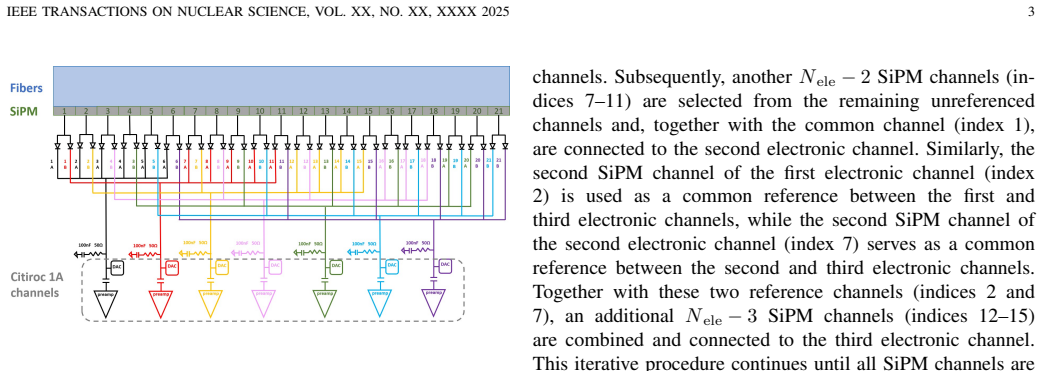
The central claim is that a diode-based symmetric charge division circuit paired with a position-encoding algorithm enables up to C squared of N electronic channels SiPM channels to be read out using only N electronic channels, and that a 21-to-7 implementation in a SciFi detector module achieves greater than 95 percent detection efficiency and approximately 0.65 mm spatial resolution with only minor degradation relative to per-channel direct readout.
What carries the argument
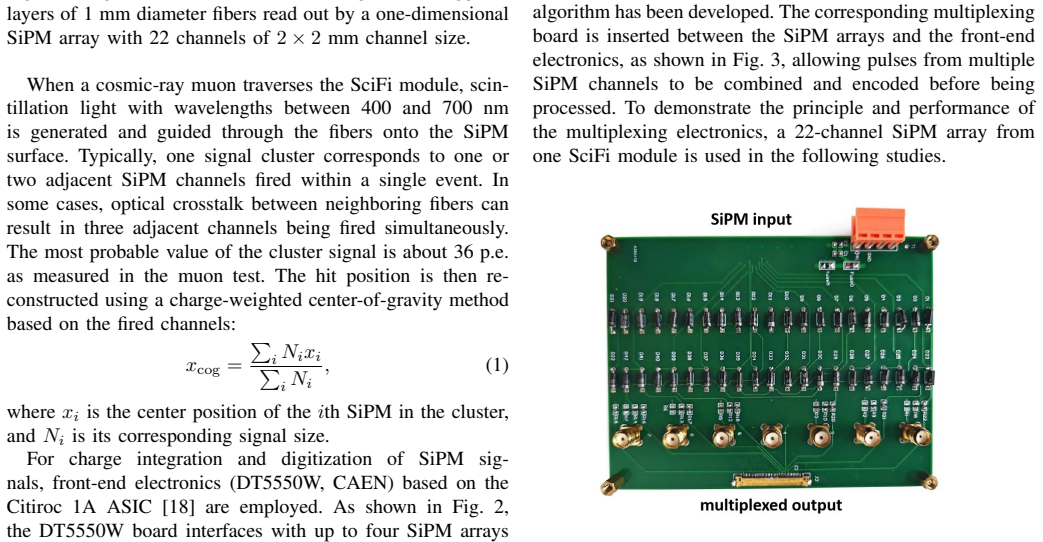
Diode-based symmetric charge division circuit combined with a position-encoding algorithm that reconstructs hit positions from the reduced set of multiplexed signals.
If this is right
- Large-area muon tomography systems can be built with far fewer electronics channels while retaining high efficiency and sub-millimeter resolution.
- The same multiplexing method applies to other one-dimensional SiPM-array scintillator detectors without major redesign.
- Circuit simulations and diode selection criteria provide a practical path to maintain SiPM signal integrity in the multiplexed configuration.
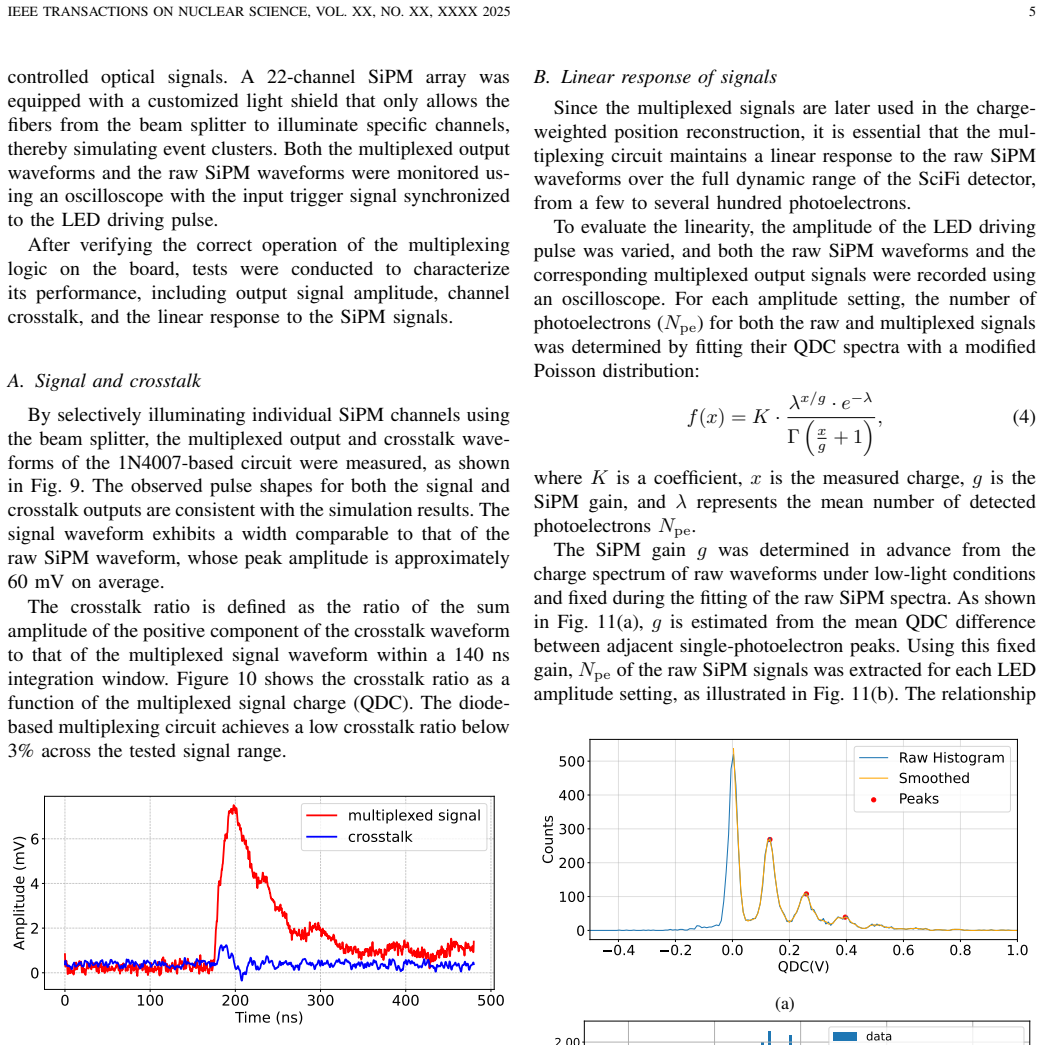
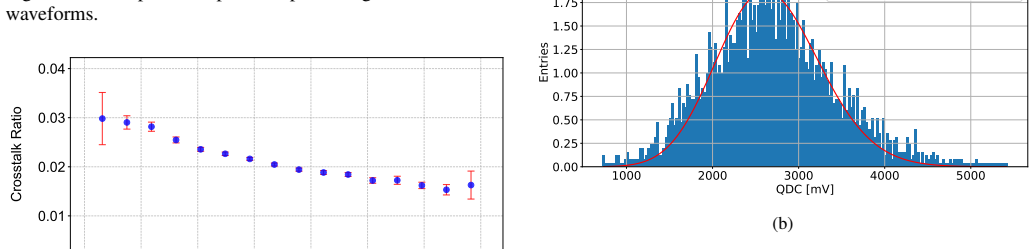
- Electronic-channel crosstalk remains low enough to support dynamic ranges from about 10 to 122 photoelectrons.
Where Pith is reading between the lines
- The channel-reduction factor grows quadratically with the number of electronic channels, which could make square-meter-scale fiber detectors feasible for industrial or security tomography.
- The same circuit might be adapted for timing or energy measurements in other cosmic-ray or particle-physics detectors that use linear SiPM arrays.
- If the encoding algorithm tolerates modest amplitude variation, the method could extend to higher-rate environments such as accelerator-based muon beams.
Load-bearing premise
The position-encoding algorithm reconstructs hit positions unambiguously from the multiplexed signals even when noise, amplitude variations, and diode non-idealities are present under typical cosmic-ray conditions.
What would settle it
A cosmic-ray test in which reconstructed hit positions show frequent ambiguities or the measured efficiency falls below 90 percent while spatial resolution worsens beyond 1 mm would falsify the claim that performance remains adequate.
Figures






read the original abstract
Muon tomography is a non-destructive imaging technique that uses cosmic-ray muons to probe dense materials. Bar scintillator and scintillating fiber detectors equipped with one-dimensional SiPM arrays offer compact, high-resolution solutions, but large-area implementations require effective reduction of readout channels while preserving detector performance. To address this challenge, we present a novel multiplexing scheme based on a diode-based symmetric charge division circuit combined with a position-encoding algorithm, enabling up to $N_{\textrm{SiPM}}^{\textrm{max}}=C^{2}_{N_{\textrm{ele}}}$ SiPM channels to be read out using only ${N_{\textrm{ele}}}$ electronic channels. Circuit simulations confirm the feasibility of the multiplexing design and guide the choice of appropriate diodes to preserve SiPM signal integrity. The approach was validated using a SciFi detector module comprising 21 SiPM channels multiplexed into 7 electronic channels. Electronic tests show that this multiplexing circuit exhibits low crosstalk between electronic channels, and preserves linearity over a dynamic range from $\sim$10 to 122 photoelectrons. Cosmic-ray measurements further show that the multiplexed SciFi detector achieves a detection efficiency above 95\% and a spatial resolution of about 0.65~mm, with only minor degradation compared to the direct (per SiPM channel) readout. These results verify that the proposed method provides a scalable and cost-effective readout solution for large-area muon tomography systems and is applicable to other scintillator-based detectors employing similar one-dimensional SiPM array readout.
Editorial analysis
A structured set of objections, weighed in public.
Referee Report
Summary. The paper introduces a diode-based symmetric charge-division multiplexing scheme that reduces the number of electronic readout channels for one-dimensional SiPM arrays in plastic scintillating fiber detectors, claiming that up to C²_N SiPM channels can be read out with only N electronic channels. Circuit simulations guide diode selection, electronic tests demonstrate low crosstalk and linearity from ~10 to 122 photoelectrons, and cosmic-ray measurements on a 21-SiPM module multiplexed into 7 channels report >95% detection efficiency and ~0.65 mm spatial resolution with only minor degradation relative to direct per-channel readout.
Significance. If the position-encoding algorithm reliably decodes hit positions without significant ambiguity under realistic amplitude spreads and noise, the approach provides a practical, scalable, and cost-effective readout solution for large-area muon tomography systems and similar scintillator detectors, directly addressing the channel-count bottleneck while preserving performance metrics that are competitive with direct readout.
major comments (1)
- [Cosmic-ray measurements / abstract] Cosmic-ray validation (abstract and results section): The headline claims of >95% efficiency and 0.65 mm resolution rest on the assumption that the position-encoding algorithm maps the 7-channel charge-division patterns to unique fiber positions without appreciable misassignment. No confusion matrix, per-event decoding error rate, or quantitative test under the reported 10–122 photoelectron amplitude range is provided; even a few-percent misassignment rate would inflate both efficiency and resolution figures relative to the direct-readout baseline and undermine the “minor degradation” claim.
minor comments (2)
- [Methods] The exact functional form of the position-encoding algorithm (weighted centroid, ratio-based, or template matching) and any threshold or gain-matching corrections applied before decoding should be stated explicitly with pseudocode or equations.
- [Results] Figure captions and text should clarify whether the reported resolution is the sigma of a Gaussian fit to the residual distribution or the FWHM, and whether it includes or excludes events with decoding ambiguity.
Simulated Author's Rebuttal
We thank the referee for their constructive feedback on our manuscript. We address the major comment on the cosmic-ray validation and position-encoding algorithm below, and we will incorporate additional quantitative analysis in the revised version.
read point-by-point responses
-
Referee: Cosmic-ray validation (abstract and results section): The headline claims of >95% efficiency and 0.65 mm resolution rest on the assumption that the position-encoding algorithm maps the 7-channel charge-division patterns to unique fiber positions without appreciable misassignment. No confusion matrix, per-event decoding error rate, or quantitative test under the reported 10–122 photoelectron amplitude range is provided; even a few-percent misassignment rate would inflate both efficiency and resolution figures relative to the direct-readout baseline and undermine the “minor degradation” claim.
Authors: We agree that an explicit quantitative assessment of the position-encoding algorithm would strengthen the presentation. In the revised manuscript we will add a dedicated analysis (new figure and text in the results section) that compares multiplexed and direct-readout events on an event-by-event basis. This will include (i) a confusion matrix for the decoded fiber positions and (ii) the per-event misassignment rate evaluated across the measured 10–122 photoelectron range. The existing side-by-side comparison already shows only minor degradation in efficiency and resolution, which indicates that decoding ambiguities are not dominant; the new metrics will make this explicit and allow readers to judge the residual error directly. revision: yes
Circularity Check
No significant circularity; results from direct measurements and simulations
full rationale
The paper reports detector performance (efficiency >95%, resolution ~0.65 mm) from cosmic-ray measurements on a physical 21-SiPM module and from electronic tests confirming linearity and low crosstalk. Circuit simulations are used only to guide diode selection and confirm feasibility of the multiplexing design, not to derive the final metrics. No equations, fitted parameters, self-citations, or uniqueness theorems appear in the provided text that reduce the claims to inputs by construction. The validation is external to any internal model loop and rests on hardware data collection.
Axiom & Free-Parameter Ledger
axioms (1)
- domain assumption SiPM output signals behave as charge sources that can be symmetrically divided by diodes while preserving sufficient integrity for position reconstruction.
Reference graph
Works this paper leans on
-
[1]
Navas, et al., Review of particle physics, Phys
S. Navas et al., “Review of particle physics,”Phys. Rev. D, vol. 110, no. 3, p. 030001, 2024, doi:10.1103/PhysRevD.110.030001
-
[2]
Radiographic imaging with cosmic-ray muons,
K. Borozdin et al., “Radiographic imaging with cosmic-ray muons,” Nature, vol. 422, no. 6929, p. 277, 2003, doi:10.1038/422277a
-
[3]
Applications of cosmic-ray muons,
G. Bonomi et al., “Applications of cosmic-ray muons,”Prog. Part. Nucl. Phys., vol. 112, p. 103768, 2020, doi:10.1016/j.ppnp.2020.103768
-
[4]
H. K. M. Tanaka et al., “Muography,”Nat. Rev. Methods Primers, vol. 3, no. 88, p. 88, 2023, doi:10.1038/s43586-023-00270-7
-
[5]
First-of-a-kind muography for nuclear waste charac- terization,
D. Mahon et al., “First-of-a-kind muography for nuclear waste charac- terization,”Philos. Trans. A, vol. 377, no. 2137, p. 20180048, 2018, doi:10.1098/rsta.2018.0048
-
[6]
Cosmic-ray tomography for border security,
S. Barnes et al., “Cosmic-ray tomography for border security,”Instru- ments, vol. 7, no. 1, p. 13, 2023, doi:10.3390/instruments7010013
-
[7]
Discovery of a big void in Khufu’s Pyramid by observation of cosmic-ray muons,
K. Morishima et al., “Discovery of a big void in Khufu’s Pyramid by observation of cosmic-ray muons,”Nature, vol. 552, no. 7685, pp. 386– 390, 2017, doi:10.1038/nature24647
-
[8]
G. Liu et al., “Deep investigation of muography in discovering geological structures in mineral exploration: a case study of Za- ozigou gold mine,”Geophys. J. Int., vol. 237, pp. 588–603, 2024, doi:10.1093/gji/ggae057
-
[9]
Design and operation of a field telescope for cosmic ray geophysical tomography,
N. Lesparre et al., “Design and operation of a field telescope for cosmic ray geophysical tomography,”Geosci. Instrum. Method. Data Syst., vol. 1, no. 1, pp. 33–42, 2012, doi:10.5194/gi-1-33-2012
-
[10]
The MU-RAY detector for muon radiography of volcanoes,
A. Anastasio et al., “The MU-RAY detector for muon radiography of volcanoes,”Nucl. Instrum. Methods Phys. Res. A, vol. 732, pp. 423–426, 2013, doi:10.1016/j.nima.2013.05.159
-
[11]
Z. Y . Wang et al., “Electronics design for a muon imaging system using triangular plastic scintillators with WLS fiber readouts,”J. Instrum., vol. 19, no. 02, p. P02033, 2024, doi:10.1088/1748-0221/19/02/P02033
-
[12]
A. Clarkson et al., “The design and performance of a scintillating-fibre tracker for the cosmic-ray muon tomography of legacy nuclear waste containers,”Nucl. Instrum. Methods Phys. Res. A, vol. 745, pp. 138– 149, 2014, doi:10.1016/j.nima.2014.01.062
-
[13]
G. Anbarjafari et al., “Atmospheric ray tomography for low-Z materials: implementing new methods on a proof-of-concept tomograph,” *arXiv preprint*, arXiv:2102.12542 [physics.ins-det], 2021
-
[14]
Compact cosmic ray muon scattering imaging system based on plastic scintillating fibers,
J. Zhai et al., “Compact cosmic ray muon scattering imaging system based on plastic scintillating fibers,”J. Instrum., vol. 19, no. 12, p. P12016, 2024, doi:10.1088/1748-0221/19/12/P12016
-
[15]
Y . Li et al., “Performance evaluation of compact plastic scintillating fiber modules for muon tomography applications,” *arXiv preprint*, arXiv:2509.14674 [physics.ins-det], 2025
-
[16]
Optical multiplexing for channel reduction in scintillator-based muon tomography system,
R. Sehgal and V . Jha, “Optical multiplexing for channel reduction in scintillator-based muon tomography system,”J. Appl. Phys., vol. 138, no. 24, p. 244501, 2025, doi:10.1063/5.0273319
-
[17]
H. Park et al., “Silicon photomultiplier signal readout and multiplexing techniques for positron emission tomography: a review,”Biomed. Eng. Lett., vol. 12, no. 3, pp. 263–283, 2022, doi:10.1007/s13534-022-00234- y
-
[18]
Citiroc 1A – Scientific instrumentation SiPM read out chip,
Weeroc, “Citiroc 1A – Scientific instrumentation SiPM read out chip,” [Online]. Available: https://www.weeroc.com/read out chips/citiroc-1a/. Accessed on: Feb. 22, 2025
work page 2025
-
[19]
Low-power charge division circuits for wireless applications based on silicon photomultipliers,
R. Massari et al., “Low-power charge division circuits for wireless applications based on silicon photomultipliers,”IEEE Sensors J., vol. 16, no. 23, pp. 8214–8219, 2016, doi:10.1109/JSEN.2016.2573638
-
[20]
J. Jung et al., “A diode-based symmetric charge division circuit with grounding path to reduce signal crosstalk and improve detector perfor- mance,”IEEE Trans. Radiat. Plasma Med. Sci., vol. 6, no. 7, pp. 788– 793, 2021, doi:10.1109/TRPMS.2021.3112184
-
[21]
TINA-TI ™ SPICE-Based Analog Simulation Pro- gram,
Texas Instruments, “TINA-TI ™ SPICE-Based Analog Simulation Pro- gram,” [Online]. Available: https://www.ti.com.cn/tool/cn/TINA-TI. Ac- cessed on: Feb. 22, 2025
work page 2025
-
[22]
Alignment of track detectors – Large scale optimiza- tion,
V . Blobel, “Alignment of track detectors – Large scale optimiza- tion,” DESY Seminar, Hamburg, Germany, 2007. [Online]. Avail- able: https://www.desy.de/ sschmitt/blobel/desy07talk.pdf. Accessed on: Feb. 22, 2025
work page 2007
-
[23]
A high spatial resolution muon tomography prototype system based on Micromegas detector,
Y . Wang et al., “A high spatial resolution muon tomography prototype system based on Micromegas detector,”IEEE Trans. Nucl. Sci., vol. 69, pp. 78–85, 2022, doi:10.1109/TNS.2021.3137415
discussion (0)
Sign in with ORCID, Apple, or X to comment. Anyone can read and Pith papers without signing in.