Observational appearance and photon rings of non-singular black holes from anisotropic fluids
Pith reviewed 2026-05-17 05:25 UTC · model grok-4.3
The pith
Non-singular black holes from anisotropic fluids produce photon rings nearly identical to Schwarzschild ones.
A machine-rendered reading of the paper's core claim, the machinery that carries it, and where it could break.
Core claim
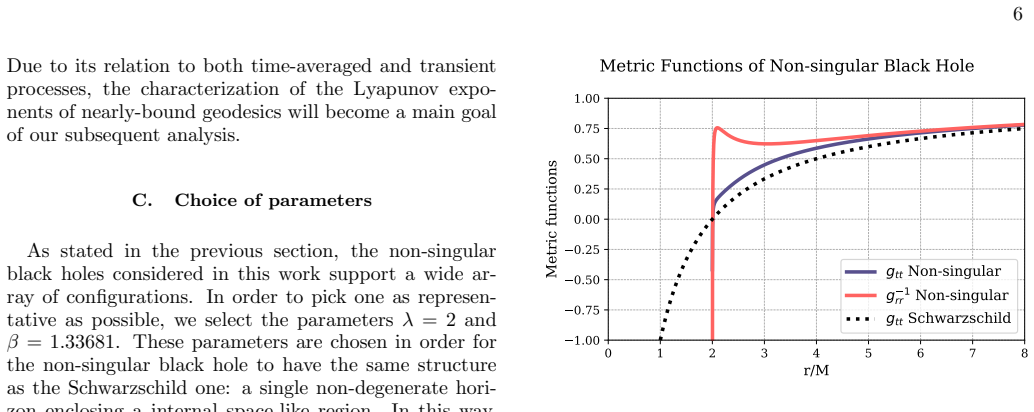
Non-singular spherically symmetric black holes arising from Eddington-inspired Born-Infeld gravity coupled to anisotropic fluids possess a single external horizon near r=2M and an unstable photon sphere at a moderately reduced radius relative to the Schwarzschild solution. When these spacetimes are illuminated by a geometrically and optically thin accretion disk whose monochromatic emission follows adapted Standard Unbound profiles, the generated images exhibit modified photon-ring and central-brightness features, yet fitting the widths of the first two photon rings recovers a Lyapunov exponent for nearly-bound geodesics that remains indistinguishable from the Schwarzschild case once the ent
What carries the argument
The Lyapunov exponent of nearly-bound geodesics, extracted by fitting the width ratio of the first two photon rings in thin-disk images.
Load-bearing premise
A geometrically and optically thin accretion disk with monochromatic emission given by adapted Standard Unbound profiles supplies an accurate enough representation that photon-ring width fitting can recover the true Lyapunov exponent without large biases from other effects.
What would settle it
A high-resolution observation of a black-hole candidate that measures the first two photon-ring widths to sufficient precision to show the recovered Lyapunov exponent lying outside the combined theoretical-numerical-disk-observational uncertainty band of the Schwarzschild prediction.
Figures


read the original abstract
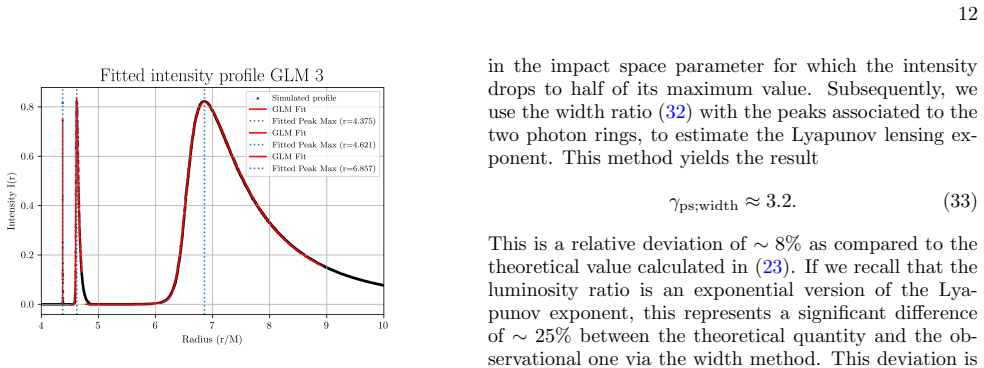
We consider the optical appearance of a non-singular, spherically symmetric black hole from Eddington-inspired Born-Infeld gravity coupled to anisotropic fluids. Such a black hole has a single (external) horizon located very near the Schwarzschild radius, $r_h=2M$, while its surface of unstable bound geodesics (photon sphere) is located at a moderately shortened radius than its Schwarzschild counterpart. Relying on a geometrically and optically thin accretion disk with a monochromatic emission described by suitable adaptations of Standard Unbound profiles previously employed in the literature, we generate images of this solution, which displays relevant modifications to the typical photon ring and central brightness depression features found in black hole images. In this sense, we fit the width of the two first photon rings in order to reconstruct the Lyapunov exponent of nearly-bound geodesics characterizing the theoretical ratio of successive rings. Such an exponent is tightly attached to observational features of photon rings such as their relative intensities in time-averaged images and the time-scale of hot-spots. Our results point out that non-singular black holes of this type are hard to distinguish from their Schwarzschild counterparts using this method alone, since the theoretical, numerical, disk-modeling, and observational uncertainties are too entangled with one another to allowing a neat distinction of such an exponent. It also points out to the need of incorporating dynamical settings such as hot-spots or quasi-normal modes from gravitational wave ringdowns as a way to circumvent such difficulties.
Editorial analysis
A structured set of objections, weighed in public.
Referee Report
Summary. The manuscript examines the optical appearance of non-singular spherically symmetric black holes arising in Eddington-inspired Born-Infeld gravity coupled to anisotropic fluids. These solutions possess a single external horizon near the Schwarzschild radius r_h=2M but feature a photon sphere at a moderately smaller radius. The authors generate synthetic images assuming a geometrically and optically thin accretion disk with monochromatic emission described by adapted Standard Unbound profiles, revealing modifications to the photon ring and central brightness depression. They fit the widths of the first two photon rings to reconstruct the Lyapunov exponent of nearly-bound geodesics and conclude that such non-singular black holes are difficult to distinguish from their Schwarzschild counterparts using this method alone, because theoretical, numerical, disk-modeling, and observational uncertainties are too entangled to permit a clean distinction; they suggest incorporating dynamical observables such as hot-spots or quasi-normal modes from gravitational-wave ringdowns.
Significance. If the central claim holds, the work is significant for providing a concrete illustration of the practical obstacles to distinguishing modified-gravity black-hole solutions from Schwarzschild via static photon-ring width measurements. It demonstrates that even a shortened photon sphere produces observable image changes, yet the extracted Lyapunov exponent remains too sensitive to modeling choices to yield a decisive test. This supplies a useful cautionary example for the Event Horizon Telescope and future imaging campaigns, underscoring the value of time-dependent or multi-messenger observables.
major comments (1)
- [§3] §3 (disk model and image generation): The indistinguishability conclusion rests on photon-ring width fits performed on images generated exclusively with a geometrically and optically thin disk whose emissivity follows adapted Standard Unbound profiles. Because the photon sphere lies at a smaller radius than 3M, the mapping from impact parameter to observed ring width is altered; any mismatch between the assumed emissivity profile and the true (unknown) one can shift the fitted widths by an amount comparable to the metric-induced shift. The manuscript does not report cross-checks with alternate radial profiles or thick-disk models, so it is unclear whether the reported entanglement of uncertainties survives changes to the disk prescription.
minor comments (2)
- The fitting procedure and results section would be strengthened by the inclusion of quantitative error bars or uncertainty estimates on the reconstructed Lyapunov exponent values.
- The range of the Eddington-inspired Born-Infeld parameter explored in the numerical examples should be stated explicitly, together with its effect on the photon-sphere location.
Simulated Author's Rebuttal
We thank the referee for their careful reading of our manuscript and for the constructive comments, which highlight important aspects of our analysis. We appreciate the positive assessment of the work's significance in illustrating practical challenges for distinguishing modified-gravity black holes via photon-ring observations. Below we respond point-by-point to the major comment.
read point-by-point responses
-
Referee: [§3] §3 (disk model and image generation): The indistinguishability conclusion rests on photon-ring width fits performed on images generated exclusively with a geometrically and optically thin disk whose emissivity follows adapted Standard Unbound profiles. Because the photon sphere lies at a smaller radius than 3M, the mapping from impact parameter to observed ring width is altered; any mismatch between the assumed emissivity profile and the true (unknown) one can shift the fitted widths by an amount comparable to the metric-induced shift. The manuscript does not report cross-checks with alternate radial profiles or thick-disk models, so it is unclear whether the reported entanglement of uncertainties survives changes to the disk prescription.
Authors: We thank the referee for this valid observation. The choice of emissivity profile is indeed a key modeling uncertainty, and because the photon sphere is shifted inward, the impact-parameter mapping to observed ring width can be affected. We selected the adapted Standard Unbound profiles as they are standard in the EHT literature for geometrically thin disks. To strengthen the robustness claim, we have performed supplementary ray-tracing calculations using an alternative power-law emissivity profile I(r) ∝ r^{-3}. The results show that absolute ring widths change, but the relative difference between our non-singular solution and Schwarzschild remains smaller than the variation caused by the profile change itself, preserving the conclusion that metric and disk uncertainties are entangled. We will add these cross-checks, together with a short discussion of their implications, to the revised manuscript (new subsection in §3). For thick-disk models we acknowledge the referee's point but note that they lie beyond the scope of the present thin-disk study; we will explicitly flag this as a limitation and a direction for future work. This constitutes a partial revision. revision: partial
Circularity Check
No significant circularity; Lyapunov exponent derived independently from geodesics
full rationale
The paper first obtains the spacetime metric from Eddington-inspired Born-Infeld gravity with anisotropic fluids, then computes the photon-sphere location and Lyapunov exponent directly from the geodesic equation on that metric. Simulated images are subsequently generated using an independent thin-disk emissivity model adapted from the literature, after which ring widths are measured to attempt reconstruction of the same exponent. Because the metric-derived Lyapunov value is obtained prior to and independently of the image-fitting step, the reconstruction does not reduce to the input by construction. No load-bearing self-citation or ansatz smuggling is present in the provided derivation chain, and the final indistinguishability statement follows from comparing these separate quantities under stated uncertainties rather than from any definitional equivalence.
Axiom & Free-Parameter Ledger
free parameters (1)
- Eddington-inspired Born-Infeld parameter
axioms (2)
- domain assumption Spherically symmetric and static spacetime
- domain assumption Anisotropic fluid with specific pressure anisotropy
Lean theorems connected to this paper
-
IndisputableMonolith/Foundation/RealityFromDistinction.leanreality_from_one_distinction unclear?
unclearRelation between the paper passage and the cited Recognition theorem.
We fit the width of the two first photon rings in order to reconstruct the Lyapunov exponent of nearly-bound geodesics... γ_ps ≈ 2.972 (γ_S_ps = π ≈ 3.141)
-
IndisputableMonolith/Cost/FunctionalEquation.leanwashburn_uniqueness_aczel unclear?
unclearRelation between the paper passage and the cited Recognition theorem.
The Lyapunov lensing exponent... γ_ps = π |Ω1| √|A − r² A''/2| at r_ps
What do these tags mean?
- matches
- The paper's claim is directly supported by a theorem in the formal canon.
- supports
- The theorem supports part of the paper's argument, but the paper may add assumptions or extra steps.
- extends
- The paper goes beyond the formal theorem; the theorem is a base layer rather than the whole result.
- uses
- The paper appears to rely on the theorem as machinery.
- contradicts
- The paper's claim conflicts with a theorem or certificate in the canon.
- unclear
- Pith found a possible connection, but the passage is too broad, indirect, or ambiguous to say the theorem truly supports the claim.
Reference graph
Works this paper leans on
-
[1]
for EiBI gravity with electromagnetic fields. On the other hand, the changes to the inner region of the solutions have also an impact in their global struc- ture in terms of horizons. In this sense, the configura- tions withδ 1 > δ c resemble the Reissner-Nordstr¨ om so- lutions in the sense of having two, one (degenerate) or none horizons. On the other h...
-
[2]
We take a finite limit to the sum of themandn indices, tom max andn max, considering that they will converge to a beforehand specified precision, F1 (α, β1, β2, γ;x, y) = mmaxX m=0 nmaxX n=0 (. . .)
-
[3]
This reduces the operations from O(mmax ·n max) toO(m max +n max)
Before doing the sums of the Appell function, pre- calculate the powersx m andy m, avoiding redun- dant calculations. This reduces the operations from O(mmax ·n max) toO(m max +n max)
-
[4]
We perform the same method for (γ)m+n, and the Gamma functions Γ(m+ 1) and Γ(n+ 1)
Before doing the sums of the Appell function, pre- calculate the Pochhammer symbols, (α)m+n, as the 15 summ+nyields redundant values when perform- ing the sums. We perform the same method for (γ)m+n, and the Gamma functions Γ(m+ 1) and Γ(n+ 1). For our specific metric,β 1 =β 2, so we can also precalculate the values of (β 1)m, and share them with (β 2)n. ...
-
[5]
We add a convergence check to avoid summing ex- tra values below our precision
Calculate the sum by checking the precalculated values of the Pochhammer and Gamma functions. We add a convergence check to avoid summing ex- tra values below our precision. Following this method, we go from the brute-force al- gorithm of orderO(N 2) to orderO(2N), beingNthe number of terms in the sum. We have found that mmax =n max = 10 converges the int...
- [6]
- [7]
-
[8]
Black Hole Uniqueness Theorems,
M. Heusler, “Black Hole Uniqueness Theorems,” Cam- bridge University Press (1996)
work page 1996
- [9]
-
[10]
B. P. Abbottet al.[LIGO Scientific and Virgo], Phys. Rev. Lett.116(2016) 061102
work page 2016
- [11]
-
[12]
Akiyamaet al.[Event Horizon Telescope], Astrophys
K. Akiyamaet al.[Event Horizon Telescope], Astrophys. J. Lett.875(2019) L1
work page 2019
-
[13]
Akiyamaet al.[Event Horizon Telescope], Astrophys
K. Akiyamaet al.[Event Horizon Telescope], Astrophys. J. Lett.930(2022) L12
work page 2022
-
[14]
J. E. Greene, J. Strader, L. C. Ho, Annual Review of Astronomy and Astrophysics58(2020) 257
work page 2020
-
[15]
J. Garcia-Bellido and E. Ruiz Morales, Phys. Dark Univ. 18(2017) 47
work page 2017
- [16]
- [17]
- [18]
-
[19]
J. M. M. Senovilla and D. Garfinkle, Class. Quant. Grav. 32(2015) 124008
work page 2015
- [20]
- [21]
-
[22]
S. W. Hawking, Phys. Rev. D72(2005) 084013
work page 2005
-
[23]
P. Chen, Y. C. Ong and D. h. Yeom, Phys. Rept.603 (2015) 1
work page 2015
-
[24]
Regular Black Holes. Towards a New Paradigm of Gravitational Collapse,
C. Bambi, “Regular Black Holes. Towards a New Paradigm of Gravitational Collapse,” Springer, 2023
work page 2023
- [25]
-
[26]
T. Clifton, P. G. Ferreira, A. Padilla and C. Skordis, Phys. Rept.513(2012) 1
work page 2012
- [27]
-
[28]
T. P. Sotiriou and S. Liberati, Annals Phys.322(2007) 935
work page 2007
-
[29]
G. J. Olmo, Int. J. Mod. Phys. D20(2011) 413
work page 2011
-
[30]
J. Beltr´ an Jim´ enez, L. Heisenberg and T. S. Koivisto, Universe5(2019) 173
work page 2019
-
[31]
V. I. Afonso, G. J. Olmo and D. Rubiera-Garcia, Phys. Rev. D97(2018) 021503
work page 2018
-
[32]
M. Banados and P. G. Ferreira, Phys. Rev. Lett.105 (2010) 011101 [erratum: Phys. Rev. Lett.113(2014) 119901]
work page 2010
-
[33]
V. I. Afonso, G. J. Olmo, E. Orazi and D. Rubiera- Garcia, Eur. Phys. J. C78(2018) 866
work page 2018
-
[34]
G. J. Olmo and D. Rubiera-Garcia, Int. J. Mod. Phys. D 31(2022) 2240012
work page 2022
- [35]
-
[36]
J. R. Nascimento, G. J. Olmo, P. J. Porfirio, A. Y. Petrov and A. R. Soares, Phys. Rev. D99(2019) 064053
work page 2019
-
[37]
W. H. Shao, C. Y. Chen and P. Chen, JCAP03(2021) 041
work page 2021
- [38]
-
[39]
J. Bora, D. J. Gogoi and U. D. Goswami, JCAP09(2022) 057
work page 2022
-
[40]
A. R. Soares, R. L. L. Vit´ oria and C. F. S. Pereira, Eur. Phys. J. C83(2023) 903
work page 2023
- [41]
-
[42]
R. B. Magalh˜ aes, A. Mas´ o-Ferrando, G. J. Olmo and L. C. B. Crispino, Phys. Rev. D108(2023) 024063
work page 2023
- [43]
-
[44]
I. D. Gialamas and A. B. Lahanas, Phys. Rev. D101 (2020) 084007
work page 2020
-
[45]
V. M. Enckell, K. Enqvist, S. Rasanen and L. P. Wahlman, JCAP02(2019) 022
work page 2019
- [46]
-
[47]
I. D. Gialamas, A. Karam, T. D. Pappas and V. C. Spanos, Phys. Rev. D104(2021) 023521
work page 2021
-
[48]
D. A. Gomes, R. Briffa, A. Kozak, J. Levi Said, M. Saal and A. Wojnar, JCAP01(2024) 011
work page 2024
- [49]
-
[50]
J. Beltran Jimenez, L. Heisenberg, G. J. Olmo and D. Rubiera-Garcia, Phys. Rept.727(2018) 1
work page 2018
-
[51]
Y. Hou, M. Guo and B. Chen, Phys. Rev. D104(2021) 024001
work page 2021
- [52]
-
[53]
X. M. Kuang, Z. Y. Tang, B. Wang and A. Wang, Phys. Rev. D106(2022) 064012
work page 2022
-
[54]
J. Daas, K. Kuijpers, F. Saueressig, M. F. Wondrak and H. Falcke, Astron. Astrophys.673(2023) A53
work page 2023
-
[55]
Y. Meng, X. M. Kuang, X. J. Wang, B. Wang and J. P. Wu, Phys. Rev. D108(2023) 064013
work page 2023
-
[56]
M. Xu, R. Li, J. Lu, S. Yang and S. M. Wu, Eur. Phys. 16 J. C85(2025) 676
work page 2025
-
[57]
H. Olivares, Z. Younsi, C. M. Fromm, M. De Laurentis, O. Porth, Y. Mizuno, H. Falcke, M. Kramer and L. Rez- zolla, Mon. Not. Roy. Astron. Soc.497(2020) 521
work page 2020
-
[58]
A. B. Joshi, D. Dey, P. S. Joshi and P. Bambhaniya, Phys. Rev. D102(2020) 024022
work page 2020
-
[59]
P. L. B. de S´ a, H. C. D. Lima, Jr., C. A. R. Herdeiro and L. C. B. Crispino, Phys. Rev. D110(2024) 104047
work page 2024
-
[60]
M. F. Fauzi, B. N. Jayawiguna, H. S. Ramadhan and A. Sulaksono, Eur. Phys. J. C85(2025) 903
work page 2025
- [61]
- [62]
-
[63]
M. H. Daouda, M. E. Rodrigues and M. J. S. Houndjo, Phys. Lett. B715(2012) 241
work page 2012
-
[64]
S. K. Maurya and S. D. Maharaj, Eur. Phys. J. C77 (2017) 328
work page 2017
- [65]
- [66]
-
[67]
M. D. Johnson,et al.Proc. SPIE Int. Soc. Opt. Eng. 13092(2024) 130922D
work page 2024
- [68]
-
[69]
J. Lewandowski, Y. Ma, J. Yang and C. Zhang, Phys. Rev. Lett.130(2023) 101501
work page 2023
-
[70]
J. T. S. S. Junior, F. S. N. Lobo and M. E. Rodrigues, Class. Quant. Grav.41(2024) 055012
work page 2024
-
[71]
G. J. Olmo, D. Rubiera-Garcia and A. Sanchez-Puente, Class. Quant. Grav.33(2016) 115007
work page 2016
-
[72]
G. J. Olmo, J. L. Rosa, D. Rubiera-Garcia and D. Saez- Chillon Gomez, Class. Quant. Grav.40(2023) 174002
work page 2023
-
[73]
R. Carballo-Rubio and A. Eichhorn, Int. J. Mod. Phys. D33(2024) 2441023
work page 2024
-
[74]
P. V. P. Cunha, E. Berti and C. A. R. Herdeiro, Phys. Rev. Lett.119(2017) 251102
work page 2017
-
[75]
P. Kocherlakota, L. Rezzolla, R. Roy and M. Wielgus, Phys. Rev. D109(2024) 064064
work page 2024
-
[76]
P. Kocherlakota, L. Rezzolla, R. Roy and M. Wielgus, Mon. Not. Roy. Astron. Soc.531(2024) 3606
work page 2024
-
[77]
A. C´ ardenas-Avenda˜ no and A. Held, Phys. Rev. D109 (2024) 064052
work page 2024
- [78]
-
[79]
V. Cardoso, A. S. Miranda, E. Berti, H. Witek and V. T. Zanchin, Phys. Rev. D79(2009) 064016
work page 2009
- [80]
discussion (0)
Sign in with ORCID, Apple, or X to comment. Anyone can read and Pith papers without signing in.