Multiqubit Rydberg Gates for Quantum Error Correction
Pith reviewed 2026-05-17 03:09 UTC · model grok-4.3
The pith
Global three-qubit Rydberg gates enable competitive fault-tolerant quantum error correction in neutral atoms.
A machine-rendered reading of the paper's core claim, the machinery that carries it, and where it could break.
Core claim
Multiqubit gates with three or more qubits can be beneficial for fault-tolerant quantum error correction when implemented via global pulses on neutral atoms. The work develops analytical, few-parameter pulses that realize CCZ operations in symmetric and asymmetric configurations and three-qubit gates for stabilizer readout, both while minimizing errors from Rydberg-state decay. Simulations with realistic noise then show that measurement-free QEC reaches break-even and that Floquet codes using three-qubit gates deliver competitive logical-qubit performance while requiring fewer shuttling operations.
What carries the argument
Analytical few-parameter pulses generated by an open-source Python package that implement CCZ and three-qubit Rydberg gates while minimizing Rydberg-state decay for atoms in symmetric or asymmetric arrangements.
If this is right
- Break-even performance of measurement-free QEC becomes reachable with present-day single-qubit, two-qubit, and three-qubit gate error rates.
- Three-qubit gates for stabilizer measurements in Floquet codes reduce the number of required shuttling operations.
- Logical-qubit error rates remain competitive in experimentally relevant noise regimes when three-qubit gates replace separate two-qubit measurements.
- The same global-pulse approach extends to fault-tolerant stabilizer readout in unrotated surface codes.
Where Pith is reading between the lines
- Neutral-atom processors could run fault-tolerant protocols without individual laser addressing, simplifying optical hardware for larger arrays.
- Lower shuttling demand may reduce cumulative motion-induced errors in scaled architectures.
- The pulse-optimization method could be reused to design other multiqubit Rydberg operations beyond CCZ.
Load-bearing premise
The Rydberg-state decay and other modeled error channels remain the dominant limitations and the proposed analytical pulses can be realized experimentally without introducing unmodeled control errors or crosstalk.
What would settle it
An experiment that implements one of the proposed analytical pulses for a three-qubit gate, measures its actual error rate under realistic conditions, and runs a full stabilizer-measurement cycle showing logical error below physical error would confirm the performance claims; persistent failure to reach break-even once the pulses are deployed would falsify the simulation predictions.
Figures





read the original abstract
Multiqubit gates that involve three or more qubits are usually thought to be of little significance for fault-tolerant quantum error correction because single gate faults can lead to errors of high Pauli weight. However, recent works have shown that multiqubit gates can be beneficial for measurement-free fault-tolerant quantum error correction and for fault-tolerant stabilizer readout in unrotated surface codes. In this work, we investigate multiqubit Rydberg gates that are useful for fault-tolerant quantum error correction in single-species neutral-atom platforms and can be implemented with global laser pulses that do not individually address atomic sites. We develop an open-source Python package to generate analytical, few-parameter pulses that implement the desired gates while minimizing gate errors due to Rydberg-state decay. The tool also allows us to identify parameter-optimal pulses, characterized by a minimal parameter count for the pulse ansatz. Measurement-free quantum error correction protocols require CCZ gates, which we analyze for atoms arranged in symmetric and asymmetric configurations. We investigate the performance of these schemes for various single-, two-, and three-qubit gate error rates, showing that break-even performance of measurement-free QEC is within reach of current hardware. Moreover, we study Floquet quantum error correction protocols that comprise two-body stabilizer measurements. Those can be realized using global three-qubit gates, and we show that this can lead to a significant reduction in shuttling operations. Simulations with realistic circuit-level noise indicate that applying three-qubit gates for stabilizer measurements in Floquet codes can yield competitive logical qubit performance in experimentally relevant error regimes.
Editorial analysis
A structured set of objections, weighed in public.
Referee Report
Summary. The manuscript develops analytical few-parameter pulses for implementing multiqubit Rydberg gates (including CCZ and three-qubit gates) via global laser pulses in neutral-atom arrays, without individual site addressing. An open-source Python package is provided to generate these pulses while minimizing Rydberg-state decay errors. The work analyzes these gates for measurement-free QEC protocols and for stabilizer measurements in Floquet codes, reporting circuit-level noise simulations that indicate competitive logical performance and that break-even measurement-free QEC is within reach of current hardware.
Significance. If the central simulation results hold, the work provides a concrete route to lowering shuttling and measurement overhead in neutral-atom QEC by exploiting global multiqubit operations. The open-source pulse-generation tool is a clear strength for reproducibility and experimental adoption. The analysis of both symmetric/asymmetric atom configurations for CCZ and the reduction in shuttling for Floquet codes adds practical value.
major comments (1)
- [Results sections on Floquet QEC simulations and measurement-free QEC performance] The circuit-level noise simulations (described in the sections reporting logical error rates for Floquet codes and measurement-free QEC) employ standard independent local error models. Because the three-qubit gates are realized with global Rydberg-blockade pulses, residual Rydberg population, imperfect blockade, and laser-intensity fluctuations induce correlated phase or leakage errors across the three qubits. These correlations are not equivalent to independent Pauli channels and can raise the effective fault weight seen by the decoder, potentially pushing logical error rates above the reported thresholds in the experimentally relevant regimes claimed.
minor comments (2)
- [Abstract] The abstract states that 'realistic circuit-level noise' is used but does not list the precise per-gate error rates or the exact depolarizing/pauli probabilities; these parameters should be stated explicitly in the main text or a table for reproducibility.
- [Methods section on pulse generation] The description of the open-source package would benefit from a brief statement of how the analytical ansatz was validated against full numerical optimal control or against measured pulse fidelities.
Simulated Author's Rebuttal
We thank the referee for their positive summary and for highlighting the practical value of our work on global multiqubit Rydberg gates. We address the single major comment below and describe the revisions we will make to strengthen the noise-model analysis.
read point-by-point responses
-
Referee: [Results sections on Floquet QEC simulations and measurement-free QEC performance] The circuit-level noise simulations (described in the sections reporting logical error rates for Floquet codes and measurement-free QEC) employ standard independent local error models. Because the three-qubit gates are realized with global Rydberg-blockade pulses, residual Rydberg population, imperfect blockade, and laser-intensity fluctuations induce correlated phase or leakage errors across the three qubits. These correlations are not equivalent to independent Pauli channels and can raise the effective fault weight seen by the decoder, potentially pushing logical error rates above the reported thresholds in the experimentally relevant regimes claimed.
Authors: We agree that the simulations reported in the manuscript rely on standard independent local Pauli error models, which is the conventional approach for establishing baseline thresholds in the literature. The referee correctly notes that global Rydberg-blockade pulses can in principle generate correlated errors (e.g., shared phase shifts or leakage from residual Rydberg population or intensity inhomogeneity). Our pulse-optimization package already minimizes Rydberg decay, but it does not yet incorporate a full microscopic model of these correlations into the circuit-level Monte Carlo runs. We will therefore revise the relevant results sections to (i) explicitly state the independent-error assumption, (ii) add a qualitative discussion of how residual Rydberg population and imperfect blockade translate into correlated channels, and (iii) include a limited set of additional simulations under a simple three-qubit correlated-error model (e.g., a shared phase-flip or leakage operator applied to the gate support). These additions will allow us to quantify whether the reported logical-error rates remain competitive or cross the threshold in the experimentally relevant regime. We do not claim that the independent model is exact; the revision will make the limitations transparent while preserving the central conclusion that global multiqubit gates can reduce shuttling overhead. revision: yes
Circularity Check
No circularity: performance claims rest on independent simulations and ansatz-based pulse generation
full rationale
The paper's central results derive from developing an open-source pulse-generation tool that produces analytical few-parameter pulses from a stated ansatz, followed by numerical simulations of logical error rates under circuit-level noise models. These steps do not reduce to self-definition or fitted inputs: the pulse parameters are chosen to minimize Rydberg decay errors independently of the QEC performance metric, and the reported logical-qubit thresholds are obtained from forward simulation rather than by construction from the same data. No load-bearing self-citation chains or uniqueness theorems imported from prior author work appear in the derivation. The simulations employ standard independent error channels whose assumptions are stated separately from the target performance numbers, rendering the chain self-contained.
Axiom & Free-Parameter Ledger
free parameters (1)
- pulse parameters in the analytical ansatz
axioms (1)
- domain assumption Rydberg-state lifetime and decay channels dominate gate infidelity under global driving
Lean theorems connected to this paper
-
IndisputableMonolith/Cost/FunctionalEquation.leanwashburn_uniqueness_aczel unclear?
unclearRelation between the paper passage and the cited Recognition theorem.
We develop an open-source Python package to generate analytical, few-parameter pulses that implement the desired gates while minimizing gate errors due to Rydberg-state decay.
-
IndisputableMonolith/Foundation/DimensionForcing.leanalexander_duality_circle_linking unclear?
unclearRelation between the paper passage and the cited Recognition theorem.
Simulations with realistic circuit-level noise indicate that applying three-qubit gates for stabilizer measurements in Floquet codes can yield competitive logical qubit performance
What do these tags mean?
- matches
- The paper's claim is directly supported by a theorem in the formal canon.
- supports
- The theorem supports part of the paper's argument, but the paper may add assumptions or extra steps.
- extends
- The paper goes beyond the formal theorem; the theorem is a base layer rather than the whole result.
- uses
- The paper appears to rely on the theorem as machinery.
- contradicts
- The paper's claim conflicts with a theorem or certificate in the canon.
- unclear
- Pith found a possible connection, but the passage is too broad, indirect, or ambiguous to say the theorem truly supports the claim.
Forward citations
Cited by 3 Pith papers
-
Multi-Qubit Stabilizer Readout on a Dual-Species Rydberg Array
Dual-species Na-Cs Rydberg array enables simultaneous non-destructive readout of multiple Pauli-Z stabilizers on four-qubit plaquettes using a single global pulse sequence after compensating geometric phase errors.
-
Three-body interactions in Rydberg lattices
A scheme is developed to engineer strong three-body interactions in Rydberg atom lattices, allowing the effective Hamiltonian and emergent quantum phases to be modified compared to two-body-only systems.
-
Numerically optimized amplitude-robust controlled-Z gate for ultracold neutral atoms with individual addressing capability
A numerically optimized Rydberg blockade CZ gate for neutral atoms improves robustness to Rabi frequency variations by nearly an order of magnitude and works with individual laser addressing at finite temperatures.
Reference graph
Works this paper leans on
-
[1]
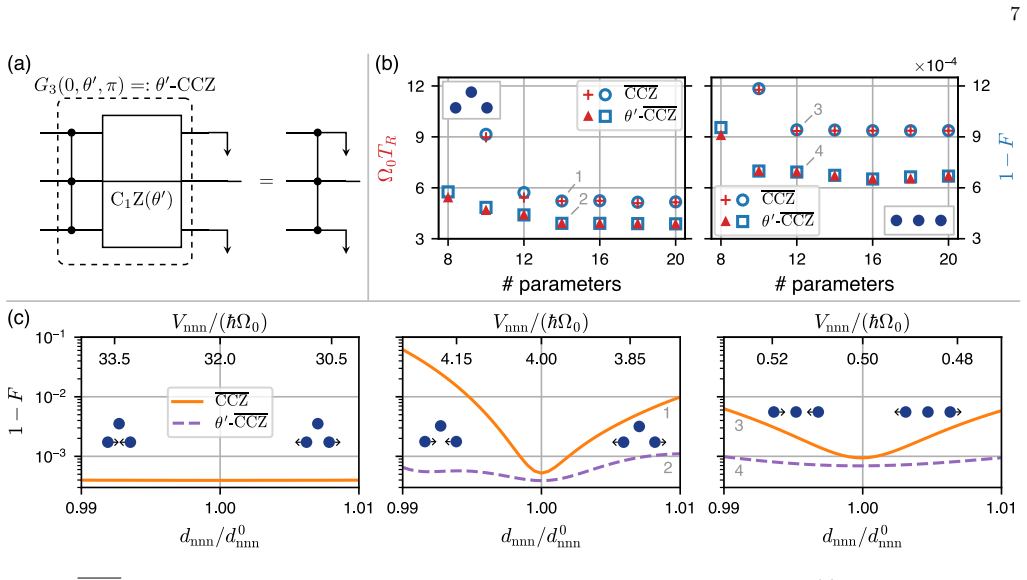
The right triangle then corresponds to a next-nearest neighbour interaction strength ofV nnn/(ℏΩ0) = 4, and for the line we getV nnn/(ℏΩ0) = 0.5. In both of these cases, the realization of the gate is more difficult than in the infinite blockade and the symmetric finite blockade 8 cases because more constraints have to be fulfilled and more states are inv...
-
[2]
Initializing allndata qubits in the state|+⟩ ⊗n
-
[3]
Performing 3d circ rounds of measurements, each containing the 6 subrounds of measurements in the schedule [⟨rX ⟩,⟨g Y ⟩,⟨b Z⟩,⟨r X ⟩,⟨b Z⟩,⟨g Y ⟩]
-
[4]
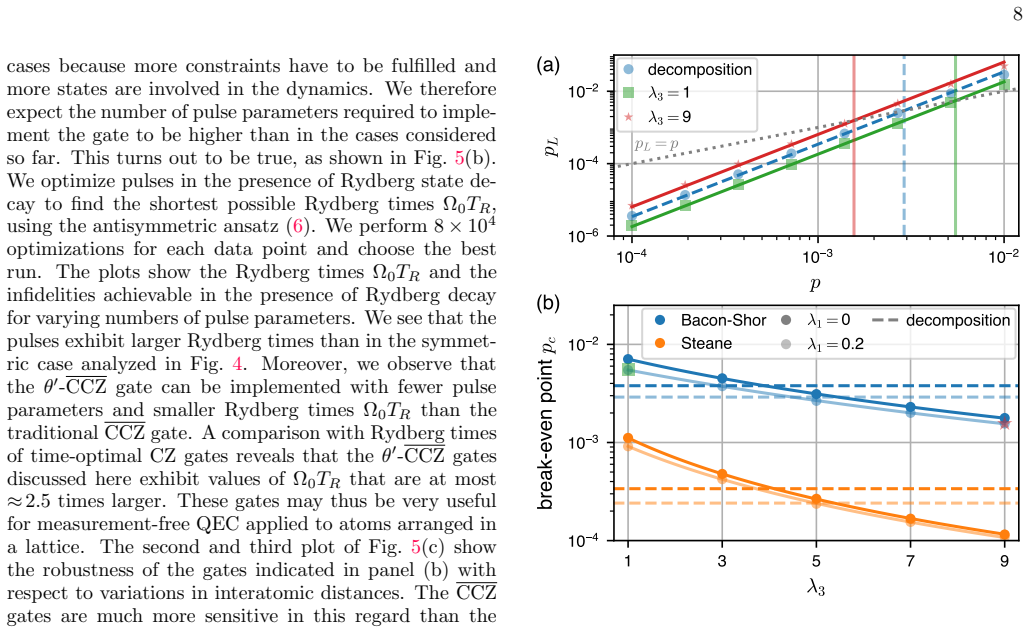
Measuring all data qubits in theX-basis. The circuit-level distance is the number of fault mech- anisms required to introduce an undetected logical er- ror. It therefore depends on the actual circuit imple- menting the measurements and on the noise model. For 13 10 4 10 3 10 2 10 1 100 pL (a) β = 0 (b) β = 0.95 (c) β = 1 size=2 size=3 size=4 size=5 CZ-CZ ...
-
[5]
M.M., D.F.L., J.O., and J.H. acknowledge fund- ing by the Munich Quantum Valley (K-8), which is sup- ported by the Bavarian state government with funds from the Hightech Agenda Bayern Plus, and by the DFG under Germany’s Excellence Strategy ‘Cluster of Excellence Matter and Light for Quantum Computing (ML4Q)’ EXC 2004/1 – 390534769. K.B., S.W., and H.P.B....
work page 2004
-
[6]
Planar honeycomb Floquet code ThehoneycombFloquet code, introduced in Refs. [34, 35] defines the Floquet code on a hexagonal, three-colorable tiling of a torus: qubits are put on vertices, and the colors of the edges define the measurement sequence: PauliXX, Y YandZZoperators are measured on qubits adjacent to red, green and blue edges respectively. We de...
-
[7]
We refer to such a (set of) measurements as adetector[56, 57, 59]
Error correction in planar Floquet codes Error correction in general works by looking at measurements or sets of measurements that are deterministic in the absence of noise. We refer to such a (set of) measurements as adetector[56, 57, 59]. For a regular stabilizer code, the detectors are the stabilizer measurements, or parities, i.e. sums, of consecutive...
-
[8]
Sample the noisy circuits. A shot samples a fault-vector ⃗faccording to the probability distribution⃗ pand calculates the syndrome ⃗d=D ⃗fand the observable outcome⃗ o=O ⃗f
-
[9]
This results in a fault-guess ⃗f ′ and an associated observable prediction⃗ o′ =O ⃗f ′
Decode the syndrome ⃗d. This results in a fault-guess ⃗f ′ and an associated observable prediction⃗ o′ =O ⃗f ′
-
[10]
If⃗ o′ ̸=⃗ o, count a logical error. It turns out that decoding the honeycomb Floquet code is equivalent to decoding the surface code [34]. For a circuit- level noise model, the detector error model still has to be decomposed in order to generate a matchable decoding problem. We show a decomposed detector error model graph in Fig. 16(c). This graph is the...
-
[11]
Planar honey- comb codes were introduced in Refs
Other variants of Floquet codes There exist CSS versions of honeycomb codes where onlyX- andZ- operators are measured [68, 69]. Planar honey- comb codes were introduced in Refs. [36, 70] and benchmarked in Ref. [37]. There are numerous other constructions of Floquet codes,hyperbolichoneycomb codes, e.g. allow for a higher encoding rate [71, 72]. XYZ ruby ...
-
[12]
To mimic a three-qubit depolarizing channel, we usestims included correlated error feature
Implementing three-qubit gates andn-qubit depolarizing errors instim To implement theG 3-gates and depolarizing channels acting onn >2 qubits instim, we place three CZ-gates in the sameTICK. To mimic a three-qubit depolarizing channel, we usestims included correlated error feature. We present the basic idea with an example. Consider a 2-qubit bit-flip cha...
-
[13]
M. A. Nielsen and I. L. Chuang,Quantum Computation and Quantum Information: 10th Anniversary Edition(Cambridge University Press, 2010)
work page 2010
- [14]
-
[15]
M. A. Perlin, V. N. Premakumar, J. Wang, M. Saffman, and R. Joynt, Fault-tolerant measurement-free quantum error correction with multiqubit gates, Phys. Rev. A108, 062426 (2023)
work page 2023
- [16]
-
[17]
K. Brechtelsbauer, F. Butt, D. F. Locher, S. H. Quintero, S. Weber, M. M¨ uller, and H. P. B¨ uchler, Measurement-free quantum error correction optimized for biased noise, PRX Quantum , (to be published) (2025)
work page 2025
-
[18]
F. Butt, D. F. Locher, K. Brechtelsbauer, H. P. B¨ uchler, and M. M¨ uller, Measurement-free, scalable, and fault-tolerant universal quantum computing, Science Advances11, eadv2590 (2025)
work page 2025
- [19]
-
[20]
J. Old, S. Tasler, M. J. Hartmann, and M. M¨ uller, Fault-tolerant stabilizer measurements in surface codes with three-qubit gates, Phys. Rev. Lett. , (to be published) (2025)
work page 2025
-
[21]
L. Pecorari, S. Jandura, and G. Pupillo, Low-depth quantum error correction via three-qubit gates in Rydberg atom arrays, Phys. Rev. Lett. , (to be published) (2025)
work page 2025
-
[22]
K. Mølmer and A. Sørensen, Multiparticle entanglement of hot trapped ions, Phys. Rev. Lett.82, 1835 (1999)
work page 1999
-
[23]
Y. Kim, A. Morvan, L. B. Nguyen, R. K. Naik, C. J¨ unger, L. Chen, J. M. Kreikebaum, D. I. Santiago, and I. Siddiqi, High-fidelity three-qubit iToffoli gate for fixed-frequency superconducting qubits, Nature Physics18, 783 (2022)
work page 2022
- [24]
-
[25]
M. Saffman, T. G. Walker, and K. Mølmer, Quantum information with Rydberg atoms, Reviews of Modern Physics82, 2313 (2010)
work page 2010
-
[26]
M. Saffman, Quantum computing with atomic qubits and Rydberg interactions: Progress and challenges, Journal of Physics B: Atomic, Molecular and Optical Physics49, 202001 (2016)
work page 2016
-
[27]
L. Henriet, L. Beguin, A. Signoles, T. Lahaye, A. Browaeys, G.-O. Reymond, and C. Jurczak, Quantum computing with neutral atoms, Quantum4, 327 (2020)
work page 2020
-
[28]
M. Morgado and S. Whitlock, Quantum simulation and computing with Rydberg-interacting qubits, AVS Quantum Science 3, 023501 (2021)
work page 2021
-
[29]
K. McDonnell, L. F. Keary, and J. D. Pritchard, Demonstration of a quantum gate using electromagnetically induced transparency, Phys. Rev. Lett.129, 200501 (2022)
work page 2022
-
[30]
S. J. Evered, M. Bluvstein, Dolevand Kalinowski, S. Ebadi, T. Manovitz, H. Zhou, S. H. Li, A. A. Geim, T. T. Wang, N. Maskara, H. Levine, G. Semeghini, M. Greiner, V. Vuleti´ c, and M. D. Lukin, High-fidelity parallel entangling gates on a neutral-atom quantum computer, Nature622, 268 (2023)
work page 2023
-
[31]
A. Cao, W. J. Eckner, T. Lukin Yelin, A. W. Young, S. Jandura, L. Yan, K. Kim, G. Pupillo, J. Ye, N. Darkwah Oppong, and A. M. Kaufman, Multi-qubit gates and schr¨ odinger cat states in an optical clock, Nature634, 315 (2024)
work page 2024
-
[32]
M. M¨ uller, I. Lesanovsky, H. Weimer, H. P. B¨ uchler, and P. Zoller, Mesoscopic Rydberg gate based on electromagnetically induced transparency, Phys. Rev. Lett.102, 170502 (2009)
work page 2009
-
[33]
M. Khazali and K. Mølmer, Fast multiqubit gates by adiabatic evolution in interacting excited-state manifolds of Rydberg atoms and superconducting circuits, Phys. Rev. X10, 021054 (2020)
work page 2020
-
[34]
J. T. Young, P. Bienias, R. Belyansky, A. M. Kaufman, and A. V. Gorshkov, Asymmetric blockade and multiqubit gates via dipole-dipole interactions, Phys. Rev. Lett.127, 120501 (2021)
work page 2021
-
[35]
S. Jandura and G. Pupillo, Time-optimal two- and three-qubit gates for Rydberg atoms, Quantum6, 712 (2022)
work page 2022
-
[36]
G. Pelegr´ ı, A. J. Daley, and J. D. Pritchard, High-fidelity multiqubit Rydberg gates via two-photon adiabatic rapid passage, Quantum Science and Technology7, 045020 (2022)
work page 2022
- [37]
- [38]
-
[39]
D. Bluvstein, S. J. Evered, A. A. Geim, S. H. Li, H. Zhou, T. Manovitz, S. Ebadi, M. Cain, M. Kalinowski, D. Hangleiter, J. P. Bonilla Ataides, N. Maskara, I. Cong, X. Gao, P. Sales Rodriguez, T. Karolyshyn, G. Semeghini, M. J. Gullans, M. Greiner, V. Vuleti´ c, and M. D. Lukin, Logical quantum processor based on reconfigurable atom arrays, Nature626, 58 (2024)
work page 2024
-
[40]
B. W. Reichardt, A. Paetznick, D. Aasen, I. Basov, J. M. Bello-Rivas, P. Bonderson, R. Chao, W. van Dam, M. B. Hastings, R. V. Mishmash, A. Paz, M. P. da Silva, A. Sundaram, K. M. Svore, A. Vaschillo, Z. Wang, M. Zanner, W. B. Cairncross, C.-A. Chen, D. Crow, H. Kim, J. M. Kindem, J. King, M. McDonald, M. A. Norcia, A. Ryou, M. Stone, L. Wadleigh, K. Barn...
work page internal anchor Pith review Pith/arXiv arXiv 2025
-
[41]
M. J. Bedalov, M. Blakely, P. D. Buttler, C. Carnahan, F. T. Chong, W. C. Chung, D. C. Cole, P. Goiporia, P. Gokhale, B. Heim, G. T. Hickman, E. B. Jones, R. A. Jones, P. Khalate, J.-S. Kim, K. W. Kuper, M. T. Lichtman, S. Lee, D. Mason, N. A. Neff-Mallon, T. W. Noel, V. Omole, A. G. Radnaev, R. Rines, M. Saffman, E. Shabtai, M. H. Teo, B. Thotakura, T. T...
-
[42]
P. Sales Rodriguez, J. M. Robinson, P. N. Jepsen, Z. He, C. Duckering, C. Zhao, K.-H. Wu, J. Campo, K. Bagnall, M. Kwon, T. Karolyshyn, P. Weinberg, M. Cain, S. J. Evered, A. A. Geim, M. Kalinowski, S. H. Li, T. Manovitz, J. Amato-Grill, J. I. Basham, L. Bernstein, B. Braverman, A. Bylinskii, A. Choukri, R. J. DeAngelo, F. Fang, C. Fieweger, P. Frederick,...
work page 2025
-
[43]
D. Bluvstein, A. A. Geim, S. H. Li, S. J. Evered, J. P. Bonilla Ataides, G. Baranes, A. Gu, T. Manovitz, M. Xu, M. Kalinowski, S. Majidy, C. Kokail, N. Maskara, E. C. Trapp, L. M. Stewart, S. Hollerith, H. Zhou, M. J. Gullans, S. F. Yelin, M. Greiner, V. Vuleti´ c, M. Cain, and M. D. Lukin, A fault-tolerant neutral-atom architecture for universal quantum ...
work page 2025
-
[44]
Demonstration of a Logical Architecture Uniting Motion and In-Place Entanglement
R. Rines, B. Hall, M. H. Teo, J. Viszlai, D. C. Cole, D. Mason, C. Barker, M. J. Bedalov, M. Blakely, T. Bothwell, C. Carnahan, F. T. Chong, S. Y. Eubanks, B. Fields, M. Gillette, P. Goiporia, P. Gokhale, G. T. Hickman, M. Iliev, E. B. Jones, R. A. Jones, K. W. Kuper, S. Lee, M. T. Lichtman, K. Loeffler, N. Mackintosh, F. Majdeteimouri, P. T. Mitchell, T....
work page internal anchor Pith review Pith/arXiv arXiv 2025
-
[45]
RydOpt – A multiqubit Rydberg gate optimizer,https://github.com/dflocher/rydopt(2025)
work page 2025
-
[46]
M. B. Hastings and J. Haah, Dynamically generated logical qubits, Quantum5, 564 (2021)
work page 2021
- [47]
-
[48]
J. Haah and M. B. Hastings, Boundaries for the Honeycomb Code, Quantum6, 693 (2022)
work page 2022
- [49]
- [50]
- [51]
- [52]
- [53]
-
[54]
M. M. M¨ uller, R. S. Said, F. Jelezko, T. Calarco, and S. Montangero, One decade of quantum optimal control in the chopped random basis, Reports on Progress in Physics85, 076001 (2022)
work page 2022
-
[55]
J. Bradbury, R. Frostig, P. Hawkins, M. J. Johnson, C. Leary, D. Maclaurin, G. Necula, A. Paszke, J. VanderPlas, S. Wanderman-Milne, and Q. Zhang, JAX: composable transformations of Python+NumPy programs (2018)
work page 2018
-
[56]
On Neural Differential Equations
P. Kidger, On neural differential equations (2022), arXiv:2202.02435 [cs.LG]
-
[57]
S. Jandura, J. D. Thompson, and G. Pupillo, Optimizing Rydberg gates for logical-qubit performance, PRX Quantum4, 020336 (2023)
work page 2023
- [58]
-
[59]
R. B.-S. Tsai, X. Sun, A. L. Shaw, R. Finkelstein, and M. Endres, Benchmarking and fidelity response theory of high-fidelity Rydberg entangling gates, PRX Quantum6, 010331 (2025)
work page 2025
-
[60]
P. O. Boykin, T. Mor, V. Roychowdhury, and F. Vatan, Algorithms on ensemble quantum computers, Natural Computing 9, 329 (2010)
work page 2010
-
[61]
G. A. Paz-Silva, G. K. Brennen, and J. Twamley, Fault tolerance with noisy and slow measurements and preparation, Phys. Rev. Lett.105, 100501 (2010)
work page 2010
-
[62]
D. Crow, R. Joynt, and M. Saffman, Improved error thresholds for measurement-free error correction, Phys. Rev. Lett. 117, 130503 (2016)
work page 2016
-
[63]
A. Radnaev, W. Chung, D. Cole, D. Mason, T. Ballance, M. Bedalov, D. Belknap, M. Berman, M. Blakely, I. Bloomfield, P. Buttler, C. Campbell, A. Chopinaud, E. Copenhaver, M. Dawes, S. Eubanks, A. Friss, D. Garcia, J. Gilbert, M. Gillette, P. Goiporia, P. Gokhale, J. Goldwin, D. Goodwin, T. Graham, C. Guttormsson, G. Hickman, L. Hurtley, M. Iliev, E. Jones,...
work page 2025
-
[64]
A. M. Steane, Error correcting codes in quantum theory, Phys. Rev. Lett.77, 793 (1996)
work page 1996
-
[65]
Bacon, Operator quantum error-correcting subsystems for self-correcting quantum memories, Phys
D. Bacon, Operator quantum error-correcting subsystems for self-correcting quantum memories, Phys. Rev. A73, 012340 (2006)
work page 2006
-
[66]
P. Aliferis and A. W. Cross, Subsystem fault tolerance with the Bacon-Shor code, Phys. Rev. Lett.98, 220502 (2007)
work page 2007
-
[67]
A. Javadi-Abhari, M. Treinish, K. Krsulich, C. J. Wood, J. Lishman, J. Gacon, S. Martiel, P. D. Nation, L. S. Bishop, A. W. Cross, B. R. Johnson, and J. M. Gambetta, Quantum computing with Qiskit (2024), arXiv:2405.08810 [quant-ph]
work page internal anchor Pith review Pith/arXiv arXiv 2024
-
[68]
J. C. Magdalena de la Fuente, J. Old, A. Townsend-Teague, M. Rispler, J. Eisert, and M. M¨ uller, XYZ ruby code: Making a case for a three-colored graphical calculus for quantum error correction in spacetime, PRX Quantum6, 010360 (2025)
work page 2025
-
[69]
P.-J. H. Derks, A. Townsend-Teague, A. G. Burchards, and J. Eisert, Designing fault-tolerant circuits using detector error models, Quantum9, 1905 (2025)
work page 1905
-
[70]
A. Paetznick, C. Knapp, N. Delfosse, B. Bauer, J. Haah, M. B. Hastings, and M. P. da Silva, Performance of Planar Floquet Codes with Majorana-Based Qubits, PRX Quantum4, 010310 (2023)
work page 2023
-
[71]
Gidney, Stim: a fast stabilizer circuit simulator, Quantum5, 497 (2021)
C. Gidney, Stim: a fast stabilizer circuit simulator, Quantum5, 497 (2021)
work page 2021
-
[72]
O. Higgott and C. Gidney, Sparse Blossom: correcting a million errors per core second with minimum-weight matching, Quantum9, 1600 (2025)
work page 2025
-
[73]
Y. Wu, S. Kolkowitz, S. Puri, and J. D. Thompson, Erasure conversion for fault-tolerant quantum computing in alkaline earth Rydberg atom arrays, Nature Communications13, 4657 (2022)
work page 2022
- [74]
-
[75]
S. Ma, G. Liu, P. Peng, B. Zhang, S. Jandura, J. Claes, A. P. Burgers, G. Pupillo, S. Puri, and J. D. Thompson, High-fidelity gates and mid-circuit erasure conversion in an atomic qubit, Nature622, 279 (2023)
work page 2023
-
[76]
I. Cong, H. Levine, A. Keesling, D. Bluvstein, S.-T. Wang, and M. D. Lukin, Hardware-efficient, fault-tolerant quantum computation with Rydberg atoms, Phys. Rev. X12, 021049 (2022)
work page 2022
-
[77]
The Heisenberg Representation of Quantum Computers
D. Gottesman, The Heisenberg representation of quantum computers (1998), arXiv:quant-ph/9807006 [quant-ph]
work page internal anchor Pith review Pith/arXiv arXiv 1998
- [78]
-
[79]
A. Dua, N. Tantivasadakarn, J. Sullivan, and T. D. Ellison, Engineering 3d Floquet codes by rewinding, PRX Quantum 5, 020305 (2024)
work page 2024
-
[80]
M. Davydova, N. Tantivasadakarn, and S. Balasubramanian, Floquet Codes without Parent Subsystem Codes, PRX Quantum4, 020341 (2023)
work page 2023
discussion (0)
Sign in with ORCID, Apple, or X to comment. Anyone can read and Pith papers without signing in.