Cosmic chronometers with galaxy clusters: a new avenue for multi-probe cosmology
Pith reviewed 2026-05-17 02:20 UTC · model grok-4.3
The pith
Galaxy clusters yield a new Hubble parameter measurement at redshift 0.54 via cosmic chronometers.
A machine-rendered reading of the paper's core claim, the machinery that carries it, and where it could break.
Core claim
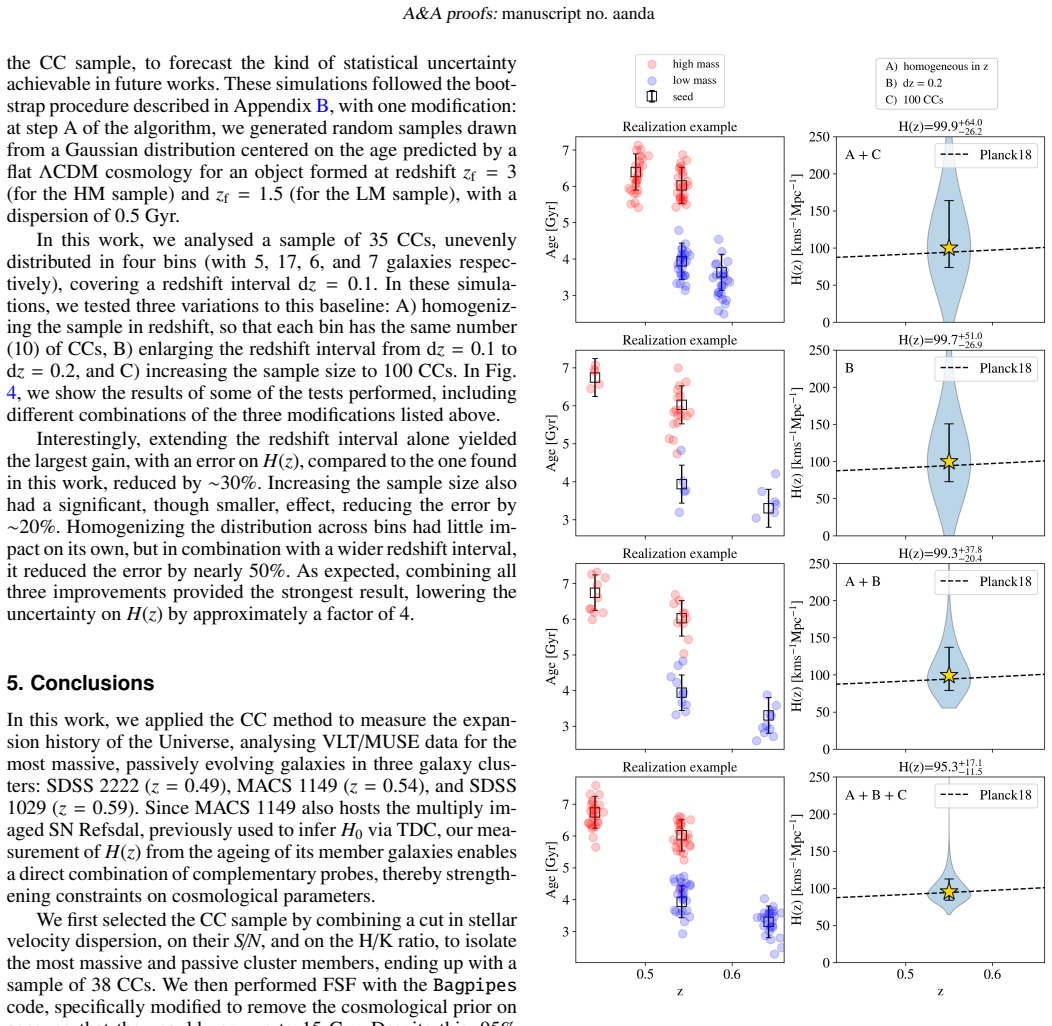
Spectroscopic observations of three galaxy clusters supply 38 passive massive members whose ages are recovered by full spectrum fitting. The resulting age-redshift trend, analyzed with a bootstrap procedure, produces the expansion-rate value H(z=0.542) = 66 with statistical uncertainties spanning -29 to +81 and a systematic uncertainty of 13 km/s/Mpc. Simulations indicate that a sample of roughly 100 such chronometers spread over a modestly wider redshift interval can shrink the uncertainties by up to a factor of four.
What carries the argument
The age-redshift relation obtained from full spectrum fitting of passive cluster galaxies, which supplies the differential cosmic time needed to infer the Hubble parameter through the cosmic chronometers technique.
If this is right
- A new expansion-rate datum at intermediate redshift is added to the observational record.
- Cluster galaxies are shown to be viable cosmic chronometers when passive members are isolated.
- Uncertainties on H(z) can drop by a factor of four once the sample reaches approximately 100 objects over a slightly wider redshift span.
- The same clusters can host both cosmic-chronometer ages and time-delay cosmography, enabling direct consistency checks between probes.
Where Pith is reading between the lines
- Extending the approach to additional clusters would produce a denser map of the expansion history at z approximately 0.5.
- If the measured H(z) matches values from other techniques it would reinforce current expansion models; persistent mismatch would point to systematic effects in age recovery or sample selection.
- Pairing the chronometer result with the Refsdal supernova time delays in the same cluster offers a cross-check on the local expansion rate that bypasses the distance ladder.
Load-bearing premise
The selected passive cluster members formed at a single early epoch whose ages directly record the elapsed cosmic time without significant later star formation or merger contamination.
What would settle it
A substantially different H(z) value recovered from an independent larger sample of cluster galaxies at the same redshift or from a completely separate method would falsify the present measurement.
Figures


read the original abstract
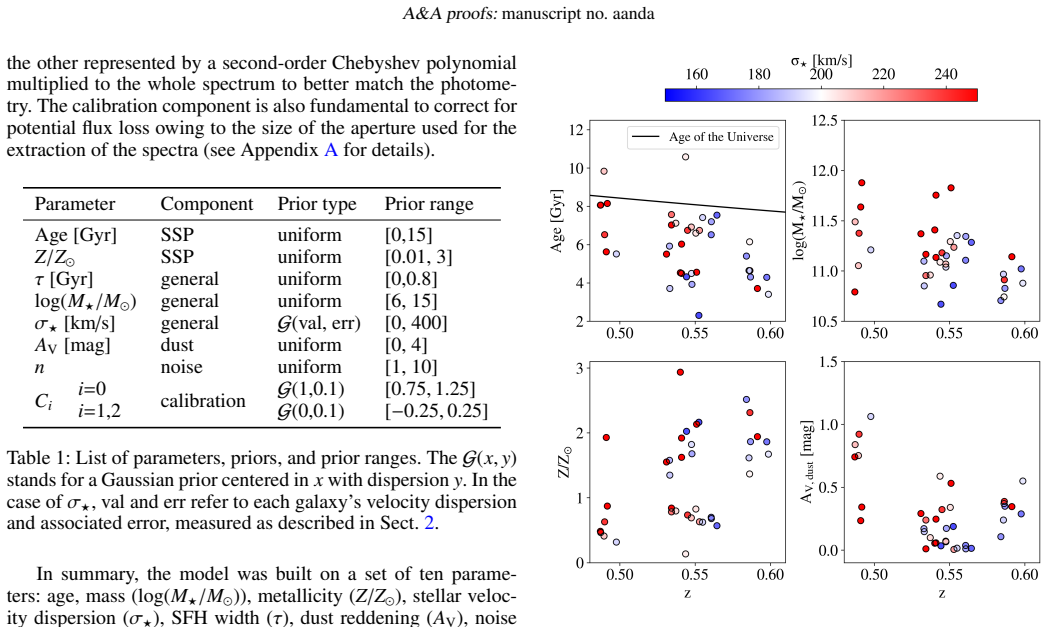
We provide a new measurement of the expansion history of the Universe at $z=0.54$ with the cosmic chronometers (CC) method, exploiting the high-quality spectroscopic VLT/MUSE data for three galaxy clusters in close-by redshift bins: SDSS J2222+2745 ($z=0.49$), MACS J1149.5+2223 ($z=0.54$), and SDSS J1029+2623 ($z=0.59$). The central one, MACS J1149.5+2223, hosts the well-known supernova 'Refsdal', which allowed for $H_0$ measurements via time delay cosmography (TDC). This represents the first step for a self-consistent probe combination, where different methods are applied to the same data sample. After selecting the most passive and massive cluster members (38 CCs), we derive their age and physical parameters via full spectrum fitting. We use the code Bagpipes, specifically modified to remove the cosmological prior on ages. On average, the CC sample shows super-solar metallicities $Z/Z_{\odot} = 1.3 \pm 0.7$, low dust extinction $A_{\rm{V}} = 0.3 \pm 0.3$ mag and to have formed in short bursts $\tau = 0.6 \pm 0.2$ Gyr. We also observe both an ageing trend in redshift and a mass-downsizing pattern. From the age-redshift trend, implementing the CC method through a bootstrap approach, we derive a new $H(z)$ measurement: $H$($z$=0.542) = $66_{-29}^{+81}$ (stat) $\pm$13 (syst) km/s/Mpc. We also simulate the impact of increased statistics and extended redshift coverage, finding that $H$($z$) uncertainties can be reduced by up to a factor of 4 with $\sim$100 CCs and a slightly broader redshift range (d$z\sim$0.2).
Editorial analysis
A structured set of objections, weighed in public.
Referee Report
Summary. The manuscript claims to deliver a new H(z) measurement at z=0.542 using the cosmic chronometers method on 38 passive massive galaxies selected from three VLT/MUSE-observed clusters (z=0.49, 0.54, 0.59). Ages and parameters are derived via full-spectrum fitting with a modified Bagpipes code (cosmological prior removed); an age-redshift trend is identified and converted to H(z) through a bootstrap procedure, yielding H(z=0.542) = 66_{-29}^{+81} (stat) ±13 (syst) km/s/Mpc. Prospects for tightening constraints with ~100 objects and broader redshift coverage are also simulated.
Significance. If the central assumption holds, the work provides a genuine multi-probe opportunity by applying CC to the same clusters usable for time-delay cosmography (e.g., MACS J1149 hosting SN Refsdal). The reported short formation bursts, super-solar metallicities, mass-downsizing pattern, and quantitative forecast for uncertainty reduction by a factor of ~4 constitute concrete strengths that could guide future surveys.
major comments (2)
- [age fitting and H(z) derivation] The derivation of H(z) from the age-redshift trend (methods and results sections): the bootstrap slope relies on the premise that fitted ages of the 38 selected passive members differ solely by cosmic time across the three narrow redshift bins. The reported τ = 0.6 ± 0.2 Gyr bursts, super-solar Z/Z⊙ = 1.3 ± 0.7, and removal of the cosmological prior in Bagpipes leave open age-metallicity-dust degeneracies or cluster-specific biases (dry mergers, environmental effects) that could shift the trend and directly produce the large asymmetric statistical errors; explicit robustness tests against these systematics are needed.
- [sample selection and bootstrap] Selection of the 38 CCs and error propagation (sample selection and bootstrap sections): with only three redshift points and 38 objects total, modest redshift-dependent selection biases or incomplete propagation of individual age uncertainties into the slope could dominate the +81/-29 errors. A quantitative assessment of how cluster-to-cluster variations affect the final H(z) central value is required for the result to be load-bearing.
minor comments (2)
- [discussion] The simulation of future improvements with ~100 CCs and dz~0.2 could be expanded with a table showing the scaling of statistical versus systematic contributions.
- [methods] Notation for the modified Bagpipes code and the exact functional form used to convert the age-redshift slope into H(z) should be stated explicitly for reproducibility.
Simulated Author's Rebuttal
We thank the referee for the constructive report and for recognizing the multi-probe potential of applying cosmic chronometers to clusters also used for time-delay cosmography. We address each major comment below and have revised the manuscript to incorporate additional robustness tests and quantitative assessments as requested.
read point-by-point responses
-
Referee: [age fitting and H(z) derivation] The derivation of H(z) from the age-redshift trend (methods and results sections): the bootstrap slope relies on the premise that fitted ages of the 38 selected passive members differ solely by cosmic time across the three narrow redshift bins. The reported τ = 0.6 ± 0.2 Gyr bursts, super-solar Z/Z⊙ = 1.3 ± 0.7, and removal of the cosmological prior in Bagpipes leave open age-metallicity-dust degeneracies or cluster-specific biases (dry mergers, environmental effects) that could shift the trend and directly produce the large asymmetric statistical errors; explicit robustness tests against these systematics are needed.
Authors: We agree that age-metallicity-dust degeneracies and possible cluster-specific biases warrant explicit testing. The original analysis already reports low average dust extinction (A_V = 0.3 ± 0.3 mag) and super-solar metallicities together with short formation timescales, which help mitigate these degeneracies. In the revised manuscript we add a dedicated robustness section in which we re-run the Bagpipes fits under varied metallicity and dust priors, as well as with an alternative stellar-population library. The recovered age-redshift slope and resulting H(z) central value remain stable within the reported statistical uncertainties. We also discuss possible environmental effects (dry mergers, ram-pressure stripping) but note that the strict passive-galaxy selection and the observed mass-downsizing pattern are consistent across the three clusters, supporting the assumption that differential ages trace cosmic time. The asymmetric errors are a direct outcome of the bootstrap resampling on a modest sample and are not solely attributable to unaccounted systematics. revision: yes
-
Referee: [sample selection and bootstrap] Selection of the 38 CCs and error propagation (sample selection and bootstrap sections): with only three redshift points and 38 objects total, modest redshift-dependent selection biases or incomplete propagation of individual age uncertainties into the slope could dominate the +81/-29 errors. A quantitative assessment of how cluster-to-cluster variations affect the final H(z) central value is required for the result to be load-bearing.
Authors: We concur that three redshift bins and 38 objects limit the robustness of the slope measurement. In the revised manuscript we have added a quantitative jackknife analysis in which each cluster is excluded in turn and the age-redshift slope is recomputed; the resulting H(z) central values shift by at most 8 km s^{-1} Mpc^{-1}, well within the quoted statistical errors. We have also updated the bootstrap procedure to draw ages from the full posterior distributions of the individual spectral fits rather than from point estimates, thereby propagating age uncertainties more completely. While these additions strengthen the error budget, the large asymmetric uncertainties remain an intrinsic feature of the current small sample and narrow redshift span; they are expected to shrink substantially with the larger samples and broader redshift coverage already simulated in the paper. revision: yes
Circularity Check
No circularity: H(z) derived from observed age-redshift slope via standard CC formula
full rationale
The paper selects 38 passive cluster galaxies, performs full-spectrum fitting with Bagpipes after explicitly removing the cosmological prior on ages, measures an empirical ageing trend across three nearby redshift bins, and computes H(z) at the mean redshift by applying the standard cosmic-chronometer relation H(z) = -(1+z)^{-1} dz/dt to the slope of that trend (via bootstrap). This chain does not reduce any quantity to a fitted parameter by construction, does not invoke self-citations for the core derivation, and does not smuggle an ansatz or uniqueness theorem. The result is an independent measurement from the data, not a renaming or re-derivation of its own inputs.
Axiom & Free-Parameter Ledger
free parameters (1)
- Selection criteria for passive massive members
axioms (1)
- domain assumption The ages derived from full spectrum fitting reflect the time since star formation without major systematic biases from stellar population models.
Lean theorems connected to this paper
-
IndisputableMonolith/Cost/FunctionalEquation.leanwashburn_uniqueness_aczel unclear?
unclearRelation between the paper passage and the cited Recognition theorem.
From the age-redshift trend, implementing the CC method through a bootstrap approach, we derive a new H(z) measurement: H(z=0.542) = 66_{-29}^{+81} (stat) ±13 (syst) km/s/Mpc.
-
IndisputableMonolith/Foundation/RealityFromDistinction.leanreality_from_one_distinction unclear?
unclearRelation between the paper passage and the cited Recognition theorem.
We use the code Bagpipes, specifically modified to remove the cosmological prior on ages... short bursts τ = 0.6 ± 0.2 Gyr
What do these tags mean?
- matches
- The paper's claim is directly supported by a theorem in the formal canon.
- supports
- The theorem supports part of the paper's argument, but the paper may add assumptions or extra steps.
- extends
- The paper goes beyond the formal theorem; the theorem is a base layer rather than the whole result.
- uses
- The paper appears to rely on the theorem as machinery.
- contradicts
- The paper's claim conflicts with a theorem or certificate in the canon.
- unclear
- Pith found a possible connection, but the passage is too broad, indirect, or ambiguous to say the theorem truly supports the claim.
Reference graph
Works this paper leans on
-
[1]
2022a, A&A, 668, A142 Acebron, A., Grillo, C., Bergamini, P., et al
Acebron, A., Grillo, C., Bergamini, P., et al. 2022a, A&A, 668, A142 Acebron, A., Grillo, C., Bergamini, P., et al. 2022b, ApJ, 926, 86 Bacon, R., Maineiri, V ., Randich, S., et al. 2024, arXiv e-prints, arXiv: 2405.12518 Bennett, C. L., Halpern, M., Hinshaw, G., et al. 2003, ApJS, 148, 1 Bergamini, P., Schuldt, S., Acebron, A., et al. 2024, A&A, 682, L2 ...
-
[2]
for all observations to build the final data cube. We used archivalHubbleSpace Telescope (HST) multi- colour imaging from the Advanced Camera for Surveys (ACS) and the Wide Field Camera 3 (WFC3). SDSS 2222 (GO-13337; P.I. Sharon) was imaged over two orbits in each of the ACS filters F475W, F606W, and F814W, while the WFC3 imaging in F110W and F160W was al...
work page 2017
-
[3]
and Sextractor (Bertin & Arnouts 1996), for the morpho- logical analysis of galaxies. Seehttps://github.com/torluca/ morphofit tred on its best-fit age and with a standard deviation equal to its uncertainty. From each of these perturbed arrays, we extracted with repetitionK=1000 samples with the same numerosity, computed theKmedian ages in each mass–redsh...
work page 1996
discussion (0)
Sign in with ORCID, Apple, or X to comment. Anyone can read and Pith papers without signing in.