REVIEW 3 major objections 4 minor 51 references
A unified framework for equation discovery and dynamic prediction of hysteretic systems
T0 review · 3 major / 4 minor · reviewed 2026-08-04 · deepseek-v4-flash
Pith's one-line read The paper aims to establish that the hidden memory state of a hysteretic system can be learned as a free parameter inside a numerical solver, after which symbolic regression writes out the explicit governing equations—including the hysteres
desk verdict A genuinely useful framework for hysteresis equation discovery, with strong Case 1 validation, but the flagship Full Equation Discovery mode is tested only under the training excitation, leaving the identifiability of the latent z unresolved. read the letter →
The pith
A machine-rendered reading of the paper's core claim, the machinery that carries it, and where it could break.
The reading
What carries the argument
The mechanism is a two-stage pipeline built on the state-space triple (x, ẋ, z). First, z is treated as a free learnable time series and integrated through a differentiable RK4 solver, which enforces temporal consistency while updating system parameters. Second, the learned trajectories are fed to symbolic regression, which searches over expression trees (including terms like |·|^n with n free) to produce the explicit equations for the motion law and the hysteresis law, replacing the predefined function library used by sparse identification methods.
What would settle it
Run the method on a simulated Bouc-Wen system driven by a single low-amplitude harmonic with no noise: if the discovered ˙z equation changes when the optimizer is re-initialized or when the excitation is swapped while the true law stays fixed, then z is not identifiable and the claimed direct discovery is falsified.
Extended reading notes
Core claim
The central claim is that reformulating a hysteretic system in state-space form, with the internal hysteretic variable z treated as a trainable parameter inside an embedded Runge-Kutta solver, makes the unobservable memory state learnable from measured responses. After convergence, the predicted trajectories provide the input-output data for symbolic regression, which discovers an explicit expression for the hysteresis evolution law ż = g(ẋ, z) and, in the full setting, for the motion equation ẍ = f(x, ẋ, z, u). The paper reports successful recovery of the Bouc-Wen-like law including a fractional exponent n = 1.5, and on experimental shake-table data recovers a rate-dominated linear law when
Load-bearing premise
The load-bearing premise is that the hidden internal variable z(t) is identifiable from the measured responses, so the optimized z is the true hysteresis state and not an arbitrary function that happens to reproduce the training data.
Editorial extensions
If this is right
- For the Bouc-Wen benchmark, the framework recovers the structure and coefficients of both governing equations with displacement prediction errors around 1–3% on test excitations, even under 20 dB measurement noise.
- For a system with cubic stiffness and a fractional hysteretic exponent of 1.5, both Hysteresis Discovery and Full Equation Discovery recover the fractional exponent with small error, whereas library-based regression cannot represent non-integer powers and introduces spurious terms.
- On experimental shake-table data, the framework automatically returns a rate-dominated linear law when no negative-stiffness device is present, and a richer nonlinear law when the device is installed, showing that the discovered equation adapts to the actual hysteresis level.
- Because the discovered equations are explicit, solving them yields forward predictions on unseen excitations, so equation discovery and dynamic prediction are handled in one unified workflow.
Reading between the lines
- The same solver-based learnable-state idea could be applied to other hidden-state dynamics—plasticity variables, battery state-of-charge, or ferromagnetic domains—where only a subset of states is measured and the evolution law is unknown.
- The method's reliance on optimizing z without an identifiability guarantee suggests that excitation richness and noise level directly control whether the recovered g_phi is the true physical law or merely one of many functions that reproduce the training data.
- The reported 14% testing displacement error in the negative-stiffness-device case hints that the framework's generalization gap widens as hysteresis becomes stronger and more history-dependent, so a diagnostic for when z is reliably identified would sharpen its practical use.
Signed reviews
Editorial analysis
A structured set of objections, weighed in public.
Referee Report
Summary. The paper proposes a unified framework for equation discovery in hysteretic systems. It reformulates the system in state-space form with an internal hysteretic variable z and treats z as a learnable parameter optimized through a differentiable ODE solver against measured responses (Eq. 8). Symbolic regression is then applied to the learned trajectories to obtain explicit equations for the hysteretic link g_phi and, in the Full Equation Discovery case, the dynamics f_theta. The framework is tested on the Bouc-Wen benchmark (Hysteresis Discovery), a synthetic system with cubic stiffness and fractional hysteresis exponent (both Hysteresis and Full Equation Discovery), and a shake-table SDOF yielding structure. The Bouc-Wen benchmark includes a genuinely different excitation for testing; the Full Equation Discovery validation uses the same excitation with different initial conditions.
Significance. If the Full Equation Discovery claims are fully substantiated, the paper would fill a real gap: a model-free, library-free method that simultaneously discovers both the primary dynamics and the hysteretic link equation. The paper makes a useful contribution by classifying equation-discovery settings for hysteretic systems and by showing that solver-based latent-variable learning combined with symbolic regression can recover known Bouc-Wen structures, including fractional exponents, more flexibly than SINDy. The Hysteresis Discovery results on the public Bouc-Wen benchmark are credible, with low NRMSE under a different testing excitation, and the experimental yielding-structure case adds real-data evidence. However, the most general and novel mode, Full Equation Discovery, is currently validated under conditions that cannot rule out overfitting of the free latent variable; the central claim therefore needs additional support before the contribution can be accepted.
major comments (3)
- [Section 3.2/3.3, Eq. (8)] The central loop is circular: z is optimized as a free learnable vector to fit the measured response (Eq. 8a/8b), and then the symbolic regression target is dot(z)=Diff(z) regressed onto (dot(x),z) (Section 3.3). Because z is never constrained by the discovered g_phi during training, a wide family of latent trajectories can be consistent with the same measured x when f_theta is sufficiently flexible. No identifiability or excitation-conditions analysis is given. The paper should provide identifiability conditions, show sensitivity of the discovered g_phi to initialization/regularization, or constrain z through the dynamical model.
- [Section 4.2, Tables 3-4] Full Equation Discovery—the article's most general and novel mode—is validated only under the same excitation u(t)=sin(2t) for training and testing; only the initial condition changes. Under a single excitation, the pair (f_theta,z) is not identifiable: a neural-network f_theta can absorb any chosen z and still reproduce the measured x. The new-initial-condition test therefore checks interpolation over initial states, not generalization to unseen forcing. The Hysteresis Discovery mode in Section 4.1 has a genuine out-of-excitation test (Testing 2, multisine), but Full Equation Discovery does not. Add a cross-excitation test for Case 2.
- [Section 3.2, Eq. (7)] The state-space formulation in Eq. (7) implies that z evolves under g_phi and that the solver integrates [x,dot(x),z]. The learning procedure, however, treats z as a learnable parameter vector whose derivative is computed by finite differences (the text in Section 3.1 says 'only the value of z is required in this step'). Thus g_phi is not part of the forward dynamics during training, and the training loss never validates the discovered g_phi. This decoupling means that after SR replaces Diff(z) with an analytic g_phi, the closed-loop system may have no reason to reproduce the training response. Please clarify, and ideally integrate g_phi (or a provisional surrogate) into the solver loop.
minor comments (4)
- [Abstract and Section 3.3] The phrase 'without predefined libraries' overstates the case, since symbolic regression itself uses a predefined operator set and complexity measure. The contrast with SINDy should be phrased as 'without a fixed library of candidate terms' to avoid overclaiming.
- [Equation (8)] Typo: 'selction matrix' should be 'selection matrix'. Also, the notation is slightly confusing because the symbol S is used for the selection matrix while the signal-to-noise ratio uses 'SNR'.
- [Section 4] Reproducibility details are missing: PySR hyperparameters (population size, iterations, operator set, complexity penalty lambda), the RK4 time step, the optimizer and learning rate, and how z(0) is initialized for test-time solution of the discovered equations. Please report these.
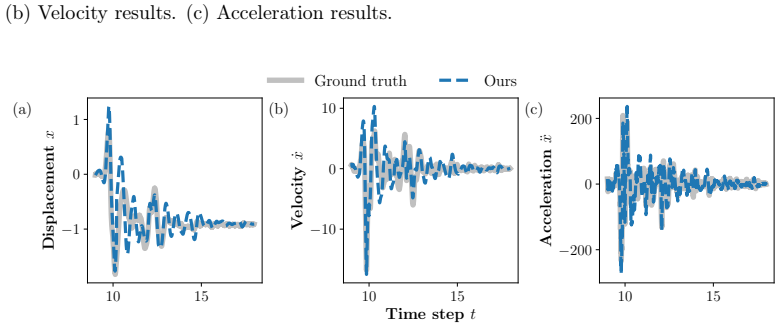
- [Section 4.2, Figures 8-9] The text says five initial conditions are used for training and one for testing, but the figures appear to show a single continuous time trace. Clarify whether the traces are concatenated and whether z is learned as a single vector across the concatenated data or per trace.
Circularity Check
Partial circularity in Full Equation Discovery: z is a free learnable parameter fitted by Eq. (8b) to the measured response, and the discovered g_phi is a symbolic regression on that fitted latent trajectory; this mode is tested only under the training excitation.
-
fitted input called prediction
[Sec. 3.1-3.3 (Case 2 definition; Eq. (8b); SR(ż_pred, ẋ_pred, z_pred))]
"For Case 2: Full Equation Discovery, since the structure of the dynamic motion equation is unknown, it is represented by a neural network N(·), parameterized by learnable parameters θ, i.e., f_θ = N(x, ẋ, u; θ, z). Here, the internal variable z is also treated as an additional learnable parameter within the model. ... For the hysteretic link equation (g_ϕ), ... symbolic regression (SR) is applied to the learned trajectories of ẋ_pred, z_pred, and ż_pred to search for mathematical expressions ż = g_ϕ(ẋ,z), and this can be written as SR(ż_pred, ẋ_pred, z_pred)."
Eq. (8b) optimizes z (and θ) by back-propagating the mismatch of the solver output against the measured y_m, so z_pred is a fitted latent variable, not observed data. The SR target is then Diff(z_pred), and its regressors are z_pred and ẋ_pred; all three come from the same fitted trajectory. In Case 2, f_θ is an unconstrained neural network and z is a free time series, so for a single excitation many pairs (f_θ,z) reproduce y_m. Hence the reported g_ϕ is a regression on an arbitrary, unidentifiable latent process rather than a law independently recovered from data.
full rationale
The paper is not circular as a whole. Case 1 (Hysteresis Discovery) on the Bouc-Wen benchmark is trained on a sinesweep and tested on a fixed multisine excitation (Testing 2), and the shaking-table experiments use different earthquake records for training and testing; with the dynamics f_θ known, the learned z is constrained by Eq. (3), and these out-of-excitation tests provide real independent support. The circularity burden is specific to Case 2 (Full Equation Discovery): Section 3.2 learns z by fitting Eq. (8b) to the measurements, and Section 3.3 then 'discovers' g_ϕ by regressing a finite-difference derivative of that fitted z. Since f_θ is a neural network and z is free, the decomposition is not identifiable, and the paper gives no identifiability or excitation-richness analysis. Moreover, Section 4.2 validates Full Equation Discovery only by changing the initial condition while keeping u(t)=sin(2t), so the test does not exercise new forcing and cannot distinguish the true equations from a forcing-tuned fit. These limitations make the central general-mode claim partially circular, but the external and out-of-excitation Case 1 and experimental results keep the paper from being wholly circular; score 4.
Assumptions & free parameters
free parameters (4)
- Internal hysteretic variable z(t) (trainable vector) =
reported only via plots; no numeric values in text
- Linear structural parameters (m, c, k, α) =
e.g., m=1.9998, c=10.0231, k=49893.86, α=1.0110 (Table 1, noise-free)
- Neural network parameters θ for f_θ in Full Equation Discovery =
not reported (intermediate representation)
- SR hyperparameters (operator set, complexity penalty λ, search budget) =
not reported
assumptions (5)
- domain assumption The unmeasured internal hysteretic variable z(t) is sufficient to close the state-space description of the system (Eq. 7).
- domain assumption The measurement data and excitation are sufficiently rich that optimizing z as a free parameter converges to a unique/meaningful latent trajectory.
- standard math RK4 time-stepping with finite-difference Diff(z) accurately approximates the true coupled ODE solution.
- domain assumption The Bouc-Wen differential form (Eq. 4/11) is the correct generative model for the synthetic benchmarks.
- domain assumption Shake-table test data from [26] are accurate and the SDOF equation of motion mẍ+cẋ+kx+αz=-mu is applicable.
Cite this review
Pith. "Pith review of A unified framework for equation discovery and dynamic prediction of hysteretic systems." pith.science (2026). https://pith.science/paper/7UZCUUSX
@misc{pith2026251202408,
  author       = {Pith},
  title        = {Pith review of: A unified framework for equation discovery and dynamic prediction of hysteretic systems},
  year         = {2026},
  howpublished = {\url{https://pith.science/paper/7UZCUUSX}},
  note         = {Machine review of arXiv:2512.02408}
}
read the original abstract
Hysteresis is a nonlinear phenomenon with memory effects, where a system's output depends on both its current state and past states. It is prevalent in various physical and mechanical systems, such as yielding structures under seismic excitation, ferromagnetic materials, and piezoelectric actuators. Analytical models like the Bouc-Wen model are often employed but rely on idealized assumptions and careful parameter calibration, limiting their applicability to diverse or mechanism-unknown behaviors. Existing equation discovery approaches for hysteresis are often system-specific or rely on predefined model libraries, which limit their flexibility and ability to capture the hidden mechanisms. To address these challenges, this research classifies equation discovery problems for hysteretic systems and develops a unified framework in which the state-space form is reformulated, and hysteretic variables are treated as trainable parameters from data. The framework further employs symbolic regression (SR) to automatically recover explicit governing equations without relying on predefined libraries, unlike methods such as sparse identification of nonlinear dynamics (SINDy). Experimental results demonstrate that the proposed method is effective in recovering governing equations for hysteretic systems, even in a challenging Full Equation Discovery setting, where prior information is extremely limited, and solving the equations naturally enables the dynamic prediction of hysteretic systems.
Figures


Figures from the paper (12 more)


Reference graph
Works this paper leans on
-
[30]
W. Liu, K. Bacsa, L. C. Tang, E. Chatzi, Structured kolmogorov-arnold neural odes for interpretable learning and symbolic discovery of nonlin- ear dynamics, arXiv preprint arXiv:2506.18339 (2025)
arXiv 2025
-
[34]
J. Qian, X. Sun, J. Xu, L. Cheng, Discovering differential governing equations of hysteresis dynamic systems by data-driven sparse regression method, Nonlinear Dynamics 112 (14) (2024) 12137–12157
2024
-
[1]
D. C. Jiles, D. L. Atherton, Theory of ferromagnetic hysteresis, Journal of magnetism and magnetic materials 61 (1-2) (1986) 48–60
1986
-
[2]
Al Janaideh, C.-Y
M. Al Janaideh, C.-Y. Su, S. Rakehja, Modeling hysteresis of smart actuators, in: 2008 5th International Symposium on Mechatronics and Its Applications, IEEE, 2008, pp. 1–4
2008
-
[3]
Bertotti, Hysteresis in magnetism: for physicists, materials scientists, and engineers, Academic press, 1998
G. Bertotti, Hysteresis in magnetism: for physicists, materials scientists, and engineers, Academic press, 1998
1998
-
[4]
E. Ko, I. Kimura, P. Clark, I. Aiken, K. Kasai, Design procedures for buildings incorporating hysteretic damping devices, in: Proceedings of the 68th Annual Convention SEAOC, Santa Barbara, CA, USA, Vol. 30, 1999
1999
-
[5]
Dominguez, R
A. Dominguez, R. Sedaghati, I. Stiharu, Modelling the hysteresis phe- nomenon of magnetorheological dampers, Smart Materials and Struc- tures 13 (6) (2004) 1351
2004
-
[6]
Ortín, L
J. Ortín, L. Delaey, Hysteresis in shape-memory alloys, International Journal of Non-Linear Mechanics 37 (8) (2002) 1275–1281
2002
Show all 51 references
-
[7]
Wen, Method for random vibration of hysteretic systems, Journal of the engineering mechanics division 102 (2) (1976) 249–263
Y.-K. Wen, Method for random vibration of hysteretic systems, Journal of the engineering mechanics division 102 (2) (1976) 249–263. 27
1976
-
[8]
Visone, Hysteresis modelling and compensation for smart sensors and actuators, in: Journal of Physics: Conference Series, Vol
C. Visone, Hysteresis modelling and compensation for smart sensors and actuators, in: Journal of Physics: Conference Series, Vol. 138, IOP Publishing, 2008, p. 012028
2008
-
[9]
E. N. Chatzi, A. W. Smyth, S. F. Masri, Experimental application of on-line parametric identification for nonlinear hysteretic systems with model uncertainty, Structural Safety 32 (5) (2010) 326–337
2010
-
[10]
Chandra, B
A. Chandra, B. Daniels, M. Curti, K. Tiels, E. A. Lomonova, D. M. Tartakovsky, Discovery of sparse hysteresis models for piezoelectric ma- terials, Applied Physics Letters 122 (21) (2023)
2023
-
[11]
Y. Liu, K. P. Kelley, R. K. Vasudevan, H. Funakubo, M. A. Ziatdi- nov, S. V. Kalinin, Experimental discovery of structure–property rela- tionships in ferroelectric materials via active learning, Nature Machine Intelligence 4 (4) (2022) 341–350
2022
-
[12]
Vlachas, K
K. Vlachas, K. Agathos, K. E. Tatsis, A. R. Brink, E. Chatzi, Two- story frame with bouc-wen hysteretic links as a multi-degree of freedom nonlinear response simulator, in: 5th Workshop on Nonlinear System Identification Benchmarks, ETH Zurich, 2021
2021
-
[13]
I. D. Mayergoyz, Mathematical models of hysteresis and their applica- tions, Academic press, 2003
2003
-
[14]
J. Oh, D. S. Bernstein, Semilinear duhem model for rate-independent and rate-dependent hysteresis, IEEE Transactions on Automatic Con- trol 50 (5) (2005) 631–645
2005
-
[15]
Visintin, Differential models of hysteresis, Vol
A. Visintin, Differential models of hysteresis, Vol. 111, Springer Science & Business Media, 2013
2013
-
[16]
S. H. Rudy, S. L. Brunton, J. L. Proctor, J. N. Kutz, Data-driven dis- covery of partial differential equations, Science advances 3 (4) (2017) e1602614
2017
-
[17]
B. Chen, C. Zhang, J. Zhang, Y. Wang, Adaptive physics-informed sys- tem modeling with control for nonlinear structural system estimation, Computer Methods in Applied Mechanics and Engineering 447 (2025) 118330. 28
2025
-
[18]
Haywood-Alexander, W
M. Haywood-Alexander, W. Liu, K. Bacsa, Z. Lai, E. Chatzi, Discussing the spectrum of physics-enhanced machine learning: a survey on struc- tural mechanics applications, Data-Centric Engineering 5 (2024) e30
2024
-
[19]
L. Yi, S. Yang, Y. Cui, Z. Lai, Transforming physics-informed machine learning to convex optimization, Engineering Applications of Artificial Intelligence 161 (2025) 112149
2025
-
[20]
S. Yang, C. Song, Z. Lai, W. Wang, KP-PINNs: Kernel packet acceler- ated physics informed neural networks, in: Proceedings of the Thirty- Fourth International Joint Conference on Artificial Intelligence, IJCAI- 25, 2025, pp. 7904–7912
2025
-
[21]
L. Yan, H. Cai, Q. Wang, L. Chen, C. Li, G. Hu, Deep reinforcement learning-based active flow control for a tall building, Physics of Fluids 37 (4) (2025)
2025
-
[22]
S. L. Brunton, J. L. Proctor, J. N. Kutz, Discovering governing equa- tions from data by sparse identification of nonlinear dynamical systems, Proceedings of the national academy of sciences 113 (15) (2016) 3932– 3937
2016
-
[23]
K. P. Champion, S. L. Brunton, J. N. Kutz, Discovery of nonlinear multiscale systems: Sampling strategies and embeddings, SIAM Journal on Applied Dynamical Systems 18 (1) (2019) 312–333
2019
-
[24]
Z. Chen, Y. Liu, H. Sun, Physics-informed learning of governing equa- tions from scarce data, Nature communications 12 (1) (2021) 6136
2021
-
[25]
Kaheman, J
K. Kaheman, J. N. Kutz, S. L. Brunton, Sindy-pi: a robust algorithm for parallel implicit sparse identification of nonlinear dynamics, Proceedings of the Royal Society A 476 (2242) (2020) 20200279
2020
-
[26]
Z. Lai, S. Nagarajaiah, Sparse structural system identification method for nonlinear dynamic systems with hysteresis/inelastic behavior, Me- chanical Systems and Signal Processing 117 (2019) 813–842
2019
-
[27]
J.-P. Noel, M. Schoukens, Hysteretic benchmark with a dynamic non- linearity, in: Workshop on nonlinear system identification benchmarks, 2016, pp. 7–14. 29
2016
-
[28]
Bolourchi, S
A. Bolourchi, S. F. Masri, O. J. Aldraihem, Studies into computational intelligence and evolutionary approaches for model-free identification of hysteretic systems, Computer-Aided Civil and Infrastructure Engineer- ing 30 (5) (2015) 330–346
2015
-
[29]
T. Wang, M. Noori, G. Wang, Z. Wu, Symbolic deep learning-based method for modeling complex rate-independent hysteresis, Computers & Structures 311 (2025) 107702
2025
-
[31]
M. Lin, C. Cheng, G. Zhang, B. Zhao, Z. Peng, G. Meng, Identification of bouc-wen hysteretic systems based on a joint optimization approach, Mechanical Systems and Signal Processing 180 (2022) 109404
2022
-
[32]
Worden, J
K. Worden, J. Hensman, Parameter estimation and model selection for a class of hysteretic systems using bayesian inference, Mechanical Systems and Signal Processing 32 (2012) 153–169
2012
-
[33]
A. E. Charalampakis, V. K. Koumousis, Identification of bouc–wen hys- teretic systems by a hybrid evolutionary algorithm, Journal of Sound and Vibration 314 (3-5) (2008) 571–585
2008
-
[35]
Charalampakis, C
A. Charalampakis, C. Dimou, Identification of bouc–wen hysteretic sys- tems using particle swarm optimization, Computers & structures 88 (21-
-
[36]
J.-P. Noël, A. F. Esfahani, G. Kerschen, J. Schoukens, A nonlinear state- space approach to hysteresis identification, Mechanical Systems and Sig- nal Processing 84 (2017) 171–184
2017
-
[37]
Novelli, P
N. Novelli, P. Belardinelli, S. Lenci, Identification of hybrid dynamic systems via a sparse regression algorithm, Nonlinear Dynamics (2025) 1–24. 30
2025
-
[38]
W. Liu, Z. Lai, E. Chatzi, A physics-guided deep learning approach to modeling nonlinear dynamics: A case study of a bouc-wen system, STRUCTURAL HEALTH MONITORING 2021 (2021)
2021
-
[39]
W. Liu, Z. Lai, K. Bacsa, E. Chatzi, Physics-guided deep markov models for learning nonlinear dynamical systems with uncertainty, Mechanical Systems and Signal Processing 178 (2022) 109276
2022
-
[40]
N. M. Newmark, A method of computation for structural dynamics, Journal of the engineering mechanics division 85 (3) (1959) 67–94
1959
-
[41]
J. C. Butcher, Numerical methods for ordinary differential equations, John Wiley & Sons, 2016
2016
-
[42]
Iserles, A first course in the numerical analysis of differential equa- tions, Cambridge university press, 2009
A. Iserles, A first course in the numerical analysis of differential equa- tions, Cambridge university press, 2009
2009
-
[43]
Cranmer, Interpretable machine learning for science with pysr and symbolicregression
M. Cranmer, Interpretable machine learning for science with pysr and symbolicregression. jl, arXiv preprint arXiv:2305.01582 (2023)
2023 arXiv
-
[44]
Quade, M
M. Quade, M. Abel, K. Shafi, R. K. Niven, B. R. Noack, Prediction of dynamical systems by symbolic regression, Physical Review E 94 (1) (2016) 012214
2016
-
[45]
Bouc, Forced vibrations of mechanical systems with hysteresis, in: Proc
R. Bouc, Forced vibrations of mechanical systems with hysteresis, in: Proc. of the Fourth Conference on Nonlinear Oscillations, Prague, 1967, 1967
1967
-
[46]
Ismail, F
M. Ismail, F. Ikhouane, J. Rodellar, The hysteresis bouc-wen model, a survey, Archives of computational methods in engineering 16 (2) (2009) 161–188
2009
-
[47]
Ikhouane, J
F. Ikhouane, J. Rodellar, Systems with hysteresis: analysis, identifica- tion and control using the Bouc-Wen model, John Wiley & Sons, 2007
2007
-
[48]
A. A. Sarlis, D. T. R. Pasala, M. Constantinou, A. Reinhorn, S. Na- garajaiah, D. Taylor, Negative stiffness device for seismic protection of structures, Journal of Structural Engineering 139 (7) (2013) 1124–1133. 31
2013
-
[49]
Pasala, A
D. Pasala, A. Sarlis, S. Nagarajaiah, A. Reinhorn, M. Constantinou, D. Taylor, Adaptive negative stiffness: new structural modification ap- proach for seismic protection, Journal of structural Engineering 139 (7) (2013) 1112–1123
2013
-
[50]
D.-T. R. Pasala, A. A. Sarlis, S. Nagarajaiah, A. M. Reinhorn, M. C. Constantinou, D. Taylor, Seismic response control of structures using a novel adaptive passive negative stiffness device, MCEER, 2013
2013
-
[51]
Attary, M
N. Attary, M. Symans, S. Nagarajaiah, A. M. Reinhorn, M. C. Con- stantinou, A. A. Sarlis, D. R. Pasala, D. Taylor, Performance evalua- tion of negative stiffness devices for seismic response control of bridge structures via experimental shake table tests, Journal of Earthquake...
2015
Reviewed August 4, 2026 · model on record in the stance chip above.
Discussion (0). Continue with ORCID to comment.