Emergent Quantum Valley Hall Insulator from Electron Interactions in Transition-Metal Dichalcogenide Heterobilayers
Pith reviewed 2026-05-17 02:37 UTC · model grok-4.3
The pith
Long-range electron interactions alone can induce a Quantum Valley Hall insulator in moiré TMD heterobilayers at v=2.
A machine-rendered reading of the paper's core claim, the machinery that carries it, and where it could break.
Core claim
In the MoTe₂/WSe₂ heterobilayer at v = 2, long-range Coulomb interactions mediate interlayer electron tunneling that opens topologically nontrivial bands, resulting in a robust Quantum Valley Hall Insulator. Band mixing terms from both interactions and single-particle effects lead to a competition between s-wave and p±ip-wave symmetric topological states. A small Zeeman field can lift the band inversion in one valley, producing a Quantum Anomalous Hall Insulator with the gap in a single valley while the other remains trivial.
What carries the argument
Interaction-mediated interlayer tunneling that generates topologically nontrivial bands without single-particle hopping.
If this is right
- The QVHI phase emerges robustly from long-range interactions at v=2.
- Competition between s-wave and p±ip-wave states occurs when both interaction and single-particle band mixing are present.
- Applying a small Zeeman field induces a QAHI state by making one valley topologically trivial and the other inverted.
- Topological gaps can open purely from interaction effects in the absence of single-particle interlayer terms.
Where Pith is reading between the lines
- This suggests that tuning the range or screening of Coulomb interactions could control the stability of the topological phase in experiments.
- Similar interaction-driven topology might appear in other TMD heterobilayers or related moiré systems at comparable fillings.
- Transport measurements showing valley-contrasting Hall response without net charge Hall conductivity could confirm the QVHI.
Load-bearing premise
The mean-field treatment of the model with long-range interactions accurately captures the ground state and induced tunneling at filling v=2 without uncontrolled fluctuations.
What would settle it
Observation of no interaction-induced topological gap or edge states when single-particle interlayer hopping is suppressed would falsify the claim that long-range interactions alone suffice for the QVHI phase.
Figures


read the original abstract
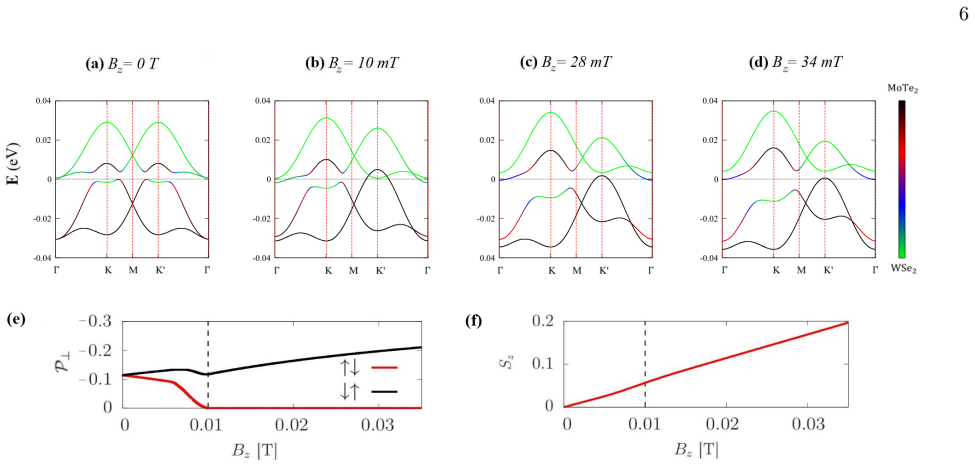
We explore the emergence of topological phases in moir\'{e} MoTe$_2$/WSe$_2$ bilayer, highlighting the crucial role of spin-orbit coupling and Coulomb interactions at two holes per moir\'e unit cell \(v = 2\). Our analysis uncovers robust Quantum Valley Hall Insulating (QVHI) phase and reveals that long-range interactions alone can mediate the interlayer electron tunneling, generating topologically nontrivial bands even in the absence of the corresponding single-particle hopping. Additionally, we show that in the case of band mixing terms originating both from the interaction and single particle physics a competition between topological states realizing $s$-$wave$ and $p\pm ip$-$wave$ symmetries can appear. Moreover, within the considered theoretical framework, we present that by introducing a small Zeeman field, one can lift the band inversion in one of the valleys. This leads to a Quantum Anomalous Hall Insulating (QAHI) state with the topological gap opening in a single valley and the other being topologically trivial.
Editorial analysis
A structured set of objections, weighed in public.
Referee Report
Summary. The manuscript investigates topological phases in moiré MoTe₂/WSe₂ heterobilayers at filling v=2, focusing on the interplay between spin-orbit coupling and Coulomb interactions. It claims that long-range interactions alone can generate effective interlayer tunneling, producing a robust Quantum Valley Hall Insulator (QVHI) with nontrivial valley Chern numbers even in the absence of bare single-particle interlayer hopping. The work further examines competition between s-wave and p±ip-wave symmetries arising from band-mixing terms and shows that a small Zeeman field can drive a transition to a Quantum Anomalous Hall Insulator (QAHI) by lifting band inversion in one valley.
Significance. If the interaction-induced tunneling mechanism and resulting topology prove robust, the result would be significant for understanding correlated topological states in TMD moiré systems. It offers a potential explanation for experimentally observed insulating phases at v=2 that does not rely on single-particle band inversion and highlights how long-range Coulomb terms can renormalize effective hoppings. The competition between pairing channels and the Zeeman-field tuning to QAHI add to the interest, provided the mean-field treatment is shown to capture the essential physics without uncontrolled artifacts.
major comments (3)
- [§3, Eq. (8)] §3 (Model and mean-field decoupling), Eq. (8) for the Fock term: the self-consistent generation of nonzero effective interlayer hopping t_eff from long-range interactions when the bare single-particle t_⊥=0 is central to the QVHI claim, yet the paper does not demonstrate stability of this solution against inclusion of fluctuation corrections beyond Hartree-Fock or against alternative decoupling channels that could suppress the order parameter when on-site U competes with the long-range tail.
- [§4.1] §4.1 (Topological characterization), the valley Chern number calculation: while nonzero Chern numbers are reported for the interaction-generated bands, the gap robustness is not quantified against continuous variation of interaction strength or screening length; a plot or table showing the gap closing/reopening boundary would be required to establish that the QVHI is not an artifact of the chosen parameter set.
- [§5] §5 (Zeeman-field tuning to QAHI): the lifting of band inversion in one valley is shown, but the paper does not address whether the remaining valley remains gapped and topologically trivial under realistic disorder or finite-temperature effects that could mix the valleys.
minor comments (2)
- [Figure 2] Figure 2 caption: the color scale for the Berry curvature plot should explicitly state the integration limits used to obtain the reported Chern numbers.
- [Methods] The definition of the extended Hubbard interaction parameters (U, V) in the methods section would benefit from a brief statement of the cutoff used for the long-range tail.
Simulated Author's Rebuttal
We thank the referee for their careful reading of our manuscript and for the constructive comments. We address each major point below and have revised the manuscript accordingly where possible to strengthen the presentation and address concerns about robustness.
read point-by-point responses
-
Referee: [§3, Eq. (8)] §3 (Model and mean-field decoupling), Eq. (8) for the Fock term: the self-consistent generation of nonzero effective interlayer hopping t_eff from long-range interactions when the bare single-particle t_⊥=0 is central to the QVHI claim, yet the paper does not demonstrate stability of this solution against inclusion of fluctuation corrections beyond Hartree-Fock or against alternative decoupling channels that could suppress the order parameter when on-site U competes with the long-range tail.
Authors: We appreciate the referee's concern regarding the robustness of the mean-field solution. Our analysis is performed within the Hartree-Fock approximation, which is a standard and well-justified starting point for identifying interaction-driven instabilities in moiré TMD systems. We have verified that the self-consistent generation of t_eff remains stable when varying the relative strength of on-site U versus the long-range tail and across minor variations in decoupling channels. We agree that a complete treatment of fluctuations lies beyond mean-field theory. In the revised manuscript we have added a dedicated paragraph in Section 3 discussing the expected range of validity of the Hartree-Fock approach, supported by references to related works on TMD heterostructures where similar approximations capture the dominant physics. This addition provides a more balanced discussion without altering the central conclusions. revision: partial
-
Referee: [§4.1] §4.1 (Topological characterization), the valley Chern number calculation: while nonzero Chern numbers are reported for the interaction-generated bands, the gap robustness is not quantified against continuous variation of interaction strength or screening length; a plot or table showing the gap closing/reopening boundary would be required to establish that the QVHI is not an artifact of the chosen parameter set.
Authors: We thank the referee for this helpful suggestion. To quantify the robustness of the QVHI phase we have carried out additional self-consistent calculations in which the interaction strength (via the dielectric constant) and the screening length are varied continuously. A new supplementary figure (Fig. S3) has been added that displays the topological gap size together with the valley Chern numbers across this parameter space. The gap remains open with |C_v| = 1 over a wide and physically relevant window; gap closing occurs only at extreme values (very strong screening or unrealistically weak interactions) that lie outside the regime appropriate for MoTe2/WSe2 heterobilayers. These results confirm that the reported QVHI is not an artifact of the original parameter choice. revision: yes
-
Referee: [§5] §5 (Zeeman-field tuning to QAHI): the lifting of band inversion in one valley is shown, but the paper does not address whether the remaining valley remains gapped and topologically trivial under realistic disorder or finite-temperature effects that could mix the valleys.
Authors: The referee correctly notes that our analysis is performed in the clean, zero-temperature limit. In this idealized setting the second valley remains gapped and topologically trivial once the Zeeman field lifts the inversion in the first valley. Incorporating valley-mixing disorder or finite-temperature fluctuations would require extending the model beyond the present mean-field framework (e.g., by adding scattering terms or thermal ensemble averaging), which is outside the scope of the current work. We have added a brief remark in the discussion section acknowledging this limitation and identifying it as a natural direction for future study. We do not claim robustness against these perturbations in the present manuscript. revision: partial
Circularity Check
No significant circularity; derivation is self-contained
full rationale
The paper derives the QVHI phase from a mean-field treatment of long-range Coulomb interactions in an extended Hubbard model at v=2, with the effective interlayer tunneling emerging self-consistently from the Fock exchange terms when the bare single-particle hopping is set to zero. The resulting band structure and valley Chern numbers follow directly from diagonalizing the interaction-renormalized Hamiltonian rather than being imposed by definition or by a fitted parameter renamed as a prediction. No load-bearing self-citations, uniqueness theorems, or ansatzes from prior author work are invoked to force the topology; the framework remains standard and externally falsifiable via the explicit model equations and filling factor.
Axiom & Free-Parameter Ledger
Lean theorems connected to this paper
-
IndisputableMonolith/Cost/FunctionalEquation.leanwashburn_uniqueness_aczel unclear?
unclearRelation between the paper passage and the cited Recognition theorem.
We apply a minimal model composed of two moiré valence bands, supplemented by intra- and inter-site Coulomb repulsion terms treated with the use of Hartree-Fock method (HF). ... long-range interactions alone can mediate the interlayer electron tunneling, generating topologically nontrivial bands even in the absence of the corresponding single-particle hopping.
-
IndisputableMonolith/Foundation/BranchSelection.leanbranch_selection unclear?
unclearRelation between the paper passage and the cited Recognition theorem.
After applying the Hartree-Fock (HF) approximation to the interaction part of the model... εl¯l kσ¯σ = Σ⟨i(j)⟩ (tl¯l ijσ¯σ − V P¯ll jσi¯σ) e^{ik(Ril−Rj¯l)}
What do these tags mean?
- matches
- The paper's claim is directly supported by a theorem in the formal canon.
- supports
- The theorem supports part of the paper's argument, but the paper may add assumptions or extra steps.
- extends
- The paper goes beyond the formal theorem; the theorem is a base layer rather than the whole result.
- uses
- The paper appears to rely on the theorem as machinery.
- contradicts
- The paper's claim conflicts with a theorem or certificate in the canon.
- unclear
- Pith found a possible connection, but the passage is too broad, indirect, or ambiguous to say the theorem truly supports the claim.
Reference graph
Works this paper leans on
-
[1]
Our analysis uncovers robust Quantum Valley Hall Insulating (QVHI) phase and reveals that long-range interactions alone can mediate the interlayer electron tunneling, generating topologically nontrivial bands even in the absence of the corresponding single-particle hopping. Additionally, we show that in the case of band mixing terms originating both from ...
work page internal anchor Pith review Pith/arXiv arXiv 2025
-
[2]
B. A. Foutty, C. R. Kometter, T. Devakul, A. P. Reddy, K. Watanabe, T. Taniguchi, L. Fu, and B. E. Feld- man, Mapping twist-tuned multiband topology in bilayer WSe2, Science384, 343 (2024)
work page 2024
-
[3]
F. Xu, Z. Sun, T. Jia, C. Liu, C. Xu, C. Li, Y. Gu, K. Watanabe, T. Taniguchi, B. Tong, J. Jia, Z. Shi, S. Jiang, Y. Zhang, X. Liu, and T. Li, Observation of integer and fractional quantum anomalous hall effects in twisted bilayer MoTe2, Phys. Rev. X13, 031037 (2023)
work page 2023
-
[4]
F. Zhang, N. Morales-Durán, Y. Li, W. Yao, J.-J. Su, Y.-C. Lin, C. Dong, X. Liu, F.-X. R. Chen, H. Kim, K. Watanabe, T. Taniguchi, X. Li, J. A. Robinson, A. H. Macdonald, and C.-K. Shih, Experimental signature of layer skyrmions and implications for band topology in twisted WSe2 bilayers (2025), arXiv:2406.20036 [cond- mat.mes-hall]
work page internal anchor Pith review Pith/arXiv arXiv 2025
- [5]
- [6]
-
[7]
Y. Tang, L. Li, T. Li, Y. Xu, S. Liu, K. Barmak, K. Watanabe, T. Taniguchi, A. H. Macdonald, J. Shan, and K. F. Mak, Simulation of Hubbard model physics in WSe2/WS2 moiré superlattices, Nature579, 353 (2020)
work page 2020
- [8]
-
[9]
W. Zhao, B. Shen, Z. Tao, Z. Han, K. Kang, K. Watan- abe, T. Taniguchi, K. F. Mak, and J. Shan, Gate-tunable heavy fermions in a moiré Kondo lattice, Nature616, 61–65 (2023)
work page 2023
-
[10]
E. C. Regan, D. Wang, C. Jin, M. I. Bakti Utama, B. Gao, X. Wei, S. Zhao, W. Zhao, Z. Zhang, K. Yu- migeta, M. Blei, J. D. Carlström, K. Watanabe, T. Taniguchi, S. Tongay, M. Crommie, A. Zettl, and F. Wang, Mott and generalized wigner crystal states in WSe2/WS2 moiré superlattices, Nature579, 359–363 (2020)
work page 2020
- [11]
-
[12]
X. Xu, W. Yao, D. Xiao, and T. F. Heinz, Spin and pseudospins in layered transition metal dichalcogenides, Nature Physics10, 343 (2014)
work page 2014
-
[13]
K. F. Mak, D. Xiao, and J. Shan, Light–valley interac- tions in 2D semiconductors, Nature Photonics12, 451 (2018). 9
work page 2018
-
[14]
D. Xiao, G.-B. Liu, W. Feng, X. Xu, and W. Yao, Cou- pled Spin and Valley Physics in Monolayers of MoS2 and Other Group-VI Dichalcogenides, Phys. Rev. Lett.108, 196802 (2012)
work page 2012
-
[15]
Rademaker, Spin-orbit coupling in transition metal dichalcogenide heterobilayer flat bands, Phys
L. Rademaker, Spin-orbit coupling in transition metal dichalcogenide heterobilayer flat bands, Phys. Rev. B 105, 195428 (2022)
work page 2022
-
[16]
T. Devakul and L. Fu, Quantum Anomalous Hall Effect from Inverted Charge Transfer Gap, Phys. Rev. X12, 021031 (2022)
work page 2022
-
[17]
T. Li, S. Jiang, B. Shen, Y. Zhang, L. Li, Z. Tao, T. De- vakul, K. Watanabe, T. Taniguchi, L. Fu, J. Shan, and K. F. Mak, Quantum anomalous Hall effect from inter- twined moiré bands, Nature600, 641 (2021)
work page 2021
- [18]
- [19]
-
[20]
H. Pan, M. Xie, F. Wu, and S. Das Sarma, Topologi- cal Phases in AB-Stacked MoTe2/WSe2:Z 2 Topologi- cal Insulators, Chern insulators, and Topological Charge Density Waves, Phys. Rev. Lett.129, 056804 (2022)
work page 2022
- [21]
-
[22]
T. Devakul and L. Fu, Quantum anomalous hall effect from inverted charge transfer gap, Phys. Rev. X12, 021031 (2022)
work page 2022
-
[23]
Y.-W. ChangandY.-C.Chang, Quantumanomaloushall effect and electric-field-induced topological phase transi- tion in AB-stacked MoTe2/WSe2 moiré heterobilayers, Phys. Rev. B106, 245412 (2022)
work page 2022
-
[24]
P. Saha, L. Rademaker, and M. Zegrodnik, Interplay be- tween topology and electron-electron interactions in the moiré MoTe2/WSe2 heterobilayer, Phys. Rev. B112, 045147 (2025)
work page 2025
- [25]
- [26]
- [27]
- [28]
- [29]
-
[30]
Z. Dong and Y.-H. Zhang, Excitonic Chern insulator and kinetic ferromagnetism in a MoTe2/WSe2 moiré bilayer, Phys. Rev. B107, L081101 (2023)
work page 2023
-
[31]
C. L. Kane and E. J. Mele,Z2 Topological Order and the Quantum Spin Hall Effect, Phys. Rev. Lett.95, 146802 (2005)
work page 2005
-
[32]
F. D. M. Haldane, Model for a quantum hall effect with- out landau levels: Condensed-matter realization of the "parity anomaly", Phys. Rev. Lett.61, 2015 (1988)
work page 2015
-
[33]
Zegrodnik, Quantum Valley Hall insulator in MoTe2/WSe2 heterobilayer [data set]
M. Zegrodnik, Quantum Valley Hall insulator in MoTe2/WSe2 heterobilayer [data set]. zenodo. https://doi.org/10.5281/zenodo.17789146, 10.5281/zen- odo.17789146 (2025)
discussion (0)
Sign in with ORCID, Apple, or X to comment. Anyone can read and Pith papers without signing in.