Quantum-Geometric Fingerprints of Altermagnetic Order in Planar Magnetotransport
Pith reviewed 2026-05-17 02:24 UTC · model grok-4.3
The pith
An in-plane Zeeman field in two-dimensional altermagnets with CnT symmetry generates transport responses whose angular periodicities and field powers directly reflect the altermagnetic order.
A machine-rendered reading of the paper's core claim, the machinery that carries it, and where it could break.
Core claim
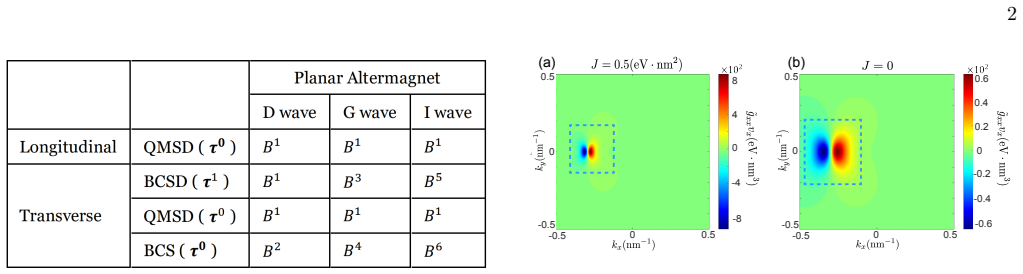
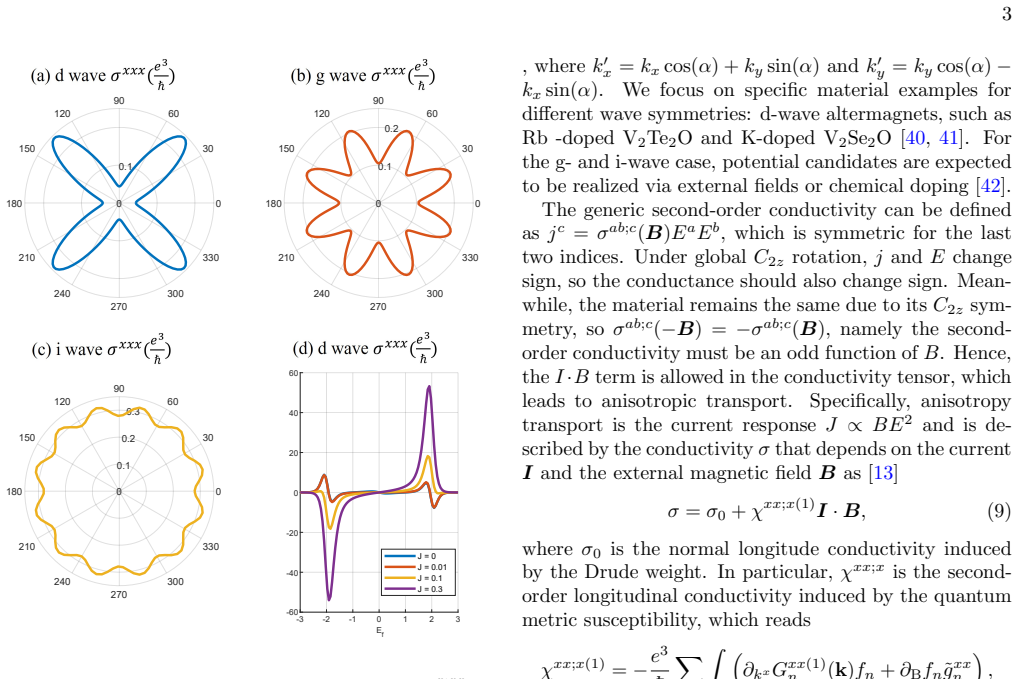
In two-dimensional altermagnets with CnT magnetic symmetry, an in-plane Zeeman field explicitly breaks the mirror and emergent C2z symmetries that otherwise suppress intrinsic Hall and second-order transport responses. The resulting magnetic field susceptibilities of the Berry curvature and quantum metric produce linear planar Hall, nonlinear planar Hall, and nonreciprocal longitudinal responses. Crucially, the leading magnetic field powers and angular periodicities of these responses are fixed by the underlying altermagnetic order. For d-, g-, and i-wave altermagnets, this yields distinct fingerprint patterns.
What carries the argument
Magnetic field susceptibilities of the Berry curvature and quantum metric that activate transport responses when an in-plane Zeeman field breaks the protective symmetries of the altermagnetic state.
If this is right
- Linear and nonlinear planar Hall effects appear with field powers and angular dependencies set by the altermagnetic symmetry.
- Nonreciprocal longitudinal resistance shows similar symmetry-determined characteristics.
- These quantum-geometric responses provide symmetry-selective probes for altermagnetic order in two-dimensional materials.
- Distinct patterns emerge for different wave symmetries such as d-wave, g-wave, and i-wave altermagnets.
Where Pith is reading between the lines
- Similar symmetry-breaking approaches might reveal hidden orders in other classes of magnetic materials through transport.
- These fingerprints could be combined with angle-resolved photoemission to map both geometry and order in the same sample.
- Extending the analysis to include disorder effects would test the robustness of the predicted periodicities.
Load-bearing premise
The leading magnetic field powers and angular periodicities of the transport responses are strictly fixed by the altermagnetic order and that no other mechanisms such as disorder or higher-order terms alter these signatures in real samples.
What would settle it
Measuring the angular dependence of the nonlinear planar Hall conductivity in a candidate d-wave altermagnet and finding a periodicity that deviates from the expected one fixed by the order, such as missing the characteristic harmonics.
Figures



read the original abstract
Identifying altermagnetic order through transport requires signatures that are sensitive to magnetic symmetry but do not rely on a net magnetization. Here we show that planar magnetotransport provides such quantum-geometric fingerprints. In two-dimensional altermagnets with $C_n\mathcal{T}$ magnetic symmetry, an in-plane Zeeman field explicitly breaks the mirror and emergent $C_{2z}$ symmetries that otherwise suppress intrinsic Hall and second-order transport responses. The resulting magnetic field susceptibilities of the Berry curvature and quantum metric produce linear planar Hall, nonlinear planar Hall, and nonreciprocal longitudinal responses. Crucially, the leading magnetic field powers and angular periodicities of these responses are fixed by the underlying altermagnetic order. For $d$-, $g$-, and $i$-wave altermagnets, we find distinct fingerprint patterns associated with quantum geometric susceptibilities. Our results establish planar magnetotransport as a symmetry selective probe of both band quantum geometry and altermagnetic order.
Editorial analysis
A structured set of objections, weighed in public.
Referee Report
Summary. The manuscript claims that planar magnetotransport in two-dimensional altermagnets with CnT magnetic symmetry yields quantum-geometric fingerprints of the order. An in-plane Zeeman field breaks mirror and emergent C2z symmetries that suppress intrinsic responses at B=0; the resulting susceptibilities of Berry curvature and quantum metric generate linear planar Hall, nonlinear planar Hall, and nonreciprocal longitudinal conductivities whose leading powers of |B| and angular periodicities (e.g., cos(2φ) for d-wave) are fixed solely by the altermagnetic symmetry. Distinct patterns are derived for d-, g-, and i-wave cases in the clean limit.
Significance. If the symmetry-derived leading terms survive, the work supplies falsifiable, parameter-free predictions that link altermagnetic order directly to measurable planar responses via quantum geometry. This strengthens experimental routes to detect altermagnetism without net magnetization and provides concrete angular harmonics and field scalings that can be tested in 2D materials.
major comments (2)
- [Section IV] The central claim that leading powers and angular periodicities are strictly fixed by altermagnetic order holds only in the clean intrinsic limit. Section IV (model calculations for d-, g-, and i-wave cases) presents results assuming no disorder, but does not estimate the disorder strength at which extrinsic skew-scattering or side-jump terms (which can enter at the same or lower order in B with different harmonics) remain subdominant. This is load-bearing for the applicability of the fingerprints to real samples.
- [§3.2] §3.2 (susceptibility derivation): the explicit expansion of the quantum-metric contribution to the nonlinear conductivity is not shown in sufficient detail to confirm that no additional symmetry-allowed terms modify the claimed leading |B| power or angular dependence once the Zeeman field is included.
minor comments (3)
- [Figure 3] Figure 3: the angular plots would benefit from explicit overlay of the predicted cos(2φ) or cos(4φ) curves to make the periodicity matching visually immediate.
- [Results] The notation for the in-plane field angle φ is introduced in the abstract but should be restated at the beginning of the results section for clarity.
- A brief comparison table summarizing the distinct leading harmonics for d-, g-, and i-wave orders would improve readability.
Simulated Author's Rebuttal
We thank the referee for the positive assessment and the constructive comments on our manuscript. We address each major comment point by point below, with a focus on strengthening the presentation of our symmetry-based results.
read point-by-point responses
-
Referee: [Section IV] The central claim that leading powers and angular periodicities are strictly fixed by altermagnetic order holds only in the clean intrinsic limit. Section IV (model calculations for d-, g-, and i-wave cases) presents results assuming no disorder, but does not estimate the disorder strength at which extrinsic skew-scattering or side-jump terms (which can enter at the same or lower order in B with different harmonics) remain subdominant. This is load-bearing for the applicability of the fingerprints to real samples.
Authors: We agree that the analysis is performed in the clean intrinsic limit, as explicitly stated throughout the manuscript. The central claim concerns the symmetry-fixed leading powers and angular periodicities of the quantum-geometric contributions, which are independent of microscopic details in that limit. Extrinsic skew-scattering and side-jump terms are sample- and disorder-dependent; while they may appear at comparable orders in |B|, their angular harmonics are not constrained by the altermagnetic symmetry in the same way and can be distinguished experimentally through the distinct patterns we derive (e.g., cos(2φ) for d-wave). In the revised manuscript we will add a dedicated paragraph in Section IV clarifying the regime of validity, noting that the intrinsic fingerprints should dominate in sufficiently clean, high-mobility samples and that the symmetry-enforced angular dependencies provide a route to separate them from extrinsic effects. A quantitative estimate of the critical disorder strength would require material-specific scattering calculations outside the present symmetry-focused scope. revision: partial
-
Referee: [§3.2] §3.2 (susceptibility derivation): the explicit expansion of the quantum-metric contribution to the nonlinear conductivity is not shown in sufficient detail to confirm that no additional symmetry-allowed terms modify the claimed leading |B| power or angular dependence once the Zeeman field is included.
Authors: We appreciate the request for greater transparency in the derivation. In the revised manuscript we will expand §3.2 to present the full explicit expansion of the quantum-metric susceptibility entering the nonlinear conductivity. This will include the intermediate steps showing how the in-plane Zeeman field breaks the relevant mirror and C2z symmetries, generating the leading |B| term with the angular periodicity dictated solely by the altermagnetic order, while confirming that no additional symmetry-allowed contributions alter this leading behavior. revision: yes
Circularity Check
Symmetry-allowed quantum-geometric susceptibilities yield independent predictions; no circular reduction
full rationale
The derivation proceeds from the definition of CnT altermagnetic symmetry (an external input) to the explicit breaking of mirror and C2z by an in-plane Zeeman field, which then permits Berry-curvature and quantum-metric susceptibilities at specific orders in B. These orders and angular harmonics follow directly from representation theory applied to the quantum geometric tensors; they are not obtained by fitting any parameter to the target observables nor by renaming a prior result. No self-citation is invoked as a load-bearing uniqueness theorem, and the clean-limit calculation is presented as a symmetry fingerprint rather than a statistical prediction. The central claim therefore remains self-contained against external benchmarks.
Axiom & Free-Parameter Ledger
axioms (1)
- domain assumption Two-dimensional altermagnets possess CnT magnetic symmetry that permits specific mirror and C2z protections in the absence of an in-plane field.
Lean theorems connected to this paper
-
IndisputableMonolith/Foundation/AlexanderDuality.leanalexander_duality_circle_linking unclear?
unclearRelation between the paper passage and the cited Recognition theorem.
the leading magnetic field powers and angular periodicities of these responses are fixed by the underlying altermagnetic order. For d-, g-, and i-wave altermagnets, we find distinct fingerprint patterns
-
IndisputableMonolith/Cost/FunctionalEquation.leanwashburn_uniqueness_aczel unclear?
unclearRelation between the paper passage and the cited Recognition theorem.
quantum metric and Berry curvature are defined as the real symmetric and imaginary antisymmetric parts of the quantum geometric tensor
What do these tags mean?
- matches
- The paper's claim is directly supported by a theorem in the formal canon.
- supports
- The theorem supports part of the paper's argument, but the paper may add assumptions or extra steps.
- extends
- The paper goes beyond the formal theorem; the theorem is a base layer rather than the whole result.
- uses
- The paper appears to rely on the theorem as machinery.
- contradicts
- The paper's claim conflicts with a theorem or certificate in the canon.
- unclear
- Pith found a possible connection, but the passage is too broad, indirect, or ambiguous to say the theorem truly supports the claim.
Reference graph
Works this paper leans on
- [1]
- [2]
-
[3]
G. Sala, M. T. Mercaldo, K. Domi, S. Gariglio, M. Cuoco, C. Ortix, and A. D. Caviglia, The quantum metric of electrons with spin- momentum locking, Science389, 822 (2025), https://www.science.org/doi/pdf/10.1126/science.adq3255
-
[4]
J.-X. Hu, S. A. Chen, and K. T. Law, Geometric and conventional contributions of superconducting diode ef- fect: Application to flat-band systems, Phys. Rev. B111, 174513 (2025)
work page 2025
- [5]
-
[6]
J.-X. Hu, O. Matsyshyn, and J. C. W. Song, Nonlinear 6 superconducting magnetoelectric effect, Phys. Rev. Lett. 134, 026001 (2025)
work page 2025
-
[7]
J.-X. Hu, C. Zeng, and Y. Yao, Colossal layer nernst effect in twisted moir´ e layers, Phys. Rev. B109, L201403 (2024)
work page 2024
-
[8]
C. Tzschaschel, J.-X. Qiu, X.-J. Gao, H.-C. Li, C. Guo, H.-Y. Yang, C.-P. Zhang, Y.-M. Xie, Y.-F. Liu, A. Gao, D. B´ erub´ e, T. Dinh, S.-C. Ho, Y. Fang, F. Huang, J. Nordlander, Q. Ma, F. Tafti, P. J. W. Moll, K. T. Law, and S.-Y. Xu, Nonlinear optical diode effect in a magnetic weyl semimetal, Nature Communications15, 3017 (2024)
work page 2024
-
[9]
Z. Wu, B. T. Zhou, X. Cai, P. Cheung, G.-B. Liu, M. Huang, J. Lin, T. Han, L. An, Y. Wang, S. Xu, G. Long, C. Cheng, K. T. Law, F. Zhang, and N. Wang, Intrinsic valley hall transport in atomically thin mos2, Nature Communications10, 611 (2019)
work page 2019
-
[10]
I. Sodemann and L. Fu, Quantum nonlinear hall effect induced by berry curvature dipole in time-reversal in- variant materials, Phys. Rev. Lett.115, 216806 (2015)
work page 2015
-
[11]
C.-P. Zhang, X.-J. Gao, Y.-M. Xie, H. C. Po, and K. T. Law, Higher-order nonlinear anomalous hall effects in- duced by berry curvature multipoles, Phys. Rev. B107, 115142 (2023)
work page 2023
-
[12]
X. F. Lu, C.-P. Zhang, N. Wang, D. Zhao, X. Zhou, W. Gao, X. H. Chen, K. T. Law, and K. P. Loh, Nonlin- ear transport and radio frequency rectification in bitebr at room temperature, Nature Communications15, 245 (2024)
work page 2024
-
[13]
T. Morimoto and N. Nagaosa, Chiral anomaly and giant magnetochiral anisotropy in noncentrosymmetric weyl semimetals, Phys. Rev. Lett.117, 146603 (2016)
work page 2016
-
[14]
Y. Tokura and N. Nagaosa, Nonreciprocal responses from non-centrosymmetric quantum materials, Nature Com- munications9, 3740 (2018)
work page 2018
-
[15]
N. Wang, D. Kaplan, Z. Zhang, T. Holder, N. Cao, A. Wang, X. Zhou, F. Zhou, Z. Jiang, C. Zhang, S. Ru, H. Cai, K. Watanabe, T. Taniguchi, B. Yan, and W. Gao, Quantum-metric-induced nonlinear transport in a topo- logical antiferromagnet, Nature621, 487 (2023)
work page 2023
- [16]
-
[17]
H. Li, C. Zhang, C. Zhou, C. Ma, X. Lei, Z. Jin, H. He, B. Li, K. T. Law, and J. Wang, Quantum geometry quadrupole-induced third-order nonlinear transport in antiferromagnetic topological insulator MnBi 2Te4, Na- ture Communications15, 7779 (2024)
work page 2024
-
[18]
C. Wang, Y. Gao, and D. Xiao, Intrinsic nonlinear hall effect in antiferromagnetic tetragonal cumnas, Phys. Rev. Lett.127, 277201 (2021)
work page 2021
-
[19]
H. Liu, J. Zhao, Y.-X. Huang, W. Wu, X.-L. Sheng, C. Xiao, and S. A. Yang, Intrinsic second-order anoma- lous hall effect and its application in compensated anti- ferromagnets, Phys. Rev. Lett.127, 277202 (2021)
work page 2021
-
[20]
S. A. Chen and K. T. Law, Ginzburg-landau theory of flat-band superconductors with quantum metric, Phys. Rev. Lett.132, 026002 (2024)
work page 2024
-
[21]
J.-X. Hu, S. A. Chen, and K. T. Law, Anomalous co- herence length in superconductors with quantum metric, Communications Physics8, 20 (2025)
work page 2025
-
[22]
Z. C. F. Li, Y. Deng, S. A. Chen, D. K. Efetov, and K. T. Law, Flat band josephson junctions with quantum metric, Phys. Rev. Res.7, 023273 (2025)
work page 2025
-
[23]
B. T. Zhou, V. Pathak, and M. Franz, Quantum- geometric origin of out-of-plane stacking ferroelectricity, Phys. Rev. Lett.132, 196801 (2024)
work page 2024
-
[24]
X. Guo, X. Ma, X. Ying, and K. T. Law, Majorana zero modes in the lieb-kitaev model with tunable quantum metric, Phys. Rev. Lett.135, 076601 (2025)
work page 2025
-
[25]
C. Song, H. Bai, Z. Zhou, L. Han, H. Reichlova, J. H. Dil, J. Liu, X. Chen, and F. Pan, Altermagnets as a new class of functional materials, Nature Reviews Materials 10, 473 (2025)
work page 2025
-
[26]
L. ˇSmejkal, J. Sinova, and T. Jungwirth, Beyond conven- tional ferromagnetism and antiferromagnetism: A phase with nonrelativistic spin and crystal rotation symmetry, Phys. Rev. X12, 031042 (2022)
work page 2022
-
[27]
L. ˇSmejkal, J. Sinova, and T. Jungwirth, Emerging re- search landscape of altermagnetism, Phys. Rev. X12, 040501 (2022)
work page 2022
-
[28]
S. Sheoran and P. Dev, Spontaneous anomalous hall ef- fect in two-dimensional altermagnets, Phys. Rev. B111, 184407 (2025)
work page 2025
-
[29]
Y. Fang, J. Cano, and S. A. A. Ghorashi, Quantum geom- etry induced nonlinear transport in altermagnets, Phys. Rev. Lett.133, 106701 (2024)
work page 2024
-
[30]
R. Y. Chu, L. Han, Z. H. Gong, X. Z. Fu, H. Bai, S. X. Liang, C. Chen, S.-W. Cheong, Y. Y. Zhang, J. W. Liu, Y. Y. Wang, F. Pan, H. Z. Lu, and C. Song, Third-order nonlinear hall effect in altermagnet ruo2, Phys. Rev. Lett. 135, 216703 (2025)
work page 2025
-
[31]
M. Roig, A. Kreisel, Y. Yu, B. M. Andersen, and D. F. Agterberg, Minimal models for altermagnetism, Physical Review B110, 144412 (2024)
work page 2024
- [32]
- [33]
- [34]
- [35]
- [36]
-
[37]
R. Chen, Z.-M. Wang, K. Wu, H.-P. Sun, B. Zhou, R. Wang, and D.-H. Xu, Probingk-space alternating spin polarization via the anomalous hall effect, Phys. Rev. Lett.135, 096602 (2025)
work page 2025
-
[38]
T. Tschirner, P. Keßler, R. D. Gonzalez Betancourt, T. Kotte, D. Kriegner, B. B¨ uchner, J. Dufouleur, M. Kamp, V. Jovic, L. Smejkal, J. Sinova, R. Claessen, T. Jungwirth, S. Moser, H. Reichlova, and L. Veyrat, Saturation of the anomalous hall effect at high mag- netic fields in altermagnetic ruo2, APL Materials11, 101103 (2023), https://pubs.aip.org/aip/...
-
[39]
R. D. Gonzalez Betancourt, J. Zub´ aˇ c, R. Gonzalez- Hernandez, K. Geishendorf, Z. ˇSob´ aˇ n, G. Springholz, K. Olejn´ ık, L.ˇSmejkal, J. Sinova, T. Jungwirth, S. T. B. Goennenwein, A. Thomas, H. Reichlov´ a, J.ˇZelezn´ y, and D. Kriegner, Spontaneous anomalous hall effect arising 7 from an unconventional compensated magnetic phase in a semiconductor, P...
work page 2023
-
[40]
Crystal-symmetry-paired spin-valley lock- ing in a layered room-temperature antiferromagnet,
F. Zhang, X. Cheng, Z. Yin, C. Liu, L. Deng, Y. Qiao, Z. Shi, S. Zhang, J. Lin, Z. Liu, M. Ye, Y. Huang, X. Meng, C. Zhang, T. Okuda, K. Shi- mada, S. Cui, Y. Zhao, G.-H. Cao, S. Qiao, J. Liu, and C. Chen, Crystal-symmetry-paired spin-valley locking in a layered room-temperature antiferromagnet (2024), arXiv:2407.19555 [cond-mat.str-el]
- [41]
-
[42]
G. Yang, Z. Li, S. Yang, J. Li, H. Zheng, W. Zhu, Z. Pan, Y. Xu, S. Cao, W. Zhao, A. Jana, J. Zhang, M. Ye, Y. Song, L.-H. Hu, L. Yang, J. Fujii, I. Vobornik, M. Shi, H. Yuan, Y. Zhang, Y. Xu, and Y. Liu, Three- dimensional mapping of the altermagnetic spin splitting in crsb, Nature Communications16, 10.1038/s41467- 025-56647-7 (2025)
-
[43]
See Supplemental Material for calculation methods and detailed analysis
discussion (0)
Sign in with ORCID, Apple, or X to comment. Anyone can read and Pith papers without signing in.