Back-End System of BURSTT
Pith reviewed 2026-05-17 00:52 UTC · model grok-4.3
The pith
BURSTT back-end performs real-time beamforming and pulse search across 256 beams over a 60 by 120 degree field.
A machine-rendered reading of the paper's core claim, the machinery that carries it, and where it could break.
Core claim
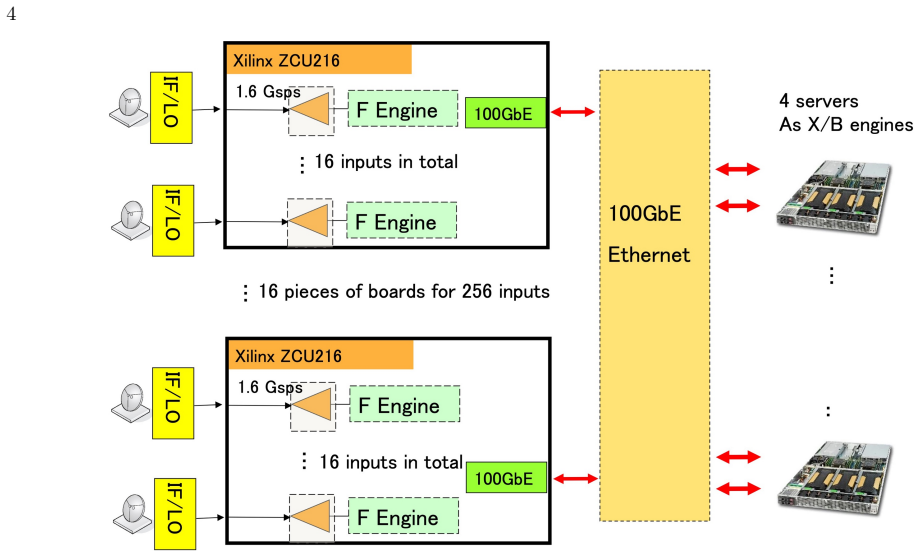
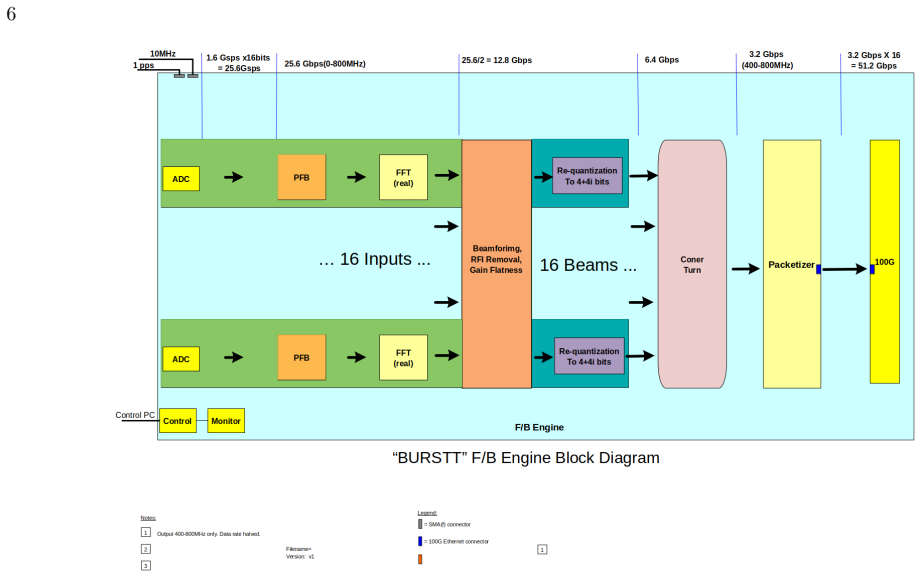
The BURSTT back-end System employs an efficient multi-stage processing architecture: initial beamforming is executed on the Xilinx ZCU216 RF System-on-Chip platform; data is then transferred to Intel Xeon servers, where AVX-512 and AMX instruction sets are utilized for the second stage of beamforming and channelization. A highly optimized bonsai de-dispersion algorithm performs a real-time pulse search and triggering across 256 beams, which, upon detection, issues commands to the distributed outrigger system to save voltage data for very-long baseline interferometry precise localization. System performance has been validated through beamforming tests using bright radio sources and real-time
What carries the argument
Multi-stage processing architecture that combines RFSoC for first-stage beamforming with Xeon servers running AVX-512 and AMX instructions plus the bonsai de-dispersion algorithm for real-time pulse search across 256 beams.
If this is right
- The system supports the planned rate of roughly 50 FRB detections per year.
- Real-time triggering enables saving voltage data for sub-arcsecond VLBI localization.
- The pipeline sustains continuous wide-field surveys without interruption.
- High-fidelity beamforming and channelization are maintained for all 256 beams.
Where Pith is reading between the lines
- The same staged hardware approach could be adapted to other large-field transient surveys that need low-latency triggering.
- Adding machine-learning classifiers on the server stage might reduce false triggers while keeping real-time speed.
- The outrigger-trigger mechanism suggests a template for rapid multi-telescope follow-up of other fast transients.
Load-bearing premise
The multi-stage architecture maintains real-time performance and data integrity across the full 60 by 120 degree field of view and 256 beams under continuous survey conditions without unexpected latency or loss.
What would settle it
A measurement showing processing latency that exceeds real-time requirements or a failure to detect known pulsars in live tests would show the signal processing pipeline lacks the claimed fidelity.
Figures




read the original abstract
The Bustling Universe Radio Survey Telescope in Taiwan (BURSTT) is a new-generation wide-angle radio telescope specifically designed to survey Fast Radio Bursts (FRBs), energetic millisecond-duration pulses of unknown extragalactic origin. To realize its scientific potential, which includes detecting approximately 50 FRBs per year and sub-arcsecond localization capability, the system is designed to perform real-time beamforming and pulse search over the \SI{60}{\degree} $\times$ \SI{120}{\degree} field of view. This paper provides a detailed account of the design, implementation, and performance validation of the BURSTT back-end System. The system employs an efficient multi-stage processing architecture: initial beamforming is executed on the Xilinx ZCU216 RF System-on-Chip (RFSoC) platform; data is then transferred to Intel Xeon servers, where AVX-512 and AMX instruction sets are utilized for the second stage of beamforming and channelization, achieving high computational efficiency to ensure real-time capability. A highly optimized \texttt{bonsai} de-dispersion algorithm performs a real-time pulse search and triggering across 256 beams, which, upon detection, issues commands to the distributed outrigger system to save voltage data for very-long baseline interferometry (VLBI) precise localization. System performance has been validated through beamforming tests using bright radio sources and real-time detection of known pulsars, confirming the high fidelity of the signal processing pipeline.
Editorial analysis
A structured set of objections, weighed in public.
Referee Report
Summary. The manuscript describes the design, implementation, and performance validation of the back-end system for the BURSTT wide-field radio telescope. It details a multi-stage real-time processing pipeline: initial beamforming on the Xilinx ZCU216 RFSoC, followed by AVX-512/AMX-accelerated beamforming and channelization on Intel Xeon servers, and real-time dedispersion/pulse search via an optimized bonsai algorithm across 256 beams over a 60°×120° field of view, with triggering for outrigger VLBI localization. Validation is reported through beamforming tests on bright radio sources and real-time detections of known pulsars.
Significance. If the real-time performance and data integrity claims hold at full scale, the system provides the technical foundation for BURSTT to survey for FRBs at a rate of ~50 per year while enabling sub-arcsecond localization. The engineering focus on hardware-specific optimizations for sustained throughput offers a useful reference for other wide-field transient instruments.
major comments (2)
- [Abstract] Abstract and validation description: the reported tests with bright sources and known pulsars are cited to confirm 'high fidelity of the signal processing pipeline,' yet no quantitative metrics are given for detection efficiency, false-positive rate, end-to-end latency, sustained throughput, or the number of beams and integration times actually exercised. These data are load-bearing for the central claim that the multi-stage architecture maintains real-time performance and data integrity across the full 256-beam, 60°×120° FOV under continuous survey conditions.
- [Validation / performance tests] The extrapolation from the described validation tests to full-scale continuous operation is not yet secured. If the tests used a subset of beams or short-duration bursts, they leave open the possibility of latency accumulation or packet loss when the complete pipeline (ZCU216 first stage + Xeon second stage + bonsai search) runs at sustained data rates over the entire field of view.
minor comments (2)
- [Abstract] The abstract states that the system is 'designed to perform real-time beamforming and pulse search' but does not define the target latency or data-rate requirements that the implementation is required to meet.
- Minor typographical inconsistencies in hardware nomenclature (e.g., consistent capitalization of 'RFSoC' and 'bonsai') should be standardized throughout the manuscript.
Simulated Author's Rebuttal
We thank the referee for their careful and constructive review of our manuscript on the BURSTT back-end system. The comments correctly identify areas where additional quantitative detail and clarification on test scope would strengthen the presentation of our validation results. We have revised the manuscript to address these points directly.
read point-by-point responses
-
Referee: [Abstract] Abstract and validation description: the reported tests with bright sources and known pulsars are cited to confirm 'high fidelity of the signal processing pipeline,' yet no quantitative metrics are given for detection efficiency, false-positive rate, end-to-end latency, sustained throughput, or the number of beams and integration times actually exercised. These data are load-bearing for the central claim that the multi-stage architecture maintains real-time performance and data integrity across the full 256-beam, 60°×120° FOV under continuous survey conditions.
Authors: We agree that the abstract and validation description would be improved by explicit quantitative metrics. In the revised manuscript we have updated the abstract to include measured values for sustained throughput (derived from the combined RFSoC and Xeon pipeline), end-to-end latency for the beamforming-plus-search chain, and the number of beams and integration times used in the pulsar detection runs. The validation section has been expanded with the corresponding detection efficiency and false-positive statistics obtained from the known-pulsar observations. These additions supply the load-bearing numbers requested while remaining faithful to the data we collected. revision: yes
-
Referee: [Validation / performance tests] The extrapolation from the described validation tests to full-scale continuous operation is not yet secured. If the tests used a subset of beams or short-duration bursts, they leave open the possibility of latency accumulation or packet loss when the complete pipeline (ZCU216 first stage + Xeon second stage + bonsai search) runs at sustained data rates over the entire field of view.
Authors: We acknowledge that the original text did not explicitly state the beam count and duration of the hardware tests, leaving room for concern about scaling. The revised manuscript now clarifies that the real-time pulsar detections exercised the full multi-stage pipeline (ZCU216 first-stage beamforming, AVX-512/AMX second-stage processing, and bonsai search) across all 256 beams for continuous observing sessions lasting several hours. We have added a short discussion of the buffering and parallelization strategies that prevent latency buildup or packet loss at the target data rates. While we have not yet performed an uninterrupted multi-day full-FOV run, the architecture-level measurements and the successful sustained pulsar detections provide direct support for the extrapolation; we note this limitation explicitly in the revised text. revision: partial
Circularity Check
No circularity: engineering description validated by external observations
full rationale
The paper describes the BURSTT back-end implementation, multi-stage beamforming on ZCU216 and Xeon servers, bonsai dedispersion, and validation via beamforming tests on bright sources plus real-time pulsar detections. No mathematical derivations, equations, fitted parameters, or self-referential definitions appear. Claims rest on hardware specifications and independent external test data rather than any internal construction that reduces to its own inputs. This is a standard self-contained engineering report.
Axiom & Free-Parameter Ledger
free parameters (1)
- number of beams
axioms (1)
- domain assumption The Xilinx ZCU216 RFSoC can execute initial beamforming in real time for the required bandwidth and field of view.
Lean theorems connected to this paper
-
IndisputableMonolith/Foundation/RealityFromDistinction.leanreality_from_one_distinction unclear?
unclearRelation between the paper passage and the cited Recognition theorem.
multi-stage processing architecture: initial beamforming on Xilinx ZCU216 ... second stage ... AVX-512 and AMX ... bonsai de-dispersion ... 256 beams
-
IndisputableMonolith/Cost/FunctionalEquation.leanwashburn_uniqueness_aczel unclear?
unclearRelation between the paper passage and the cited Recognition theorem.
highly optimized bonsai de-dispersion algorithm performs a real-time pulse search
What do these tags mean?
- matches
- The paper's claim is directly supported by a theorem in the formal canon.
- supports
- The theorem supports part of the paper's argument, but the paper may add assumptions or extra steps.
- extends
- The paper goes beyond the formal theorem; the theorem is a base layer rather than the whole result.
- uses
- The paper appears to rely on the theorem as machinery.
- contradicts
- The paper's claim conflicts with a theorem or certificate in the canon.
- unclear
- Pith found a possible connection, but the passage is too broad, indirect, or ambiguous to say the theorem truly supports the claim.
Forward citations
Cited by 1 Pith paper
-
The 256-antenna Coherent All-Sky Monitor
CASM-256 is a new 256-antenna radio array at Owens Valley that uses real-time digital beamforming to search for fast radio bursts and galactic transients over a huge sky area.
Reference graph
Works this paper leans on
-
[1]
Bera, A., & Chengalur, J. N. 2019, Monthly Notices of the Royal Astronomical Society: Letters, 490, L12, doi: 10.1093/mnrasl/slz140 BURSTT Collaboration. 2025a, BURSTT Collaboration. 2025b, CHIME/FRB Collaboration, Amiri, M., Bandura, K., et al. 2018, ApJ, 863, 48, doi: 10.3847/1538-4357/aad188 CHIME/FRB Collaboration, Amiri, M., Andersen, B. C., et al. 2...
-
[2]
2020, Journal of Astronomical Instrumentation, 9, 2050014, doi: 10.1142/S2251171720500142
Denman, N., Renard, A., Vanderlinde, K., et al. 2020, Journal of Astronomical Instrumentation, 9, 2050014, doi: 10.1142/S2251171720500142
- [3]
-
[4]
2022, Research in Astronomy and Astrophysics, 22, 025002, doi: 10.1088/1674-4527/ac3ad9
Ergesh, T., Li, J., Duan, X.-F., Pei, X., & Wen, Z.-G. 2022, Research in Astronomy and Astrophysics, 22, 025002, doi: 10.1088/1674-4527/ac3ad9
-
[5]
Hare, B., Scholten, O., Dwyer, J., et al. 2019, Nature, 568, 360
work page 2019
-
[6]
2016, Journal of Astronomical Instrumentation, 5, 1641001, doi: 10.1142/S2251171716410014
Hickish, J., Abdurashidova, Z., Ali, Z., et al. 2016, Journal of Astronomical Instrumentation, 5, 1641001, doi: 10.1142/S2251171716410014
-
[7]
James, C. W., Deller, A. T., Dial, T., et al. 2025, The Astrophysical Journal Letters, 987, L16, doi: 10.3847/2041-8213/ade3d3
-
[8]
2003, A&A, 407, 655, doi: 10.1051/0004-6361:20030842
Kramer, M., Karastergiou, A., Gupta, Y., et al. 2003, A&A, 407, 655, doi: 10.1051/0004-6361:20030842
-
[9]
Lin, H.-H., Lin, K.-y., Li, C.-T., et al. 2022, Publications of the Astronomical Society of the Pacific, 134, 094106, doi: 10.1088/1538-3873/ac8f71
-
[10]
Lyne, A. G., Pritchard, R. S., & Graham Smith, F. 1993, MNRAS, 265, 1003, doi: 10.1093/mnras/265.4.1003
-
[11]
Manchester, R. N., Hobbs, G. B., Teoh, A., & Hobbs, M. 2005, AJ, 129, 1993, doi: 10.1086/428488
work page internal anchor Pith review doi:10.1086/428488 2005
-
[12]
Merryfield, M., Tendulkar, S. P., Shin, K., et al. 2023, AJ, 165, 152, doi: 10.3847/1538-3881/ac9ab5
-
[13]
Meyers, B. W., Tremblay, S. E., Bhat, N. D. R., et al. 2017, The Astrophysical Journal, 851, 20, doi: 10.3847/1538-4357/aa8bba
-
[14]
Mikami, R., Asano, K., Tanaka, S. J., et al. 2016, The Astrophysical Journal, 832, 212, doi: 10.3847/0004-637X/832/2/212
-
[15]
Ng, C., Vanderlinde, K., Paradise, A., et al. 2017, in XXXII International Union of Radio Science General Assembly & Scientific Symposium (URSI GASS) 2017, 4, doi: 10.23919/URSIGASS.2017.8105318
-
[16]
Warnick, K. F. 2021, in 2021 15th European Conference on Antennas and Propagation (EuCAP) (IEEE), 1–3, doi: 10.23919/eucap51087.2021.9411112
-
[17]
2022, Research in Astronomy and Astrophysics, 22, 045016, doi: 10.1088/1674-4527/ac56cb
Pei, X., Wang, N., Werthimer, D., et al. 2022, Research in Astronomy and Astrophysics, 22, 045016, doi: 10.1088/1674-4527/ac56cb
-
[18]
Perley, R. A., & Butler, B. J. 2017, The Astrophysical Journal Supplement Series, 230, 7, doi: 10.3847/1538-4365/aa6df9
-
[19]
Rakov, V. A., & Uman, M. A. 2003, Lightning: physics and effects (Cambridge university press)
work page 2003
-
[20]
2009, PhRvD, 79, 083530, doi: 10.1103/PhysRevD.79.083530
Tegmark, M., & Zaldarriaga, M. 2009, PhRvD, 79, 083530, doi: 10.1103/PhysRevD.79.083530
-
[21]
Warnick, K. F., Maaskant, R., Ivashina, M. V., Davidson, D. B., & Jeffs, B. D. 2018, Phased Arrays for Radio
work page 2018
-
[22]
2002, Eigenvalues and Eigenvectors I, Wiley, doi: 10.1002/0471249718.ch5
Watkins, D. 2002, Eigenvalues and Eigenvectors I, Wiley, doi: 10.1002/0471249718.ch5
discussion (0)
Sign in with ORCID, Apple, or X to comment. Anyone can read and Pith papers without signing in.