Two-Stage Signal Reconstruction for Amplitude-Phase-Time Block Modulation-based Communications
Pith reviewed 2026-05-16 20:57 UTC · model grok-4.3
The pith
A two-stage reconstruction algorithm for amplitude-phase-time block modulation allows power amplifiers to operate at 5 dB lower input back-off in simulations and 2 dB lower in experiments without signal degradation.
A machine-rendered reading of the paper's core claim, the machinery that carries it, and where it could break.
Core claim
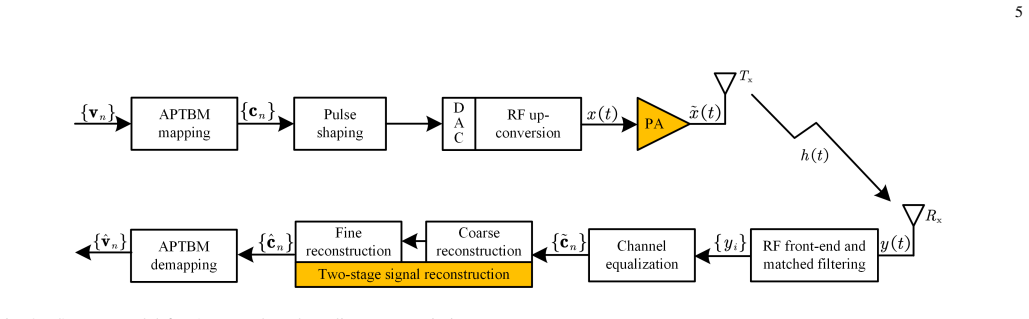
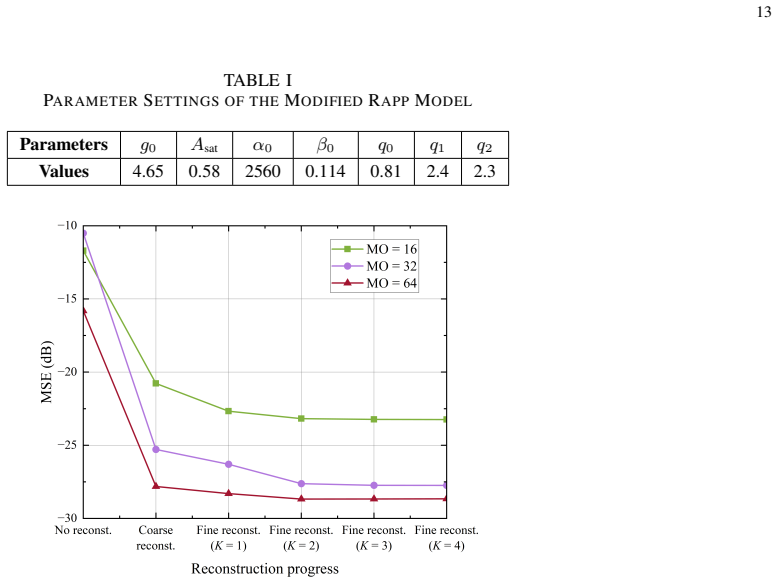
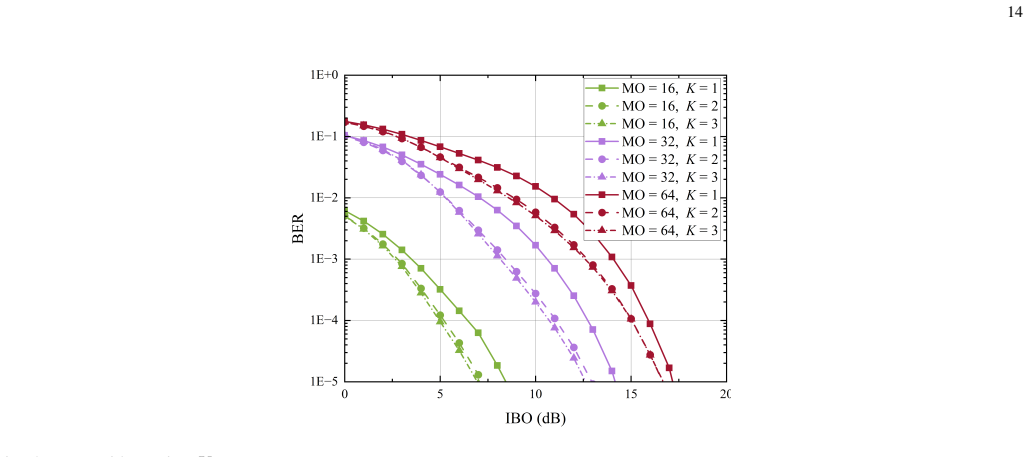
The paper decomposes PA-induced nonlinear distortion into dominant and residual components. The coarse stage removes the dominant part by jointly exploiting APTBM block structure and PA nonlinear characteristics. The fine stage then casts residual minimization as a nonconvex optimization subject to explicit APTBM constraints and derives a closed-form solution for it. This two-stage process achieves additional IBO reductions of approximately 5 dB in simulations and 2 dB in experiments over baseline reconstruction methods, producing relative PA efficiency improvements of 77.8 percent and 30.9 percent without compromising transmission quality.
What carries the argument
Two-stage signal reconstruction that first eliminates dominant distortion via joint APTBM block and PA characteristic exploitation, then minimizes residual distortion through a derived closed-form solution to the constrained nonconvex optimization.
If this is right
- Transmitters can run power amplifiers at lower input back-off while preserving the same signal quality, directly raising efficiency.
- The closed-form fine-stage solution removes the need for iterative solvers inside each APTBM block, lowering computational cost at the receiver.
- The decomposition approach generalizes the use of modulation-specific constraints to counteract amplifier nonlinearity beyond heuristic statistical methods.
- Measured efficiency gains of 30.9 percent in hardware imply reduced heat dissipation and extended battery life in portable APTBM devices.
Where Pith is reading between the lines
- If the dominant-residual split holds for other amplifier models, the same two-stage structure could be reused across different hardware without redesigning the fine-stage solver.
- The explicit constraint formulation may allow the method to be combined with forward error correction that also respects block-level amplitude and phase rules.
- In systems where multiple APTBM blocks share the same amplifier, the coarse stage could be extended to exploit cross-block correlation for further distortion reduction.
Load-bearing premise
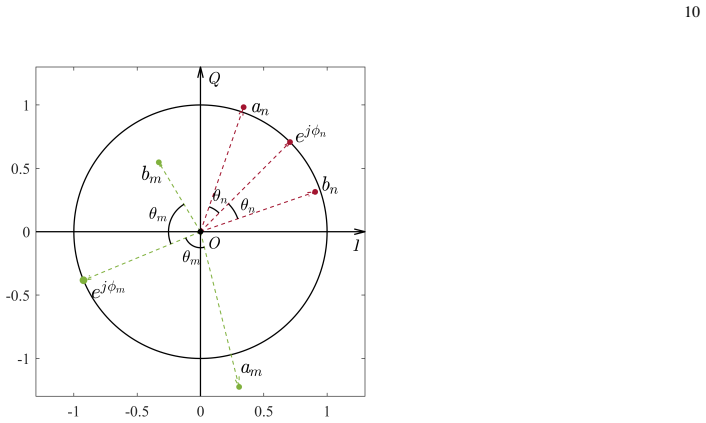
The nonlinear distortion can be cleanly split into a dominant component handled by coarse joint exploitation and a residual component that admits a reliable closed-form solution under the APTBM amplitude and phase constraints.
What would settle it
A side-by-side testbed run in which the two-stage method produces no additional IBO reduction beyond baselines or shows increased bit-error rate or error-vector magnitude at the claimed lower back-off levels.
Figures




read the original abstract
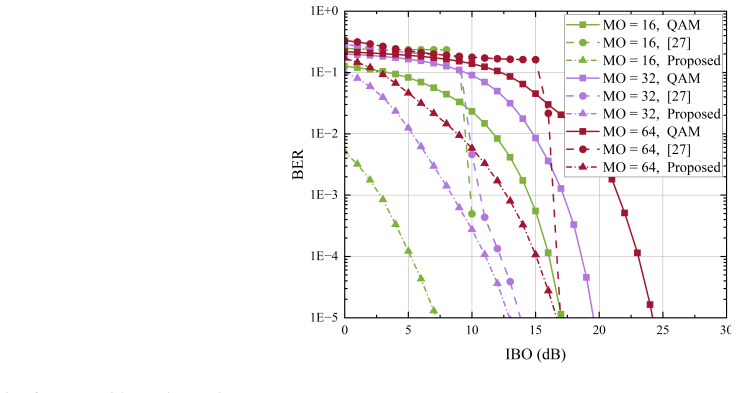
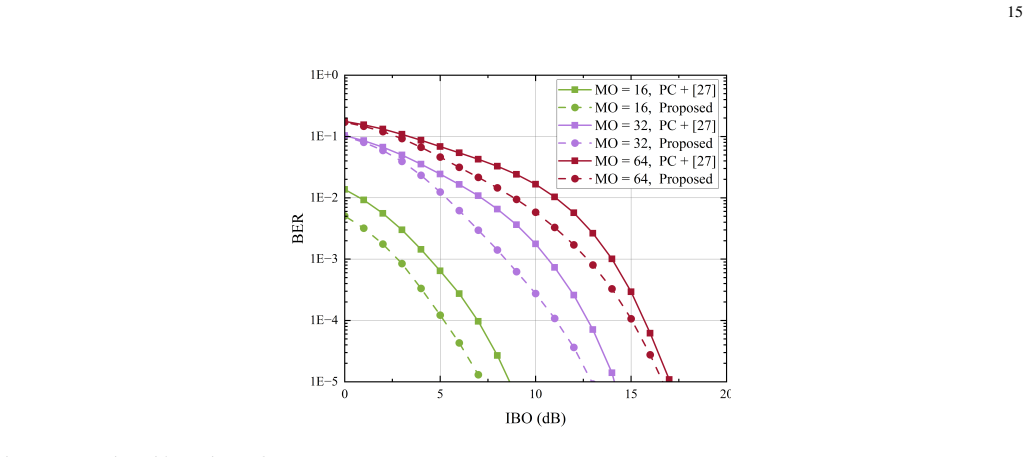
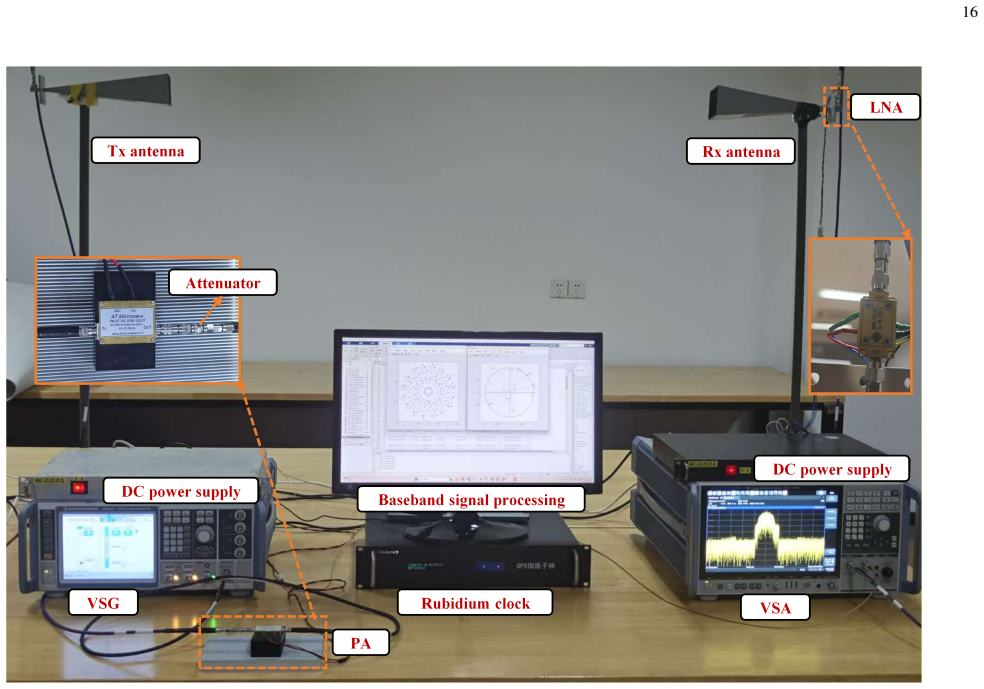
Operating power amplifiers (PAs) at lower input back-off (IBO) levels is an effective way to improve PA efficiency, but often introduces severe nonlinear distortion that degrades transmission performance. Amplitude-phase-time block modulation (APTBM) has recently emerged as an effective solution to this problem. The intrinsic amplitude and phase constraints of each APTBM block can be leveraged to mitigate PA-induced nonlinear distortion via constraint-guided signal reconstruction. However, existing reconstruction methods apply these constraints only heuristically and statistically, limiting the achievable IBO reduction and PA efficiency improvement. This paper addresses this limitation by decomposing the nonlinear distortion into dominant and residual components, and accordingly develops a novel two-stage signal reconstruction algorithm consisting of coarse and fine reconstruction stages. The coarse reconstruction stage eliminates the dominant distortion by jointly exploiting the APTBM block structure and PA nonlinear characteristics. Subsequently, the fine reconstruction stage minimizes the residual distortion by casting it as a nonconvex optimization problem subject to explicit APTBM constraints, for which a closed-form solution is derived. The proposed algorithm is validated through comprehensive numerical simulations and testbed experiments. Results show that, without compromising transmission quality, the proposed algorithm enables an additional IBO reduction of approximately 5 dB in simulations and 2 dB in experiments over baseline methods, yielding relative PA efficiency improvements of 77.8\% and 30.9\%, respectively.
Editorial analysis
A structured set of objections, weighed in public.
Referee Report
Summary. The paper claims that decomposing PA nonlinear distortion into dominant and residual components enables a two-stage reconstruction algorithm for APTBM signals: a coarse stage jointly exploits block structure and PA characteristics to remove dominant distortion, followed by a fine stage that solves a nonconvex optimization under explicit APTBM amplitude-phase-time constraints via a derived closed-form solution. This yields an additional ~5 dB IBO reduction in simulations and ~2 dB in testbed experiments over baselines, corresponding to relative PA efficiency gains of 77.8% and 30.9% without degrading transmission quality.
Significance. If the decomposition and closed-form solution are rigorously validated, the work would offer a concrete, constraint-guided method to operate PAs at lower IBO while preserving signal integrity in APTBM systems, directly addressing efficiency bottlenecks in wireless transmitters. The inclusion of both numerical simulations and hardware experiments provides practical grounding, though the magnitude of the reported gains hinges on the unverified technical steps noted below.
major comments (3)
- [Abstract, §4] Abstract and §4 (fine-stage derivation): the claim that a closed-form solution exists for the nonconvex optimization subject to explicit APTBM constraints provides no derivation steps, no verification that the minimizer remains feasible under the amplitude-phase-time block constraints, and no check that the residual after the coarse stage is small enough for the dominant/residual separation to hold. This is load-bearing for attributing the reported IBO reductions to the two-stage method.
- [§3.1] §3.1 (distortion decomposition): the central assumption that nonlinear distortion cleanly separates into dominant and residual components lacks quantitative validation (e.g., norm of residual vs. dominant component across IBO levels or modulation parameters); without this, the performance advantage over heuristic/statistical baselines cannot be isolated from the decomposition itself.
- [Results section] Results (e.g., simulation and experimental figures/tables reporting IBO reduction): the claimed 5 dB (sim) and 2 dB (exp) gains and efficiency percentages are presented without error bars, confidence intervals, or statistical tests across multiple runs or channel realizations, weakening the robustness of the cross-method comparison.
minor comments (2)
- [Abstract, §2] Notation for APTBM block constraints is introduced without an explicit equation reference in the abstract or early sections, making it harder to trace how the fine-stage closed-form satisfies them.
- [Figure captions] Figure captions for experimental results should clarify the exact PA model parameters and testbed hardware used to allow reproducibility.
Simulated Author's Rebuttal
We thank the referee for the constructive and detailed review. We address each major comment below and indicate the specific revisions we will incorporate in the next version of the manuscript.
read point-by-point responses
-
Referee: [Abstract, §4] Abstract and §4 (fine-stage derivation): the claim that a closed-form solution exists for the nonconvex optimization subject to explicit APTBM constraints provides no derivation steps, no verification that the minimizer remains feasible under the amplitude-phase-time block constraints, and no check that the residual after the coarse stage is small enough for the dominant/residual separation to hold. This is load-bearing for attributing the reported IBO reductions to the two-stage method.
Authors: We agree that the derivation in §4 was presented too concisely. In the revised manuscript we will expand §4 with the complete step-by-step derivation of the closed-form solution. We will also add a short feasibility proof showing that the minimizer satisfies the explicit APTBM amplitude-phase-time block constraints and include numerical checks (across IBO levels) confirming that the residual after the coarse stage remains small enough for the dominant/residual separation to be valid. revision: yes
-
Referee: [§3.1] §3.1 (distortion decomposition): the central assumption that nonlinear distortion cleanly separates into dominant and residual components lacks quantitative validation (e.g., norm of residual vs. dominant component across IBO levels or modulation parameters); without this, the performance advantage over heuristic/statistical baselines cannot be isolated from the decomposition itself.
Authors: We accept that quantitative validation of the decomposition is needed. We will add a new figure (or table) in §3.1 that plots the Euclidean norms of the dominant and residual distortion components versus IBO and modulation parameters. This will explicitly demonstrate that the residual is small relative to the dominant term and thereby isolate the contribution of the two-stage reconstruction. revision: yes
-
Referee: [Results section] Results (e.g., simulation and experimental figures/tables reporting IBO reduction): the claimed 5 dB (sim) and 2 dB (exp) gains and efficiency percentages are presented without error bars, confidence intervals, or statistical tests across multiple runs or channel realizations, weakening the robustness of the cross-method comparison.
Authors: We agree that statistical robustness indicators are important. In the revised results section we will augment all simulation and experimental figures/tables with error bars (standard deviation) computed over multiple independent runs and channel realizations. We will also state the number of trials performed and briefly discuss the observed consistency of the reported IBO reductions. revision: yes
Circularity Check
No circularity: two-stage derivation relies on independent PA characteristics and explicit constraints
full rationale
The paper decomposes nonlinear distortion into dominant/residual parts, applies coarse reconstruction using APTBM block structure plus external PA nonlinearity, then solves the fine-stage nonconvex problem subject to explicit amplitude-phase-time constraints via a derived closed-form. No equation reduces the claimed IBO gains to a parameter fitted inside the paper, no self-citation chain bears the central result, and no ansatz or uniqueness theorem is smuggled from prior author work. Simulations and experiments provide external validation against baselines, keeping the derivation self-contained.
Axiom & Free-Parameter Ledger
axioms (2)
- domain assumption Nonlinear distortion from the power amplifier can be decomposed into dominant and residual components that can be handled separately.
- domain assumption The fine-stage residual minimization problem subject to APTBM constraints admits a closed-form solution.
Reference graph
Works this paper leans on
-
[1]
On the road to 6G: Visions, requirements, key technologies, and testbeds,
C.-X. Wang, X. You, X. Gaoet al., “On the road to 6G: Visions, requirements, key technologies, and testbeds,”IEEE Commun. Surv. Tutor ., vol. 25, no. 2, pp. 905–974, 2023. 18 (a) (b) (c) (d) Fig. 11. Measured constellations at 5.4 GHz. (a) Without signal reconstruction. (b) With baseline reconstruction. (c) With PC-enhanced baseline reconstruction. (d) Wi...
work page 2023
-
[2]
W. Xu, Z. Yang, D. W. K. Nget al., “Edge learning for B5G networks with distributed signal processing: Semantic communication, edge computing, and wireless sensing,”IEEE J. Sel. Top. Signal Process., vol. 17, no. 1, pp. 9–39, Jan. 2023
work page 2023
-
[3]
W. Shi, W. Xu, X. Youet al., “Intelligent reflection enabling technologies for integrated and green Internet-of-Everything beyond 5G: Communication, sensing, and security,”IEEE Wireless Commun., vol. 30, no. 2, pp. 147–154, Apr. 2023
work page 2023
-
[4]
Toward net-zero carbon emissions in network AI for 6G and beyond,
P. Zhang, Y . Xiao, Y . Liet al., “Toward net-zero carbon emissions in network AI for 6G and beyond,”IEEE Commun. Mag., vol. 62, no. 4, pp. 58–64, Apr. 2024
work page 2024
-
[5]
Energy-efficient edge inference in integrated sensing, communication, and computation networks,
J. Yao, W. Xu, G. Zhuet al., “Energy-efficient edge inference in integrated sensing, communication, and computation networks,”IEEE J. Sel. Areas Commun., vol. 43, no. 10, pp. 3580–3595, Oct. 2025
work page 2025
-
[6]
Green radio: Radio techniques to enable energy-efficient wireless networks,
C. Han, T. Harrold, S. Armouret al., “Green radio: Radio techniques to enable energy-efficient wireless networks,”IEEE Commun. Mag., vol. 49, no. 6, pp. 46–54, Jun. 2011. 19 (a) (b) (c) (d) Fig. 12. Measured constellations at 38 GHz. (a) Without signal reconstruction. (b) With baseline reconstruction. (c) With PC-enhanced baseline reconstruction. (d) With...
work page 2011
-
[7]
Green 5G: Building a sustainable world,
C. Gabriel, A. Hansang, and A. Chern, “Green 5G: Building a sustainable world,” 2020, [Online]. Available: https://www.huawei.com/ en/public-policy/green-5g-building-a-sustainable-world
work page 2020
-
[8]
Improving energy performance in 5G networks and beyond,
C. Andersson, J. Bengtsson, G. Bystr ¨omet al., “Improving energy performance in 5G networks and beyond,”Ericsson Technol. Rev., vol. 2022, no. 8, pp. 2–11, Aug. 2022
work page 2022
-
[9]
How much energy is needed to run a wireless network?
G. Auer, V . Giannini, C. Dessetet al., “How much energy is needed to run a wireless network?”IEEE Wireless Commun., vol. 18, no. 5, pp. 40–49, Oct. 2011
work page 2011
-
[10]
J. He, S. Huang, Y . Huanget al., “A unified power amplifier representation-based receiver equalization technique for nonlinear OFDM signal detection,”IEEE Trans. Commun., vol. 72, no. 4, pp. 2260–2274, Apr. 2024
work page 2024
-
[11]
Digital predistortion for hybrid MIMO transmitters,
M. Abdelaziz, L. Anttila, A. Brihuegaet al., “Digital predistortion for hybrid MIMO transmitters,”IEEE J. Sel. Top. Signal Process., vol. 12, no. 3, pp. 445–454, Jun. 2018. 20 (a) (b) Fig. 13. Measured SER in experiments. (a) 5.4 GHz. (b) 38 GHz
work page 2018
-
[12]
Green communications: Digital predistortion for wideband RF power amplifiers,
L. Guan and A. Zhu, “Green communications: Digital predistortion for wideband RF power amplifiers,”IEEE Microwave Mag., vol. 15, no. 7, pp. 84–99, Nov. 2014
work page 2014
-
[13]
A. Katz, J. Wood, and D. Chokola, “The evolution of PA linearization: From classic feedforward and feedback through analog and digital predistortion,”IEEE Microwave Mag., vol. 17, no. 2, pp. 32–40, Feb. 2016
work page 2016
-
[14]
A low-complexity digital predistorter for large-scale MIMO systems with crosstalk,
L. Zhao, H. Qian, W. Fenget al., “A low-complexity digital predistorter for large-scale MIMO systems with crosstalk,”IEEE Trans. V eh. Technol., vol. 72, no. 10, pp. 13 203–13 213, Oct. 2023
work page 2023
-
[15]
T. Feys, L. V . D. Perre, and F. Rottenberg, “Toward energy-efficient massive MIMO: Graph neural network precoding for mitigating non-linear PA distortion,”IEEE Trans. Cognit. Commun. Networking, vol. 11, no. 1, pp. 184–201, Feb. 2025
work page 2025
-
[16]
Unlocking potentials of near-field propagation: ELAA-empowered integrated sensing and communication,
Z. He, W. Xu, Z. Yanget al., “Unlocking potentials of near-field propagation: ELAA-empowered integrated sensing and communication,” IEEE Commun. Mag., vol. 62, no. 9, pp. 82–89, Sep. 2024
work page 2024
-
[17]
Optimal beamforming for hybrid satellite terrestrial networks with nonlinear PA and imperfect CSIT,
C. Liu, W. Feng, Y . Chenet al., “Optimal beamforming for hybrid satellite terrestrial networks with nonlinear PA and imperfect CSIT,” IEEE Wireless Commun. Lett., vol. 9, no. 3, pp. 276–280, Mar. 2020
work page 2020
-
[18]
Frequency-independent and frequency-dependent nonlinear models of TWT amplifiers,
A. A. M. Saleh, “Frequency-independent and frequency-dependent nonlinear models of TWT amplifiers,”IEEE Trans. Commun., vol. 29, no. 11, pp. 1715–1720, Nov. 1981
work page 1981
-
[19]
Distortion-aware linear precoding for millimeter-wave multiuser MISO downlink,
S. J. S. R. Aghdam and T. Eriksson, “Distortion-aware linear precoding for millimeter-wave multiuser MISO downlink,” inProc. IEEE Int. Conf. Commun. Workshops (ICC Workshops), Shanghai, China, May 2019, pp. 1–6
work page 2019
-
[20]
Crosscorrelation functions of amplitude-distorted Gaussian signals,
J. J. Bussgang, “Crosscorrelation functions of amplitude-distorted Gaussian signals,” Res. Lab. Electron., MIT, Cambridge, MA, USA, Tech. Rep. 216, 1952
work page 1952
-
[21]
P. Priya, C. S. Reddy, and D. Sen, “Channel estimator and nonlinear detector for mmWave beamformed OTFS systems in high mobility scenarios,”IEEE Trans. V eh. Technol., vol. 72, no. 9, pp. 11 698–11 713, Sep. 2023
work page 2023
-
[22]
Y . Jian, D. Li, Y . Liet al., “Sparse channel estimation combined with successive intersymbol interference and power amplifier nonlinear distortion cancellation for UWB OFDM systems,”IEEE Wireless Commun. Lett., early access, Sep. 9, 2025, doi: 10.1109/LWC.2025.3608061
-
[23]
Optimized iterative clipping and filtering for PAPR reduction of OFDM signals,
Y .-C. Wang and Z.-Q. Luo, “Optimized iterative clipping and filtering for PAPR reduction of OFDM signals,”IEEE Trans. Commun., vol. 59, no. 1, pp. 33–37, Jan. 2011
work page 2011
-
[24]
Constant envelope orthogonal frequency division multiplexing with index modulation,
H. Chen, Y . Xiao, Y . Wanget al., “Constant envelope orthogonal frequency division multiplexing with index modulation,”IEEE Trans. V eh. Technol., vol. 73, no. 6, pp. 8083–8096, Jun. 2024
work page 2024
-
[25]
Transmitter-centric channel estimation and low-PAPR precoding for millimeter-wave MIMO systems,
Z. Guo, Y . Y . lmaz, and X. Wang, “Transmitter-centric channel estimation and low-PAPR precoding for millimeter-wave MIMO systems,”IEEE Trans. Commun., vol. 64, no. 7, pp. 2925–2938, Jul. 2016
work page 2016
-
[26]
N. N. Moghadam, G. Fodor, M. Bengtssonet al., “On the energy efficiency of MIMO hybrid beamforming for millimeter-wave systems with nonlinear power amplifiers,”IEEE Trans. Wireless Commun., vol. 17, no. 11, pp. 7208–7221, Nov. 2018
work page 2018
-
[27]
M. Fan, C. Yi, W. Xuet al., “Amplitude-phase-time block modulation for resisting nonlinear amplification and its application for energy-efficient wireless communications,”IEEE Trans. Commun., vol. 73, no. 4, pp. 2329–2343, Apr. 2025
work page 2025
-
[28]
3-D polarized modulation: System analysis and performance,
P. Henarejos and A. I. P ´erez-Neira, “3-D polarized modulation: System analysis and performance,”IEEE Trans. Commun., vol. 66, no. 11, pp. 5305–5316, Nov. 2018
work page 2018
-
[29]
Power consumption minimization for MIMO systems — a cognitive radio approach,
A. He, S. Srikanteswara, K. K. Baeet al., “Power consumption minimization for MIMO systems — a cognitive radio approach,”IEEE J. Sel. Areas Commun., vol. 29, no. 2, pp. 469–479, Feb. 2011
work page 2011
-
[30]
Realistic power amplifier model for the new radio evaluation,
3GPP, “Realistic power amplifier model for the new radio evaluation,” 3GPP, TSG-RAN WG4 Meeting 79 R4-163314, 2016
work page 2016
-
[31]
C. Zhao, M. Liu, H. Liuet al., “A 23-41 GHz broadband power amplifier with common-mode stability enhancement technique in 65-nm CMOS process,”IEEE Trans. Circuits Syst. I Regul. Pap., 2025, early access, May 8, 2025, doi: 10.1109/TCSI.2025.3563467
-
[32]
S. Boyd and L. Vandenberghe,Convex Optimization. Cambridge, U.K.: Cambridge Univ. Press, 2004. 21
work page 2004
-
[33]
A semidefinite framework for trust region subproblems with applications to large scale minimization,
F. Rendl and H. Wolkowicz, “A semidefinite framework for trust region subproblems with applications to large scale minimization,” Math. Program., vol. 77, no. 1, pp. 273–299, Apr. 1997
work page 1997
discussion (0)
Sign in with ORCID, Apple, or X to comment. Anyone can read and Pith papers without signing in.