Effect of Underlayer Induced Charge Carrier Substitution on the Superconductivity of Ti40V60 Alloy Thin Films
Pith reviewed 2026-05-16 20:28 UTC · model grok-4.3
The pith
Silicon under-layers raise the superconducting transition temperature in Ti40V60 thin films by introducing disorder that suppresses spin-fluctuation pair breaking.
A machine-rendered reading of the paper's core claim, the machinery that carries it, and where it could break.
Core claim
Under-layer induced charge carrier substitution changes both carrier type and density in Ti40V60 thin films, producing a clear correlation in which increasing carrier concentration lowers the superconducting transition temperature. The Si under-layer, which introduces the largest disorder, nevertheless yields the highest Tc. This indicates that a moderate amount of disorder suppresses the spin-fluctuations inherent to the alloy and thereby reduces pair breaking, enhancing superconductivity. The comparable Tc of the V-under-layer film and the pristine film, together with the short coherence length relative to film thickness, confirm the absence of significant proximity effects.
What carries the argument
Under-layer-induced charge carrier substitution combined with controlled disorder, which modulates carrier density while allowing moderate disorder to suppress spin-fluctuation pair breaking.
If this is right
- The superconducting transition temperature of Ti40V60 films can be tuned over a 1 K window by choice of under-layer material.
- Higher carrier concentrations systematically lower Tc in this alloy system.
- Moderate disorder enhances superconductivity by counteracting the pair-breaking effect of intrinsic spin fluctuations.
- Under-layer engineering provides a route to optimize film properties without introducing proximity-induced suppression.
- The short coherence length relative to film thickness allows independent control of superconductivity via the under-layer.
Where Pith is reading between the lines
- The same under-layer strategy could be tested in other transition-metal alloys where spin fluctuations limit Tc.
- Thin-film devices could incorporate tailored Tc values through simple under-layer deposition steps.
- Direct probes of spin fluctuations, such as NMR or specific-heat measurements, would test whether the disorder effect is truly the dominant mechanism.
Load-bearing premise
That the rise in Tc with Si-induced disorder is caused by suppression of spin-fluctuation pair breaking rather than by unmeasured changes in electron-phonon coupling or interface scattering.
What would settle it
A measurement of spin susceptibility or the pair-breaking parameter across the same set of under-layers that fails to show reduced spin-fluctuation strength for the Si case despite its higher Tc.
Figures

read the original abstract
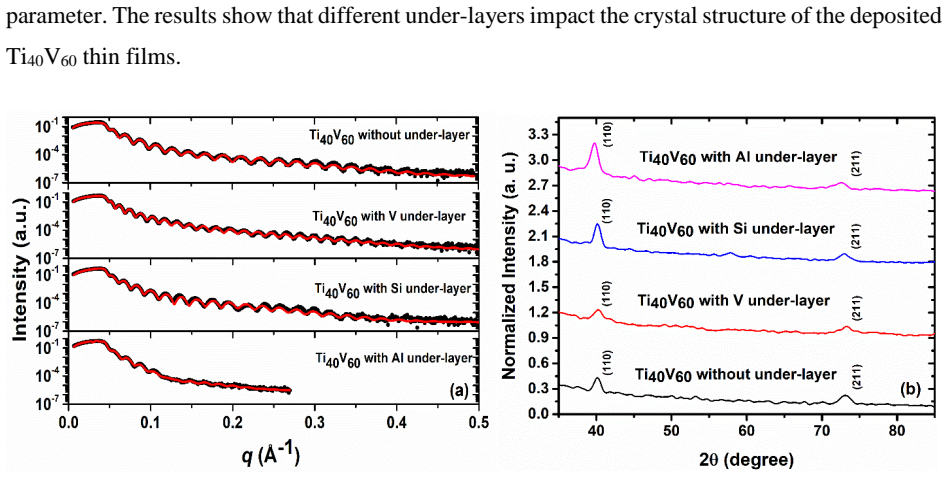
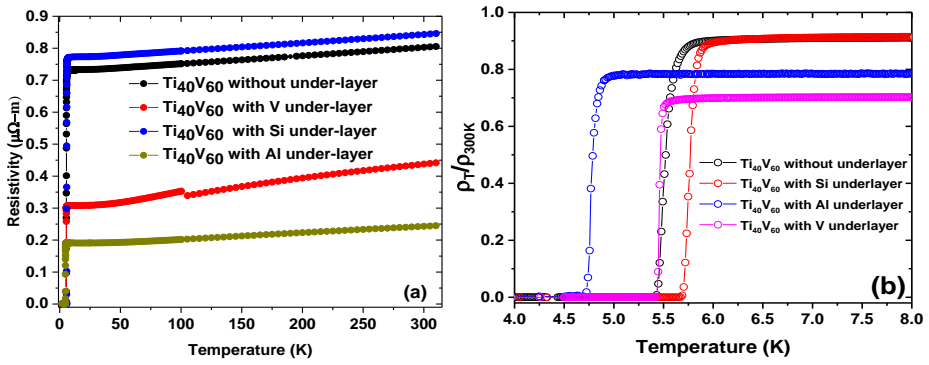
The influence of metallic and semiconducting (V, Al, and Si) under-layer induced charge carrier substitution on the superconducting properties of the Ti40V60 alloy thin films are studied and also compared with a pristine reference film without any under-layer. All the films exhibit metallic behavior in the normal state and a superconducting transition at low temperatures, where the superconducting transition temperature is tunable between 4.77 K and 5.73 K. Hall measurements on the films reveal that the under-layer strongly affects the charge carrier type and density, leading to a correlation between increasing carrier concentration and decreasing TC. The Si under-layer introduces the highest disorder, yet yields the highest TC. This indicates that in the Ti40V60 alloys, a moderate amount of disorder suppresses the spin-fluctuations (inherent to the alloy system) induced pair breaking, thereby enhancing the superconductivity. The comparable TC of the film with V under-layer and the film without under-layer, and the much smaller coherence length (~6.2 nm) as compared to the film thickness (25 nm), confirm the absence of any significant proximity effects. These findings demonstrate that under-layer engineering provides an effective route to tune the superconducting properties of Ti-V alloy thin films.
Editorial analysis
A structured set of objections, weighed in public.
Referee Report
Summary. The manuscript experimentally investigates the effects of V, Al, and Si under-layers on Ti40V60 alloy thin films, reporting metallic normal-state behavior, tunable superconducting transition temperatures between 4.77 K and 5.73 K, and Hall-derived carrier densities that correlate inversely with Tc. The Si under-layer produces the highest Tc despite the highest disorder (evidenced by resistivity upturns), which the authors interpret as moderate disorder suppressing spin-fluctuation pair-breaking inherent to the alloy; proximity effects are ruled out by a coherence length of ~6.2 nm versus 25 nm film thickness.
Significance. The experimental demonstration of under-layer control over Tc and carrier density in Ti-V thin films could offer a practical route for tuning superconductivity in alloy-based devices if the mechanism is validated. However, the current significance is tempered because the central causal attribution to spin-fluctuation suppression rests on correlation alone without direct microscopic probes, limiting immediate impact on the field.
major comments (2)
- [Abstract and discussion of Si under-layer results] The interpretation that Si-induced disorder suppresses spin-fluctuation pair-breaking (stated in the abstract and discussion of results) lacks direct supporting data; no magnetic susceptibility, NMR, or specific-heat measurements are presented to confirm the existence or modulation of spin fluctuations in Ti40V60. The inverse carrier-density–Tc trend and resistivity upturns alone do not establish this mechanism over alternatives such as altered electron-phonon coupling or unaccounted interface scattering.
- [Results section on transport and Hall measurements] Experimental robustness is insufficiently documented: the manuscript provides no error bars on reported Tc values (4.77–5.73 K), coherence length (~6.2 nm), or Hall coefficients, nor details on the number of samples, measurement statistics, or fitting procedures for extracting carrier densities and coherence lengths. This undermines assessment of the claimed trends and the conclusion that the Si under-layer yields unambiguously highest Tc.
minor comments (1)
- [Abstract] Clarify whether the under-layers change the dominant carrier type (electrons vs. holes) in addition to density, as this is mentioned qualitatively but not quantified in the Hall data summary.
Simulated Author's Rebuttal
We thank the referee for the careful review and constructive feedback on our manuscript. We have revised the abstract and discussion to present the spin-fluctuation interpretation more cautiously as a plausible hypothesis rather than a confirmed mechanism, and we have substantially improved the documentation of experimental statistics, error bars, and analysis procedures.
read point-by-point responses
-
Referee: The interpretation that Si-induced disorder suppresses spin-fluctuation pair-breaking (stated in the abstract and discussion of results) lacks direct supporting data; no magnetic susceptibility, NMR, or specific-heat measurements are presented to confirm the existence or modulation of spin fluctuations in Ti40V60. The inverse carrier-density–Tc trend and resistivity upturns alone do not establish this mechanism over alternatives such as altered electron-phonon coupling or unaccounted interface scattering.
Authors: We agree that the manuscript lacks direct microscopic probes of spin fluctuations. In the revised version we have removed the definitive phrasing from the abstract and discussion, now describing the suppression of spin-fluctuation pair-breaking as a working hypothesis supported by the observed correlation between moderate disorder (resistivity upturn) and elevated Tc. We explicitly note that transport data alone cannot rule out alternative explanations such as changes in electron-phonon coupling or interface scattering, and we have added a short paragraph discussing these possibilities. revision: partial
-
Referee: Experimental robustness is insufficiently documented: the manuscript provides no error bars on reported Tc values (4.77–5.73 K), coherence length (~6.2 nm), or Hall coefficients, nor details on the number of samples, measurement statistics, or fitting procedures for extracting carrier densities and coherence lengths. This undermines assessment of the claimed trends and the conclusion that the Si under-layer yields unambiguously highest Tc.
Authors: We have added error bars (standard deviations from repeated measurements) to all Tc values, the coherence length, and Hall coefficients throughout the figures and text. The revised manuscript now states that at least three independent samples were measured for each under-layer type, reports the number of Hall sweeps per sample, and describes the linear fitting procedure used to extract carrier densities from the Hall resistivity. The coherence length was obtained via the Werthamer-Helfand-Hohenberg formula applied to upper-critical-field data; the fitting details and raw data ranges are provided in the methods section. revision: yes
- Direct microscopic confirmation of spin fluctuations (via NMR, specific-heat, or susceptibility measurements) cannot be supplied in the present revision, as such experiments require specialized equipment and sample preparation beyond the scope of the current study.
Circularity Check
No circularity: purely experimental study with interpretive claims unsupported by derivations
full rationale
The paper reports direct experimental measurements of Tc (4.77–5.73 K), Hall-derived carrier densities, resistivity upturns, and coherence length (~6.2 nm) for Ti40V60 films with different underlayers. The central interpretation—that moderate Si-induced disorder suppresses inherent spin-fluctuation pair-breaking—is presented as an inference from the observed inverse carrier-density–Tc correlation and highest Tc despite highest disorder. No equations, fitted parameters, self-citations, or derivations are used; the claim does not reduce to inputs by construction. The study is self-contained against external benchmarks (measured values), with the mechanism remaining a hypothesis rather than a load-bearing mathematical step.
Axiom & Free-Parameter Ledger
axioms (1)
- domain assumption Spin fluctuations inherent to the Ti-V alloy system cause pair breaking that can be suppressed by moderate disorder
Lean theorems connected to this paper
-
IndisputableMonolith/Foundation/RealityFromDistinction.leanreality_from_one_distinction unclear?
unclearRelation between the paper passage and the cited Recognition theorem.
The Si under-layer introduces the highest disorder, yet yields the highest TC. This indicates that in the Ti40V60 alloys, a moderate amount of disorder suppresses the spin-fluctuations (inherent to the alloy system) induced pair breaking
What do these tags mean?
- matches
- The paper's claim is directly supported by a theorem in the formal canon.
- supports
- The theorem supports part of the paper's argument, but the paper may add assumptions or extra steps.
- extends
- The paper goes beyond the formal theorem; the theorem is a base layer rather than the whole result.
- uses
- The paper appears to rely on the theorem as machinery.
- contradicts
- The paper's claim conflicts with a theorem or certificate in the canon.
- unclear
- Pith found a possible connection, but the passage is too broad, indirect, or ambiguous to say the theorem truly supports the claim.
Reference graph
Works this paper leans on
-
[1]
Webb G W, Marsiglio F and Hirsch J E 2015 Superconductivity in the elements, alloys and simple compounds Physica C: Superconductivity and its Applications 514 17
work page 2015
-
[2]
Mito M, Matsui H, Tsuruta K, Yamaguchi T, Nakamura K, Deguchi H, Shirakawa N, Adachi H, Yamasaki T, Iwaoka H, Ikoma Y and Horita Z 2016 Large e nhancement of superconducting transition temperature in single -element superconducting rhenium by shear strain Scientific Reports 6 36337
work page 2016
-
[3]
Cao Z-Y, Jang H, Choi S, Kim J, Kim S, Zhang J-B, Sharbirin A S, Kim J and Park T 2023 Spectroscopic evidence for the superconductivity of elemental metal Y under pressure NPG Asia Materials 15 5 16
work page 2023
-
[4]
Mito M, Tsuji H, Tajiri T, Nakamura K, Tang Y and Horita Z 2024 Superconductivity of barium with highest transition temperatures in metallic materials at ambient pressure Scientific Reports 14 965
work page 2024
-
[5]
Zhang C, He X, Liu C, Li Z, Lu K, Zhang S, Feng S, Wang X, Peng Y, Long Y, Yu R, Wang L, Prakapenka V, Chariton S, Li Q, Liu H, Chen C and Jin C 2022 Record high Tc element superconductivity achieved in titanium Nature Communications 13 5411
work page 2022
-
[6]
Compton V B, Corenzwit E, Maita J P, Matthias B T and Morin F J 1961 Superconductivity of Technetium Alloys and Compounds Physical Review 123 1567
work page 1961
-
[7]
Matthias B T, Geballe T H, Compton V B, Corenzwit E and Hull G W 1962 Superconductivity of Chromium Alloys Physical Review 128 588
work page 1962
-
[8]
Tai M, Inoue K, Kikuchi A, Takeuchi T, Kiyoshi T and Hishinuma Y 2007 Superconducting Properties of V -Ti Alloys IEEE Transactions on Applied Superconductivity 17 2542
work page 2007
-
[9]
Matin M, Sharath Chandra L S , Chattopadhyay M K, Meena R K, Kaul R, Singh M N, Sinha A K and Roy S B 2015 Critical current and flux pinning properties of the superconducting Ti–V alloys Physica C: Superconductivity and its Applications 512 32
work page 2015
-
[10]
Si Q and Hussey N E 2023 Iron -based superconductors: Teenage, complex, challenging Physics Today 76 34
work page 2023
-
[11]
Stewart G R 2011 Superconductivity in iron compounds Reviews of Modern Physics 83 1589
work page 2011
-
[12]
Disiena M N, Jha R, Sloan L and Banerjee S K 2025 Effect s of Mo Doping on the Superconducting Properties of NbSe2 ACS Applied Electronic Materials 7 9526
work page 2025
-
[13]
Bohnenstiehl S D, Susner M A, Yang Y, Collings E W, Sumption M D, Rindfleisch M A and Boone R 2011 Carbon doping of MgB2 by toluene and malic-acid-in-toluene Physica C: Superconductivity 471 108
work page 2011
-
[14]
Han D, Ming W, Xu H, Chen S, Sun D and Du M -H 2019 Chemical Trend of Transition- Metal Doping in WSe2 Physical Review Applied 12 034038
work page 2019
-
[15]
Drozdov A P, Eremets M I, Troyan I A, Ksenofontov V and Shylin S I 2015 Conventional superconductivity at 203 kelvin at high pressures in the sulfur hydride system Nature 525 73
work page 2015
-
[16]
Lorenz B and Chu C W 2005 Frontiers in Superconducting Materials, ed A V Narlikar (Berlin, Heidelberg: Springer Berlin Heidelberg) pp 459
work page 2005
-
[17]
Ramjan S K, Khandelwal A, Paul S, Chandra L S S, Singh R, Venkatesh R, Kumar K, Rawat R, Dutt S, Sagdeo A, Ganesh P and Chattopadhyay M K 2024 Enhancement of irreversibility field and critical current density of rare earth containing V0.60Ti0.40 alloy superconductor by cold -working and annealing Journal of Alloys and Compounds 976 173321
work page 2024
-
[18]
Ramjan S K, Sharath Chandra L S, Singh R and Chattopadhyay M K 2023 Proceedings of the 29th International Conference on Low Temperature Physics (LT29) : Journal of the Physical Society of Japan)
work page 2023
-
[19]
Ramjan S K, Sharath Chandra L S, Singh R, Ganesh P, Sagdeo A and Chattopadhyay M K 2022 Enhancement of functional properties of V0.6Ti0.4 alloy superconductor by the addition of yttrium Journal of Applied Physics 131 063901
work page 2022
-
[20]
Matin M, Sharath Chandra L S, Pandey S K, Chattopadhyay M K and Roy S B 2014 The influence of electron -phonon coupling and spin fluctuations on the superconductivity of the Ti-V alloys The European Physical Journal B 87 131 17
work page 2014
-
[21]
Matin M, Sharath Chandra L S, Meena R, Chattopadhyay M K, Sinha A K, Singh M N and Roy S B 2014 Spin -fluctuations in Ti0.6V0.4 alloy and its influence on the superconductivity Physica B: Condensed Matter 436 20
work page 2014
-
[22]
Mitra M, Ghosh H and Behera S N 1998 Effect of electron correlation on superconducting pairing symmetry The European Physical Journal B - Condensed Matter and Complex Systems 2 371
work page 1998
-
[23]
Jones D, Östlin A, Weh A, Beiuşeanu F, Eckern U, Vitos L and Chioncel L 2024 Superconducting transition temperatures of pure vanadi um and vanadium-titanium alloys in the presence of dynamical electronic correlations Physical Review B 109 165107
work page 2024
-
[24]
Neverov V D, Lukyanov A E, Krasavin A V, Vagov A, Lvov B G and Croitoru M D 2024 Exploring disorder correlations in superconducting syste ms: spectroscopic insights and matrix element effects Beilstein journal of nanotechnology 15 199
work page 2024
-
[25]
Guo Y, Qiu D, Shao M, Song J, Wang Y, Xu M, Yang C, Li P, Liu H and Xiong J 2023 Modulations in Superconductors: Probes of Underlying Physics 35 2209457
work page 2023
-
[26]
Maggiora J, Wang X and Zheng R 2024 Superconductivity and interfaces Physics Reports 1076 1
work page 2024
-
[27]
Liu Y, Meng Q, Mahmoudi P, Wang Z, Zhang J, Yang J, Li W, Wang D, Li Z, Sorrell C C and Li S 2024 Advancing Superconductivity with Interface Engineering Advanced Materials 36 2405009
work page 2024
-
[28]
Al-Tawhid A H, Poage S J, Salmani-Rezaie S, Gonzalez A, Chikara S, Muller D A, Kumah D P, Gastiasoro M N, Lorenzana J and Ahadi K 2023 Enhanced Critical Field of Superconductivity at an Oxide Interface Nano Letters 23 6944
work page 2023
-
[29]
Yang B, Zhao C, Xia B, Ma H, Chen H, Cai J, Yang H, Liu X, Liu L, Guan D, Wang S, Li Y, Liu C, Zheng H and Jia J 2023 Interface-enhanced superconductivity in monolayer 1T′- MoTe2 on SrTiO3(001) Quantum Frontiers 2 9
work page 2023
-
[30]
Qiao W, Ma Y, Yan J, Xing W, Yao Y, Cai R, Li B, Xiong R, Xie X C, Lin X and Han W 2021 Gate tunability of the superconducting state at the EuOKTaO3 (111) interface Physical Review B 104 184505
work page 2021
-
[31]
Piatti E 2021 Ionic gating in metallic superconductors: A brief review Nano Express 2 024003
work page 2021
-
[32]
Liu L, Miao G, Liu B, Nan P, Wang Y, Ge B, Zhu X, Yang F, Wang W and Guo J 2019 Interfacial effects on the superconducting properties of LaSi2 (112) films on Si(111) Physical Review B 100 165308
work page 2019
-
[33]
Liu Y, Meng Q, Mahmoudi P, Wang Z, Zhang J, Ya ng J, Li W, Wang D, Li Z, Sorrell C C and Li S 2024 Advancing Superconductivity with Interface Engineering 36 2405009
work page 2024
-
[34]
Mito M, Mokutani N, Tsuji H, Tang Y, Matsumoto K, Murayama M and Horita Z 2022 Achieving superconductivity with higher Tc in lightweight Al –Ti–Mg alloys: Prediction using machine learning and synthesis via high-pressure torsion process Journal of Applied Physics 131 105903
work page 2022
-
[35]
Pandey S C, Sharma S, Khandelwal A and Chattopadhyay M K 2025 Ambient temperature growth and superconducting properties of Ti -V alloy thin films AIP Conference Proceedings 3198 020113
work page 2025
-
[36]
Anderson P W and Matthias B T 1964 Superconductivity Science 144 373
work page 1964
-
[37]
Matin M, Chattopadhyay M K, Chandra L S S and Roy S B 2016 High-field paramagnetic Meissner effect and flux creep in low -Tc Ti –V alloy superconductors Superconductor Science and Technology 29 025003 18
work page 2016
-
[38]
Matin M, Sharath Chandra L S, Chattopadhyay M K, Meena R K, Kaul R, Singh M N, Sinha A K and Roy S B 2013 Magnetic irreversibility and pinning force density in the Ti- V alloys Journal of Applied Physics 113 163903
work page 2013
-
[39]
Matin M, Sharath Chandra L S, Chattopadhyay M K, Singh M N, Sinha A K and Roy S B 2013 High field paramagnetic effect in the superconducting state of Ti0.8V0.2 alloy Superconductor Science and Technology 26 115005
work page 2013
-
[40]
Collings E W 1974 Anomalous electrical resistivity, bcc phase stability, a nd superconductivity in titanium-vanadium alloys Physical Review B 9 3989
work page 1974
-
[41]
Paul S, Ramjan S, Venkatesh R, Chandra L S S and Chattopadhyay M K 2021 Grain Refinement and Enhancement of Critical Current Density in the V0.60Ti0.40 Alloy Superconductor With Gd Addition IEEE Transactions on Applied Superconductivity 31 1
work page 2021
-
[42]
Pandey S C, Sharma S, Pandey K K, Gupta P, Rai S, Singh R and Chattopadhyay M K 2025 Sputtering current driven growth and transport characteristics of superconducting Ti40V60 alloy thin films Journal of Applied Physics 137 113902
work page 2025
-
[43]
Pandey S C, Sharma S and Chattopadhyay M K 2025 Growth Optimization of MoSi Thin Film and Measurement of Transport Critical Current Density of its Meander Structure physica status solidi (b) e202500289
work page 2025
-
[44]
Vignaud G and Gibaud A 2019 REFLEX: a program for the analysis of specular X-ray and neutron reflectivity data Journal of Applied Crystallography 52 201
work page 2019
-
[45]
Spaepen F 2000 Interfaces and stresses in thin films Acta Materialia 48 31
work page 2000
-
[46]
Kuvandikov O K, Ha mrayev N S, Rajabov R M and Hamrayeva N N 2023 Anisotropic scattering of charge carriers in double continuous solid solutions of the niobium-vanadium system Journal of Physics: Conference Series 2573 012022
work page 2023
-
[47]
Bradley J M and Stringer J 1974 Hall effect measurements in aluminium alloys Journal of Physics F: Metal Physics 4 839
work page 1974
-
[48]
Huang L-F, Grabowski B, McEniry E, Trinkle D R and Neugebauer J 2015 Importance of coordination number and bond length in titanium revealed by electronic structure investigations 252 1907
work page 2015
-
[49]
Donachie M J 2000 Titanium: A Technical Guide, 2nd Edition: ASM International)
work page 2000
-
[50]
Ballor J, Shawon A A, Zevalkink A, Sunaoshi T, Misture S and Boehlert C J 2023 The effects of Fe and Al on the phase transformations and mechanical behavior of β -Ti alloy Ti-11at.%Cr Materials Science and Engineering: A 886 145677
work page 2023
discussion (0)
Sign in with ORCID, Apple, or X to comment. Anyone can read and Pith papers without signing in.