A Novel Geometry-Aware GPR-Based Energy-Efficient and Low-Overhead Channel Estimation Scheme
Pith reviewed 2026-05-16 19:30 UTC · model grok-4.3
The pith
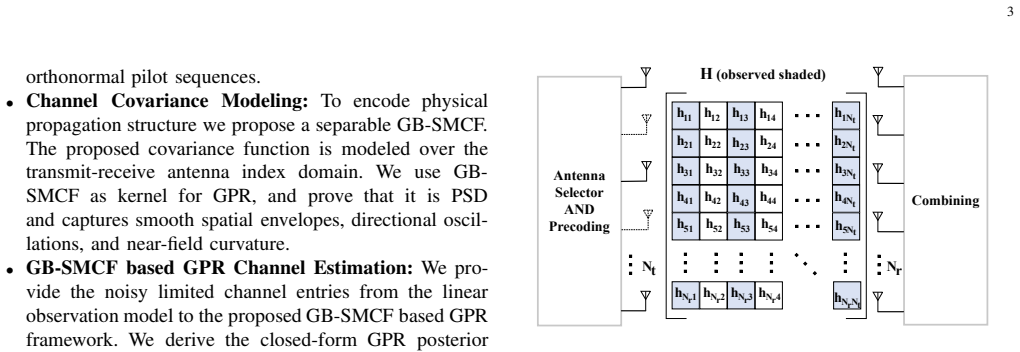
A geometry-aware Gaussian process regressor reconstructs full channel state information from sparse noisy pilots by extrapolating with an array-geometry kernel.
A machine-rendered reading of the paper's core claim, the machinery that carries it, and where it could break.
Core claim
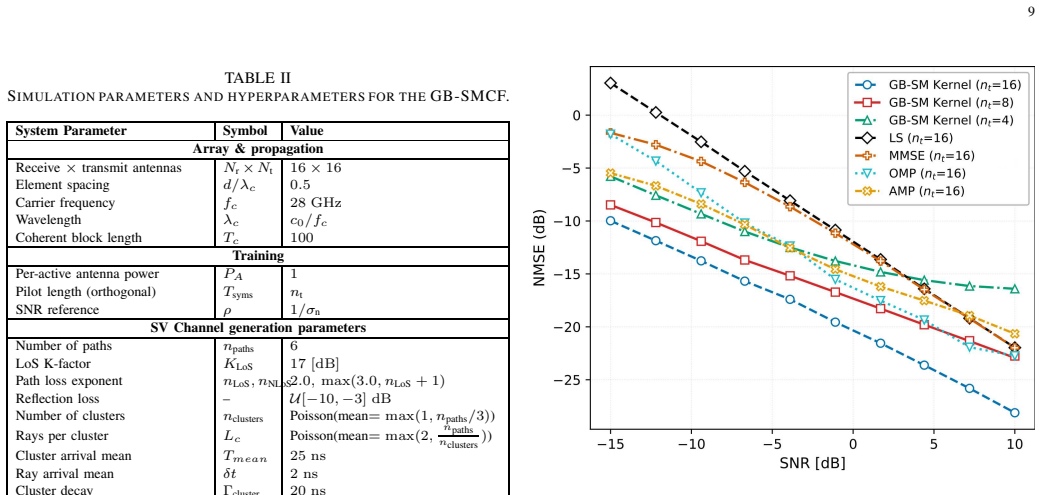
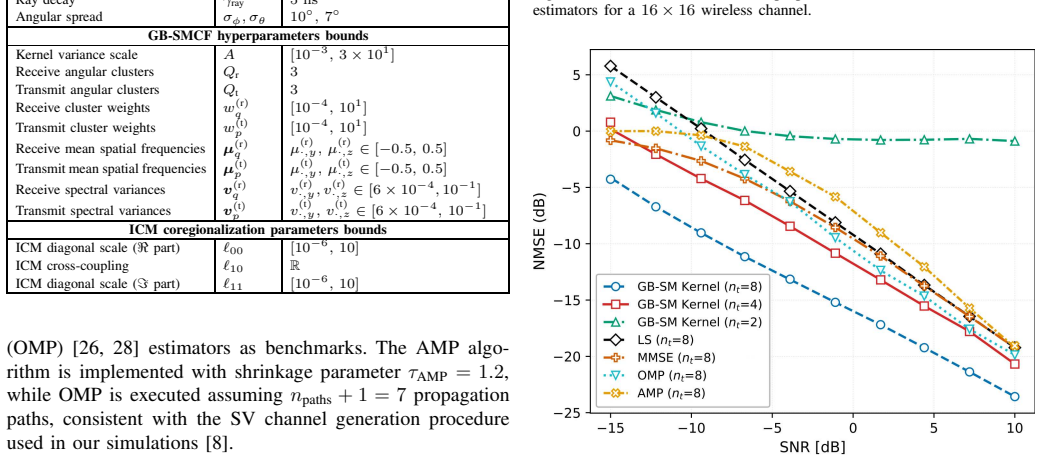
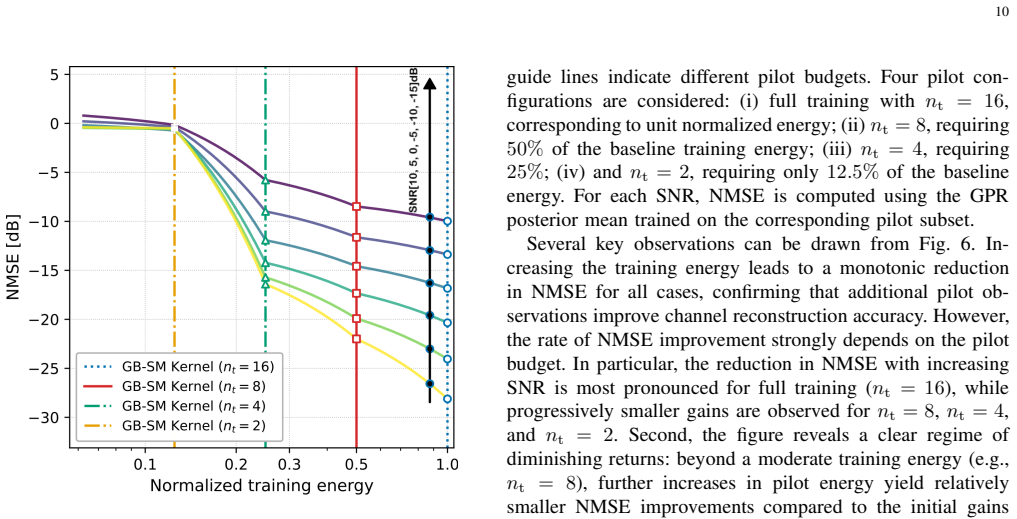
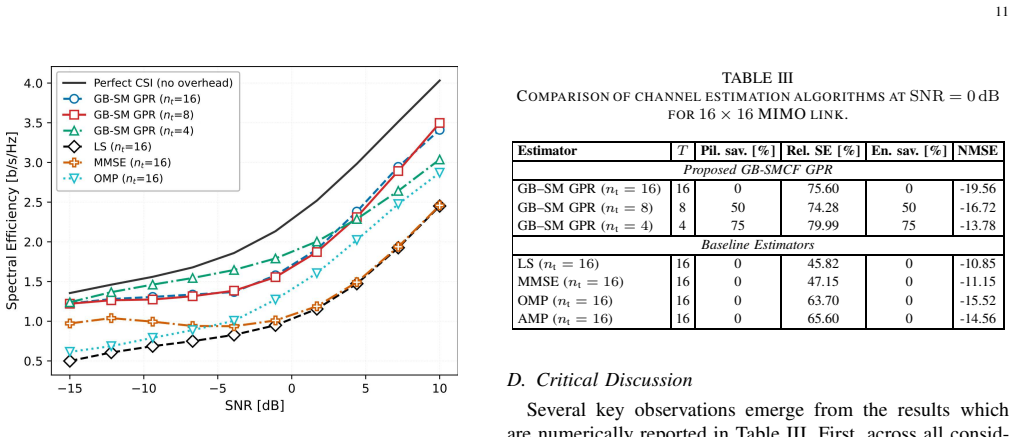
The proposed Gaussian process regression estimator reconstructs the full channel state information matrix from partial noisy pilot observations by treating the channel as a proper complex Gaussian process whose spatial correlations are captured by a novel array-geometry kernel; numerical evaluations demonstrate that this approach reduces pilot overhead by up to 75 percent and total training energy by up to 93.75 percent while achieving lower normalized mean-square error and higher spectral efficiency than standard estimators in the low-to-moderate SNR regime.
What carries the argument
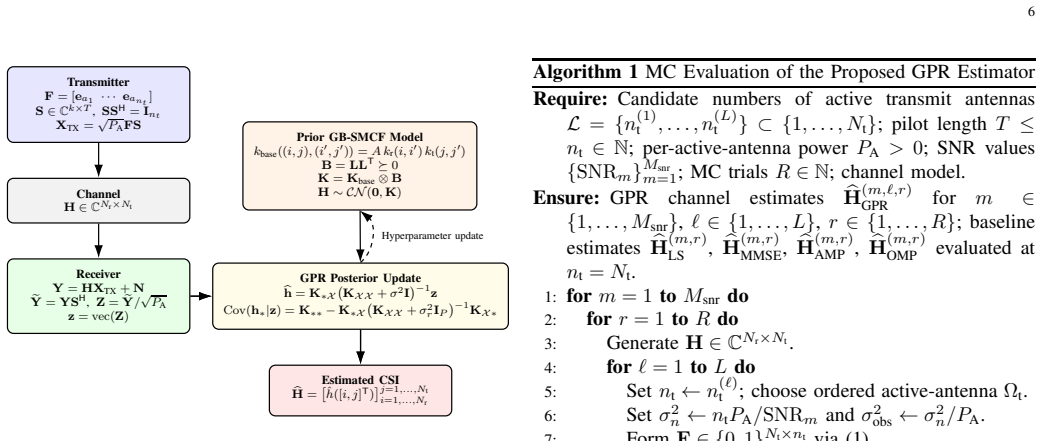
The array-geometry-based kernel, which incorporates antenna array propagation geometry into the Gaussian process prior and is proven to be Hermitian positive semidefinite, allowing richer hyperparameter learning from limited data.
If this is right
- Spectral efficiency rises because the same coherence block carries more data symbols once pilot count drops.
- Total training energy consumption falls sharply, extending battery life for energy-constrained devices.
- The method remains effective in low-to-moderate SNR conditions where pilot contamination is severe.
- Online hyperparameter learning inside each coherence block removes the need for separate offline training phases.
Where Pith is reading between the lines
- The same kernel construction could be tested on measured channels from different frequency bands to check whether the geometry prior generalizes beyond the simulated scenarios.
- Integration with compressive sensing or deep-learning estimators might further reduce overhead if the Gaussian-process posterior is used as a warm start.
- Because the kernel is proven positive semidefinite, the framework could be extended to time-varying channels by adding a temporal kernel dimension without losing convexity guarantees.
Load-bearing premise
The wireless channel can be accurately represented as a proper complex Gaussian process over the antenna arrays, with the introduced geometry kernel capturing all relevant spatial correlations without needing extra validation on measured data.
What would settle it
Real-world channel measurements in which the normalized mean-square error of the proposed GPR estimator exceeds that of conventional least-squares or minimum-mean-square-error estimators when both use the same reduced number of pilots.
Figures

read the original abstract
Accurate channel state information (CSI) acquisition under tight pilot and training-energy constraints is essential for next-generation wireless networks. In this work, we model the wireless channel as a proper complex Gaussian process over the transmit and receive antenna arrays, reducing pilot overhead and training energy by estimating the CSI from partial observations. We formulate the CSI acquisition problem as a highly underdetermined Bayesian linear inverse problem. We develop a Gaussian process regression (GPR) framework that reconstructs the full CSI from sparse and noisy observations by extrapolating to the unknown entries. To incorporate propagation information into the GPR prior, we introduce a novel array-geometry-based kernel and prove that it is Hermitian positive semidefinite. The proposed kernel better captures the channel spatial correlations through richer hyperparameters. Our GPR-based CSI extrapolation approach learns the channel hyperparameters online from sparse, noisy pilot measurements within each coherence block. Numerical results show that the proposed estimator reduces pilot overhead by up to 75 percent and total training energy by up to 93.75 percent, while maintaining lower normalized mean-square error and higher spectral efficiency in the low-to-moderate signal-to-noise-ratio regime.
Editorial analysis
A structured set of objections, weighed in public.
Referee Report
Summary. The paper claims to develop a Gaussian process regression (GPR) framework for CSI acquisition by modeling the wireless channel as a proper complex Gaussian process over transmit and receive antenna arrays. It introduces a novel array-geometry-based kernel (proven Hermitian positive semidefinite), formulates CSI estimation as a Bayesian linear inverse problem, learns kernel hyperparameters online from sparse noisy pilots within each coherence block, and extrapolates the full CSI matrix, reporting up to 75% pilot overhead reduction and 93.75% training energy reduction while achieving lower NMSE and higher spectral efficiency in the low-to-moderate SNR regime.
Significance. If the numerical claims hold under realistic conditions, the geometry-aware GPR extrapolation could meaningfully lower pilot overhead and energy costs in massive MIMO and next-generation systems. The independent proof of the kernel's positive semidefiniteness and the online hyperparameter learning (performed on the same sparse observations used for extrapolation) are clear methodological strengths that avoid circular fitting to final performance metrics.
major comments (2)
- [Numerical Results] Numerical Results section: the headline reductions (75% pilot overhead, 93.75% training energy) and NMSE/SE gains are demonstrated exclusively on channels drawn from the exact proper complex Gaussian process prior with the proposed array-geometry kernel; no tests against measured channels, ray-tracing, or standard 3GPP models are reported, so the practical validity of the overhead savings is not yet established.
- [§3] Abstract and §3 (problem formulation): the claim that the array-geometry kernel 'better captures the channel spatial correlations through richer hyperparameters' is not accompanied by an explicit comparison of hyperparameter count or identifiability against standard kernels (e.g., exponential or Matérn), leaving unclear whether the reported gains stem from the geometry term or simply from additional degrees of freedom.
minor comments (2)
- [Abstract] Abstract: simulation parameters, baseline methods (e.g., LS, MMSE, compressed sensing), channel models, SNR ranges, and whether error bars or multiple Monte-Carlo runs are used are omitted, hindering quick assessment of the numerical evidence.
- [Kernel Definition] Kernel definition: the precise functional form of the array-geometry-based kernel (including how antenna positions enter the covariance) should be stated explicitly in an equation rather than described only in prose.
Simulated Author's Rebuttal
We thank the referee for the constructive and detailed review. The positive assessment of the methodological contributions is appreciated. We address each major comment below and specify the planned revisions.
read point-by-point responses
-
Referee: [Numerical Results] Numerical Results section: the headline reductions (75% pilot overhead, 93.75% training energy) and NMSE/SE gains are demonstrated exclusively on channels drawn from the exact proper complex Gaussian process prior with the proposed array-geometry kernel; no tests against measured channels, ray-tracing, or standard 3GPP models are reported, so the practical validity of the overhead savings is not yet established.
Authors: We agree that validation on measured channels, ray-tracing, or 3GPP models would strengthen claims about practical overhead savings. The presented results are generated under the assumed proper complex Gaussian process model to isolate and validate the theoretical framework, kernel properties, and online learning procedure. In the revised manuscript we will add a new subsection in the Numerical Results section that explicitly discusses the modeling assumptions, notes the limitations when extrapolating to real-world channels, and outlines directions for future empirical validation using measured data. This is a partial revision because new simulations on external datasets cannot be added without additional resources. revision: partial
-
Referee: [§3] Abstract and §3 (problem formulation): the claim that the array-geometry kernel 'better captures the channel spatial correlations through richer hyperparameters' is not accompanied by an explicit comparison of hyperparameter count or identifiability against standard kernels (e.g., exponential or Matérn), leaving unclear whether the reported gains stem from the geometry term or simply from additional degrees of freedom.
Authors: We accept that an explicit comparison is needed to clarify the origin of the gains. The array-geometry kernel embeds the physical antenna positions, yielding hyperparameters that correspond directly to inter-element distances and angles; these are physically motivated and differ in structure from the scalar length-scale parameters of exponential or Matérn kernels. We will revise §3 and add a short table in the revised manuscript that compares hyperparameter counts, their physical meaning, and a brief discussion of identifiability from sparse observations. This will demonstrate that the performance advantage arises from the geometry-aware construction rather than an arbitrary increase in degrees of freedom. revision: yes
Circularity Check
No significant circularity; derivation is self-contained
full rationale
The paper models the channel as a proper complex Gaussian process, introduces a novel array-geometry-based kernel, and explicitly proves it Hermitian positive semidefinite. Hyperparameters are learned online from the sparse pilot observations within each coherence block rather than fitted to any target performance metric. The reported overhead reductions and NMSE/SE gains are presented as outcomes of numerical simulations under the stated model; these do not reduce by construction to the inputs via self-definition, fitted-input renaming, or load-bearing self-citation. No uniqueness theorems, ansatzes, or renamings of known results are invoked in a manner that collapses the central claims to prior inputs. The derivation chain therefore remains independent of the final performance numbers.
Axiom & Free-Parameter Ledger
free parameters (1)
- kernel hyperparameters
axioms (2)
- domain assumption Wireless channel is a proper complex Gaussian process over the transmit and receive antenna arrays
- standard math The array-geometry-based kernel is Hermitian positive semidefinite
invented entities (1)
-
array-geometry-based kernel
no independent evidence
Lean theorems connected to this paper
-
IndisputableMonolith/Foundation/Cost/FunctionalEquation.leanwashburn_uniqueness_aczel unclear?
unclearRelation between the paper passage and the cited Recognition theorem.
We model the wireless channel as a proper complex Gaussian process over the transmit and receive antenna arrays... introduce a novel array-geometry-based kernel and prove that it is Hermitian positive semidefinite.
-
IndisputableMonolith/Foundation/AlphaCoordinateFixation.leancostAlphaLog_high_calibrated_iff unclear?
unclearRelation between the paper passage and the cited Recognition theorem.
The proposed GB-SMCF... separable... spectral mixture... cos(2π[μ Δ]) exp(−(2π)² v Δ²)
What do these tags mean?
- matches
- The paper's claim is directly supported by a theorem in the formal canon.
- supports
- The theorem supports part of the paper's argument, but the paper may add assumptions or extra steps.
- extends
- The paper goes beyond the formal theorem; the theorem is a base layer rather than the whole result.
- uses
- The paper appears to rely on the theorem as machinery.
- contradicts
- The paper's claim conflicts with a theorem or certificate in the canon.
- unclear
- Pith found a possible connection, but the passage is too broad, indirect, or ambiguous to say the theorem truly supports the claim.
Reference graph
Works this paper leans on
-
[1]
H. Alves, N. H. Mahmood et al. , “6G resilience white paper,” arXiv preprint arXiv:2509.09005 , 2025
-
[2]
White paper on broadband connectivity in 6G,
N. Rajatheva, I. Atzeni et al., “White paper on broadband connectivity in 6G,” arXiv preprint arXiv:2004.14247 , 2020
-
[3]
Spectrum access options for local 6g networks,
M. Matinmikko-Blue, S. Yrj¨ ol¨ aet al. , “Spectrum access options for local 6g networks,” Intelligent Spectrum Management: T owards 6G, pp. 27–53, 2025
work page 2025
-
[4]
Use cases for local 6g networks,
P . Ahokangas, M. Matinmikko-Blue et al. , “Use cases for local 6g networks,” in 2024 Joint European Confer- ence on Networks and Communications & 6G Summit (EuCNC/6G Summit) , 2024, pp. 1127–1132
work page 2024
-
[5]
S. Rahman, S. L. Shah et al. , “Controlled out-band device to device communication in cellular networks using backup channel in television white space,” in 2023 18th International Conference on Emerging T echnologies (ICET), 2023, pp. 275–280
work page 2023
-
[6]
Impact of channel aging on cell-free massive mimo over spatially correlated chan- nels,
J. Zheng, J. Zhang et al. , “Impact of channel aging on cell-free massive mimo over spatially correlated chan- nels,” IEEE Transactions on Wireless Communications , vol. 20, no. 10, pp. 6451–6466, 2021
work page 2021
-
[7]
¨O. T. Demir, A. Kosasih et al., “Spatial correlation mod- eling and RS-LS estimation of near-field channels with uniform planar arrays,” in 2024 IEEE 25th International W orkshop on Signal Processing Advances in Wireless Communications (SPAWC). IEEE, 2024, pp. 236–240
work page 2024
-
[8]
Electromagnetic information theory-based statistical channel model for improved channel estimation,
J. Zhu, Z. Wan et al. , “Electromagnetic information theory-based statistical channel model for improved channel estimation,” IEEE Trans. Inf. Theory , vol. 71, no. 3, pp. 1777–1793, 2025
work page 2025
-
[9]
An overview of massive mimo technology components in metis,
G. Fodor, N. Rajatheva et al. , “An overview of massive mimo technology components in metis,” IEEE Commu- nications Magazine , vol. 55, no. 6, pp. 155–161, 2017
work page 2017
-
[10]
E. Bj¨ ornson, C. Chae et al. , “Towards 6G MIMO: Mas- sive spatial multiplexing, dense arrays, and interplay be- tween electromagnetics and processing,” arXiv preprint arXiv:2401.02844, 2024
-
[11]
Low-overhead CSI prediction via Gaussian process regression,
S. L. Shah, N. H. Mahmood et al. , “Low-overhead CSI prediction via Gaussian process regression,” arXiv preprint arXiv:2510.25390 , 2025
-
[12]
Z. Chen, Q. Y ao et al. , “Efficient spatial channel esti- mation in extremely large antenna array communication systems: A subspace approximated matrix completion approach,” IEEE Open J. Commun. Soc. , vol. 6, pp. 1216–1230, 2025
work page 2025
-
[13]
S. L. Shah, N. H. Mahmood et al. , “Interference predic- tion using gaussian process regression and management framework for critical services in local 6G networks,” in Proc. IEEE Wireless Commun. and Netw. Conf. (WCNC) , 2025
work page 2025
-
[14]
Gaussian processes for machine learning,
C. E. Rasmussen and C. Williams, “Gaussian processes for machine learning,” Cambridge, MA, USA: MIT Press , 2006
work page 2006
-
[15]
Massive MIMO channel estimation for millimeter wave systems via matrix completion,
E. Vlachos, G. C. Alexandropoulos et al. , “Massive MIMO channel estimation for millimeter wave systems via matrix completion,” IEEE Signal Process. Lett. , vol. 25, no. 11, pp. 1675–1679, 2018
work page 2018
-
[16]
A. Arjas and I. Atzeni, “Nonlinear sparse Bayesian learning methods with application to massive MIMO channel estimation with hardware impairments,” arXiv preprint arXiv:2506.03775 , 2025
-
[17]
Channel modeling and channel estimation for holographic massive mimo with planar arrays,
¨O. T. Demir, E. Bj¨ ornson et al. , “Channel modeling and channel estimation for holographic massive mimo with planar arrays,” IEEE Wireless Communications Letters , vol. 11, no. 5, pp. 997–1001, 2022
work page 2022
-
[18]
D. Needell and R. V ershynin, “Signal recovery from incomplete and inaccurate measurements via regularized orthogonal matching pursuit,” IEEE J. Sel. T opics Signal Process., vol. 4, no. 2, pp. 310–316, 2010
work page 2010
-
[19]
Orthogonal matching pursuit for sparse signal recovery with noise,
T. T. Cai and L. Wang, “Orthogonal matching pursuit for sparse signal recovery with noise,” IEEE Transactions on Information theory , vol. 57, no. 7, pp. 4680–4688, 2011
work page 2011
-
[20]
Message passing algorithms for compressed sensing: I. motivation and construction,
D. L. Donoho, A. Maleki et al. , “Message passing algorithms for compressed sensing: I. motivation and construction,” in 2010 IEEE information theory work- shop on information theory (ITW 2010, Cairo) . IEEE, 2010, pp. 1–5
work page 2010
-
[21]
K.-C. Toh and S. Y un, “An accelerated proximal gra- dient algorithm for nuclear norm regularized linear least squares problems,” Pacific Journal of optimization , vol. 6, no. 615-640, p. 15, 2010
work page 2010
-
[22]
Spatio-temporal electromagnetic kernel learning for channel prediction,
J. Li, J. Zhu et al. , “Spatio-temporal electromagnetic kernel learning for channel prediction,” arXiv preprint arXiv:2412.17414, 2024
-
[23]
Accurate channel prediction based on spatial- temporal electromagnetic kernel learning,
——, “Accurate channel prediction based on spatial- temporal electromagnetic kernel learning,” in ICC 2025 - IEEE International Conference on Communications , 2025, pp. 1013–1018
work page 2025
-
[24]
Goovaerts, Geostatistics for natural resources evalua- tion
P . Goovaerts, Geostatistics for natural resources evalua- tion. Oxford university press, 1997
work page 1997
-
[25]
Multi-task gaussian process prediction,
E. V . Bonilla, K. Chai et al., “Multi-task gaussian process prediction,” Advances in neural information processing systems, vol. 20, 2007
work page 2007
-
[26]
Sparsity adaptive matching pursuit algorithm for practical compressed sensing,
T. T. Do, L. Gan et al. , “Sparsity adaptive matching pursuit algorithm for practical compressed sensing,” in 2008 42nd Asilomar conference on signals, systems and computers. IEEE, 2008, pp. 581–587
work page 2008
-
[27]
A statistical model for indoor multipath propagation,
A. Saleh and R. V alenzuela, “A statistical model for indoor multipath propagation,” IEEE Journal on Selected Areas in Communications , vol. 5, no. 2, pp. 128–137, 1987
work page 1987
-
[28]
Low-complexity mas- sive mimo subspace estimation and tracking from low- dimensional projections,
S. Haghighatshoar and G. Caire, “Low-complexity mas- sive mimo subspace estimation and tracking from low- dimensional projections,” IEEE Transactions on Signal Processing, vol. 66, no. 7, pp. 1832–1844, 2018
work page 2018
discussion (0)
Sign in with ORCID, Apple, or X to comment. Anyone can read and Pith papers without signing in.