Tethering effects on first-passage variables of lattice random walks in linear and quadratic focal point potentials
Pith reviewed 2026-05-16 18:54 UTC · model grok-4.3
The pith
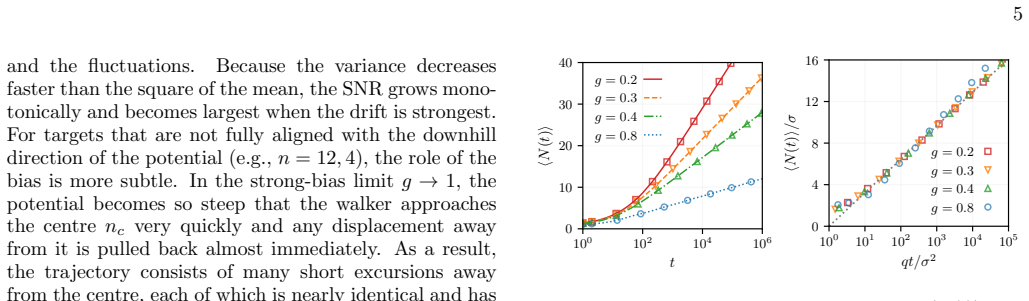
Lattice random walks under linear focal potentials grow the number of distinct sites visited only logarithmically and can show a minimum mean first-passage time at intermediate bias.
A machine-rendered reading of the paper's core claim, the machinery that carries it, and where it could break.
Core claim
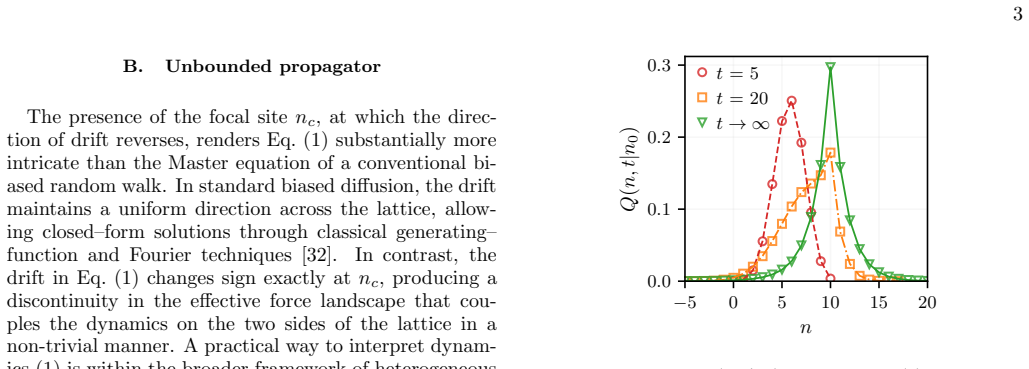
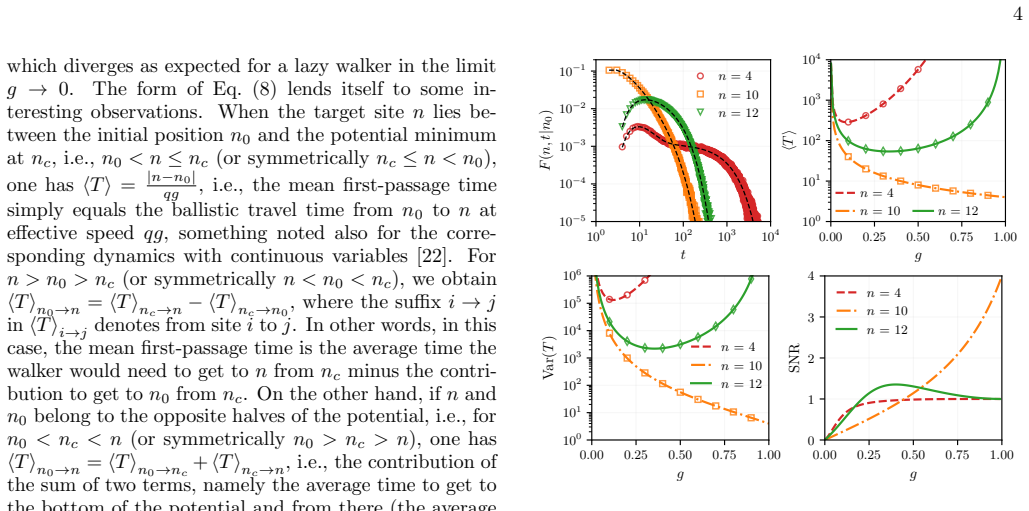
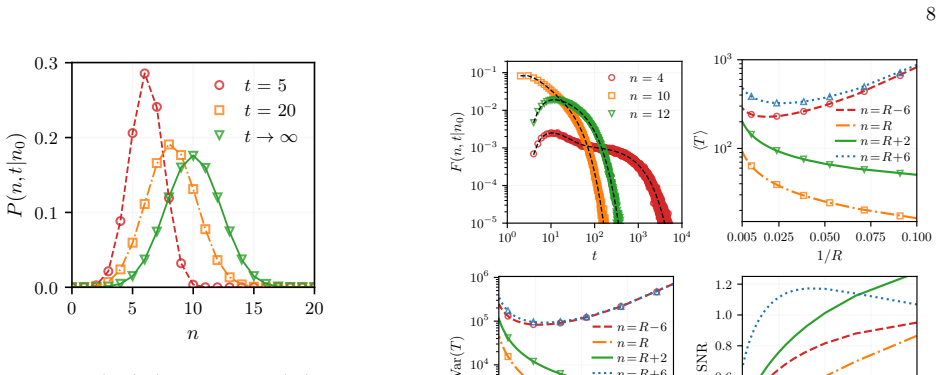
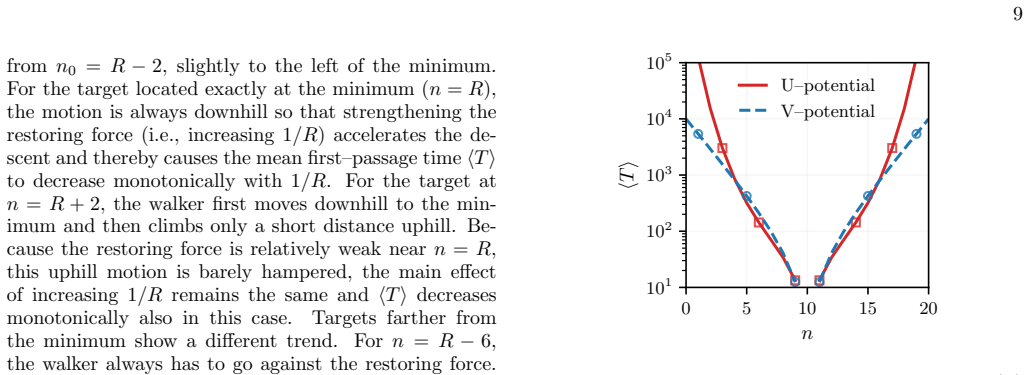
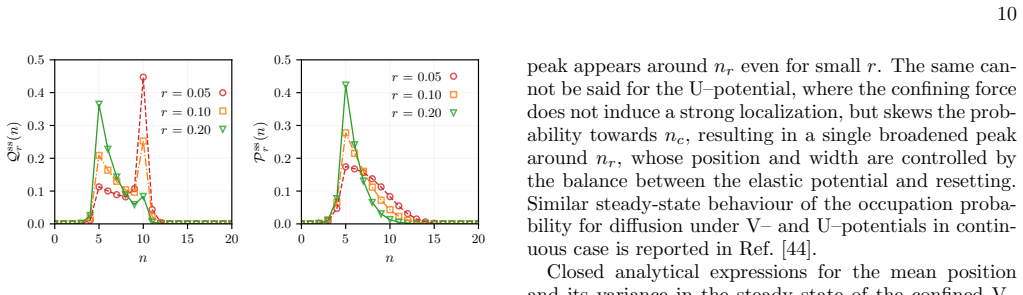
For the unbounded V-potential the generating function of the occupation probability is obtained, from which the mean number of distinct sites visited is shown to grow logarithmically at long times. The mean first-passage time to a target site displays a minimum as a function of bias strength when the initial and target sites lie on opposite sides of the focal point or at certain distances from it. Qualitatively similar non-monotonic dependence appears for the finite U-potential. When resetting is superimposed on bounded V- and U-potentials, the steady-state probabilities and first-passage dynamics differ between the two shapes, with a motion-limited regime emerging for moderate resetting.
What carries the argument
The position-dependent bias obtained by discretising linear and quadratic focal potentials on the lattice, together with generating-function techniques for occupation probabilities and first-passage statistics.
If this is right
- The mean number of distinct sites visited grows only logarithmically rather than linearly with time in the unbounded linear potential.
- Mean first-passage times can be minimised by tuning bias strength for given initial and target locations relative to the focal point.
- Resetting produces qualitatively different steady-state occupation for bounded linear versus quadratic potentials.
- A motion-limited regime in first-passage dynamics appears even for moderate resetting probabilities.
Where Pith is reading between the lines
- The logarithmic growth implies that linear tethers restrict spatial exploration far more severely than unbiased diffusion or quadratic confinement.
- The existence of an optimal bias for minimal mean first-passage time suggests a trade-off between drift speed and diffusive spread that could be tested by varying lattice spacing.
- Combining resetting with focal potentials offers a minimal model for biological search processes that return to a home base after excursions.
Load-bearing premise
Discretising the continuous linear and quadratic potentials onto the lattice preserves the qualitative bias structure without changing long-time asymptotics or the existence of a minimum in mean first-passage time.
What would settle it
Numerical simulations on large lattices that show the mean number of distinct sites growing faster than logarithmically, or that find no minimum in mean first-passage time for any bias strength and any choice of initial and target sites, would contradict the central claims.
Figures



read the original abstract
Diffusion in a confining potential offers a minimal setting to understand the interplay between random motion and deterministic forces driving a particle towards a focal point or potential minimum. In continuous space and time, two extensively studied examples are Brownian motion in a linear (V-shaped) or a quadratic (U-shaped) potential. The deterministic bias towards the minimum is represented, respectively, by a constant force for the former and by an elastic restoring force that increases proportionally with distance for the latter. Surprisingly, unlike Brownian walks, random walks under focal point potentials in discrete space and time have received little attention. Here, we bridge this gap by analysing the dynamics of lattice random walkers in the presence of a V-shaped potential, both in a finite and an infinite spatial domain, and a finite U-shaped potential. For the V-potential in unbounded space, we find the generating function of the occupation probability and analyse the time dependence of the mean number of distinct sites visited, demonstrating that its long-time growth is logarithmic. We also study the first-passage probability and show that its mean may display a minimum as a function of bias strength, depending on the location of the initial and target sites relative to the focal point. Qualitatively similar dependencies in the first-passage probability and its mean appear for the finite U-potential. As a comparative analysis to the U-potential, we construct the bounded V-potential and superimpose in both cases a resetting process, in which the walker returns at random times to a site distinct from the focal point with some probability. We quantify the different effects of resetting on the steady-state probability and the first-passage dynamics in the two cases, and show a motion-limited regime emerges even for relatively moderate resetting probabilities.
Editorial analysis
A structured set of objections, weighed in public.
Referee Report
Summary. The manuscript examines lattice random walks in linear (V-shaped) and quadratic (U-shaped) focal-point potentials. For the unbounded V-potential it derives the generating function of the occupation probability and shows that the mean number of distinct sites visited grows logarithmically at long times; it further analyzes the first-passage probability and its mean, which can exhibit a minimum versus bias strength depending on initial and target locations. Comparative results are given for the finite U-potential and for both potentials under resetting, quantifying how resetting alters the steady-state distribution and first-passage dynamics.
Significance. If the derivations are correct, the work supplies exact, checkable results for the discrete-space versions of two canonical confined-diffusion problems. The logarithmic range growth, arising from the geometric stationary measure, and the non-monotonic mean-first-passage behavior constitute concrete, falsifiable predictions that distinguish the lattice setting from its continuous counterpart. The resetting analysis further illustrates how an external resetting mechanism interacts with the potential shape.
major comments (2)
- [§3] The central derivation of the generating function for the unbounded V-potential (abstract and §3) must be presented in full; the transition probabilities induced by the discretized linear potential should be written explicitly before the generating-function equation is solved, so that the absence of lattice artifacts can be verified directly.
- [§4] The asymptotic extraction of the logarithmic growth of the mean number of distinct sites visited (abstract) relies on the extreme-value cutoff k ~ log(t) from the geometric stationary measure; the manuscript should supply the explicit large-t expansion or Tauberian argument used to obtain this scaling.
minor comments (3)
- [§5] Notation for the bias strength and resetting probability should be unified across the V- and U-potential sections to avoid confusion when comparing the two cases.
- [Fig. 4] Figure captions for the mean-first-passage-time plots should state the precise initial and target site indices used, as the location dependence is emphasized in the text.
- [Introduction] A brief remark on the continuum limit of the lattice results would help readers connect the findings to the well-studied Brownian-motion cases mentioned in the introduction.
Simulated Author's Rebuttal
We thank the referee for the careful reading of our manuscript and the constructive comments. We are pleased that the referee finds the results significant and agrees with the recommendation for minor revision. We address each major comment below.
read point-by-point responses
-
Referee: [§3] The central derivation of the generating function for the unbounded V-potential (abstract and §3) must be presented in full; the transition probabilities induced by the discretized linear potential should be written explicitly before the generating-function equation is solved, so that the absence of lattice artifacts can be verified directly.
Authors: We agree with this suggestion. In the revised version, we will explicitly write the transition probabilities for the discretized V-potential at the start of §3, before deriving the generating function. This will make the discretization transparent and allow direct verification that no unintended lattice artifacts are introduced. revision: yes
-
Referee: [§4] The asymptotic extraction of the logarithmic growth of the mean number of distinct sites visited (abstract) relies on the extreme-value cutoff k ~ log(t) from the geometric stationary measure; the manuscript should supply the explicit large-t expansion or Tauberian argument used to obtain this scaling.
Authors: We appreciate this comment. The logarithmic scaling arises from the geometric decay of the stationary probability. We will add in the revised manuscript the explicit large-t asymptotic analysis, including the Tauberian theorem application or the direct expansion showing that the mean number of distinct sites S(t) ∼ (log t) / |log ρ| where ρ is the ratio of the geometric distribution, plus lower-order terms. revision: yes
Circularity Check
No significant circularity identified
full rationale
The paper's central derivations begin from the standard master equation for lattice random walks with position-dependent transition rates defined directly from the discretized potential differences. The generating function for occupation probabilities in the unbounded V-potential is obtained via standard techniques for birth-death chains, and the logarithmic growth of the mean number of distinct sites visited follows from the geometric decay of the stationary measure without any fitted parameters or self-referential definitions. First-passage quantities are extracted from the same generating functions or renewal equations, with no reduction to prior self-citations or ansatzes. The analysis of resetting and bounded cases similarly proceeds from explicit transition rules and does not invoke uniqueness theorems or imported results from the authors' prior work as load-bearing premises. All steps remain internally consistent and externally verifiable against the lattice master equation.
Axiom & Free-Parameter Ledger
free parameters (2)
- bias strength
- resetting probability
axioms (2)
- domain assumption The walker performs unbiased nearest-neighbor hops that are then reweighted by the Boltzmann factor of the potential at each step.
- domain assumption The lattice is one-dimensional and translationally invariant except for the focal-point bias.
Reference graph
Works this paper leans on
-
[1]
Semi-bounded propagator To construct the full propagator in the bounded do- main, it is convenient to impose the reflecting conditions one boundary at a time, following the general approach in [12]. We begin by introducing a single reflecting de- fect at site 0; this yields thesemi-bounded(left-bounded) propagator, whereby when the walker is at site 0, it...
-
[2]
Fully-bounded propagator To introduce a reflecting site to the right at 2R, we use the semi-bounded propagator eL(n, z|n0) and treat the reflecting site at 2Ras a defect. When the walker is at 2R, it remains there with probability 1−q(1 +g)/2 or moves to 2R−1 with probabilityq(1 +g)/2. Using the same approach as in (11), the fully-bounded propagator eQref...
-
[3]
Breakdown of ergodicity in classical and quan- tum many-body systems
First-passage statistics in fully-bounded domain The propagator eQref(n, z|n0) gives us access to the generating function of the first-passage probability eF ref(n, z|n0) = eQref(n, z|n0)/eQref(n, z|n), from which one may derive the mean first-passage time for the walker to reachnstarting fromn 0 [see appendix B] ⟨T⟩= |n0 −R| − |n−R| gq + f −|n−R| θ(n)−θ(...
-
[4]
The interface at the shared siteMis associated with a hypothetical third medium–c
Propagator generating function We consider the lattice walk dynamics in heterogeneous space with two media separated by the Type B interface placed at siteM, such that sitesn≤(M−1) andn≥(M+ 1) belong to medium–1, with diffusivityq 1 and bias g1, and medium–2, with diffusivityq 2 and biasg 2, respectively [12]. The interface at the shared siteMis associate...
-
[5]
The steady-state We note that, atz= 1, we haveβ ±(1) = 1±g,ξ(1) =f, andχ(1) = 0. Therefore, in the limitz→1, only the single factorχ(z) generates a simple pole atz= 1, while all other pieces remain finite. Expanding the propagator eQ(n, z|n0) from Eq. (2) into a series of (1−z), we obtain the leading behaviour as eQ(n, z|n0)≈ Q0 1−z +Q 1 +Q 2(1−z) +Q 3(1−...
-
[6]
To this end, one needs to apply az-inversion to the generating function eQ(n, z|n0) given in Eq
Time-dependent propagator We now provide a recipe to find the time-dependent propagator for the V–potential in unbounded space. To this end, one needs to apply az-inversion to the generating function eQ(n, z|n0) given in Eq. (2). For later convenience, we first identify from Eqs. (4) and (5) the following relations ξ(z)= 1−z(1−q)− p (1−zρ +)(1−zρ −) zq(1 ...
-
[7]
K. Pearson. The Problem of the Random Walk.Nature, 72(1867):342, 1905
work page 1905
-
[8]
G. P´ olya. Quelques probl´ emes de probabilit´ e se rap- portant ´ a la “promenade au hasard”.Enseign. Math., 20:444–445, 1918
work page 1918
-
[9]
G. P´ olya. ¨Uber eine Aufgabe der Wahrscheinlichkeit- srechnung betreffend die Irrfahrt im Straßennetz.Math. Ann., 84(1):149–160, 1921
work page 1921
-
[10]
G. H. Weiss.Aspects and Applications of the Random Walk.North-Holland, Amsterdam, 1994
work page 1994
-
[11]
B. D. Hughes.Random Walks and Random Environ- ments.Clarendon Press, Oxford, 1995
work page 1995
-
[12]
Redner.A Guide to First-Passage Processes
S. Redner.A Guide to First-Passage Processes. Cam- bridge University Press, Cambridge, 2001
work page 2001
-
[13]
E. W. Montroll and G. H. Weiss. Random walks on lat- tices. II.J. Math. Phys., 6(2):167–181, 1965
work page 1965
- [14]
-
[15]
J. D. Noh and H. Rieger. Random walks on complex networks.Phys. Rev. Lett., 92:118701, 2004
work page 2004
- [16]
-
[17]
S. Sarvaharman and L. Giuggioli. Particle-environment interactions in arbitrary dimensions: A unifying analytic framework to model diffusion with inert spatial hetero- geneities.Phys. Rev. Res., 5:043281, 2023
work page 2023
- [18]
-
[19]
L. Giuggioli, S. Sarvaharman, D. Das, D. Marris, and T. Kay. Multi-target search in bounded and hetero- geneous environments: a lattice random walk perspec- tive. InTarget Search Problems, pages 107–133. Springer, Cham, 2024
work page 2024
-
[20]
A. P. Riascos and D. P. Sanders. Mean encounter times for multiple random walkers on networks.Phys. Rev. E, 103(4):042312, 2021
work page 2021
-
[21]
L. Giuggioli and S. Sarvaharman. Spatio-temporal dy- namics of random transmission events: from information sharing to epidemic spread.J. Phys. A: Math. Theor., 55(37):375005, 2022
work page 2022
-
[22]
D. Das, V. M. Kenkre, R. Nathan, and L. Giuggioli. Mis- conceptions about quantifying animal encounter and in- teraction processes.Front. Ecol. Evol., 11:1230890, 2023
work page 2023
-
[23]
D. Marris and L. Giuggioli. Persistent and anti-persistent motion in bounded and unbounded space: resolution of the first-passage problem.New J. Phys., 26(7):073020, 2024
work page 2024
-
[24]
Y. Sarmiento, B. Walter, D. Das, S. Mahapatra, ´E. Rold´ an, and R. J. Harris. First-passage-time asymmetry for biased run-and-tumble processes.J. Phys. A: Math. Theor., 58(49):495002, 2025
work page 2025
-
[25]
L. Bresque, D. Das, and ´E. Rold´ an. Run-and-tumble exact work statistics in a lazy quantum measurement en- gine: Stochastic information processing.Phys. Rev. Lett., 134:200402, 2025
work page 2025
-
[26]
H. Touchette, E. Van der Straeten, and W. Just. Brow- nian motion with dry friction: Fokker–planck approach. J. Phys. A: Math. Theor., 43(44):445002, 2010
work page 2010
- [27]
-
[28]
L. Giuggioli, S. Gupta, and M. Chase. Comparison of two models of tethered motion.J. Phys. A: Math. Theor., 52(7):075001, 2019
work page 2019
-
[29]
G. E. Uhlenbeck and L. S. Ornstein. On the theory of the brownian motion.Phys. Rev., 36:823–841, 1930
work page 1930
-
[30]
H. J. H. Clercx and P. P. J. M. Schram. Brownian par- ticles in shear flow and harmonic potentials: A study of long-time tails.Phys. Rev. A, 46(4):1942–1950, 1992
work page 1942
-
[31]
V. Mancois, B. Marcos, P. Viot, and D. Wilkowski. Two- temperature brownian dynamics of a particle in a confin- ing potential.Phys. Rev. E, 97:052121, 2018
work page 2018
-
[32]
Risken.The Fokker-Planck Equation: Methods of So- lution and Applications
H. Risken.The Fokker-Planck Equation: Methods of So- lution and Applications. Springer, Berlin, 1996
work page 1996
-
[33]
Zwanzig.Nonequilibrium Statistical Mechanics
R. Zwanzig.Nonequilibrium Statistical Mechanics. Ox- ford University Press, Oxford, 2001
work page 2001
-
[34]
N. S. Goel and N. R. Dyn.Stochastic Models in Biology. Academic Press, London, 1974
work page 1974
-
[35]
E. W. Montroll. Stochastic processes and chemical ki- netics. In W. Mueller, editor,Energetics in Metallurgic Phenomena: Vol III, volume 3, pages 122–187. Gordon 23 and Breach, New York, 1967
work page 1967
-
[36]
M. Khantha and V. Balakrishnan. Reflection principles for biased random walks and application to escape time distributions.J. Stat. Phys., 41(5-6):811–824, 1985
work page 1985
-
[37]
S. Godoy and S. Fujita. Reflection principles for biased correlated walks. Simple applications.J. Math. Phys., 33(9):2998–3003, 1992
work page 1992
-
[38]
S. Sarvaharman and L. Giuggioli. Closed-form solutions to the dynamics of confined biased lattice random walks in arbitrary dimensions.Phys. Rev. E, 102(6):062124, 2020
work page 2020
-
[39]
M. Kac. Random walk and the theory of Brownian mo- tion.Am. Math. Mon., 54(7):369, 1947
work page 1947
-
[40]
M. R. Evans, S. N. Majumdar, and G. Schehr. Stochastic resetting and applications.J. Phys. A: Math. Theor., 53(19):193001, 2020
work page 2020
-
[41]
S. Gupta and A. M. Jayannavar. Stochastic Resetting: A (Very) Brief Review.Front. Phys., Volume 10 - 2022, 2022
work page 2022
-
[42]
A. Barbini and L. Giuggioli. Lattice random walk dy- namics with stochastic resetting in heterogeneous space. J. Phys. A: Math. Theor., 57(42):425001, 2024
work page 2024
-
[43]
J. Abate and W. Whitt. Numerical inversion of probabil- ity generating functions.Oper. Res. Lett., 12(4):245–251, 1992
work page 1992
-
[44]
G. H. Weiss and R. J. Rubin. Random Walks: Theory and Selected Applications. In I. Prigogine and Stuart A. Rice, editors,Advances in Chemical Physics, volume 52, pages 363–505. Wiley, 1 edition, 1982
work page 1982
-
[45]
I. Dayan and S. Havlin. Number of distinct sites visited by a random walker in the presence of a trap.J. Phys. A: Math. Gen., 25(9):L549–L553, 1992
work page 1992
-
[46]
L. Giuggioli, G. Abramson, V. M. Kenkre, R. R. Par- menter, and T. L. Yates. Theory of home range estima- tion from displacement measurements of animal popula- tions.J. Theor. Biol., 240(1):126–135, 2006
work page 2006
- [47]
-
[48]
E. W. Montroll and R. B. Potts. Effect of defects on lattice vibrations.Phys. Rev., 100(2):525–543, 1955
work page 1955
- [49]
-
[50]
A. Pal. Diffusion in a potential landscape with stochastic resetting.Phys. Rev. E, 91(1):012113, 2015
work page 2015
discussion (0)
Sign in with ORCID, Apple, or X to comment. Anyone can read and Pith papers without signing in.