Power Minimization in Pinching-Antenna Systems under Probabilistic LoS Blockage
Pith reviewed 2026-05-16 19:34 UTC · model grok-4.3
The pith
Optimally positioning pinching antennas cuts the transmit power needed to meet SNR targets under random LoS blockages.
A machine-rendered reading of the paper's core claim, the machinery that carries it, and where it could break.
Core claim
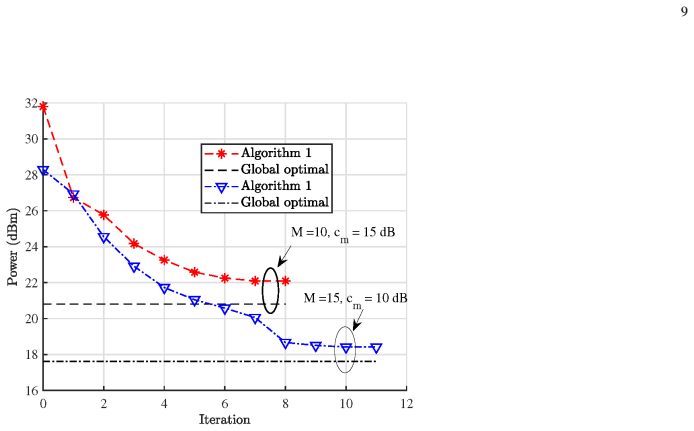
For a single pinching antenna the simplified power-minimization problem is convex, admitting a globally optimal position; for multiple antennas closed-form beamforming structures are derived and an efficient first-order algorithm produces high-quality local solutions; theoretical examination reveals the explicit dependence of total transmit power on the degree of link correlation in the probabilistic LoS blockage model.
What carries the argument
joint antenna-positioning and beamforming (AP-BF) optimization subject to per-user SNR constraints under a probabilistic LoS blockage model that includes link correlation
If this is right
- Single-PA systems admit an exact closed-form or convex solution for the optimal antenna location.
- Multi-PA systems can be solved to high quality with low computational cost via the derived beamforming structure and first-order method.
- The total power scales explicitly with the correlation coefficient of the blockage events, allowing designers to predict sensitivity to environmental changes.
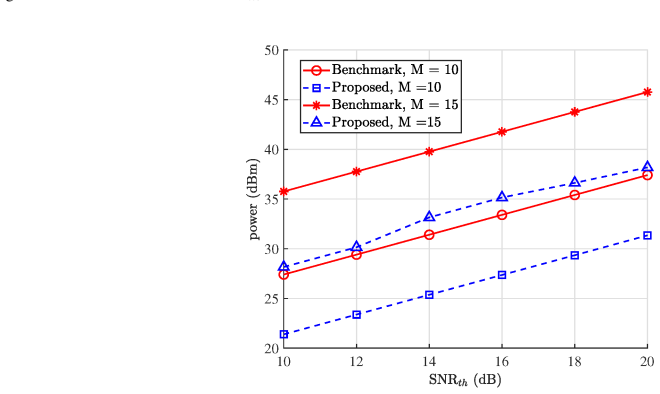
- The numerical results establish a concrete power-saving margin relative to fixed-antenna baselines under the same SNR targets.
Where Pith is reading between the lines
- The same positioning framework could be extended to time-varying blockages by re-optimizing positions on a slower time scale than beamforming.
- If the power savings hold in practice, network operators could reduce base-station energy consumption or increase coverage range without adding more antennas.
- Hardware prototypes that physically move the pinching elements would provide a direct test of whether the derived closed-form beamforming remains robust to phase noise and positioning error.
Load-bearing premise
The chosen probabilistic model of line-of-sight blockages, including their correlations, matches the statistics of real-world obstructions and that SNR constraints alone fully represent quality-of-service needs.
What would settle it
A side-by-side comparison, either in hardware or in a calibrated ray-tracing simulator, of the transmit power required by the optimized pinching-antenna design versus a fixed-antenna baseline when the actual blockage probabilities deviate from the assumed values.
Figures



read the original abstract
With great flexibility to adjust antenna positions, pinching antennas (PAs) are promising for alleviating large-scale attenuation in wireless networks. In this work, we investigate the antenna positioning and beamforming (AP-BF) design in a multi-PA multi-user system under probabilistic light-of-sight (LoS) blockage and formulate a power minimization problem subject to per-user signal-to-noise ratio (SNR) constraints. For a single PA, we prove the convexity of the simplified problem and obtain its global optimum. For multiple PAs, we derive closed-form BF structures and develop an efficient first-order algorithm to achieve high-quality local solutions. Moreover, the impact of link correlation on the transmit power is analyzed theoretically. Extensive numerical results validate the efficacy of our proposed designs and the substantial performance advantage of PA systems compared with conventional fixed-antenna systems in a term of power saving.
Editorial analysis
A structured set of objections, weighed in public.
Referee Report
Summary. The manuscript formulates a power-minimization problem for antenna positioning and beamforming (AP-BF) in multi-PA multi-user systems subject to per-user SNR constraints under a probabilistic LoS blockage model that incorporates link correlation. For the single-PA case it claims to prove convexity of the simplified problem and obtain the global optimum; for the multiple-PA case it derives closed-form beamforming structures and develops an efficient first-order algorithm for high-quality local solutions. It further provides a theoretical analysis of the impact of link correlation on transmit power and presents numerical results claiming substantial power savings relative to conventional fixed-antenna systems.
Significance. If the convexity proof and closed-form derivations hold, the work supplies practical, low-complexity design tools for energy-efficient pinching-antenna deployments in blockage-prone environments. The separation of positioning and beamforming, together with the explicit treatment of correlated blockage probabilities, offers a concrete advance over standard fixed-antenna optimization and could inform real-time resource allocation in future wireless networks.
major comments (2)
- [§III.B] §III.B (single-PA formulation): the convexity claim after simplification to Eq. (15) depends on the effective channel gain expression that folds in the correlated blockage probability; the second-derivative analysis must be shown to remain non-negative when the correlation coefficient is non-zero, otherwise the global-optimality guarantee does not extend to the stated model.
- [§IV.A] §IV.A (multi-PA beamforming): the closed-form structure in Eq. (22) is derived under the assumption that blockage states are known when computing the effective channels; the manuscript should quantify the degradation when only the probabilistic model is available, as this directly affects the claimed power savings.
minor comments (3)
- The numerical-results section should include a table listing all simulation parameters (carrier frequency, blockage probability range, correlation coefficient values, number of Monte-Carlo runs, etc.) so that the reported power-saving gains can be reproduced.
- Figure captions for the power-versus-number-of-PAs curves should state the exact blockage probability and correlation values used; without this information the comparison to fixed-antenna baselines is difficult to interpret.
- [Abstract] Minor typographical issues: 'in a term of power saving' in the abstract should read 'in terms of power saving'; ensure consistent notation for the blockage probability p_b across equations and text.
Simulated Author's Rebuttal
We thank the referee for the careful and constructive review. The comments help strengthen the presentation of the convexity result and the practical applicability of the beamforming design. We address each major comment below and will revise the manuscript accordingly.
read point-by-point responses
-
Referee: [§III.B] §III.B (single-PA formulation): the convexity claim after simplification to Eq. (15) depends on the effective channel gain expression that folds in the correlated blockage probability; the second-derivative analysis must be shown to remain non-negative when the correlation coefficient is non-zero, otherwise the global-optimality guarantee does not extend to the stated model.
Authors: We appreciate the referee pointing out the need for explicit verification under non-zero correlation. The effective channel gain in the simplified problem (15) incorporates the joint LoS probability that depends on the correlation coefficient ρ. Upon re-derivation, the second derivative of the objective with respect to the antenna position remains non-negative for all |ρ| ≤ 1, because ρ enters only as a positive scaling factor on the constant term and does not change the sign of the Hessian. We will add the full second-derivative expression and the accompanying non-negativity proof in the revised Section III.B to cover the correlated case explicitly. revision: yes
-
Referee: [§IV.A] §IV.A (multi-PA beamforming): the closed-form structure in Eq. (22) is derived under the assumption that blockage states are known when computing the effective channels; the manuscript should quantify the degradation when only the probabilistic model is available, as this directly affects the claimed power savings.
Authors: The referee correctly notes that Eq. (22) is derived for deterministic effective channels. In the probabilistic formulation we optimize the expected transmit power using the average blockage probabilities. To quantify the performance gap, we will add a new set of numerical results in Section V that compare the achieved power under perfect blockage-state knowledge versus the probabilistic model for different correlation levels. These results will be included in the revised manuscript to demonstrate that the degradation remains modest for typical correlation values, thereby supporting the practical relevance of the proposed design. revision: yes
Circularity Check
No significant circularity detected
full rationale
The paper proves convexity of the simplified single-PA problem to obtain its global optimum and derives closed-form beamforming structures plus a first-order algorithm for the multi-PA case, all under a probabilistic LoS blockage model with correlation. These steps rely on standard convex optimization and algorithmic techniques rather than any reduction to fitted inputs by construction, self-definitional loops, or load-bearing self-citations. The theoretical analysis of link correlation impact is presented as independent grounding, and numerical results serve as external validation against fixed-antenna baselines. The formulation separates positioning from beamforming in a manner that permits the claimed closed forms without circularity. This is the most common honest finding for papers whose central claims rest on verifiable optimization derivations.
Axiom & Free-Parameter Ledger
axioms (1)
- domain assumption Probabilistic LoS blockage occurs with specified correlation properties across links
Lean theorems connected to this paper
-
IndisputableMonolith/Cost/FunctionalEquation.leanwashburn_uniqueness_aczel unclear?
unclearRelation between the paper passage and the cited Recognition theorem.
Lemma 1. The function P_m(x) is convex w.r.t. x. Proof: ... ψ''(t_m) = ... >0 ... composition rule
-
IndisputableMonolith/Foundation/RealityFromDistinction.leanreality_from_one_distinction unclear?
unclearRelation between the paper passage and the cited Recognition theorem.
min_x sum P_m(x) s.t. 0≤x≤L; Algorithm 1: projected L-BFGS
What do these tags mean?
- matches
- The paper's claim is directly supported by a theorem in the formal canon.
- supports
- The theorem supports part of the paper's argument, but the paper may add assumptions or extra steps.
- extends
- The paper goes beyond the formal theorem; the theorem is a base layer rather than the whole result.
- uses
- The paper appears to rely on the theorem as machinery.
- contradicts
- The paper's claim conflicts with a theorem or certificate in the canon.
- unclear
- Pith found a possible connection, but the passage is too broad, indirect, or ambiguous to say the theorem truly supports the claim.
Forward citations
Cited by 1 Pith paper
-
Pinching Antenna Systems (PASS): Enabling Reconfigurable and Controllable Wireless Channels -- A Comprehensive Survey
The paper provides a comprehensive review and categorization of pinching antenna systems (PASS) for objectives including network coverage, data rate, secure transmission, sensing, integrated sensing and communication,...
Reference graph
Works this paper leans on
-
[1]
ITU-R framework for IMT-2030: Review and future direction,
N. Alliance and G. D ¨usseldorf, “ITU-R framework for IMT-2030: Review and future direction,” 2024
work page 2030
-
[2]
Flexible-antenna systems: A pinching-antenna perspective,
Z. Ding, R. Schober, and H. Vincent Poor, “Flexible-antenna systems: A pinching-antenna perspective,”IEEE Trans. Wireless Commun., pp. 1–1, 2025
work page 2025
-
[3]
Y . Xu, J. Cui, Y . Zhu, Z. Ding, T.-H. Chang, R. Schober, V . W. Wong, O. A. Dobre, G. K. Karagiannidis, H. V . Poor, and X. You, “Generalized pinching-antenna systems: A tutorial on principles, design strategies, and future directions,”arXiv preprint arXiv:2510.14166, 2025
-
[4]
Rate maximization for downlink pinching-antenna systems,
Y . Xu, Z. Ding, and G. K. Karagiannidis, “Rate maximization for downlink pinching-antenna systems,”IEEE Wireless Commun. Lett., vol. 14, no. 5, pp. 1431–1435, 2025
work page 2025
-
[5]
Modeling and beamforming optimization for pinching-antenna systems,
Z. Wang, C. Ouyang, X. Mu, Y . Liu, and Z. Ding, “Modeling and beamforming optimization for pinching-antenna systems,”arXiv preprint arXiv:2502.05917, 2025
-
[6]
LoS blockage in pinching-antenna systems: Curse or blessing?
Z. Ding and H. Vincent Poor, “LoS blockage in pinching-antenna systems: Curse or blessing?”IEEE Wireless Commun. Lett., vol. 14, no. 9, pp. 2798–2802, 2025
work page 2025
-
[7]
Pinching-antenna system design with LoS blockage: Does in-waveguide attenuation matter?
Y . Xu, Z. Ding, O. A. Dobre, and T.-H. Chang, “Pinching-antenna system design with LoS blockage: Does in-waveguide attenuation matter?”arXiv preprint arXiv:2508.07131, 2025
-
[8]
Spatially adaptive swipt with pinching antenna under probabilistic LoS blockage,
R. Jiang, R. Zhang, Y . Xu, H. Hu, Y . Lu, and D. Niyato, “Spatially adaptive swipt with pinching antenna under probabilistic LoS blockage,” arXiv preprint arXiv:2509.03038, 2025
-
[9]
On the limited memory BFGS method for large scale optimization,
D. C. Liu and J. Nocedal, “On the limited memory BFGS method for large scale optimization,”Mathematical programming, vol. 45, no. 1, pp. 503–528, 1989
work page 1989
-
[10]
Beam focusing for near-field multiuser MIMO communications,
H. Zhang, N. Shlezinger, F. Guidi, D. Dardari, M. F. Imani, and Y . C. Eldar, “Beam focusing for near-field multiuser MIMO communications,”IEEE Trans. Wireless Commun., vol. 21, no. 9, pp. 7476–7490, 2022
work page 2022
-
[11]
Analysis of blockage effects on urban cellular networks,
T. Bai, R. Vaze, and R. W. Heath, “Analysis of blockage effects on urban cellular networks,”IEEE Trans. Wireless Commun., vol. 13, no. 9, pp. 5070–5083, 2014
work page 2014
-
[12]
Study on channel model for frequencies from 0.5 to 100 GHz,
T. S. Group, “Study on channel model for frequencies from 0.5 to 100 GHz,”3rd Generation Partnership Project (3GPP), V ersion 16.1.0, document TR 38.901, 2020
work page 2020
-
[13]
S. Boyd and L. Vandenberghe,Convex Optimization. Cambridge, UK: Cambridge University Press, 2004
work page 2004
discussion (0)
Sign in with ORCID, Apple, or X to comment. Anyone can read and Pith papers without signing in.