Concatenated continuous driving of silicon qubit by amplitude and phase modulation
Pith reviewed 2026-05-21 16:21 UTC · model grok-4.3
The pith
Simultaneous amplitude and phase modulation of a qubit drive cancels the counter-rotating term and removes a key source of fast-gate error.
A machine-rendered reading of the paper's core claim, the machinery that carries it, and where it could break.
Core claim
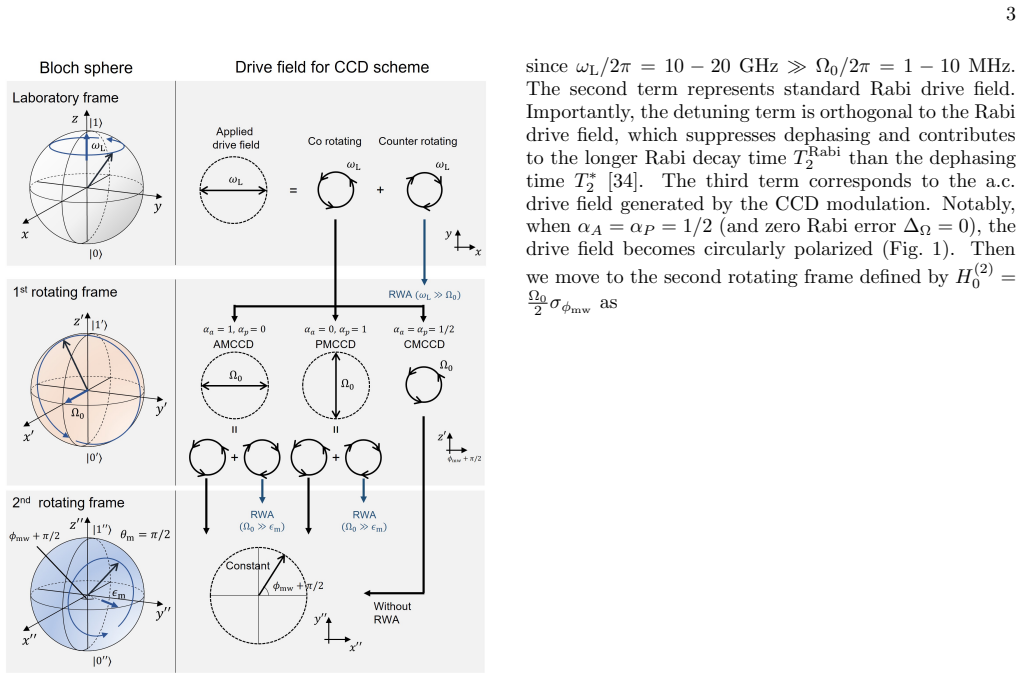
By simultaneously modulating amplitude and phase to generate a circularly polarized field in the rotating frame of the carrier frequency, the CMCCD scheme cancels the counter-rotating term in the second rotating frame. This eliminates the systematic pulse-area error that arises from an imperfect rotating wave approximation during fast gates. The method therefore delivers higher gate fidelity than conventional concatenated continuous driving and markedly greater robustness to static detuning and Rabi-frequency errors on a silicon spin qubit.
What carries the argument
The circularly polarized field generated by joint amplitude and phase modulation in the rotating frame, which cancels the counter-rotating term and thereby removes the pulse-area error.
If this is right
- CMCCD reaches higher gate fidelity than conventional CCD schemes.
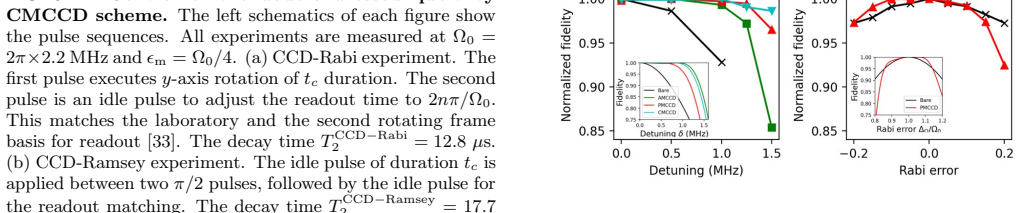
- Robustness to static detuning and Rabi frequency errors is significantly improved relative to standard Rabi driving.
- The scheme remains effective for qubit arrays that contain spreads in qubit frequency, drive coupling strength, and low-frequency noise.
- The same modulation approach can be transferred to other driven systems such as trapped atoms, cold atoms, superconducting qubits, and NV centers.
Where Pith is reading between the lines
- Faster gate times may become practical in noisy environments because the counter-rotating error is suppressed at the drive level.
- Large-scale arrays could require less per-qubit calibration if the protocol tolerates the natural spreads in frequency and coupling that occur in fabrication.
- The same modulation idea might be adapted to suppress analogous errors in other continuously driven quantum systems beyond spin qubits.
Load-bearing premise
Amplitude and phase modulations can be applied together with enough precision to produce a clean circularly polarized field without adding new high-frequency noise or calibration errors that would undo the cancellation.
What would settle it
A measurement of gate fidelity or pulse-area error under the CMCCD protocol that shows no improvement over standard CCD when realistic detuning and Rabi-frequency variations are introduced would falsify the central claim.
Figures


read the original abstract
The rate of coherence loss is lower for a qubit under the Rabi drive than a freely evolving qubit $T_{2}^{\rm{Rabi}}>T_{2}^*$. Building on this principle, concatenated continuous driving (CCD) keeps the qubit under continuous drive to suppress noise and manipulate dressed states by either phase or amplitude modulation. In this work, we propose a variant of CCD which simultaneously modulates both the amplitude and phase of the driving field to generate a circularly polarized field in the rotating frame of the carrier frequency. This circular-modulated CCD(CMCCD) cancels the counter-rotating term in the second rotating frame, eliminating a systematic pulse-area error that arises from an imperfect rotating wave approximation for fast gates. Numerical simulations demonstrate that the proposed CMCCD achieves higher gate fidelity than conventional CCD schemes. We further implement and compare different CCD protocols using an electron spin-qubit in an isotopically purified $^{28}$Si-MOS quantum dot and evaluate its robustness by applying static detuning and Rabi frequency errors. The robustness is significantly improved compared with the standard Rabi drive, showing the effectiveness of this scheme for qubit arrays with variation in qubit frequency, coupling to the Rabi drive, and low-frequency noise. The proposed scheme can be applied to various physical systems, including trapped atoms, cold atoms, superconducting qubits, and NV centers.
Editorial analysis
A structured set of objections, weighed in public.
Referee Report
Summary. The paper proposes circular-modulated concatenated continuous driving (CMCCD) for silicon spin qubits, in which simultaneous amplitude and phase modulation of the drive field produces a circularly polarized field in the first rotating frame. This is claimed to cancel the counter-rotating term in the second rotating frame, thereby removing a systematic pulse-area error that survives under imperfect RWA for fast gates. Numerical simulations are presented showing higher gate fidelity than conventional CCD, and experiments on an isotopically purified 28Si-MOS quantum dot demonstrate improved robustness to static detuning and Rabi-frequency errors relative to standard Rabi driving.
Significance. If the central claims hold, the scheme provides a concrete route to mitigate RWA-induced errors in continuous-driving protocols without requiring additional hardware beyond standard modulation capabilities. The combination of analytic cancellation, numerical fidelity benchmarks, and experimental robustness tests on a silicon platform is relevant for scalable qubit arrays subject to frequency variation and low-frequency noise, and the approach is stated to be portable to other systems such as superconducting qubits and NV centers.
major comments (2)
- [§3 (Theory of CMCCD)] §3 (Theory of CMCCD) and the associated rotating-frame derivation: the cancellation of the counter-rotating term is shown under the assumption of ideal, perfectly synchronized amplitude and phase modulation that produces a clean circular polarization; the manuscript does not quantify the residual counter-rotating amplitude that would remain under realistic modulator bandwidth limits, phase jitter, or calibration mismatch, which directly affects whether the claimed elimination of pulse-area error is realized in practice.
- [§4 (Numerical Simulations)] §4 (Numerical Simulations): the fidelity advantage of CMCCD over conventional CCD is reported for ideal modulation; however, the simulations do not incorporate the additional high-frequency noise or decoherence channels that simultaneous dual modulation may introduce, leaving open whether the net fidelity gain survives when these effects are included at the level required for the fast-gate regime.
minor comments (2)
- [Experimental section] The experimental robustness data compare CMCCD to standard Rabi drive but do not include a direct side-by-side comparison with conventional (single-modulation) CCD under the same static-error conditions; adding this baseline would strengthen the claim that the improvement originates specifically from counter-rotating cancellation.
- [Figures] Figure captions and axis labels in the simulation and experimental panels should explicitly state the gate duration and the magnitude of the applied detuning/Rabi errors to allow quantitative comparison with other works.
Simulated Author's Rebuttal
We thank the referee for the careful reading of our manuscript and the constructive comments. We address each major comment below and have revised the manuscript to strengthen the presentation of practical considerations.
read point-by-point responses
-
Referee: [§3 (Theory of CMCCD)] §3 (Theory of CMCCD) and the associated rotating-frame derivation: the cancellation of the counter-rotating term is shown under the assumption of ideal, perfectly synchronized amplitude and phase modulation that produces a clean circular polarization; the manuscript does not quantify the residual counter-rotating amplitude that would remain under realistic modulator bandwidth limits, phase jitter, or calibration mismatch, which directly affects whether the claimed elimination of pulse-area error is realized in practice.
Authors: We agree that a discussion of non-ideal effects is valuable for assessing practical utility. The derivation in §3 is presented for ideal modulation to demonstrate the exact cancellation of the counter-rotating term. In the revised manuscript we have added a quantitative estimate of residual counter-rotating amplitude arising from finite modulator bandwidth (200 MS/s) and phase jitter (<0.5°), using parameters consistent with our experimental AWG. The analysis shows the residual remains below the level that would compromise the pulse-area error suppression for the gate durations considered. revision: yes
-
Referee: [§4 (Numerical Simulations)] §4 (Numerical Simulations): the fidelity advantage of CMCCD over conventional CCD is reported for ideal modulation; however, the simulations do not incorporate the additional high-frequency noise or decoherence channels that simultaneous dual modulation may introduce, leaving open whether the net fidelity gain survives when these effects are included at the level required for the fast-gate regime.
Authors: Section 4 simulations isolate the coherent cancellation benefit under ideal drive conditions. We note that any additional noise channels from dual modulation are already present in the laboratory implementation. The experimental robustness data in §5, obtained with the actual CMCCD drive on the 28Si-MOS qubit, demonstrate improved performance relative to standard Rabi driving despite all real-world noise sources. We have added a short clarifying paragraph in the revised §4 that connects the ideal simulations to the experimental results and references the measured coherence times under dual modulation. revision: partial
Circularity Check
No significant circularity; proposal and validation are independent
full rationale
The paper proposes CMCCD by extending CCD via simultaneous amplitude and phase modulation to cancel the counter-rotating term in the second rotating frame, then validates the claim through numerical simulations comparing gate fidelities and experimental robustness tests on a 28Si-MOS qubit under detuning and Rabi errors. No derivation step reduces by construction to a fitted parameter, self-defined quantity, or load-bearing self-citation chain; the central advantage is demonstrated directly via simulation and measurement rather than renamed prior results or ansatzes imported from author-only citations. The work is self-contained against external benchmarks.
Axiom & Free-Parameter Ledger
axioms (2)
- domain assumption T2^Rabi > T2* for a qubit under Rabi drive compared to free evolution
- domain assumption The rotating-wave approximation and second rotating frame remain valid when both amplitude and phase are modulated to produce circular polarization
Reference graph
Works this paper leans on
-
[1]
C. L. Degen, F. Reinhard, and P. Cappellaro, Rev. Mod. Phys.89, 035002 (2017)
work page 2017
-
[2]
D. DeMille, N. R. Hutzler, A. M. Rey, and T. Zelevinsky, Nat. Phys.20, 741 (2024)
work page 2024
-
[3]
V. Giovannetti, S. Lloyd, and L. Maccone, Phys. Rev. Lett.96, 010401 (2006)
work page 2006
-
[4]
R. P. Feynman, Int. J. Theor. Phys.21(1982)
work page 1982
-
[5]
I. M. Georgescu, S. Ashhab, and F. Nori, Rev. Mod. Phys.86, 153 (2014)
work page 2014
-
[6]
T. Hensgens, T. Fujita, L. Janssen, X. Li, C. J. Van Diepen, C. Reichl, W. Wegscheider, S. Das Sarma, and L. M. K. Vandersypen, Nature548, 70 (2017)
work page 2017
-
[7]
D. P. DiVincenzo, Fortschr. Phys.48, 771 (2000)
work page 2000
-
[8]
M. A. Nielsen and I. L. Chuang,Quantum computation and quantum information(Cambridge University Press, 2010)
work page 2010
-
[9]
R. Raussendorf and J. Harrington, Phys. Rev. Lett.98, 190504 (2007)
work page 2007
-
[10]
A. G. Fowler, M. Mariantoni, J. M. Martinis, and A. N. Cleland, Phys. Rev. A86, 032324 (2012)
work page 2012
- [11]
-
[12]
N. Timoney, I. Baumgart, M. Johanning, A. F. Var´ on, M. B. Plenio, A. Retzker, and C. Wunderlich, Nature 476, 185 (2011)
work page 2011
- [13]
-
[14]
X. Xu, Z. Wang, C. Duan, P. Huang, P. Wang, Y. Wang, N. Xu, X. Kong, F. Shi, X. Rong,et al., Phys. Rev. Lett. 109, 070502 (2012)
work page 2012
-
[15]
D. A. Golter, T. K. Baldwin, and H. Wang, Phys. Rev. Lett.113, 237601 (2014)
work page 2014
-
[16]
H. Morishita, T. Tashima, D. Mima, H. Kato, T. Makino, S. Yamasaki, M. Fujiwara, and N. Mizuochi, Sci. Rep.9, 13318 (2019)
work page 2019
-
[17]
K. C. Miao, J. P. Blanton, C. P. Anderson, A. Bourassa, A. L. Crook, G. Wolfowicz, H. Abe, T. Ohshima, and D. D. Awschalom, Science369, 1493 (2020)
work page 2020
- [18]
-
[19]
K. Tsoukalas, U. von L¨ upke, A. Orekhov, B. Het´ enyi, I. Seidler, L. Sommer, E. G. Kelly, L. Massai, M. Aldeghi, M. Pita-Vidal,et al., arXiv (2025), 2501.14627
- [20]
-
[21]
H. H. Vallabhapurapu, I. Hansen, C. Adambukulam, R. St¨ ohr, A. Denisenko, C. H. Yang, and A. Laucht, Phys. Rev. A108, 022606 (2023)
work page 2023
- [22]
- [23]
-
[24]
J. M. Cai, B. Naydenov, R. Pfeiffer, L. P. McGuinness, K. D. Jahnke, F. Jelezko, M. B. Plenio, and A. Retzker, New J. Phys.14, 113023 (2012)
work page 2012
- [25]
- [26]
-
[27]
D. Farfurnik, N. Aharon, I. Cohen, Y. Hovav, A. Retzker, and N. Bar-Gill, Phys. Rev. A96, 013850 (2017)
work page 2017
- [28]
- [29]
- [30]
- [31]
-
[32]
A. J. Ramsay, R. Hekmati, C. J. Patrickson, S. Baber, D. R. M. Arvidsson-Shukur, A. J. Bennett, and I. J. Lux- moore, Nat. Commun.14, 461 (2023)
work page 2023
- [33]
- [34]
-
[35]
A. Elsayed, M. M. K. Shehata, C. Godfrin, S. Kubicek, S. Massar, Y. Canvel, J. Jussot, G. Simion, M. Mongillo, D. Wan,et al., npj Quantum Inf.10, 70 (2024)
work page 2024
-
[36]
J. M. Elzerman, R. Hanson, L. H. Willems van Beveren, B. Witkamp, L. M. K. Vandersypen, and L. P. Kouwen- hoven, Nature430, 431 (2004)
work page 2004
-
[37]
A. V. Khaetskii, D. Loss, and L. Glazman, Phys. Rev. Lett.88, 186802 (2002)
work page 2002
- [38]
-
[39]
L. V. C. Assali, H. M. Petrilli, R. B. Capaz, B. Koiller, X. Hu, and S. Das Sarma, Phys. Rev. B83, 165301 (2011)
work page 2011
-
[40]
R. Ferdous, K. W. Chan, M. Veldhorst, J. C. C. Hwang, C. H. Yang, H. Sahasrabudhe, G. Klimeck, A. Morello, A. S. Dzurak, and R. Rahman, Phys. Rev. B97, 241401 (2018)
work page 2018
-
[41]
J. D. Cifuentes, T. Tanttu, W. Gilbert, J. Y. Huang, E. Vahapoglu, R. C. C. Leon, S. Serrano, D. Otter, D. Dunmore, P. Y. Mai,et al., Nat. Commun.15, 4299 (2024)
work page 2024
-
[42]
B. Undseth, O. Pietx-Casas, E. Raymenants, M. Mehmandoost, M. T. Madzik, S. G. J. Philips, S. L. De Snoo, D. J. Michalak, S. V. Amitonov, L. Tryputen,et al., Phys. Rev. X13, 041015 (2023)
work page 2023
- [43]
-
[44]
J. T. Muhonen, A. Laucht, S. Simmons, J. P. Dehollain, R. Kalra, F. E. Hudson, S. Freer, K. M. Itoh, D. N. Jamieson, J. C. McCallum,et al., J. Phys.: Condens. Matter27, 154205 (2015)
work page 2015
-
[45]
M. N¨ unnerich, D. Cohen, P. Barthel, P. H. Huber, D. Ni- roomand, A. Retzker, and C. Wunderlich, Phys. Rev. X 15, 021079 (2025)
work page 2025
-
[46]
G. Wang, W. Xu, C. Li, V. Vuleti´ c, and P. Cappellaro, Phys. Rev. Appl.23, 024072 (2025)
work page 2025
discussion (0)
Sign in with ORCID, Apple, or X to comment. Anyone can read and Pith papers without signing in.