Convolutional causal learning for aerodynamic flows
Pith reviewed 2026-05-21 15:03 UTC · model grok-4.3
The pith
A convolutional neural network with information-theoretic decomposition extracts time-dependent vortical structures that causally influence future aerodynamic forces from snapshot data.
A machine-rendered reading of the paper's core claim, the machinery that carries it, and where it could break.
Core claim
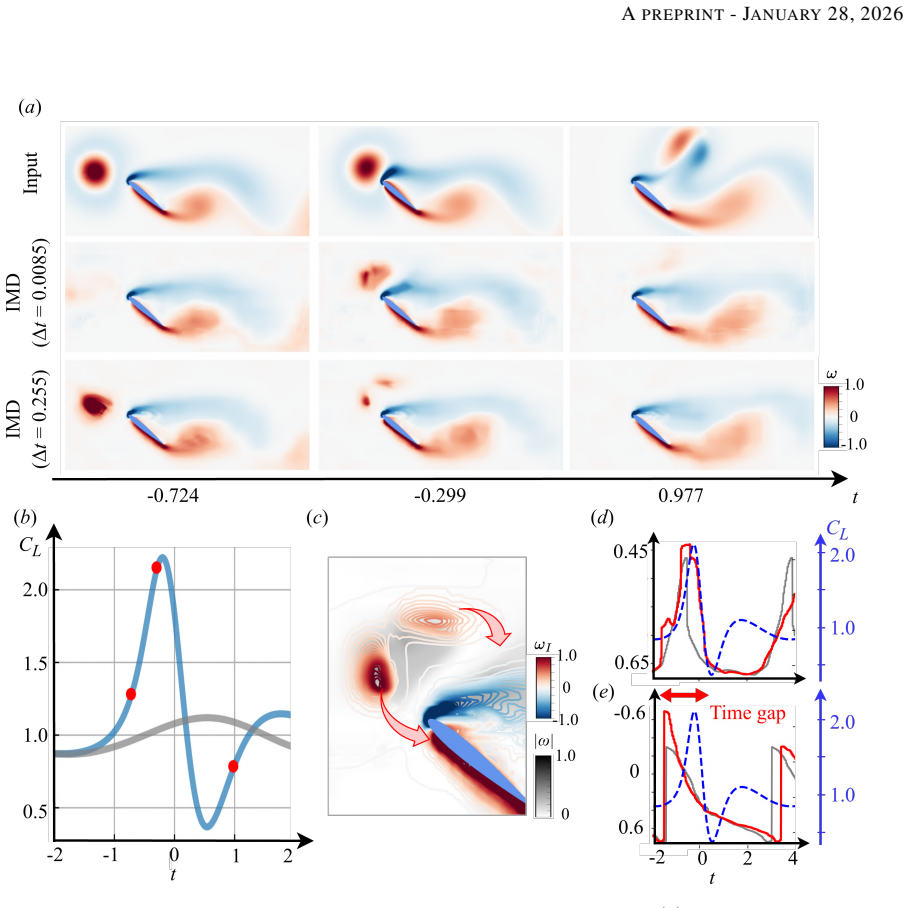
The central claim is that aerodynamic causality can be captured from snapshot data with a time-varying mode decomposition technique referred to as information-theoretic machine learning. When this decomposition is paired with a convolutional neural network, it yields spatial continuous modes and identifies time-dependent informative vortical structures that contribute to the future evolution of aerodynamic coefficients. A low-order representation of these structures and coefficients is obtained via autoencoder compression. The method applied to vortex-gust airfoil interactions extracts the time-varying gust effect on lift response, while in the turbulent separated wake it reveals the link to
What carries the argument
The information-theoretic machine learning time-varying mode decomposition integrated with a convolutional neural network, which produces spatial continuous modes and isolates vortical structures that drive future aerodynamic coefficients.
If this is right
- In gust-airfoil cases the time-varying influence of the gust on the lift response is isolated in an interpretable form.
- In turbulent wakes the relationship between large-scale vortical motion and lift force is recovered without any supplied spatial length-scale information.
- Autoencoder compression yields a low-order representation that characterizes both the informative vortical structures and the associated aerodynamic coefficients.
- The overall framework supplies a basis for data-driven causal modeling and control across a range of unsteady aerodynamic flows.
Where Pith is reading between the lines
- The same snapshot-based causal extraction could be tested on three-dimensional or compressible flows to check whether the identified structures remain predictive when additional physics enter.
- If the low-order representations prove stable across Reynolds numbers, they might be inserted into reduced-order controllers for real-time gust alleviation on aircraft.
- The technique might be applied to other snapshot-rich domains such as ocean current data to locate causal drivers of transport without assuming fixed length scales.
Load-bearing premise
The information-theoretic decomposition applied to snapshot data extracts genuine causal contributions to future aerodynamic coefficients rather than statistical correlations.
What would settle it
Introduce a controlled perturbation to one of the vortical structures identified as causal and measure whether the aerodynamic coefficients change in the predicted way; absence of the expected change would falsify the causal extraction.
Figures




read the original abstract
This study aims to capture aerodynamic causality from snapshot data with a time-varying mode decomposition technique referred to as information-theoretic machine learning. The current approach extracts time-dependent informative vortical structures, contributing to the future evolution of the aerodynamic coefficients. The present decomposition is employed with a convolutional neural network, enabling the identification of the spatial continuous mode. In addition, a low-order representation, characterizing the informative vortical structures and their corresponding aerodynamic coefficients, can also be identified by considering autoencoder-based data compression. The present technique is applied to a range of aerodynamic examples, including extreme vortex-gust airfoil interactions, experimentally measured transverse jet-wing interaction, and a turbulent separated wake across different Reynolds numbers. For the cases of gust-wing interaction, the time-varying gust effect on the lift response is extracted in an interpretable manner. With the example of a turbulent wake, the relationship between large-scale vortical motion and lift force is identified without any spatial length-scale information. The proposed approach could serve as a foundation for data-driven causal modeling and control for a range of unsteady flows.
Editorial analysis
A structured set of objections, weighed in public.
Referee Report
Summary. The manuscript introduces a convolutional causal learning framework that applies an information-theoretic machine learning time-varying mode decomposition to snapshot data in order to extract time-dependent vortical structures that causally influence the future evolution of aerodynamic coefficients. The decomposition is combined with a convolutional neural network to obtain spatially continuous modes and with an autoencoder to produce low-order representations of the informative structures and coefficients. The method is demonstrated on three cases: extreme vortex-gust airfoil interactions, experimentally measured transverse jet-wing interactions, and turbulent separated wakes at multiple Reynolds numbers. The authors claim that the approach identifies interpretable causal links, such as the time-varying gust effect on lift and the relationship between large-scale vortical motion and lift force in the wake without requiring explicit spatial length-scale information, and that it can serve as a foundation for data-driven causal modeling and control of unsteady flows.
Significance. If the extracted modes can be shown to isolate genuine causal contributions rather than predictive correlations, the work would offer a useful data-driven route to interpretable causal modeling in unsteady aerodynamics. The integration of information-theoretic decomposition with CNNs and autoencoders for both spatial continuity and dimensionality reduction is a constructive combination that could support downstream control applications across gust, jet, and wake problems.
major comments (1)
- [Abstract and §4.3] The central causality claim for the turbulent-wake example (abstract and §4.3) rests on the assertion that the time-varying mode decomposition identifies structures whose influence on lift is causal. Snapshot data alone yields joint statistics; without reported interventional tests (e.g., targeted mode perturbation, time-shuffling, or surrogate-data controls that preserve correlations while destroying directed temporal influence), the extracted relationship remains consistent with non-causal predictive modeling. This issue is load-bearing for the claim that the method extracts causality rather than correlation.
minor comments (2)
- [§3] The method section would benefit from explicit equations or pseudocode showing how the information-theoretic objective is optimized and how the time-varying modes are updated at each snapshot.
- [§4] Quantitative error metrics, ablation studies, or baseline comparisons (e.g., against standard DMD or POD) should be added to the result figures for the gust-wing and jet-wing cases to allow assessment of improvement over existing decompositions.
Simulated Author's Rebuttal
We thank the referee for the constructive review and positive assessment of the work's potential. We address the single major comment below, proposing targeted revisions to strengthen the presentation of the causality claims.
read point-by-point responses
-
Referee: [Abstract and §4.3] The central causality claim for the turbulent-wake example (abstract and §4.3) rests on the assertion that the time-varying mode decomposition identifies structures whose influence on lift is causal. Snapshot data alone yields joint statistics; without reported interventional tests (e.g., targeted mode perturbation, time-shuffling, or surrogate-data controls that preserve correlations while destroying directed temporal influence), the extracted relationship remains consistent with non-causal predictive modeling. This issue is load-bearing for the claim that the method extracts causality rather than correlation.
Authors: We agree that interventional or surrogate tests provide stronger validation for directed causality. Our information-theoretic time-varying mode decomposition quantifies directed information transfer (via measures such as transfer entropy) from vortical structures to future aerodynamic coefficients, which is a standard approach for inferring causal influence in observational dynamical systems. However, we acknowledge that the current results are most accurately described as identifying structures with significant predictive influence on lift that is consistent with causal mechanisms in the flow. In the revised version we will (i) moderate the language in the abstract and §4.3 to emphasize information-theoretic directed influence rather than interventional causality, (ii) add surrogate-data controls that preserve spatial correlations while destroying temporal ordering, and (iii) include a brief discussion of the distinction between observational and interventional causality. These additions directly address the concern while preserving the method's core contribution. revision: yes
Circularity Check
No circularity: method applies standard information-theoretic decomposition plus CNN/autoencoder to snapshots without reducing predictions to fitted inputs or self-citations
full rationale
The paper presents a time-varying mode decomposition based on information-theoretic machine learning, combined with convolutional networks and autoencoders, to extract vortical structures from aerodynamic snapshot data. No equations or procedures in the provided abstract or description reduce a claimed prediction or causal extraction to a fitted parameter or self-referential definition by construction. The approach is applied to example flows (gust interactions, jet-wing, turbulent wake) as an empirical technique rather than a closed derivation. Central claims rest on the interpretability of extracted modes for future aerodynamic coefficients, but these are not shown to be statistically forced by the input data fitting itself. Self-contained against external benchmarks with no load-bearing self-citation chains or ansatz smuggling visible.
Axiom & Free-Parameter Ledger
axioms (1)
- domain assumption Snapshot data of unsteady flows contains sufficient information to extract time-dependent causal vortical structures via information-theoretic decomposition
Lean theorems connected to this paper
-
IndisputableMonolith.Foundation.RealityFromDistinctionreality_from_one_distinction unclear?
unclearRelation between the paper passage and the cited Recognition theorem.
The informative component is defined as the state that maximizes mutual information with λ at a future time stamp... H(λ|qI)=0... I(qR;qI)=0 (eqs. 2-4, §2)
-
IndisputableMonolith.Cost.FunctionalEquationwashburn_uniqueness_aczel unclear?
unclearRelation between the paper passage and the cited Recognition theorem.
w∗=argminw ||q−qI||² + β||I(qR;qI)||² (eq. 6); convolutional autoencoder / CNN extractor
What do these tags mean?
- matches
- The paper's claim is directly supported by a theorem in the formal canon.
- supports
- The theorem supports part of the paper's argument, but the paper may add assumptions or extra steps.
- extends
- The paper goes beyond the formal theorem; the theorem is a base layer rather than the whole result.
- uses
- The paper appears to rely on the theorem as machinery.
- contradicts
- The paper's claim conflicts with a theorem or certificate in the canon.
- unclear
- Pith found a possible connection, but the passage is too broad, indirect, or ambiguous to say the theorem truly supports the claim.
Reference graph
Works this paper leans on
-
[1]
Potential flow and forces for incompressible viscous flow.Proc
Chien-Cheng Chang. Potential flow and forces for incompressible viscous flow.Proc. Roy. Soc. A, 437(1901):517– 525, 1992
work page 1901
- [2]
-
[3]
J. L. Lumley. The structure of inhomogeneous turbulent flows.Atmos. Turbul. Radio Wave Propag., pages 166–178, 1967
work page 1967
-
[4]
P. J. Schmid. Dynamic mode decomposition of numerical and experimental data.J. Fluid Mech., 656:5–28, 2010
work page 2010
-
[5]
S. L. Brunton, B. R. Noack, and P. Koumoutsakos. Machine learning for fluid mechanics.Annu. Rev. Fluid Mech., 52(1):477–508, 2020
work page 2020
- [6]
-
[7]
A. Cremades, S. Hoyas, and R. Vinuesa. Classically studied coherent structures only paint a partial picture of wall-bounded turbulence.Nat. Commun., 16(1):10189, 2025
work page 2025
- [8]
-
[9]
G. Arranz and A. Lozano-Durán. Informative and non-informative decomposition of turbulent flow fields.J. Fluid Mech., 1000:A95, 2024
work page 2024
-
[10]
K. Fukami and R. Araki. Information-theoretic machine learning for time-varying mode decomposition of separated aerodynamic flows.AIAA J., pages 1–9, 2025. 8 APREPRINT- JANUARY28, 2026
work page 2025
- [11]
- [12]
-
[13]
C. E. Shannon. A mathematical theory of communication.Bell Syst. Tech. J., 27(3):379–423, 1948
work page 1948
-
[14]
Á. Martínez-Sánchez, G. Arranz, and A. Lozano-Durán. Decomposing causality into its synergistic, unique, and redundant components.Nat. Commun., 15(1):9296, 2024
work page 2024
- [15]
-
[16]
G. E. Hinton and R. R. Salakhutdino. Reducing the dimensionality of data with neural networks.Science, 313(5786):504–507, 2006
work page 2006
-
[17]
K. Fukami and K. Taira. Grasping extreme aerodynamics on a low-dimensional manifold.Nat. Commun., 14(1):6480, 2023
work page 2023
- [18]
-
[19]
Q. Liu, L. C. Trujillo Corona, D. Espinoza, F. Shu, and A. Gross. Design and dimensional transfer of reinforcement learning-based closed-loop airfoil flow control.Theor . Comput. Fluid Dyn., 39:49, 2025
work page 2025
- [20]
-
[21]
G. I. Taylor. On the dissipation of eddies.Meteorology, Oceanography and Turbulent Flow, pages 96–101, 1918
work page 1918
- [22]
-
[23]
I. Andreu-Angulo, H. abinsky, H. Biler, G. Sedky, and A. R. Jones. Effect of transverse gust velocity profiles. AIAA J., 58(12):5123–5133, 2020
work page 2020
-
[24]
K. Fukagata and K. Fukami. Compressing fluid flows with nonlinear machine learning: mode decomposition, latent modeling, and flow control.Fluid Dyn. Res., 57(4):041401, 2025
work page 2025
- [25]
- [26]
- [27]
discussion (0)
Sign in with ORCID, Apple, or X to comment. Anyone can read and Pith papers without signing in.