Dissipative Quantum Battery in the Ultrastrong Coupling Regime Between Two Oscillators
Pith reviewed 2026-05-15 21:20 UTC · model grok-4.3
The pith
An open quantum battery using two ultrastrongly coupled oscillators stores more energy and ergotropy across wider temperatures.
A machine-rendered reading of the paper's core claim, the machinery that carries it, and where it could break.
Core claim
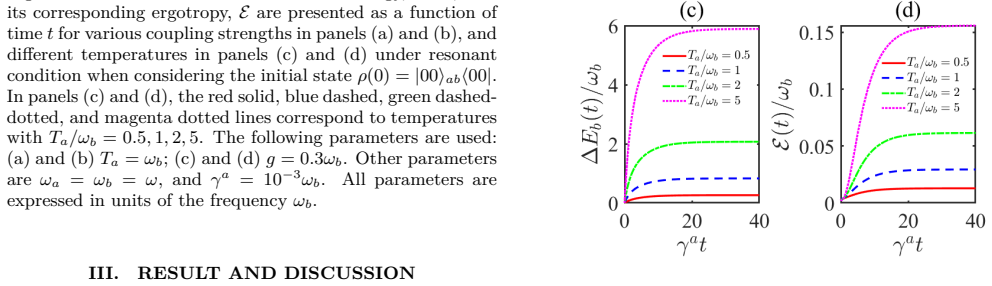
In a dissipative two-mode ultrastrongly coupled bosonic system that functions as a quantum battery, both the charging energy and the ergotropy are enhanced inside the ultra-strong coupling regime and over a wider temperature range during transient evolution. The enhancement requires the joint action of beam-splitter and parametric amplification (squeezing) couplings; either interaction alone produces zero ergotropy. The squared electromagnetic vector potential term stabilizes the Hamiltonian, prevents phase transitions, and permits high performance even in the deep-strong coupling regime. Unidirectional energy flow is obtained by preparing the system in its two-mode squeezed ground state, so
What carries the argument
Two-mode ultrastrongly coupled bosonic Hamiltonian containing beam-splitter coupling, two-mode squeezing, and the squared vector potential term, with one mode coupled to a thermal reservoir.
If this is right
- Charging energy and ergotropy increase with coupling strength once the ultra-strong regime is reached.
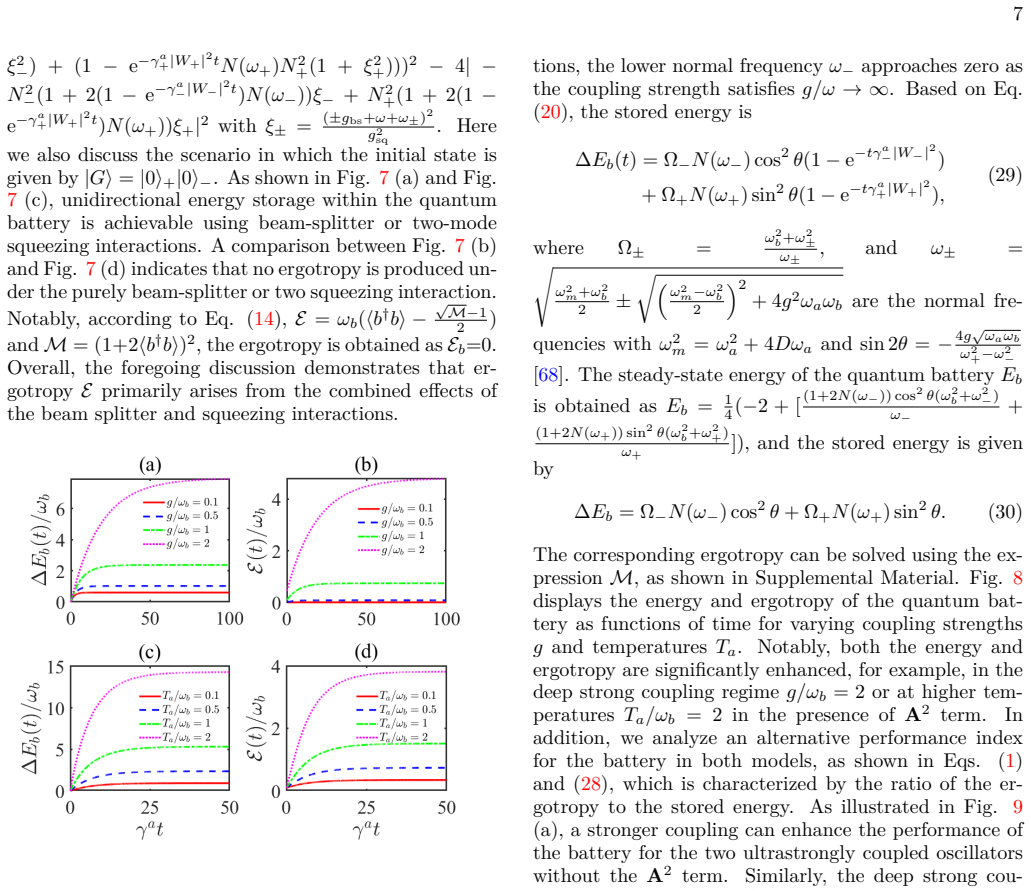
- Steady-state stored energy and ergotropy improve at both larger temperatures and stronger couplings.
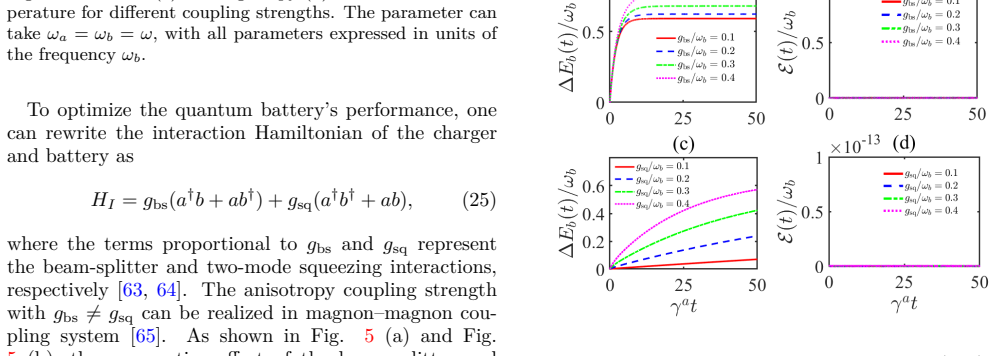
- Pure beam-splitter or pure two-mode squeezing interaction yields zero ergotropy.
- Initial preparation in the two-mode squeezed ground state produces unidirectional energy flow into the battery.
- The squared vector potential term enables significant charging energy and high ergotropy in the deep-strong regime.
Where Pith is reading between the lines
- The approach could reduce the need for cryogenic cooling in practical quantum energy storage devices.
- Similar enhancements may appear in other coupled-oscillator platforms such as circuit QED or optomechanical systems.
- The requirement for mixed beam-splitter and squeezing terms suggests a design rule for engineering ergotropy in bosonic batteries.
- Transient dynamics rather than steady state may offer the most practical operating window for such devices.
Load-bearing premise
The two-mode Hamiltonian that includes the squared electromagnetic vector potential term remains valid and prevents phase transitions without additional corrections in the deep-strong coupling regime.
What would settle it
Direct observation of a phase transition or a drop in charging energy when the squared vector potential term is retained at deep-strong coupling strengths would falsify the claimed enhancement.
Figures





read the original abstract
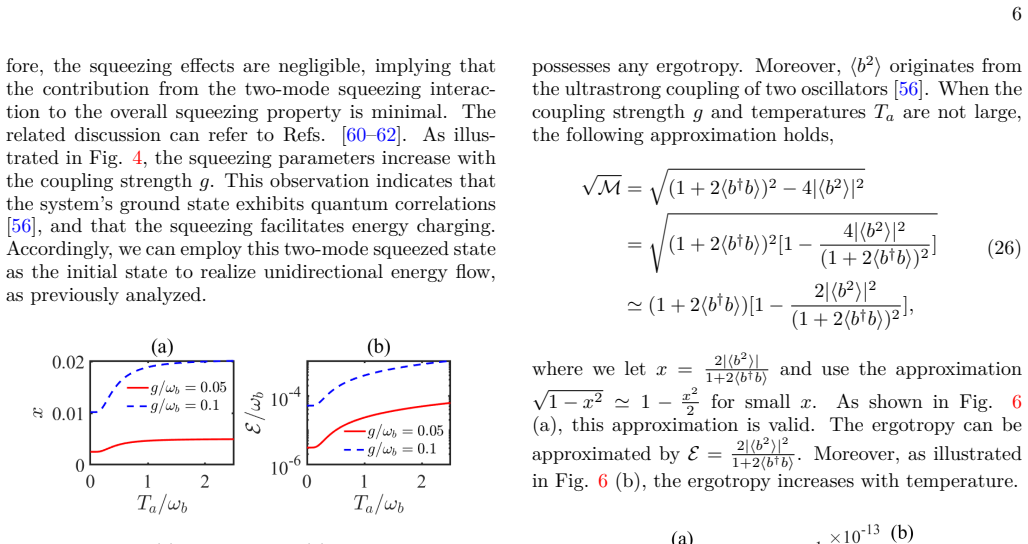
In this work, we propose an open quantum battery that stores and releases energy by employing a two-mode ultrastrongly coupled bosonic system, with one mode (the charger) coupled to an independent heat reservoir. Our results demonstrate that both the charging energy and ergotropy of the quantum batteries can be significantly enhanced within the ultra-strong coupling regime and across a broader temperature range in transient time. A unidirectional energy flow is achieved by controlling the system's initial state through its two-mode squeezed ground state. Furthermore, we show that the steady-state stored energy, along with its corresponding ergotropy, can be enhanced at larger temperatures and stronger coupling strengths. Notably, a purely beam-splitter or two-mode squeezing interaction yields zero ergotropy. These findings indicate that the enhanced stored energy and ergotropy of the quantum battery arises principally from the combined effects of beam-splitter and parametric amplification (squeezing) couplings. In addition, the presence of the squared electromagnetic vector potential term can prevent a phase transition and achieve a significant charging energy and high ergotropy in the deep-strong coupling regime. The results presented herein enhance our understanding of the operating principles of open bosonic quantum batteries.
Editorial analysis
A structured set of objections, weighed in public.
Referee Report
Summary. The manuscript proposes an open quantum battery realized by two ultrastrongly coupled bosonic modes, with one mode (the charger) coupled to an independent thermal reservoir. It reports that both charging energy and ergotropy are substantially enhanced in the ultrastrong-coupling regime and over a wider temperature window during transient dynamics, that unidirectional energy flow is obtained by preparing the two-mode squeezed ground state, and that the diamagnetic A² term prevents a phase transition while enabling high performance in the deep-strong regime. The enhancement is attributed to the simultaneous presence of beam-splitter and parametric-amplification couplings; purely beam-splitter or purely two-mode-squeezing interactions are stated to yield zero ergotropy. Steady-state stored energy and ergotropy are also claimed to increase with temperature and coupling strength.
Significance. If the central claims are substantiated, the work would clarify how ultrastrong coupling and the diamagnetic term can be exploited to improve the performance of dissipative bosonic quantum batteries, extending their operational temperature range and demonstrating a concrete route to unidirectional charging via initial-state engineering. The explicit contrast between combined versus single-interaction Hamiltonians supplies a useful design principle for future open-system quantum batteries.
major comments (3)
- [model Hamiltonian / Eq. (1)] The central claim that the two-mode Hamiltonian including the A² term remains valid and prevents phase transitions in the deep-strong-coupling regime (abstract and model section) is load-bearing for all reported enhancements. No explicit diagonalization, critical-coupling calculation, or comparison against higher-order corrections is supplied to confirm the absence of instabilities or the validity of the standard Lindblad form.
- [open-system dynamics] The master-equation derivation for the ultrastrong-coupling regime (open-system section) applies a standard Lindblad dissipator without USC-specific counter-rotating or bath-coupling corrections. This truncation directly affects the reported transient unidirectional flow and steady-state values; an explicit check of the secular approximation or a comparison with a USC-consistent master equation is required.
- [ergotropy calculation] The statements that pure beam-splitter or pure two-mode-squeezing interactions produce zero ergotropy while their combination yields finite ergotropy (results section) are central to the interpretation. The explicit expressions for the ergotropy (or the passive-state energy) used to obtain these conclusions are not provided, preventing verification that the enhancement is not an artifact of the chosen initial state or truncation.
minor comments (2)
- [figures] Figure captions and axis labels should explicitly state the units of energy and the precise definition of the coupling strength g/ω used in each panel.
- [results] The phrase “broader temperature range” is used without a quantitative benchmark; a reference curve for the weak-coupling limit should be added to the temperature-sweep plots.
Simulated Author's Rebuttal
We thank the referee for the thorough review and valuable suggestions. We have carefully addressed each of the major comments and revised the manuscript accordingly.
read point-by-point responses
-
Referee: [model Hamiltonian / Eq. (1)] The central claim that the two-mode Hamiltonian including the A² term remains valid and prevents phase transitions in the deep-strong-coupling regime (abstract and model section) is load-bearing for all reported enhancements. No explicit diagonalization, critical-coupling calculation, or comparison against higher-order corrections is supplied to confirm the absence of instabilities or the validity of the standard Lindblad form.
Authors: We appreciate this observation. To substantiate the claim, we have added an appendix with the explicit diagonalization of the Hamiltonian in the presence of the A² term. This shows that the critical coupling for the phase transition is pushed to infinity, preventing instabilities in the deep-strong regime. We also include a brief discussion on the validity of the model and the Lindblad form within the parameter range considered. revision: yes
-
Referee: [open-system dynamics] The master-equation derivation for the ultrastrong-coupling regime (open-system section) applies a standard Lindblad dissipator without USC-specific counter-rotating or bath-coupling corrections. This truncation directly affects the reported transient unidirectional flow and steady-state values; an explicit check of the secular approximation or a comparison with a USC-consistent master equation is required.
Authors: We agree that this is an important point. In the revised version, we have performed a comparison with a master equation that accounts for USC effects (following the approach in relevant literature). The results confirm that the key features—enhanced charging energy, ergotropy, and unidirectional flow—persist, although quantitative values may shift slightly. We have added this analysis to the supplementary information and clarified the approximations used. revision: yes
-
Referee: [ergotropy calculation] The statements that pure beam-splitter or pure two-mode-squeezing interactions produce zero ergotropy while their combination yields finite ergotropy (results section) are central to the interpretation. The explicit expressions for the ergotropy (or the passive-state energy) used to obtain these conclusions are not provided, preventing verification that the enhancement is not an artifact of the chosen initial state or truncation.
Authors: We thank the referee for highlighting this omission. The ergotropy is calculated as the difference between the mean energy and the energy of the passive state, where the passive state is obtained by sorting the eigenvalues of the density matrix in decreasing order and assigning them to the Hamiltonian eigenvalues in increasing order. We have now included the explicit expressions and the calculations for the pure interaction cases in the main text, showing that the resulting states are passive, hence zero ergotropy, while the combined interaction leads to non-passive states with finite ergotropy. revision: yes
Circularity Check
No significant circularity detected in derivation chain
full rationale
The paper derives its claims about enhanced charging energy, ergotropy, and unidirectional flow directly from the time evolution of the proposed two-mode ultrastrongly coupled Hamiltonian (including the A² term) under an open-system master equation, starting from specified initial states such as the two-mode squeezed ground state. No parameters are fitted to data and then relabeled as predictions; no self-definitional loops appear where a quantity is defined in terms of the result it is claimed to produce; and no load-bearing uniqueness theorems or ansatzes are imported solely via self-citation. The central results follow from solving the dynamical equations under the stated model assumptions, making the derivation self-contained against external benchmarks.
Axiom & Free-Parameter Ledger
axioms (2)
- domain assumption Two bosonic modes interact via ultrastrong coupling that includes both beam-splitter and parametric-amplification terms plus the squared vector potential.
- domain assumption One mode couples to an independent thermal reservoir while the overall system remains Markovian.
Reference graph
Works this paper leans on
-
[1]
Hence M = (1 + 2 ∑ j[(|uj|2 + |wj|2)⟨A† jAj⟩ + |wj|2])2 − 4| − ∑ j u∗ j wj(2⟨A† jAj⟩ + 1)|2. The correspond- ing ergotropy can be written as E = ωb{∑ j[(|uj|2 + |wj|2)⟨A† jAj⟩+|wj|2]− 1 2 [(1+2 ∑ j(|uj|2 +|wj|2)⟨A† jAj⟩+ |wj|2])2 − 4| − ∑ j u∗ j wj(2⟨A† jAj⟩ + 1)|2] 1 2 + 1 2 }. 4 Figure 2. The behavior of the stored energy, ∆Eb, and its corresponding erg...
-
[2]
on the energy and ergotropy of the quantum bat- tery. The presence of D(a + a†)2 in the Dicke Hamilto- nian can eliminate the quantum critical point and inhibit the superradiant phase transition [ 67] under the Thomas- Reiche-Kuhn (TRK) sum rule [ 54, 55]. The Hamilto- nian based on Eq. ( 1) for Hopfield model is expressed as [37, 68] HHop = HS + D(a + a†...
- [3]
-
[4]
F. Campaioli, S. Gherardini, J. Q. Quach, M. Polini, and G. M. Andolina, Colloquium: Quantum batteries, Rev. Mod. Phys. 96, 031001 (2024)
work page 2024
-
[5]
R. Alicki and M. Fannes, Entanglement boost for ex- tractable work from ensembles of quantum batteries, Phys. Rev. E 87, 042123 (2013)
work page 2013
- [6]
-
[7]
R. P. A. Simon, J. Anders, and K. V. Hovhannisyan, Correlations enable lossless ergotropy transport, Phys. Rev. Lett. 134, 010408 (2025)
work page 2025
-
[8]
S. Seah, M. Perarnau-Llobet, G. Haack, N. Brunner, and S. Nimmrichter, Quantum speed-up in collisional battery charging, Phys. Rev. Lett. 127, 100601 (2021)
work page 2021
- [9]
-
[10]
F. Centrone, L. Mancino, and M. Paternostro, Charging batteries with quantum squeezing, Phys. Rev. A 108, 052213 (2023)
work page 2023
-
[11]
P. A. Erdman, G. M. Andolina, V. Giovannetti, and F. Noé, Reinforcement Learning Optimization of the Charging of a Dicke Quantum Battery, Phys. Rev. Lett. 133, 243602 (2024)
work page 2024
- [12]
-
[13]
A. Catalano, S. Giampaolo, O. Morsch, V. Giovannetti, and F. Franchini, Frustrating quantum batteries, PRX Quantum 5, 030319 (2024)
work page 2024
-
[14]
A. Crescente, M. Carrega, M. Sassetti, and D. Ferraro, Ultrafast charging in a two-photon dicke quantum bat- tery, Phys. Rev. B 102, 245407 (2020)
work page 2020
-
[15]
D. Ferraro, M. Campisi, G. M. Andolina, V. Pellegrini, and M. Polini, High-power collective charging of a solid- state quantum battery, Phys. Rev. Lett. 120, 117702 (2018)
work page 2018
-
[16]
G. M. Andolina, D. Farina, A. Mari, V. Pellegrini, V. Giovannetti, and M. Polini, Charger-mediated energy transfer in exactly solvable models for quantum batter- ies, Phys. Rev. B 98, 205423 (2018)
work page 2018
- [17]
-
[18]
Barra, Dissipative charging of a quantum battery, Phys
F. Barra, Dissipative charging of a quantum battery, Phys. Rev. Lett. 122, 210601 (2019)
work page 2019
-
[19]
Z.-K. Wang, K. Xu, Z.-D. Wei, W. Han, Y.-J. Zhang, Z.- X. Man, and Y.-J. Xia, Classical-driving-assisted qubit- array quantum battery, Phys. Rev. E 111, 014121 (2025)
work page 2025
-
[20]
F. T. Tabesh, F. H. Kamin, and S. Salimi, Environment- mediated charging process of quantum batteries, Phys. Rev. A 102, 052223 (2020)
work page 2020
-
[21]
W.-L. Song, J.-L. Wang, B. Zhou, W.-L. Yang, and J.-H. An, Self-discharging mitigated quantum battery, Phys. Rev. Lett. 135, 020405 (2025)
work page 2025
-
[22]
S.-Y. Bai and J.-H. An, Floquet engineering to reactivate a dissipative quantum battery, Phys. Rev. A 102, 060201 (2020)
work page 2020
-
[23]
W.-L. Song, H.-B. Liu, B. Zhou, W.-L. Yang, and J.-H. An, Remote charging and degradation suppression for the quantum battery, Phys. Rev. Lett. 132, 090401 (2024)
work page 2024
- [24]
-
[25]
P. Forn-Díaz, L. Lamata, E. Rico, J. Kono, and E. Solano, Ultrastrong coupling regimes of light-matter 9 interaction, Rev. Mod. Phys. 91, 025005 (2019)
work page 2019
-
[26]
A. F. Kockum, A. Miranowicz, S. De Liberato, S. Savasta, and F. Nori, Ultrastrong coupling between light and matter, Nat. Rev. Phys. 1, 19 (2019)
work page 2019
-
[27]
I. M. Georgescu, S. Ashhab, and F. Nori, Quantum sim- ulation, Rev. Mod. Phys. 86, 153 (2014)
work page 2014
-
[28]
N. K. Langford, R. Sagastizabal, M. Kounalakis, C. Dickel, A. Bruno, F. Luthi, D. J. Thoen, A. Endo, and L. DiCarlo, Experimentally simulating the dynam- ics of quantum light and matter at deep-strong coupling, Nat. Commun. 8 (2017)
work page 2017
-
[29]
S. Fedortchenko, S. Felicetti, D. Marković, S. Jezouin, A. Keller, T. Coudreau, B. Huard, and P. Milman, Quan- tum simulation of ultrastrongly coupled bosonic modes using superconducting circuits, Phys. Rev. A 95, 042313 (2017)
work page 2017
-
[30]
R. Puebla, M.-J. Hwang, J. Casanova, and M. B. Plenio, Protected ultrastrong coupling regime of the two-photon quantum rabi model with trapped ions, Phys. Rev. A 95, 063844 (2017)
work page 2017
-
[31]
G. Hunanyan, J. Koch, S. Moll, E. Rico, E. Solano, and M. Weitz, Periodic quantum rabi model with cold atoms at deep strong coupling, Phys. Rev. Res. 6, 033023 (2024)
work page 2024
-
[32]
J. Koch, G. R. Hunanyan, T. Ockenfels, E. Rico, E. Solano, and M. Weitz, Quantum rabi dynamics of trapped atoms far in the deep strong coupling regime, Nat. Commun. 14, 954 (2023)
work page 2023
-
[33]
A. Ridolfo, M. Leib, S. Savasta, and M. J. Hartmann, Photon blockade in the ultrastrong coupling regime, Phys. Rev. Lett. 109, 193602 (2012)
work page 2012
-
[34]
L. Giannelli, E. Paladino, M. Grajcar, G. S. Paraoanu, and G. Falci, Detecting virtual photons in ultrastrongly coupled superconducting quantum circuits, Phys. Rev. Res. 6, 013008 (2024)
work page 2024
-
[35]
L. Garziano, R. Stassi, V. Macrì, A. F. Kockum, S. Savasta, and F. Nori, Multiphoton quantum rabi oscil- lations in ultrastrong cavity qed, Phys. Rev. A 92, 063830 (2015)
work page 2015
- [36]
-
[37]
D. De Bernardis, P. Pilar, T. Jaako, S. De Liberato, and P. Rabl, Breakdown of gauge invariance in ultrastrong- coupling cavity qed, Phys. Rev. A 98, 053819 (2018)
work page 2018
-
[38]
Y.-q. Liu, S. Sun, Y.-j. Yang, Z. Liu, X. Zhao, Z. Zhu, W. Liu, and C.-s. Yu, Quantum entanglement and einstein-podolsky-rosen steering in ultrastrongly light- matter-coupled systems, Phys. Rev. A 111, 052437 (2025)
work page 2025
-
[39]
S. De Liberato, Light-matter decoupling in the deep strong coupling regime: The breakdown of the purcell effect, Phys. Rev. Lett. 112, 016401 (2014)
work page 2014
-
[40]
C.-s. Yu and Q.-y. Zhu, Re-examining the self-contained quantum refrigerator in the strong-coupling regime, Phys. Rev. E 90, 052142 (2014)
work page 2014
- [41]
-
[42]
P. Lipka-Bartosik, M. Perarnau-Llobet, and N. Brun- ner, Thermodynamic computing via autonomous quan- tum thermal machines, Sci. Adv. 10, eadm8792 (2024)
work page 2024
-
[43]
A. H. A. Malavazi, B. Ahmadi, P. Mazurek, and A. Man- darino, Detuning effects for heat-current control in quan- tum thermal devices, Phys. Rev. E 109, 064146 (2024)
work page 2024
-
[44]
B.-q. Guo, T. Liu, and C.-s. Yu, Multifunctional quantum thermal device utilizing three qubits, Phys. Rev. E 99, 032112 (2019)
work page 2019
-
[45]
L. Wang, Z. Wang, C. Wang, and J. Ren, Cycle flux ranking of network analysis in quantum thermal devices, Phys. Rev. Lett. 128, 067701 (2022)
work page 2022
-
[46]
J. J. Mendoza-Arenas and S. R. Clark, Giant rectifica- tion in strongly interacting driven tilted systems, PRX Quantum 5, 010341 (2024)
work page 2024
-
[47]
S. Felicetti, M. Sanz, L. Lamata, G. Romero, G. Johans- son, P. Delsing, and E. Solano, Dynamical casimir effect entangles artificial atoms, Phys. Rev. Lett. 113, 093602 (2014)
work page 2014
-
[48]
S. Felicetti and A. Le Boité, Universal spectral features of ultrastrongly coupled systems, Phys. Rev. Lett. 124, 040404 (2020)
work page 2020
-
[49]
T. Jaako, Z.-L. Xiang, J. J. Garcia-Ripoll, and P. Rabl, Ultrastrong-coupling phenomena beyond the Dicke model, Phys. Rev. A 94, 033850 (2016)
work page 2016
-
[50]
D. G. Baranov, B. Munkhbat, E. Zhukova, A. Bisht, A. Canales, B. Rousseaux, G. Johansson, T. J. An- tosiewicz, and T. Shegai, Ultrastrong coupling between nanoparticle plasmons and cavity photons at ambient conditions, Nat. Commun. 11, 2715 (2020)
work page 2020
- [51]
-
[52]
A. Ferreri and F. K. Wilhelm, Quantum simulation in hybrid transmission lines, Phys. Rev. Appl. 23, 024026 (2025)
work page 2025
-
[53]
M. Bamba and T. Ogawa, Recipe for the hamilto- nian of system-environment coupling applicable to the ultrastrong-light-matter-interaction regime, Phys. Rev. A 89, 023817 (2014)
work page 2014
-
[54]
J. J. Hopfield, Theory of the contribution of excitons to the complex dielectric constant of crystals, Phys. Rev. 112, 1555 (1958)
work page 1958
-
[55]
C. Emary and T. Brandes, Chaos and the quantum phase transition in the Dicke model, Phys. Rev. E 67, 066203 (2003)
work page 2003
-
[56]
P. Nataf and C. Ciuti, No-go theorem for superradiant quantum phase transitions in cavity qed and counter- example in circuit qed, Nat. Commun. 1, 72 (2010)
work page 2010
-
[57]
O. Viehmann, J. von Delft, and F. Marquardt, Superra- diant phase transitions and the standard description of circuit qed, Phys. Rev. Lett. 107, 113602 (2011)
work page 2011
- [58]
-
[59]
A. J. Leggett, S. Chakravarty, A. T. Dorsey, M. P. A. Fisher, A. Garg, and W. Zwerger, Dynamics of the dissi- pative two-state system, Rev. Mod. Phys. 59, 1 (1987)
work page 1987
-
[60]
H.-P. Breuer and F. Petruccione, The theory of open quantum systems (Oxford University Press, Oxford, 2002)
work page 2002
-
[61]
A. E. Allahverdyan, R. Balian, and T. M. Nieuwenhuizen, Maximal work extraction from finite quantum systems, Europhys. Lett. 67, 565 (2004)
work page 2004
- [62]
-
[63]
K. Gietka, Vacuum rabi splitting as a manifestation of virtual two-mode squeezing: Extracting the squeezing parameters from frequency shifts, Phys. Rev. A 110, 063703 (2024)
work page 2024
-
[64]
L. Bakemeier, A. Alvermann, and H. Fehske, Quantum phase transition in the dicke model with critical and non- critical entanglement, Phys. Rev. A 85, 043821 (2012)
work page 2012
-
[65]
C. Weedbrook, S. Pirandola, R. García-Patrón, N. J. Cerf, T. C. Ralph, J. H. Shapiro, and S. Lloyd, Gaussian quantum information, Rev. Mod. Phys. 84, 621 (2012)
work page 2012
-
[66]
M. Aspelmeyer, T. J. Kippenberg, and F. Marquardt, Cavity optomechanics, Rev. Mod. Phys. 86, 1391 (2014)
work page 2014
-
[67]
T. Makihara, K. Hayashida, G. T. Noe Ii, X. Li, N. Mar- quez Peraca, X. Ma, Z. Jin, W. Ren, G. Ma, I. Katayama, et al. , Ultrastrong magnon–magnon coupling dominated by antiresonant interactions, Nature Communications 12, 3115 (2021)
work page 2021
-
[68]
K. Rzażewski, K. Wódkiewicz, and W. Żakowicz, Phase transitions, two-level atoms, and the A2 term, Phys. Rev. Lett. 35, 432 (1975)
work page 1975
-
[69]
M. Bamba and T. Ogawa, Dissipation and detection of polaritons in the ultrastrong-coupling regime, Phys. Rev. A 86, 063831 (2012)
work page 2012
-
[70]
T. Tufarelli, K. R. McEnery, S. A. Maier, and M. S. Kim, Signatures of the A2 term in ultrastrongly coupled oscil- lators, Phys. Rev. A 91, 063840 (2015)
work page 2015
-
[71]
A. A. Clerk, M. H. Devoret, S. M. Girvin, F. Marquardt, and R. J. Schoelkopf, Introduction to quantum noise, measurement, and amplification, Rev. Mod. Phys. 82, 1155 (2010)
work page 2010
-
[72]
Braak, Integrability of the Rabi Model, Phys
D. Braak, Integrability of the Rabi Model, Phys. Rev. Lett. 107, 100401 (2011) . S1 Supplemental Material: Dissipative Quantum Battery in the Ultrastrong Coupling Regime Between T wo Oscillators Appendix A: The diagonalization of the system Hamiltonian The eigenvalues and eigenstates of the system Hamiltonian Eq. (1) in the main text are determined by exp...
work page 2011
discussion (0)
Sign in with ORCID, Apple, or X to comment. Anyone can read and Pith papers without signing in.