Corrosion Evolution of T91 Steel in Static Lead-Bismuth Eutectic Under an Oxidising Environment
Pith reviewed 2026-05-15 20:50 UTC · model grok-4.3
The pith
T91 steel forms an iron-enriched BCC surface layer in oxidizing lead-bismuth eutectic, with oxide scale stability deciding whether corrosion stays intergranular or spreads.
A machine-rendered reading of the paper's core claim, the machinery that carries it, and where it could break.
Core claim
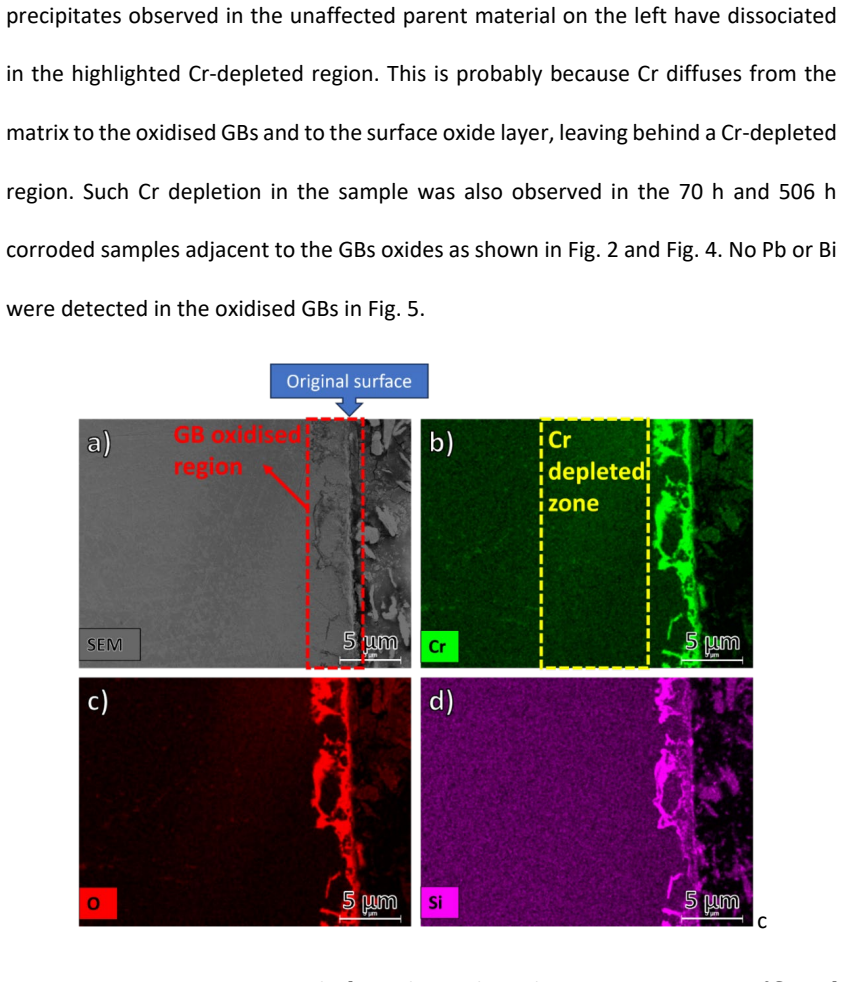
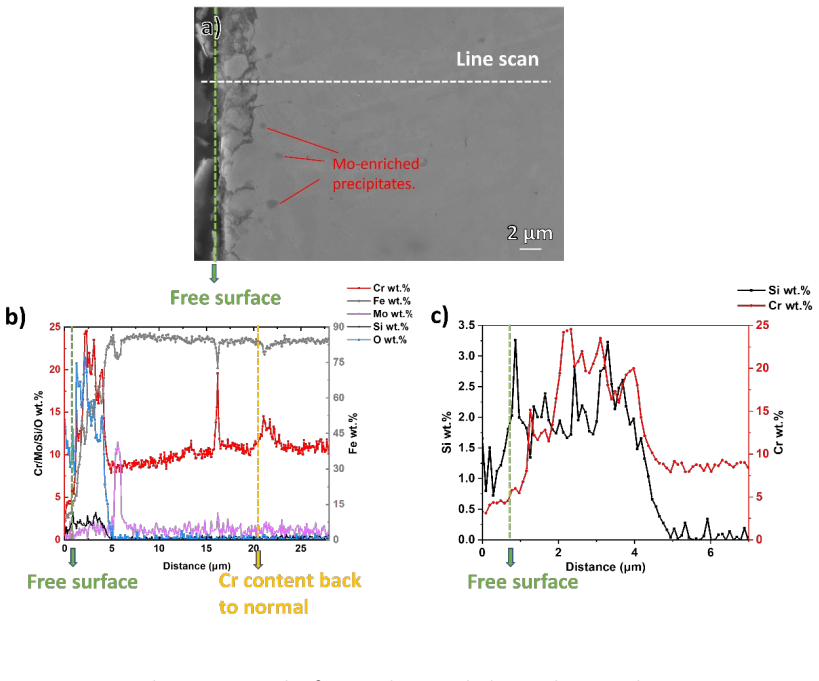
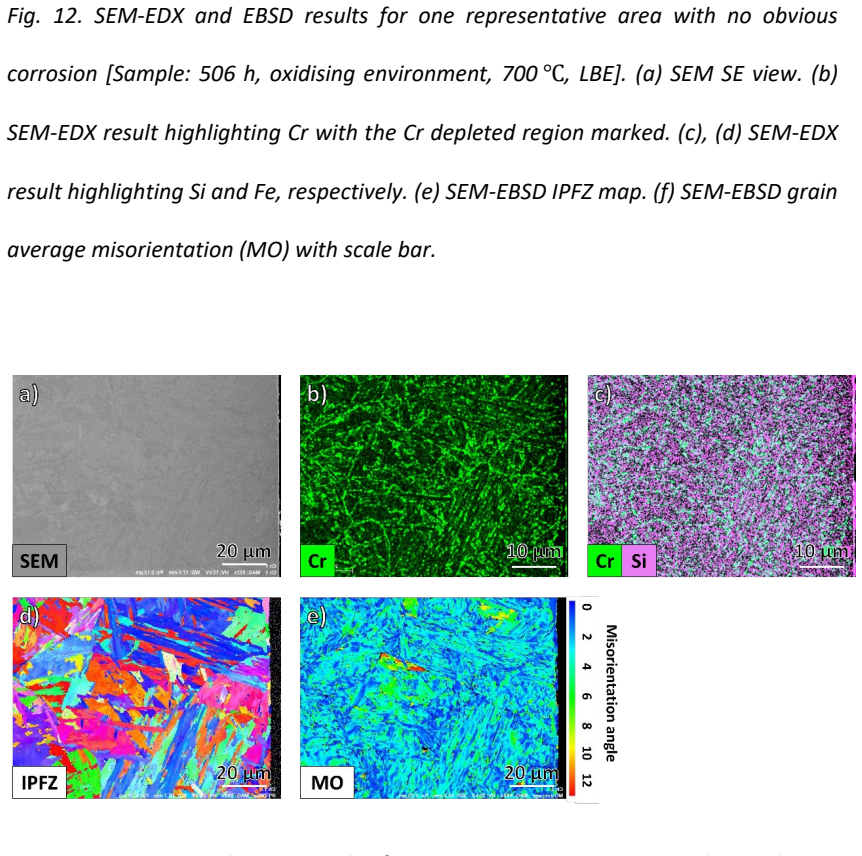
In T91 steel exposed to static lead-bismuth eutectic under oxidizing conditions, LBE penetrates along grain boundaries, inducing chromium depletion that decomposes martensite to ferrite and thereby slows corrosion; a stable coherent oxide scale then determines whether attack remains localized or broadens, while an iron-enriched body-centered cubic phase unexpectedly forms as the outermost surface layer instead of the oxide-only structures reported previously.
What carries the argument
The stable coherent oxide scale that blocks intergranular LBE ingress, together with the iron-enriched BCC surface phase that forms during exposure.
If this is right
- Promoting a stable oxide scale on T91 can restrict LBE attack to isolated grain boundaries rather than allowing widespread corrosion.
- Chromium depletion and resulting ferrite formation provide a built-in slowing mechanism once corrosion starts.
- The iron-enriched BCC layer replaces the expected oxide surface and may change how the material responds to further environmental exposure.
- Material selection and surface treatment for LBE systems can target oxide scale coherence to reduce intergranular damage.
Where Pith is reading between the lines
- Similar oxide-scale control and BCC-layer formation may appear in other 9Cr ferritic-martensitic steels under comparable oxidizing LBE conditions.
- Adjusting oxygen levels in the LBE could be used to tune oxide scale growth and thereby extend the period before intergranular attack begins.
- Surface mechanical properties or subsequent coating adhesion may differ from expectations because of the BCC layer rather than a conventional oxide.
Load-bearing premise
The iron-enriched BCC surface phase and the corrosion-slowing martensite decomposition are intrinsic responses to the oxidizing LBE environment rather than artifacts of sample preparation or limited test conditions.
What would settle it
Repeated tests on freshly prepared T91 samples with longer exposure times and independent surface analysis that still fail to detect the iron-enriched BCC phase would show the phase is not produced by the corrosion process itself.
Figures
read the original abstract
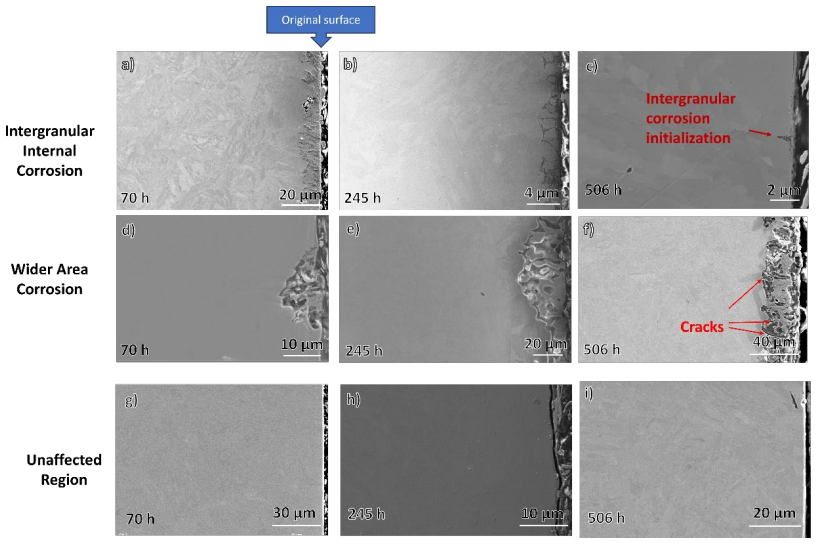
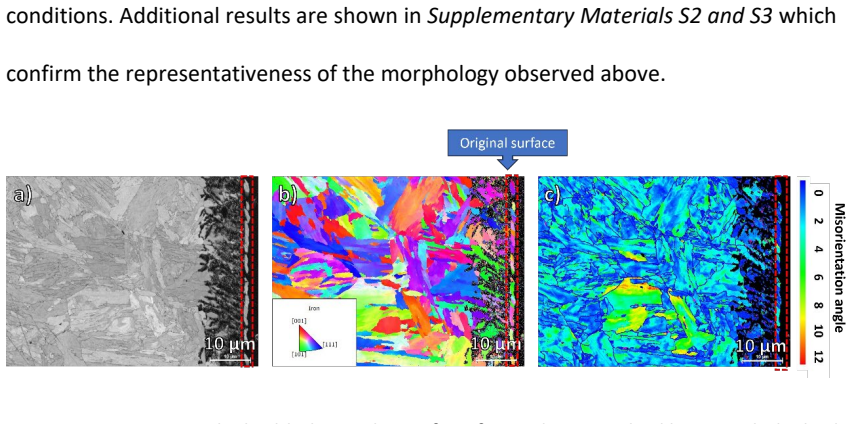
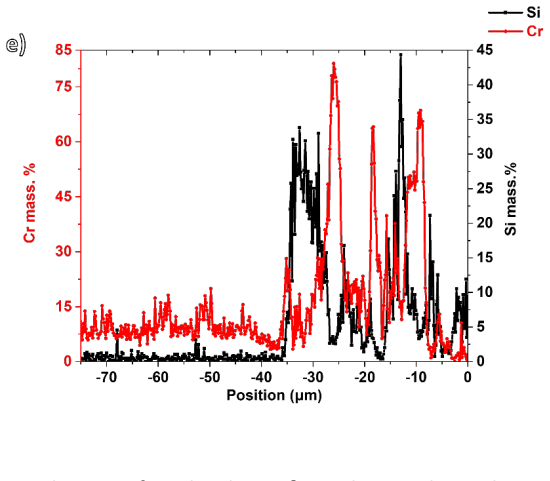
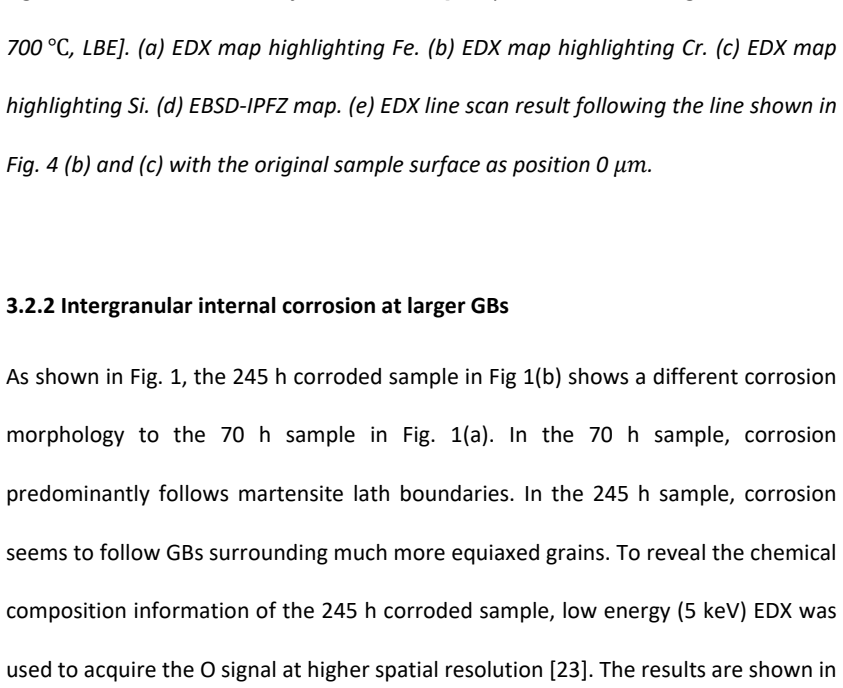
Understanding corrosion in liquid metal-cooled nuclear systems is essential in order be able to control it. While much literature exists detailing corrosion rates and mechanisms of structural materials in liquid metals, much still remains to be discovered in new regimes of temperature, chemistry, and impurity content. We focus on a less-studied set of conditions, specifically to investigate how liquid lead-bismuth eutectic (LBE) corrodes ferritic/martensitic steels under high-temperature oxidizing conditions. We find that the evolution of corrosion is determined by the formation of protection layer on the surface. The area without effective protection layer experiences oxidation along martensite grain boundaries, transitioning from intergranular attack to broader area corrosion as it progresses. The area a stable, coherent oxide scale will slow the corrosion process and then is oxidized along pre-austenite grain boundaries. Both chromium and oxygen diffusion play vital roles in this process. Most surprisingly, a layer of iron enriched body-centred cubic phase forms on the surface of LBE-corroded T91, contradicting previous studies, which reported only oxide-based surface layers.
Editorial analysis
A structured set of objections, weighed in public.
Referee Report
Summary. The paper examines the corrosion evolution of T91 ferritic/martensitic steel in static lead-bismuth eutectic (LBE) under high-temperature oxidizing conditions. Corrosion proceeds via intergranular attack that transitions to broader area corrosion, with Cr and O diffusion playing key roles. Localized Cr depletion induces martensite-to-ferrite decomposition that slows further attack. A stable coherent oxide scale is presented as the primary control on whether intergranular LBE penetration occurs. Most notably, an iron-enriched BCC surface layer is reported on LBE-exposed samples, contradicting prior studies that observed only oxide-based surface layers.
Significance. If the microstructural observations hold after addressing the noted concerns, the work supplies useful mechanistic detail on LBE corrosion of T91 under oxidizing regimes relevant to liquid-metal-cooled nuclear systems. The emphasis on oxide-scale protection and the reported BCC phase (if confirmed as environment-specific) could guide alloy design and operating limits. The study is grounded in consistent qualitative microstructural evidence, though its impact is tempered by the absence of quantitative metrics and controls.
major comments (3)
- [microstructural characterization and Discussion] The claim of an iron-enriched BCC surface phase that contradicts previous oxide-only reports (Abstract and Discussion) is load-bearing for the novelty argument. No controls are described (e.g., identically prepared and analyzed unexposed T91 at the same temperature and oxygen potential) to exclude polishing-induced transformation, surface relaxation, or technique-specific effects (EBSD indexing or XRD penetration depth). This directly affects whether the observation is intrinsic to the LBE environment.
- [Discussion] The central assertion that a stable, coherent oxide scale is the deciding factor controlling intergranular LBE attack (Abstract and Discussion) rests on qualitative interpretation of microstructures without supporting quantitative data such as oxide thickness distributions, coverage statistics, or statistical correlation between oxide presence and attack depth across multiple samples or time points.
- [Methods] The manuscript lacks full experimental details on temperature, oxygen potential, test durations, sample preparation, and characterization protocols (including error bars or replicate statistics). This absence makes it difficult to assess reproducibility and to evaluate whether the reported martensite decomposition and slowed corrosion are robust or limited by the specific test conditions.
minor comments (2)
- [Figures] Figure captions and labels should explicitly indicate the corrosion stage, magnification, and technique (e.g., SEM, EBSD, XRD) for each panel to improve clarity.
- [Abstract] The abstract would benefit from stating the specific temperature and oxygen concentration range to place the conditions in context with prior LBE studies.
Simulated Author's Rebuttal
We thank the referee for their thorough review and valuable comments. We address each major comment below and will revise the manuscript accordingly to improve clarity and completeness.
read point-by-point responses
-
Referee: [microstructural characterization and Discussion] The claim of an iron-enriched BCC surface phase that contradicts previous oxide-only reports (Abstract and Discussion) is load-bearing for the novelty argument. No controls are described (e.g., identically prepared and analyzed unexposed T91 at the same temperature and oxygen potential) to exclude polishing-induced transformation, surface relaxation, or technique-specific effects (EBSD indexing or XRD penetration depth). This directly affects whether the observation is intrinsic to the LBE environment.
Authors: We agree that additional controls would strengthen the claim regarding the iron-enriched BCC phase. In the revised version, we will include microstructural analysis of unexposed T91 samples subjected to the same preparation and characterization procedures to rule out artifacts from polishing or other effects. We will also provide more details on the EBSD indexing and XRD conditions to address concerns about technique-specific effects. revision: yes
-
Referee: [Discussion] The central assertion that a stable, coherent oxide scale is the deciding factor controlling intergranular LBE attack (Abstract and Discussion) rests on qualitative interpretation of microstructures without supporting quantitative data such as oxide thickness distributions, coverage statistics, or statistical correlation between oxide presence and attack depth across multiple samples or time points.
Authors: The referee is correct that our interpretation is primarily qualitative. While we observed consistent patterns across samples, we lack comprehensive quantitative statistics. In the revision, we will add available quantitative data on oxide thicknesses and attempt to provide coverage estimates from the existing micrographs. However, due to the nature of the study with limited replicates, full statistical correlation may not be feasible, and we will adjust the language to reflect the qualitative nature of the evidence. revision: partial
-
Referee: [Methods] The manuscript lacks full experimental details on temperature, oxygen potential, test durations, sample preparation, and characterization protocols (including error bars or replicate statistics). This absence makes it difficult to assess reproducibility and to evaluate whether the reported martensite decomposition and slowed corrosion are robust or limited by the specific test conditions.
Authors: We will revise the Methods section to include all requested experimental details, including precise values for temperature, oxygen potential, test durations, sample preparation protocols, and characterization methods. Where available, we will include error bars and information on replicates. revision: yes
Circularity Check
No circularity: purely observational experimental study
full rationale
The paper reports experimental observations of corrosion in T91 steel under LBE exposure using microscopy and surface analysis. No equations, models, fitted parameters, predictions, or derivations are present in the abstract or described content. Claims about oxide scales controlling intergranular attack, martensite decomposition, and the iron-enriched BCC surface phase are presented as direct empirical findings without any self-referential reduction to inputs. No self-citations form load-bearing chains, and no ansatzes or renamings of known results occur. The derivation chain is absent, making the study self-contained against external benchmarks.
Axiom & Free-Parameter Ledger
Lean theorems connected to this paper
-
IndisputableMonolith/Foundation/RealityFromDistinction.leanreality_from_one_distinction unclear?
unclearRelation between the paper passage and the cited Recognition theorem.
A stable, coherent oxide scale appears to be the deciding factor that controls whether intergranular LBE attack occurs or not. Most surprisingly, a layer of iron enriched body-centred cubic phase forms on the surface...
-
IndisputableMonolith/Foundation/AbsoluteFloorClosure.leanabsolute_floor_iff_bare_distinguishability unclear?
unclearRelation between the paper passage and the cited Recognition theorem.
Mechanistically speaking, the ingress of LBE induces regions of martensite decomposition to ferrite via localized chromium depletion
What do these tags mean?
- matches
- The paper's claim is directly supported by a theorem in the formal canon.
- supports
- The theorem supports part of the paper's argument, but the paper may add assumptions or extra steps.
- extends
- The paper goes beyond the formal theorem; the theorem is a base layer rather than the whole result.
- uses
- The paper appears to rely on the theorem as machinery.
- contradicts
- The paper's claim conflicts with a theorem or certificate in the canon.
- unclear
- Pith found a possible connection, but the passage is too broad, indirect, or ambiguous to say the theorem truly supports the claim.
discussion (0)
Sign in with ORCID, Apple, or X to comment. Anyone can read and Pith papers without signing in.