REVIEW 3 major objections 5 minor 9 references
Standard test-time guidance estimators for diffusion models are provably inconsistent, and the paper's CBG estimators converge to the true Bayesian posterior.
Reviewed by Pith at T0; open to challenge. T0 means a machine referee read the full paper against a public rubric. the ladder, T0–T4 →
CBG replaces biased point estimates of the diffused likelihood with consistent Monte Carlo score estimates, and corrects how guidance scales temper the likelihood.
T0 review reviewed 2026-08-02 challenge →
load-bearing objection The bias theorems are the real contribution; the black-hole experiment doesn't yet prove calibrated posterior sampling for pretrained priors. the 3 major comments →
Calibrated Test-Time Guidance for Bayesian Inference
The pith
A machine-rendered reading of the paper's core claim, the machinery that carries it, and where it could break.
The reading
Core claim
The paper proves that common test-time guidance methods — the posterior-mean approximation, Gaussian posterior approximation, and optimal-control formulations — are inconsistent estimators of the diffused likelihood p(y|x_t) = ∫ p(x|x_t)p(y|x)dx. Even with infinite compute, they do not converge to the true Bayesian posterior. It then introduces Calibrated Bayesian Guidance, with two consistent estimators: a reparameterization-based estimator for differentiable likelihoods and a gradient-free REINFORCE-style estimator that weights samples from p(x|x_t) by their likelihood. Both recover the correct diffused likelihood and hence the true posterior as the number of samples grows. The paper also
What carries the argument
The central object is the diffused likelihood p(y|x_t) = ∫ p(x|x_t)p(y|x)dx, which averages the reward or observation likelihood over the denoising posterior at noise level t. The paper replaces point or Gaussian approximations of this integral with Monte Carlo estimators built from exact samples x^(i) ~ p(x|x_t). Equation (16) uses the reparameterization trick to push gradients through those samples; Equation (20) uses the score identity and self-normalized importance weights w_i = p(y|x^(i)) to produce a gradient-free estimate of the guided score. Consistency follows from exchanging the order of integration and differentiation, which the biased approximations fail to do.
Load-bearing premise
The consistency proofs assume exact i.i.d. sampling from the denoising posterior p(x|x_t); for real pretrained diffusion priors this is only approximated — the black-hole experiment uses M=50 inner-loop steps and K=512 samples (Appendix G) — so the deployed system is not the proven-consistent estimator, and bias in those inner samples would weaken the calibration guarantee.
What would settle it
On a one-dimensional non-Gaussian prior, e.g. p(x)=U(-1,1), with likelihood p(y|x)=N(y; x^3, 0.1) and fixed y and t in (0,1), compute the exact diffused likelihood ∫ p(x|x_t)p(y|x)dx by numerical integration and compare it with the posterior-mean estimate p(y|E[x|x_t]). Theorem 4.1 predicts a positive-measure set of x_t where they differ; if they agree everywhere, the claim is wrong. For CBG, check that Eq. (20) with exact samples from p(x|x_t) has expectation converging to ∇ log p(y|x_t) as K grows, while the same quantity computed by exponentiating p(y|x_t) and rescaling the gradient stays b
If this is right
- No amount of additional compute can fix the bias in posterior-mean, Gaussian, or optimal-control guidance: they converge to a wrong distribution, not to the Bayesian posterior.
- CBG's gradient-free estimator needs no gradients through the likelihood or the diffusion sampler, so it can guide pretrained diffusion and flow priors toward non-differentiable objectives without retraining.
- With exact samples from p(x|x_t), CBG's posterior quality improves toward the oracle C2ST of 0.5 as the number of samples grows, while baselines plateau at a suboptimal distribution.
- Correct tempering requires raising the raw likelihood p(y|x)^γ inside the diffused-likelihood integral; simply rescaling the guidance gradient by γ samples a different distribution unless the likelihood is constant.
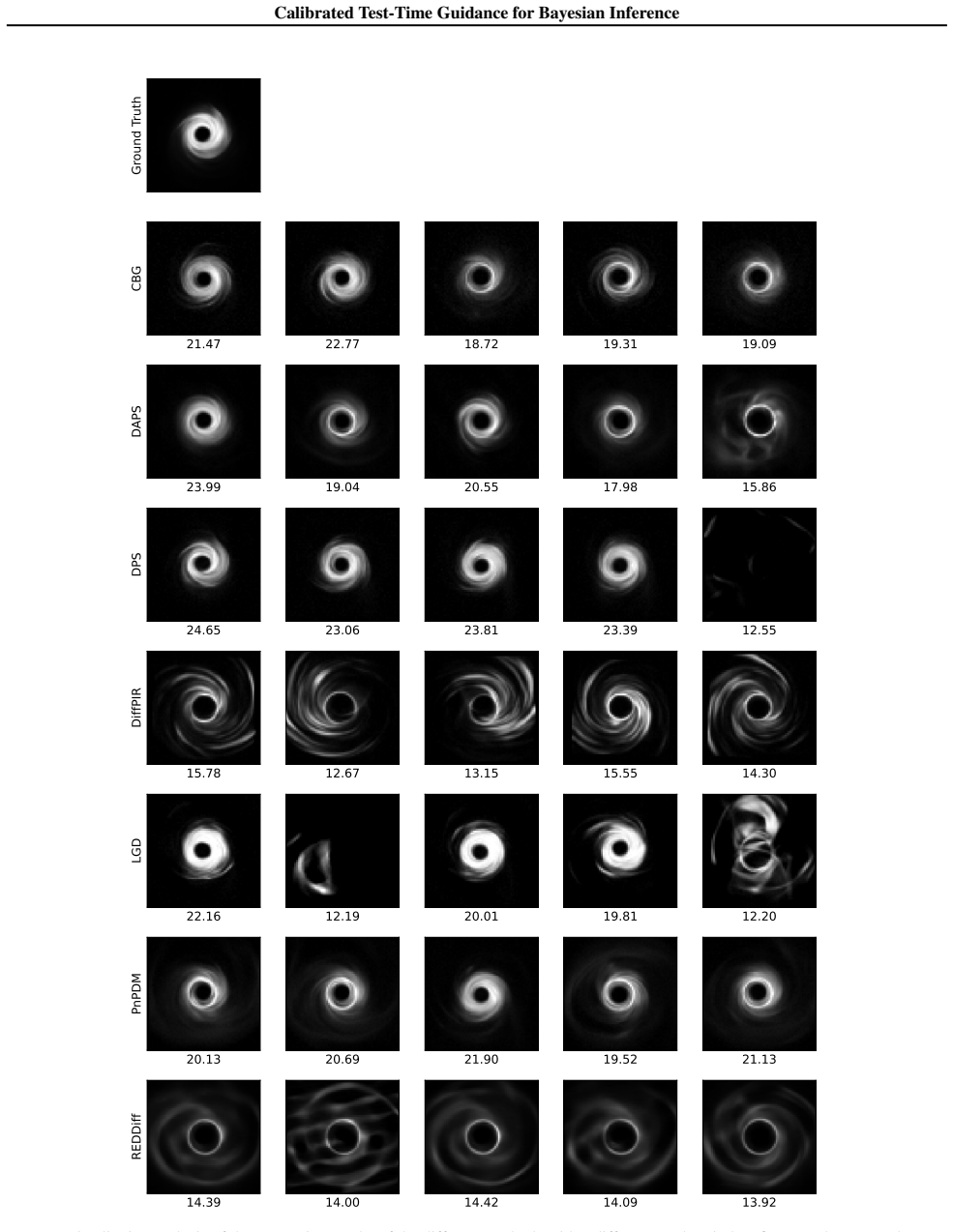
- The gradient-free CBG matches the best reported PSNR on black-hole imaging, showing that the framework can scale to high-dimensional scientific inverse problems.
Where Pith is reading between the lines
- The consistency guarantee is conditional on exact i.i.d. samples from p(x|x_t); the black-hole experiment approximates this with an inner denoising loop of M=50 steps and K=512 samples, so the deployed system is an approximation of the estimator analyzed in Section 5.
- A cheap exact sampler for p(x|x_t) — for instance, a few-step or one-step diffusion model — would turn CBG from an O(N·M) nested loop into a practical plug-in for any pretrained prior.
- The lower variance of the gradient-free estimator under sharp likelihoods suggests guidance can be reframed as weighted resampling of candidate denoised samples, linking CBG to particle-filter and sequential-Monte-Carlo treatments of diffusion posteriors.
- The tempering theorem implies that a classifier-guidance model trained for one temperature cannot be correctly tempered at test time by gradient rescaling; a tempered conditional model is needed, which may explain the sensitivity of classifier guidance to guidance-scale values.
Editorial analysis
A structured set of objections, weighed in public.
Referee Report
Summary. The paper studies test-time guidance for diffusion models as a Bayesian inference procedure. It argues that existing guidance methods—posterior-mean approximation (DPS), Gaussian posterior approximation (ΠGDM), and optimal-control formulations (NDTM)—use inconsistent estimators of the diffused likelihood p(y|x_t), so they converge to the wrong posterior even with unlimited compute. It then proposes Calibrated Bayesian Guidance (CBG), a Monte Carlo estimator that directly approximates the integral defining p(y|x_t), with a gradient-based variant (Eq. 16) and a gradient-free REINFORCE-style variant (Eq. 20). The authors prove inconsistency theorems for the existing estimators, prove that exponentiated likelihood tempering is wrong, and report experiments on a Bayesian-inference benchmark with analytic priors plus a black-hole imaging task with a pretrained diffusion prior. The central theoretical claim is conditional on exact sampling from the denoising posterior p(x|x_t), which is available in closed form for the analytic benchmarks but only approximated by an inner diffusion loop in the black-hole experiment.
Significance. If fully established, the paper would make an important conceptual point: much of test-time guidance optimizes reward rather than sampling the Bayesian posterior, and the two goals are not interchangeable. The analytic benchmark provides concrete evidence that CBG improves distributional fit with more compute, and the negative results for existing estimators (Theorems 4.2 and 4.3, and the tempering analysis in Section 4.2) are valuable for the scientific-imaging community. The main strength is that the proposed estimators are simple, principled Monte Carlo approximations of the exact diffused-likelihood integral. However, the paper's strongest practical claim—that CBG samples the calibrated posterior for pretrained diffusion priors—is not supported by the black-hole experiment as implemented, because that experiment uses an approximate inner sampler and a heavily tempered likelihood. The theoretical contribution is solid under an oracle assumption; the practical reach is broader than the evidence.
major comments (3)
- [§5.1/§5.2, §6.2, Appendix G] The consistency of Eqs. (16) and (20) requires x^(i) to be exact i.i.d. draws from the denoising posterior p(x|x_t). In the black-hole experiment, Appendix G replaces this oracle with an inner diffusion loop using M=50 steps and K=512 samples, and the experiment uses γ=0.003. A 50-step reverse run from x_t with a learned score is not an exact draw from p(x|x_t); it carries discretization and score-model error with no quantitative bound. Consequently, the implemented black-hole estimator is not the consistent estimator analyzed in Section 5, and the consistency guarantee need not vanish as K grows. Moreover, γ=0.003 means the method samples a heavily tempered posterior, not p(x|y). PSNR alone (Table 2) does not validate posterior calibration. The paper should either provide a calibration metric (C2ST, coverage, or posterior contraction) on this task, correct the tempering, or explicitly r
- [§A.1, Theorem 4.1] The proof of Theorem 4.1 is not rigorous as written. Equation (24) asserts that Lipschitz continuity of p(x) implies p(x|x_t) is approximately Gaussian for small t, but a Lipschitz density can be multimodal (e.g., a mixture of two distant Gaussians is Lipschitz), so the Gaussian approximation is an additional unproven assumption. The O(σ_t^3) remainder in Eq. (25) is uncontrolled, and the subsequent step from equality of p(y|x_t) and p(y|mean) to vanishing Hessian requires uniform bounds on the likelihood and its derivatives that are not stated. This means the claimed general inconsistency of the posterior-mean estimator is not established by the provided argument. The theorem should either be proved under a precise small-noise/large-curvature asymptotic with explicit error terms, or downgraded to a heuristic/empirical statement.
- [§5, Algorithm 1] The paper states that CBG 'yields a consistent sampling procedure' and 'converges to the true Bayesian posterior.' The analysis, however, shows consistency only for the per-step score estimator at a fixed x_t, not for the composition of K-sample estimates across the reverse-time discretization in Algorithm 1. Sums of unbiased estimators do not automatically yield an unbiased or consistent estimator of the final posterior distribution after a nonlinear Euler update and repeated re-estimation. The experiments in Figure 3 provide empirical evidence on analytic benchmarks, but the formal claim as worded in Section 5.1 ('as K→∞, any bias vanishes') is stronger than what is proven. Please state the end-to-end consistency as a conjecture or provide a proof for the coupled process.
minor comments (5)
- [Abstract vs. §7, Table 2] The abstract says 'set a new state-of-the-art PSNR,' but Section 7 says 'match state-of-the-art PSNR,' and Table 2 shows CBG at 26.10 vs. PnP-DM at 26.07, with overlapping standard deviations. Please use a consistent and appropriately hedged phrasing.
- [Affiliations] The affiliation line contains a typo: 'Ivine, CA' should be 'Irvine, CA.'
- [§5.3, Eq. (21)] The notation E[x|y] in Eq. (21) is ambiguous: it denotes the self-normalized importance-weighted estimate of the posterior mean, not the exact conditional expectation. Please clarify, e.g., by writing E_hat[x|y].
- [Figure 2 caption] The caption says 'true diffusion posterior p(x_t|x)', which is the forward noising distribution. The integral in Eq. (6) uses p(x|x_t), the denoising posterior. Please correct the notation.
- [Appendix G] The hyperparameters M=50, K=512, γ=0.003 are selected on validation, but the text does not report how sensitive the results are to γ, nor whether the validation criterion was PSNR or a calibration measure. Since the central claim is about calibration, this choice deserves more discussion.
Circularity Check
No significant circularity: CBG is a direct Monte Carlo evaluation of the diffused-likelihood integral, benchmarked against external reference posteriors.
full rationale
The central derivation is self-contained. Equations (16) and (20) are Monte Carlo/REINFORCE estimators of the exact diffused-likelihood score, and their consistency follows directly from the defining integral in Equation (6) plus exact i.i.d. samples from the denoising posterior p(x|x_t). The paper does not fit a parameter and then ‘predict’ the same quantity; the estimators are not equivalent to their inputs by construction. The negative results on existing methods (Theorems 4.1–4.3) are proven in the appendix using standard calculus and Jensen-type arguments, not by appeal to self-citations. Self-citations to NDTM, C-ΠGDM, variational tempering, and related work are background or baselines, not load-bearing for the main claim. The benchmark uses closed-form p(x|x_t) from known priors and external reference posterior samples, so it is a genuine external test. The black-hole experiment approximates p(x|x_t) with an inner denoising loop of M=50 steps and K=512 samples and tunes γ=0.003 on validation; this is an acknowledged limitation and a correctness/scope caveat, not a circular reduction, because the paper explicitly conditions its consistency guarantee on exact sampling and does not claim the approximate inner loop is exact. No equation reduces to an identity with a fitted constant, and no load-bearing result is imported from an unverified self-citation.
Axiom & Free-Parameter Ledger
free parameters (4)
- K (number of CBG samples) =
512 (black hole), 1000 (benchmark)
- M (inner-loop diffusion steps) =
50 (black hole)
- gamma (guidance scale for black-hole imaging) =
0.003
- N (total denoising steps) =
1000 (black hole), 100 (benchmark)
axioms (6)
- domain assumption Exact i.i.d. samples from p(x|x_t) are available.
- domain assumption The prior p(x) is Lipschitz and the likelihood p(y|x) is twice differentiable.
- domain assumption A reparameterizable sampler g_t(x_t; epsilon) differentiable in x_t exists.
- standard math Standard diffusion forward process p(x_t|x) = N(a_t x, b_t^2 I).
- domain assumption p(y|x) is nonnegative for all x in R^d, so an affine nonconstant likelihood is impossible.
- standard math Self-normalized importance-sampling convergence (finite first moments, weight tails) holds.
Cite this review
Pith. "Pith review of Calibrated Test-Time Guidance for Bayesian Inference." pith.science (2026). https://pith.science/paper/6GTDGQ4E
@misc{pith2026260222428,
  author       = {Pith},
  title        = {Pith review of: Calibrated Test-Time Guidance for Bayesian Inference},
  year         = {2026},
  howpublished = {\url{https://pith.science/paper/6GTDGQ4E}},
  note         = {Machine review of arXiv:2602.22428}
}
read the original abstract
Test-time guidance is a widely used mechanism for steering pretrained diffusion models toward outcomes specified by a reward function. Existing approaches, however, focus on maximizing reward rather than sampling from the true Bayesian posterior, leading to miscalibrated inference. In this work, we show that common test-time guidance methods do not recover the correct posterior distribution and identify the structural approximations responsible for this failure. We then propose consistent alternative estimators that enable calibrated sampling from the Bayesian posterior. We significantly outperform previous methods on a set of Bayesian inference tasks, and set a new state-of-the-art PSNR in black hole image reconstruction.
Figures


Reference graph
Works this paper leans on
-
[5]
Jazbec, M., Wong-Toi, E., Xia, G., Zhang, D., Nalisnick, E., and Mandt, S
URL https://openreview.net/forum? id=BOrut7M2X7. Jazbec, M., Wong-Toi, E., Xia, G., Zhang, D., Nalisnick, E., and Mandt, S. Generative uncertainty in diffusion models. In Chiappa, S. and Magliacane, S. (eds.),Pro- ceedings of the Forty-first Conference on Uncertainty in Artificial Intelligence, volume 286 ofProceedings of Machine Learning Research, pp. 18...
Pith/arXiv arXiv 2025
-
[8]
Wuttke, R., Hofmann, H., Nettels, D., Borgia, M
URL https://openreview.net/forum? id=Xq9HQf7VNV. Wuttke, R., Hofmann, H., Nettels, D., Borgia, M. B., Mittal, J., Best, R. B., and Schuler, B. Temperature-dependent solvation modulates the dimensions of disordered pro- teins.Proceedings of the National Academy of Sciences, 111(14):5213–5218, 2014. Yang, R., Srivastava, P., and Mandt, S. Diffusion probabil...
2014
-
[9]
Yu, J., Wang, Y ., Zhao, C., Ghanem, B., and Zhang, J
URL https://openreview.net/forum? id=N8YbGX98vc. Yu, J., Wang, Y ., Zhao, C., Ghanem, B., and Zhang, J. Free- dom: Training-free energy-guided conditional diffusion model. InProceedings of the IEEE/CVF International Conference on Computer Vision, pp. 23174–23184, 2023. Zhang, B., Chu, W., Berner, J., Meng, C., Anandkumar, A., and Song, Y . Improving diffu...
Pith/arXiv arXiv 2023
-
[2016]
cc/paper_files/paper/2016/file/ f718499c1c8cef6730f9fd03c8125cab-Paper
URL https://proceedings.neurips. cc/paper_files/paper/2016/file/ f718499c1c8cef6730f9fd03c8125cab-Paper. pdf. Sohl-Dickstein, J., Weiss, E., Maheswaranathan, N., and Ganguli, S. Deep unsupervised learning using nonequi- librium thermodynamics. InInternational conference on machine learning, pp. 2256–2265. pmlr, 2015. Song, J., Vahdat, A., Mardani, M., and...
2016
-
[2021]
Song, Y ., Dhariwal, P., Chen, M., and Sutskever, I
URL https://openreview.net/forum? id=PxTIG12RRHS. Song, Y ., Dhariwal, P., Chen, M., and Sutskever, I. Con- sistency models. In Krause, A., Brunskill, E., Cho, K., Engelhardt, B., Sabato, S., and Scarlett, J. (eds.), Proceedings of the 40th International Conference on Machine Learning, volume 202 ofProceedings of Ma- chine Learning Research, pp. 32211–322...
Pith/arXiv arXiv 2023
-
[2023]
Arfken, G
URL https://openreview.net/forum? id=li7qeBbCR1t. Arfken, G. B., Weber, H. J., and Harris, F. E.Mathematical methods for physicists: a comprehensive guide. Aca- demic press, 2011. Bansal, A., Chu, H.-M., Schwarzschild, A., Sengupta, R., Goldblum, M., Geiping, J., and Goldstein, T. Uni- versal guidance for diffusion models. InThe Twelfth International Conf...
2011
-
[2024]
URL https://openreview.net/forum? id=pzpWBbnwiJ. Beaumont, M. A., Cornuet, J.-M., Marin, J.-M., and Robert, C. P. Adaptive approximate bayesian com- putation.Biometrika, 96(4):983–990, 2009. ISSN 00063444, 14643510. URL http://www.jstor. org/stable/27798882. Black, K., Janner, M., Du, Y ., Kostrikov, I., and Levine, S. Training diffusion models with reinf...
arXiv 2009
-
[2025]
9 Calibrated Test-Time Guidance for Bayesian Inference Friedman, J
URL https://openreview.net/forum? id=OlzB6LnXcS. 9 Calibrated Test-Time Guidance for Bayesian Inference Friedman, J. On multivariate goodness–of–fit and two–sample testing.Conference on Statistical Problems in Particle Physics, Astrophysics and Cosmology, 2004. Friel, N. and Pettitt, A. N. Marginal likelihood estimation via power posteriors.Journal of the...
2004
-
[8887]
Huang, Y ., Ghatare, A., Liu, Y ., Hu, Z., Zhang, Q., Chandra, S., Gururani, S., Oore, S., and Yue, Y
PMLR, 2022. Huang, Y ., Ghatare, A., Liu, Y ., Hu, Z., Zhang, Q., Chandra, S., Gururani, S., Oore, S., and Yue, Y . Symbolic music generation with non-differentiable rule guided diffusion. InProceedings of the 41st International Conference on Machine Learning, volume 235, 2024. Janati, Y ., MOUFAD, B., Durmus, A. O., Moulines, E., and Olsson, J. Divide-an...
2022
This paper was first reviewed by deepseek-v4-flash on August 2, 2026.
discussion (0)
Sign in with ORCID, Apple, or X to comment. Anyone can read and Pith papers without signing in.