Coupling of phase transition, anharmonicity, and thermal transport in CaSnF₆
Pith reviewed 2026-05-15 01:07 UTC · model grok-4.3
The pith
In CaSnF6, lattice thermal conductivity exhibits a non-monotonic anomaly near the structural phase transition instead of the usual 1/T decline.
A machine-rendered reading of the paper's core claim, the machinery that carries it, and where it could break.
Core claim
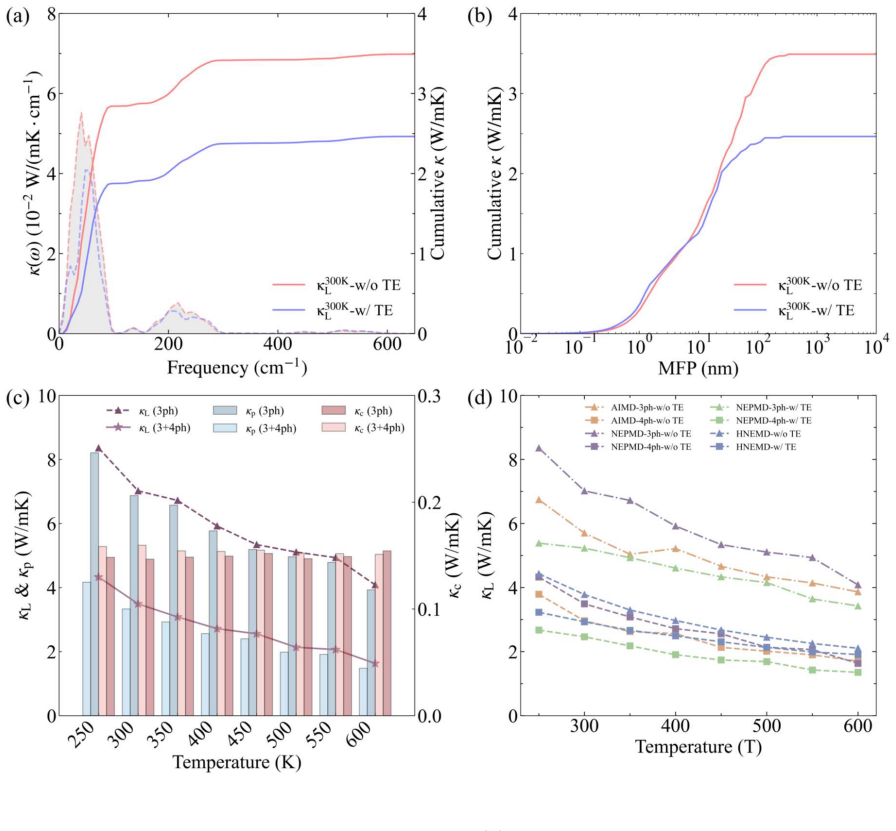
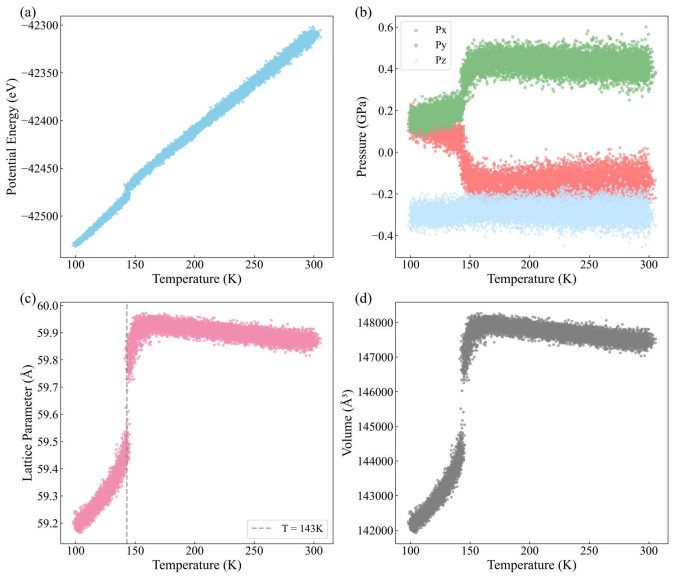
Non-equilibrium molecular dynamics simulations using a machine-learned neuroevolution potential demonstrate that lattice thermal conductivity in CaSnF6 displays a pronounced non-monotonic anomaly near the first-order structural phase transition, deviating from the conventional ~1/T^α dependence. This anomaly provides direct transport evidence of lattice reconstruction and is tied to strong anharmonicity dominated by four-phonon scattering processes. The negative thermal expansion is traced to low-energy rigid unit modes involving cooperative rotations of [CaF6]4- octahedra that induce bond-angle bending and volume contraction.
What carries the argument
The neuroevolution potential trained on first-principles data, which enables large-scale molecular dynamics simulations that capture the first-order phase transition, rigid unit modes, and four-phonon scattering rates.
Load-bearing premise
The machine-learned neuroevolution potential accurately reproduces the first-order structural phase transition, rigid unit modes, and four-phonon scattering rates without introducing fitting artifacts that distort the transport anomaly.
What would settle it
Experimental measurement of lattice thermal conductivity versus temperature in CaSnF6 that either confirms or rules out a non-monotonic deviation from the 1/T trend exactly at the known phase transition temperature.
Figures




read the original abstract
Understanding the coupling between structural phase transitions and thermal transport is essential for designing functional materials with tunable properties. Here, we investigate this interplay in CaSnF$_6$ by combining first-principles calculations with a machine-learned neuroevolution potential that enables large-scale molecular dynamics simulations across a wide temperature range. The simulations accurately capture the first-order structural phase transition and associated lattice dynamics. We show that the negative thermal expansion originates from low-energy rigid unit modes involving cooperative rotations of corner-sharing [CaF$_6$]$^{4-}$ octahedra, which induce bond-angle bending and volume contraction. At the same time, strong anharmonicity, dominated by four-phonon scattering, plays a central role in suppressing lattice thermal conductivity ($\kappa_L$). Crucially, non-equilibrium simulations reveal a pronounced non-monotonic anomaly in $\kappa_L$ near the phase transition, deviating from the conventional $\sim 1/T^{\alpha}$ behavior and providing direct transport evidence of lattice reconstruction. These results establish a unified mechanism linking lattice geometry, anharmonic vibrational dynamics, and thermal transport, and highlight the potential of machine-learned potentials for bridging atomic-scale phase transitions with macroscopic transport properties.
Editorial analysis
A structured set of objections, weighed in public.
Referee Report
Summary. The paper claims to elucidate the coupling between the first-order structural phase transition, anharmonic lattice dynamics, and thermal transport in CaSnF6. Using first-principles calculations to train a neuroevolution potential, large-scale molecular dynamics simulations are performed to show that negative thermal expansion stems from rigid-unit modes of [CaF6] octahedra, that four-phonon scattering dominates anharmonicity and suppresses lattice thermal conductivity, and that non-equilibrium MD reveals a pronounced non-monotonic anomaly in κ_L near the transition temperature, deviating from the usual 1/T^α dependence and serving as direct evidence of lattice reconstruction.
Significance. If the results hold, the work is significant for demonstrating how machine-learned potentials can bridge atomic-scale phase transitions with macroscopic thermal transport properties, providing a unified mechanism for lattice geometry, vibrations, and conductivity in materials with tunable properties. It offers potential for designing functional materials and highlights the role of strong anharmonicity in suppressing heat transport.
major comments (1)
- [Abstract and Results] The headline claim of a non-monotonic anomaly in κ_L near the phase transition (deviating from ∼1/T^α) is obtained exclusively from non-equilibrium MD with the neuroevolution potential. No quantitative benchmarks are presented comparing the potential's four-phonon scattering rates, phonon lifetimes, or computed κ_L values against direct first-principles methods (such as DFPT or frozen-phonon calculations) at temperatures around the transition. This validation is essential to rule out fitting artifacts in the higher-order force constants that could artificially produce the observed anomaly.
minor comments (1)
- The abstract states that 'strong anharmonicity, dominated by four-phonon scattering' suppresses κ_L but provides no details on how the relative contributions of three-phonon versus four-phonon processes are quantified or extracted from the simulations.
Simulated Author's Rebuttal
We thank the referee for the positive evaluation of our work's significance and for the constructive major comment. We address the point below and will incorporate revisions to strengthen the validation of the neuroevolution potential.
read point-by-point responses
-
Referee: [Abstract and Results] The headline claim of a non-monotonic anomaly in κ_L near the phase transition (deviating from ∼1/T^α) is obtained exclusively from non-equilibrium MD with the neuroevolution potential. No quantitative benchmarks are presented comparing the potential's four-phonon scattering rates, phonon lifetimes, or computed κ_L values against direct first-principles methods (such as DFPT or frozen-phonon calculations) at temperatures around the transition. This validation is essential to rule out fitting artifacts in the higher-order force constants that could artificially produce the observed anomaly.
Authors: We agree that direct quantitative benchmarks against first-principles methods are important to confirm the reliability of the neuroevolution potential for anharmonic properties near the transition. In the revised manuscript, we will add comparisons of four-phonon scattering rates and phonon lifetimes extracted from the potential against DFPT-based calculations at representative temperatures below and approaching the transition. For κ_L, we will include available first-principles benchmarks at lower temperatures and note the computational limitations that preclude full four-phonon DFPT at high temperatures around the transition; these additions will demonstrate that the non-monotonic anomaly arises from the underlying lattice dynamics rather than potential artifacts. revision: yes
Circularity Check
No significant circularity in derivation chain
full rationale
The paper trains a neuroevolution potential on first-principles data and deploys it for large-scale MD to compute temperature-dependent lattice dynamics and non-equilibrium thermal transport. The non-monotonic κ_L anomaly is generated by the MD trajectories, which operate at scales inaccessible to direct first-principles methods; this constitutes an independent prediction rather than a re-expression of the training inputs. No equation or claim reduces by construction to a fitted parameter or self-citation, and the workflow follows standard practice of using ab initio data as external benchmark for the potential.
Axiom & Free-Parameter Ledger
free parameters (1)
- neuroevolution potential parameters
axioms (1)
- domain assumption The neuroevolution potential accurately reproduces the first-order phase transition and anharmonic phonon scattering
Lean theorems connected to this paper
-
IndisputableMonolith/Cost/FunctionalEquation.leanwashburn_uniqueness_aczel unclear?
unclearRelation between the paper passage and the cited Recognition theorem.
strong anharmonicity, dominated by four-phonon scattering, plays a central role in suppressing lattice thermal conductivity
What do these tags mean?
- matches
- The paper's claim is directly supported by a theorem in the formal canon.
- supports
- The theorem supports part of the paper's argument, but the paper may add assumptions or extra steps.
- extends
- The paper goes beyond the formal theorem; the theorem is a base layer rather than the whole result.
- uses
- The paper appears to rely on the theorem as machinery.
- contradicts
- The paper's claim conflicts with a theorem or certificate in the canon.
- unclear
- Pith found a possible connection, but the passage is too broad, indirect, or ambiguous to say the theorem truly supports the claim.
Reference graph
Works this paper leans on
-
[1]
Phonon-engineered extreme thermal conductivity materials
Xin Qian, Jiawei Zhou, and Gang Chen. Phonon-engineered extreme thermal conductivity materials. Nat. Mater. , 20(9):1188–1202, 2021
work page 2021
-
[2]
High-performance thermoelectrics and challenges for practical devices
Qingyu Yan and Mercouri G Kanatzidis. High-performance thermoelectrics and challenges for practical devices. Nat. Mater. , 21(5):503–513, 2022
work page 2022
-
[3]
Ab initio green-kubo ap- proach for the thermal conductivity of solids
Christian Carbogno, Rampi Ramprasad, and Matthias Sche ffler. Ab initio green-kubo ap- proach for the thermal conductivity of solids. Phys. Rev. Lett. , 118(17):175901, 2017
work page 2017
-
[4]
First-principles green-kub o method for thermal conductivity calculations
Jun Kang and Lin-Wang Wang. First-principles green-kub o method for thermal conductivity calculations. Phys. Rev. B , 96(2):020302, 2017
work page 2017
-
[5]
Generalized neura l-network representation of high- dimensional potential-energy surfaces
J¨ org Behler and Michele Parrinello. Generalized neura l-network representation of high- dimensional potential-energy surfaces. Phys. Rev. Lett. , 98(14):146401, 2007
work page 2007
-
[6]
Gaussian approximation potentials: The accuracy of quantum mechanics, without the electrons
Albert P Bart´ ok, Mike C Payne, Risi Kondor, and G´ abor Cs ´ anyi. Gaussian approximation potentials: The accuracy of quantum mechanics, without the electrons. Phys. Rev. Lett. , 104(13):136403, 2010
work page 2010
-
[7]
Miguel A Caro. Optimizing many-body atomic descriptors for enhanced computational per- formance of machine learning based interatomic potentials . Phys. Rev. B , 100(2):024112, 2019. 18
work page 2019
-
[8]
Simple machine-learned inter- atomic potentials for complex alloys
Jesper Byggm¨ astar, Kai Nordlund, and Flyura Djurabeko va. Simple machine-learned inter- atomic potentials for complex alloys. Phys. Rev. Mater. , 6(8):083801, 2022
work page 2022
-
[9]
Aidan P Thompson, Laura P Swiler, Christian R Trott, Step hen M Foiles, and Garritt J Tucker. Spectral neighbor analysis method for automated ge neration of quantum-accurate interatomic potentials. J. Comput. Phys. , 285:316–330, 2015
work page 2015
-
[10]
The mlip package: moment tensor potentials with mpi and active l earning
Ivan S Novikov, Konstantin Gubaev, Evgeny V Podryabink in, and Alexander V Shapeev. The mlip package: moment tensor potentials with mpi and active l earning. Mach. Learn.: Sci. Technol., 2(2):025002, 2020
work page 2020
-
[11]
Han Wang, Linfeng Zhang, Jiequn Han, et al. Deepmd-kit: A deep learning package for many- body potential energy representation and molecular dynami cs. Comput. Phys. Commun. , 228:178–184, 2018
work page 2018
-
[12]
Atomic cluster expansion for accurate and transferable interatomic potentials
Ralf Drautz. Atomic cluster expansion for accurate and transferable interatomic potentials. Phys. Rev. B , 99(1):014104, 2019
work page 2019
-
[13]
Zheyong Fan, Zezhu Zeng, Cunzhi Zhang, Yanzhou Wang, Ke ke Song, Haikuan Dong, Yue Chen, and Tapio Ala-Nissila. Neuroevolution machine learn ing potentials: Combining high accuracy and low cost in atomistic simulations and applicat ion to heat transport. Phys. Rev. B, 104(10):104309, 2021
work page 2021
-
[14]
Improving the accuracy of the neuroevolut ion machine learning potential for multi-component systems
Zheyong Fan. Improving the accuracy of the neuroevolut ion machine learning potential for multi-component systems. J. Phys.: Condens. Matter , 34(12):125902, 2022
work page 2022
-
[15]
Zheyong Fan, Yanzhou Wang, Penghua Ying, Keke Song, Jun jie Wang, Yong Wang, Zezhu Zeng, Ke Xu, Eric Lindgren, J Magnus Rahm, et al. Gpumd: A pack age for constructing accurate machine-learned potentials and performing highl y efficient atomistic simulations. J. Chem. Phys. , 157(11), 2022
work page 2022
-
[16]
Negative thermal expansion: Mechanisms and materials
Erjun Liang, Qiang Sun, Huanli Yuan, Jiaqi Wang, Gaojie Zeng, and Qilong Gao. Negative thermal expansion: Mechanisms and materials. Front. Phys., 16(5):53302, 2021
work page 2021
-
[17]
Valerio Oddone, Benji Boerner, and Stephanie Reich. Co mposites of aluminum alloy and magnesium alloy with graphite showing low thermal expansio n and high specific thermal conductivity. Sci. Technol. Adv. Mater. , 18(1):180–186, 2017
work page 2017
-
[18]
Zhunyun Tang, Xiaoxia Wang, Jin Li, Chaoyu He, Chao Tang , Huimin Wang, Mingxing Chen, and Tao Ouyang. Anomalous and non-monotonic strain depende nt thermal conductivity of typical negative thermal expansion material scf3. Appl. Phys. Lett. , 122(17), 2023. 19
work page 2023
-
[19]
Zhunyun Tang, Xiaoxia Wang, Chaoyu He, Jin Li, Mingxing Chen, Chao Tang, and Tao Ouyang. Effects of thermal expansion and four-phonon interac tions on the lattice thermal conductivity of the negative thermal expansion material sc f 3. Phys. Rev. B , 110(13):134320, 2024
work page 2024
-
[20]
Ultralow th ermal conductivity and negative thermal expansion of cuscn
Yupeng Shen, Fancy Qian Wang, and Qian Wang. Ultralow th ermal conductivity and negative thermal expansion of cuscn. Nano Energy , 73:104822, 2020
work page 2020
-
[21]
Piezoresistivity as a fingerprint of ferroaxial transitions
Ezra Day-Roberts, Rafael M Fernandes, and Turan Birol. Piezoresistivity as a fingerprint of ferroaxial transitions. Phys. Rev. Lett. , 134(1):016401, 2025
work page 2025
-
[22]
A new isotropic negative thermal e xpansion material of casnf6 with facile and low-cost synthesis
Qilong Gao, Sen Zhang, Yixin Jiao, Yongqiang Qiao, Andr ea Sanson, Qiang Sun, Xinwei Shi, Erjun Liang, and Jun Chen. A new isotropic negative thermal e xpansion material of casnf6 with facile and low-cost synthesis. Nano Res. , 16(4):5964–5972, 2023
work page 2023
-
[23]
Statistical mechanics of nonequilbrium liquids
Denis J Evans and Gary P Morriss. Statistical mechanics of nonequilbrium liquids . ANU Press, 2007
work page 2007
-
[24]
Zheyong Fan, Haikuan Dong, Ari Harju, and Tapio Ala-Nis sila. Homogeneous nonequilibrium molecular dynamics method for heat transport and spectral d ecomposition with many-body potentials. Phys. Rev. B , 99(6):064308, 2019
work page 2019
-
[25]
Density functional theory (d ft)
P Hohenberg and WJPR Kohn. Density functional theory (d ft). Phys. Rev., 136(1964):B864, 1964
work page 1964
-
[26]
Self-consistent equations including exchange and correlation effects
Walter Kohn and Lu Jeu Sham. Self-consistent equations including exchange and correlation effects. Phys. Rev. , 140(4A):A1133, 1965
work page 1965
-
[27]
Ab initio molecular dy namics for liquid metals
Georg Kresse and J¨ urgen Hafner. Ab initio molecular dy namics for liquid metals. Phys. Rev. B, 47(1):558, 1993
work page 1993
-
[28]
Georg Kresse and J¨ urgen Hafner. Ab initio molecular-d ynamics simulation of the liquid- metal–amorphous-semiconductor transition in germanium. Phys. Rev. B , 49(20):14251, 1994
work page 1994
-
[29]
Georg Kresse and J¨ urgen Furthm¨ uller. Efficiency of ab- initio total energy calculations for metals and semiconductors using a plane-wave basis set. Comput. Mater. Sci. , 6(1):15–50, 1996
work page 1996
-
[30]
Efficient iterat ive schemes for ab initio total-energy calculations using a plane-wave basis set
Georg Kresse and J¨ urgen Furthm¨ uller. Efficient iterat ive schemes for ab initio total-energy calculations using a plane-wave basis set. Phys. Rev. B , 54(16):11169, 1996
work page 1996
-
[31]
From ultrasoft pseudo potentials to the projector augmented-wave method
Georg Kresse and Daniel Joubert. From ultrasoft pseudo potentials to the projector augmented-wave method. Phys. Rev. B , 59(3):1758, 1999. 20
work page 1999
-
[32]
Ge neralized gradient approximation made simple
John P Perdew, Kieron Burke, and Matthias Ernzerhof. Ge neralized gradient approximation made simple. Phys. Rev. Lett. , 77(18):3865, 1996
work page 1996
-
[33]
Tdep: Temperature dependent effective potentials
Florian Knoop, Nina Shulumba, Alo ¨ ıs Castellano, Jos´ e Pedro Alvarinhas Batista, Roberta Farris, Matthieu J Verstraete, Matthew Heine, David Broido , Dennis S Kim, Johan Klarbring, et al. Tdep: Temperature dependent effective potentials. J. Open Source Softw. , 9(94), 2024
work page 2024
-
[34]
Temperature depen- dent effective potential method for accurate free energy calc ulations of solids
Olle Hellman, Peter Steneteg, Igor A Abrikosov, and Ser gei I Simak. Temperature depen- dent effective potential method for accurate free energy calc ulations of solids. Phys. Rev. B , 87(10):104111, 2013
work page 2013
-
[35]
Temperature-depend ent effective third-order interatomic force constants from first principles
Olle Hellman and Igor A Abrikosov. Temperature-depend ent effective third-order interatomic force constants from first principles. Phys. Rev. B , 88(14):144301, 2013
work page 2013
-
[36]
T hermal conductivity in pbte from first principles
AH Romero, EKU Gross, MJ Verstraete, and Olle Hellman. T hermal conductivity in pbte from first principles. Phys. Rev. B , 91(21):214310, 2015
work page 2015
-
[37]
Thermal conductivity of bulk and nanowire mg 2 si x sn 1- x alloys from fi rst principles
Wu Li, Lucas Lindsay, David A Broido, Derek A Stewart, an d Natalio Mingo. Thermal conductivity of bulk and nanowire mg 2 si x sn 1- x alloys from fi rst principles. Phys. Rev. B , 86(17):174307, 2012
work page 2012
-
[38]
Shengbte: A solver of the boltz- mann transport equation for phonons
Wu Li, Jes´ us Carrete, Nebil A Katcho, and Natalio Mingo . Shengbte: A solver of the boltz- mann transport equation for phonons. Comput. Phys. Commun. , 185(6):1747–1758, 2014
work page 2014
-
[39]
Zherui Han, Xiaolong Yang, Wu Li, Tianli Feng, and Xiuli n Ruan. Fourphonon: An extension module to shengbte for computing four-phonon scattering ra tes and thermal conductivity. Comput. Phys. Commun. , 270:108179, 2022
work page 2022
-
[40]
Chen W. Li, Xiaoli Tang, J. A. Mu˜ noz, J. B. Keith, S. J. Tr acy, D. L. Abernathy, and B. Fultz. Structural relationship between negative thermal expansi on and quartic anharmonicity of cubic (scf 3). Phys. Rev. Lett. , 107:195504, Nov 2011
work page 2011
-
[41]
Ioffe-regel criter ion and diffusion of vibrations in random lattices
YM Beltukov, VI Kozub, and DA Parshin. Ioffe-regel criter ion and diffusion of vibrations in random lattices. Phys. Rev. B , 87(13):134203, 2013
work page 2013
-
[42]
Erik Fransson, Petter Rosander, Fredrik Eriksson, J Ma gnus Rahm, Terumasa Tadano, and Paul Erhart. Limits of the phonon quasi-particle picture at the cubic-to-tetragonal phase transition in halide perovskites. Commun. Phys. , 6(1):173, 2023
work page 2023
-
[43]
Erik Fransson, J Magnus Rahm, Julia Wiktor, and Paul Erh art. Revealing the free en- ergy landscape of halide perovskites: Metastability and tr ansition characters in cspbbr3 and mapbi3. Chem. Mater. , 35(19):8229–8238, 2023. 21
work page 2023
-
[44]
Phase tra nsitions in inorganic halide perovskites from machine-learned potentials
Erik Fransson, Julia Wiktor, and Paul Erhart. Phase tra nsitions in inorganic halide perovskites from machine-learned potentials. J. Phys. Chem. C , 127(28):13773–13781, 2023
work page 2023
-
[45]
Martin T Dove and Hong Fang. Negative thermal expansion and associated anomalous phys- ical properties: review of the lattice dynamics theoretica l foundation. Rep. Prog. Phys. , 79(6):066503, 2016. 22
work page 2016
discussion (0)
Sign in with ORCID, Apple, or X to comment. Anyone can read and Pith papers without signing in.