Recognition: 2 theorem links
· Lean TheoremEffects of Cosmic Muons on μeV-to-meV Scale Axion Dark Matter Searches
Pith reviewed 2026-05-14 01:39 UTC · model grok-4.3
The pith
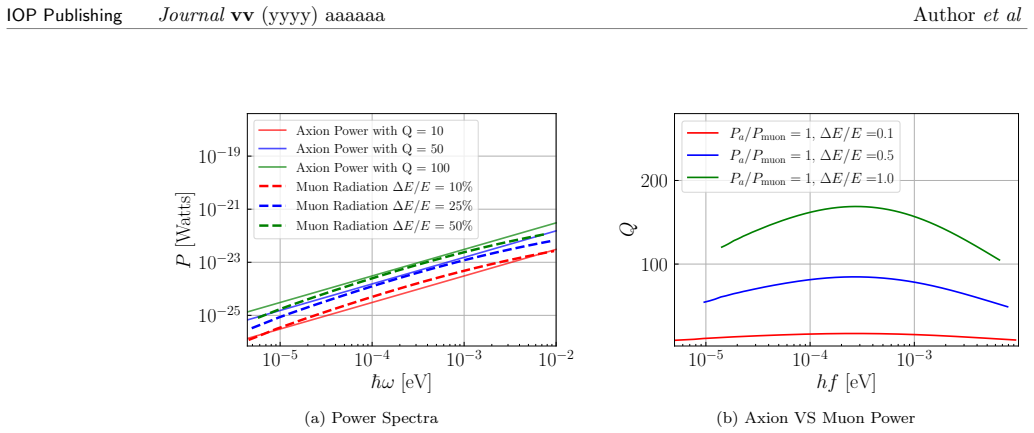
Cosmic muons generate synchrotron radiation that current high-Q axion searches can reject but future broadband detectors cannot ignore without fine energy resolution.
A machine-rendered reading of the paper's core claim, the machinery that carries it, and where it could break.
Core claim
The synchrotron radiation from cosmic muons does not dominate the noise background for current μeV-scale axion dark matter experiments because of the high quality factor Q and fine energy resolution in the readout; without sufficient energy resolution, future broadband axion dark matter experiments will be vulnerable to this radiation from charged particles.
What carries the argument
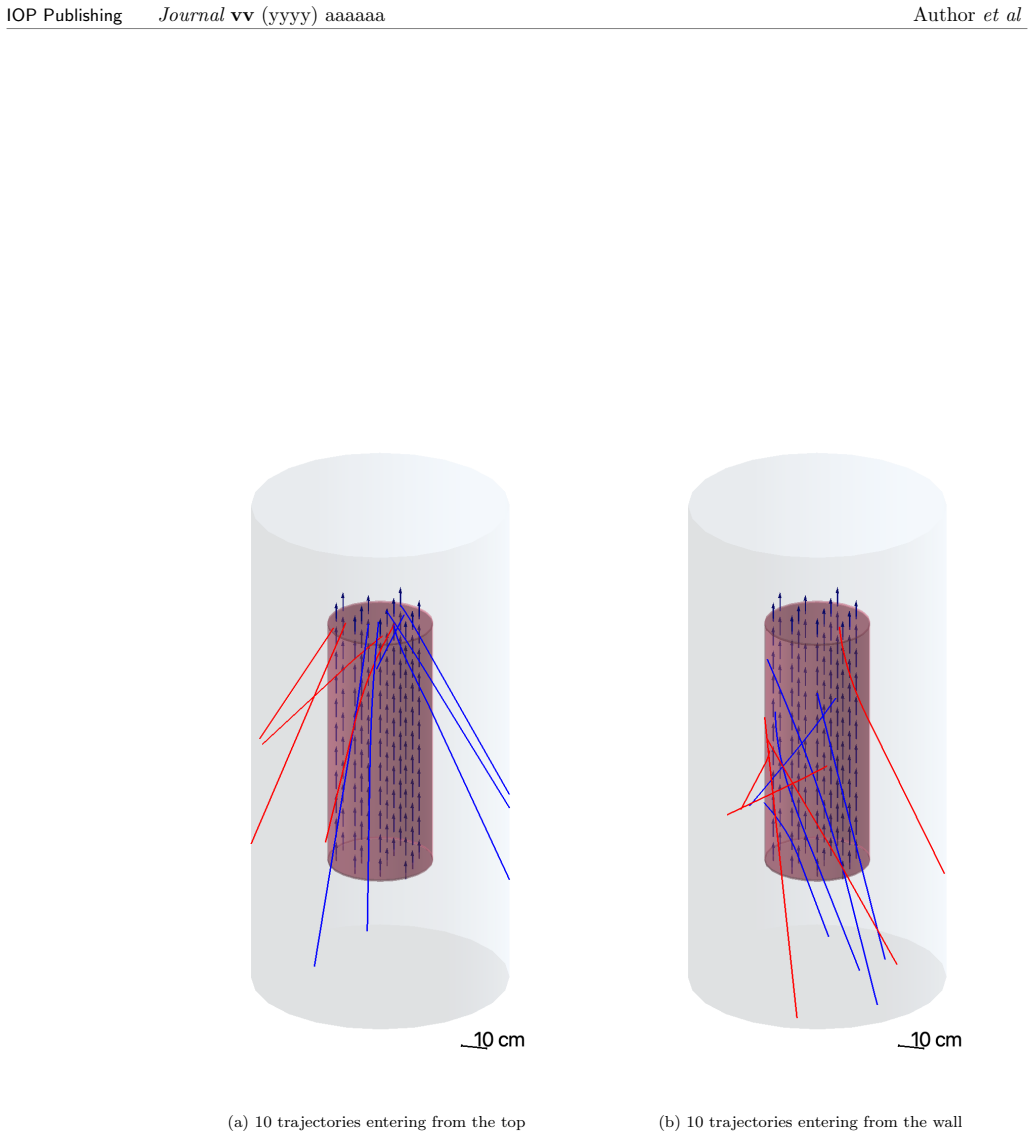
GEANT4 simulation of muon tracks in a cylindrical volume with uniform 8 T field, combined with an analytical model for the angular-frequency-differential synchrotron radiation power spectra across wide Lorentz factor and pitch-angle ranges.
If this is right
- Current μeV-scale axion experiments with high Q and fine energy resolution remain insensitive to muon synchrotron backgrounds.
- Broadband axion detectors must incorporate sufficient energy resolution to suppress muon-induced events.
- The analytical synchrotron spectra provide a reusable tool for estimating backgrounds in any similar strong-field detector.
- Detector designs for future axion searches should prioritize energy resolution over raw bandwidth alone.
Where Pith is reading between the lines
- Energy resolution upgrades could allow larger-volume broadband searches without new shielding against cosmic rays.
- The same muon radiation mechanism may set practical limits on other precision experiments that use strong magnets and wide-band readouts.
- Varying the applied magnetic field strength in a test setup would directly test how the predicted radiation scales with B squared.
Load-bearing premise
The GEANT4 muon-track simulation and the derived analytical synchrotron spectra accurately represent the real cosmic muon flux, pitch angles, and radiation inside the experimental volume under the uniform 8 T field assumption.
What would settle it
A direct measurement of the rate and spectrum of synchrotron radiation events from cosmic muons in an 8 T field that deviates significantly from the simulated and analytical predictions would falsify the claim that muons remain negligible for current detectors.
Figures


read the original abstract
We estimate the synchrotron radiation of cosmic muons in a uniform magnetic field in the $\mu$eV-to-meV energy scale. Such events can potentially bring backgrounds to the axion dark matter searches. The GEANT4 software package is utilized to simulate the muon tracks in a cylindrical region of interest with an 8~T solenoid magnetic field applied. We further develop an analytical estimation of the angular-frequency-differential synchrotron radiation power spectra in this work as the cosmic muons span a wide range of Lorentz factor $\gamma$ and pitch angle $\alpha$. We verify that the cosmic muons are not the dominant noise background for the current axion dark matter experiments on the $\mu$eV scale because of the high quality factor $Q$ and fine energy resolution in the readout. However, without sufficient energy resolution in the detector readout, future broadband axion dark matter experiments will be vulnerable to the synchrotron radiation of these charged particles.
Editorial analysis
A structured set of objections, weighed in public.
Referee Report
Summary. The paper estimates synchrotron radiation from cosmic muons in an 8 T uniform magnetic field as a potential background for axion dark matter searches in the μeV-to-meV range. GEANT4 is used to simulate muon tracks in a cylindrical volume of interest, and an analytical calculation is developed for the angular-frequency-differential power spectra across wide ranges of Lorentz factor γ and pitch angle α. The central claim is that muons are not the dominant background for current μeV-scale experiments due to high quality factor Q and fine energy resolution in the readout, but future broadband searches without sufficient resolution will be vulnerable.
Significance. If the simulations and spectra accurately capture real conditions, the work provides a timely assessment of an under-studied background for axion haloscopes, quantifying how high-Q and resolution suppress muon-induced noise while flagging risks for broadband designs. The dual use of GEANT4 tracks and first-principles synchrotron formulas for broad γ/α distributions is a strength, offering concrete guidance on readout requirements for next-generation detectors.
major comments (2)
- [GEANT4 Simulation] GEANT4 simulation section: The muon track modeling and derived synchrotron spectra lack any validation or comparison against measured cosmic muon flux, pitch-angle distributions, or radiation yields in comparable 8 T fields. This is load-bearing for the central claim, as the conclusion that muons remain below the resolution-suppressed threshold assumes the simulated rates and power are accurate within a factor of ~2; unmodeled systematics (site flux, field gradients) could reverse the 'not dominant' verdict for current experiments.
- [Analytical Estimation] Analytical estimation and results: The power spectra rely on the uniform 8 T cylinder assumption and external distributions for γ and α; no sensitivity analysis is shown for deviations (e.g., field non-uniformity or factor-of-2 flux variation), which directly affects whether the broadband vulnerability conclusion holds or whether current high-Q suppression remains robust.
minor comments (2)
- [Abstract] Abstract: Typical numerical values for Q and energy resolution used in the comparison are not stated, making it harder to assess the quantitative suppression claimed.
- [Results] Figures: Spectra plots would benefit from overlaid uncertainty bands reflecting simulation statistics or parameter variations to improve clarity.
Simulated Author's Rebuttal
We thank the referee for the thorough review and valuable comments on our manuscript. The points raised regarding validation and sensitivity analysis are important for strengthening the robustness of our conclusions. We have revised the manuscript to incorporate additional discussion, references, and analyses addressing these concerns, as detailed in the point-by-point responses below.
read point-by-point responses
-
Referee: [GEANT4 Simulation] GEANT4 simulation section: The muon track modeling and derived synchrotron spectra lack any validation or comparison against measured cosmic muon flux, pitch-angle distributions, or radiation yields in comparable 8 T fields. This is load-bearing for the central claim, as the conclusion that muons remain below the resolution-suppressed threshold assumes the simulated rates and power are accurate within a factor of ~2; unmodeled systematics (site flux, field gradients) could reverse the 'not dominant' verdict for current experiments.
Authors: We acknowledge the importance of validation. The GEANT4 simulations employ the standard QGSP_BERT physics list, which has been validated for cosmic muon propagation and magnetic field effects in multiple high-energy physics contexts (we have added explicit citations to relevant validation studies in the revised text). Input flux and pitch-angle distributions follow established models from the PDG and dedicated cosmic-ray literature. Direct experimental data on synchrotron yields from cosmic muons in precisely 8 T fields are not available, but we have added a new discussion subsection quantifying expected systematics: site flux variations are typically <30% and field gradients in real solenoids introduce <10% broadening. Even assuming a conservative factor-of-2 increase in rate, the high-Q (>10^5) and fine energy resolution of current experiments keep the background below threshold, as the effective noise contribution scales with the narrow bandwidth. This supports our central claim while noting that dedicated beam tests would be valuable future work. revision: partial
-
Referee: [Analytical Estimation] Analytical estimation and results: The power spectra rely on the uniform 8 T cylinder assumption and external distributions for γ and α; no sensitivity analysis is shown for deviations (e.g., field non-uniformity or factor-of-2 flux variation), which directly affects whether the broadband vulnerability conclusion holds or whether current high-Q suppression remains robust.
Authors: We agree that sensitivity analysis improves the paper. The revised manuscript now includes explicit calculations for field non-uniformity (±10% variation across the volume, which slightly broadens the frequency spectra but leaves integrated power nearly unchanged) and flux variations by a factor of 2. For high-Q detectors the suppression remains effective because resolution is finer than the induced broadening. For broadband designs the total power scales linearly with flux, preserving the vulnerability conclusion. These results are presented in a new figure and text section, confirming that the main findings are robust under the explored deviations. revision: yes
Circularity Check
No significant circularity; estimates from external GEANT4 and first-principles synchrotron formulas
full rationale
The paper's central verification that cosmic muons are not dominant for current μeV-scale axion searches rests on GEANT4-simulated tracks in an 8 T field plus an independently derived analytical synchrotron power spectrum for wide γ/α ranges. These inputs are external (simulation package) or first-principles (standard synchrotron formulas) and do not reduce to parameters fitted from the target background threshold or to self-citations that carry the load-bearing step. The conclusion about high-Q and fine-resolution suppression follows directly from comparing the computed spectra against known experimental parameters, without self-definition or renaming of results. No load-bearing step collapses to its own output by construction.
Axiom & Free-Parameter Ledger
axioms (2)
- domain assumption Standard GEANT4 modeling of charged particle propagation in uniform magnetic fields accurately reproduces real muon trajectories and energy loss.
- standard math Classical synchrotron radiation formulas apply without quantum corrections across the relevant Lorentz factors and pitch angles for cosmic muons.
Lean theorems connected to this paper
-
IndisputableMonolith/Cost/FunctionalEquation.leanwashburn_uniqueness_aczel unclear?
unclearRelation between the paper passage and the cited Recognition theorem.
GEANT4 simulation of muon tracks... analytical estimation of angular-frequency-differential synchrotron radiation power spectra... Eq. (2)–(4) with Bessel Jn
-
IndisputableMonolith/Foundation/AlexanderDuality.leanalexander_duality_circle_linking unclear?
unclearRelation between the paper passage and the cited Recognition theorem.
8 T solenoid... cylindrical region of interest
What do these tags mean?
- matches
- The paper's claim is directly supported by a theorem in the formal canon.
- supports
- The theorem supports part of the paper's argument, but the paper may add assumptions or extra steps.
- extends
- The paper goes beyond the formal theorem; the theorem is a base layer rather than the whole result.
- uses
- The paper appears to rely on the theorem as machinery.
- contradicts
- The paper's claim conflicts with a theorem or certificate in the canon.
- unclear
- Pith found a possible connection, but the passage is too broad, indirect, or ambiguous to say the theorem truly supports the claim.
Reference graph
Works this paper leans on
-
[1]
R. D. Peccei and Helen R. Quinn. CP conservation in the presence of pseudoparticles.Phys. Rev. Lett., 38:1440–1443, Jun 1977
work page 1977
-
[2]
Steven Weinberg. A New Light Boson?Phys. Rev. Lett., 40:223–226, 1978
work page 1978
-
[3]
Problem of Strong p and t Invariance in the Presence of Instantons.Phys
Frank Wilczek. Problem of Strong p and t Invariance in the Presence of Instantons.Phys. Rev. Lett., 40:279–282, 1978
work page 1978
-
[4]
John Preskill, Mark B. Wise, and Frank Wilczek. Cosmology of the invisible axion.Physics Letters B, 120(1):127–132, 1983
work page 1983
-
[5]
L.F. Abbott and P. Sikivie. A cosmological bound on the invisible axion.Physics Letters B, 120(1):133–136, 1983
work page 1983
-
[6]
The not-so-harmless axion.Physics Letters B, 120(1):137–141, 1983
Michael Dine and Willy Fischler. The not-so-harmless axion.Physics Letters B, 120(1):137–141, 1983
work page 1983
-
[7]
J. Ipser and P. Sikivie. Can galactic halos be made of axions?Phys. Rev. Lett., 50:925–927, Mar 1983
work page 1983
-
[8]
S. Borsanyi, Z. Fodor, J. Guenther, et al. Calculation of the axion mass based on high-temperature lattice quantum chromodynamics.Nature, 539(7627):69–71, Nov 2016. 8 IOP PublishingJournalvv(yyyy) aaaaaa Authoret al
work page 2016
-
[9]
Axions, instantons, and the lattice.Phys
Michael Dine, Patrick Draper, Laurel Stephenson-Haskins, and Di Xu. Axions, instantons, and the lattice.Phys. Rev. D, 96:095001, Nov 2017
work page 2017
-
[10]
William A. Bardeen and S.-H.H. Tye. Current algebra applied to properties of the light higgs boson.Physics Letters B, 74(3):229–232, 1978
work page 1978
-
[11]
T. W. Donnelly, S. J. Freedman, R. S. Lytel, et al. Do axions exist?Phys. Rev. D, 18:1607–1620, Sep 1978
work page 1978
-
[12]
Matthew J. Dolan, Frederick J. Hiskens, and Raymond R. Volkas. Advancing globular cluster constraints on the axion-photon coupling.Journal of Cosmology and Astroparticle Physics, 2022(10):096, oct 2022
work page 2022
-
[13]
Revisiting the bound on axion-photon coupling from globular clusters.Phys
Adrian Ayala, Inma Dom´ ınguez, Maurizio Giannotti, et al. Revisiting the bound on axion-photon coupling from globular clusters.Phys. Rev. Lett., 113:191302, Nov 2014
work page 2014
-
[14]
First constraints on qcd axion dark matter using james webb space telescope observations, 2025
Elena Pinetti. First constraints on qcd axion dark matter using james webb space telescope observations, 2025. arXiv:2503.11753
-
[15]
Improved estimation of radiated axions from cosmological axionic strings.Phys
Takashi Hiramatsu, Masahiro Kawasaki, Toyokazu Sekiguchi, et al. Improved estimation of radiated axions from cosmological axionic strings.Phys. Rev. D, 83:123531, Jun 2011
work page 2011
-
[16]
Axion dark matter from topological defects.Phys
Masahiro Kawasaki, Ken’ichi Saikawa, and Toyokazu Sekiguchi. Axion dark matter from topological defects.Phys. Rev. D, 91:065014, Mar 2015
work page 2015
-
[17]
Evan Berkowitz, Michael I. Buchoff, and Enrico Rinaldi. Lattice qcd input for axion cosmology.Phys. Rev. D, 92:034507, Aug 2015
work page 2015
-
[18]
Leesa Fleury and Guy D. Moore. Axion dark matter: strings and their cores.Journal of Cosmology and Astroparticle Physics, 2016(01):004–004, jan 2016
work page 2016
-
[19]
Claudio Bonati, Massimo D’Elia, Marco Mariti, et al. Axion phenomenology andθ-dependence from nf= 2 + 1 lattice qcd.Journal of High Energy Physics, 2016(3):155, Mar 2016
work page 2016
-
[20]
Peter Petreczky, Hans-Peter Schadler, and Sayantan Sharma. The topological susceptibility in finite temperature qcd and axion cosmology.Physics Letters B, 762:498–505, 2016
work page 2016
-
[21]
Unifying inflation with the axion, dark matter, baryogenesis, and the seesaw mechanism.Phys
Guillermo Ballesteros, Javier Redondo, Andreas Ringwald, and Carlos Tamarit. Unifying inflation with the axion, dark matter, baryogenesis, and the seesaw mechanism.Phys. Rev. Lett., 118:071802, Feb 2017
work page 2017
-
[22]
Vincent B. Klaer and Guy D. Moore. The dark-matter axion mass.Journal of Cosmology and Astroparticle Physics, 2017(11):049–049, nov 2017
work page 2017
-
[23]
Malte Buschmann, Joshua W. Foster, and Benjamin R. Safdi. Early-universe simulations of the cosmological axion.Phys. Rev. Lett., 124:161103, Apr 2020
work page 2020
-
[24]
More Axions from Strings.SciPost Phys., 10:50, 2021
Marco Gorghetto, Edward Hardy, and Giovanni Villadoro. More Axions from Strings.SciPost Phys., 10:50, 2021
work page 2021
-
[25]
Malte Buschmann, Joshua W. Foster, Anson Hook, et al. Dark matter from axion strings with adaptive mesh refinement.Nature Commun., 13(1):1049, 2022
work page 2022
-
[26]
Peter W. Graham and Adam Scherlis. Stochastic axion scenario.Phys. Rev. D, 98:035017, Aug 2018
work page 2018
-
[27]
Fuminobu Takahashi, Wen Yin, and Alan H. Guth. Qcd axion window and low-scale inflation. Phys. Rev. D, 98:015042, Jul 2018
work page 2018
-
[28]
P. Sikivie. Experimental tests of the ”invisible” axion.Phys. Rev. Lett., 51:1415–1417, Oct 1983
work page 1983
-
[29]
Jihn E. Kim. Weak Interaction Singlet and Strong CP Invariance.Phys. Rev. Lett., 43:103, 1979
work page 1979
-
[30]
Mikhail A. Shifman, A.I. Vainshtein, and Valentin I. Zakharov. Can Confinement Ensure Natural CP Invariance of Strong Interactions?Nucl.Phys., B166:493, 1980. 9 IOP PublishingJournalvv(yyyy) aaaaaa Authoret al
work page 1980
-
[31]
A Simple Solution to the Strong CP Problem with a Harmless Axion.Phys
Michael Dine, Willy Fischler, and Mark Srednicki. A Simple Solution to the Strong CP Problem with a Harmless Axion.Phys. Lett., B104:199, 1981
work page 1981
-
[32]
A.R. Zhitnitsky. On Possible Suppression of the Axion Hadron Interactions. (In Russian).Sov. J. Nucl. Phys., 31:260, 1980
work page 1980
-
[33]
N. Du, N. Force, R. Khatiwada, et al. Search for invisible axion dark matter with the axion dark matter experiment.Phys. Rev. Lett., 120:151301, Apr 2018
work page 2018
- [34]
-
[35]
C. Bartram, T. Braine, E. Burns, et al. Search for invisible axion dark matter in the 3.3− −4.2µeV mass range.Phys. Rev. Lett., 127:261803, Dec 2021
work page 2021
-
[36]
C. Goodman, M. Guzzetti, C. Hanretty, et al. Admx axion dark matter bounds around 3.3µeV with dine-fischler-srednicki-zhitnitsky discovery ability.Phys. Rev. Lett., 134:111002, Mar 2025
work page 2025
- [37]
-
[38]
Yi, Saebyeok Ahn, C ¸ a ˘ glar Kutlu, et al
Andrew K. Yi, Saebyeok Ahn, C ¸ a ˘ glar Kutlu, et al. Axion dark matter search around 4.55µeV with dine-fischler-srednicki-zhitnitskii sensitivity.Phys. Rev. Lett., 130:071002, Feb 2023
work page 2023
-
[39]
Saebyeok Ahn, JinMyeong Kim, Boris I. Ivanov, et al. Extensive search for axion dark matter over 1 ghz with capp’s main axion experiment.Phys. Rev. X, 14:031023, Aug 2024
work page 2024
-
[40]
M. Guzzetti, D. Zhang, C. Goodman, et al. Improved receiver noise calibration for admx axion search: 4.54 to 5.41µev.Phys. Rev. D, 111:092012, May 2025
work page 2025
-
[41]
J. Allison, K. Amako, J. Apostolakis, et al. Recent developments in geant4.Nuclear Instruments and Methods in Physics Research Section A: Accelerators, Spectrometers, Detectors and Associated Equipment, 835:186–225, 2016
work page 2016
-
[42]
J. Allison, K. Amako, J. Apostolakis, et al. Geant4 developments and applications.IEEE Transactions on Nuclear Science, 53(1):270–278, 2006
work page 2006
-
[43]
S. Agostinelli, J. Allison, K. Amako, J. Apostolakis, et al. Geant4—a simulation toolkit. Nuclear Instruments and Methods in Physics Research Section A: Accelerators, Spectrometers, Detectors and Associated Equipment, 506(3):250–303, 2003
work page 2003
-
[44]
BEKEFI.Radiation Processes In Plasmas
G. BEKEFI.Radiation Processes In Plasmas. JOHN WILEY AND SONS, 1966
work page 1966
-
[45]
Gabe Hoshino, Stefan Knirck, Mohamed H. Awida, et al. First axionlike particle results from a broadband search for wavelike dark matter in the 44 to 52µeV range with a coaxial dish antenna.Phys. Rev. Lett., 134:171002, Apr 2025
work page 2025
-
[46]
B. Ary dos Santos Garcia, D. Bergermann, A. Caldwell, et al. First search for axion dark matter with a madmax prototype.Phys. Rev. Lett., 135:041001, Jul 2025
work page 2025
- [47]
-
[48]
R. Khatiwada, D. Bowring, A. S. Chou, et al. Axion dark matter experiment: Detailed design and operations.Review of Scientific Instruments, 92(12):124502, 12 2021
work page 2021
-
[49]
J. D. Jackson.Classical Electrodynamics. Wiley, 3rd edition, 1999
work page 1999
-
[50]
Gates, Geza Gyuk, and Michael S
Evalyn I. Gates, Geza Gyuk, and Michael S. Turner. The local halo density.The Astrophysical Journal, 449(2):L123, aug 1995
work page 1995
-
[51]
Pablo F de Salas and A Widmark. Dark matter local density determination: recent observations and future prospects.Reports on Progress in Physics, 84(10):104901, oct 2021. 10 IOP PublishingJournalvv(yyyy) aaaaaa Authoret al
work page 2021
-
[52]
Kristof Schmieden and Matthias Schott. The global network of cavities to search for gravitational waves (gravnet): A novel scheme to hunt gravitational waves signatures from the early universe, 2023. arXiv:2308.11497
-
[53]
A. Ashtari Esfahani, S. Bhagvati, S. B¨ oser, M. J. Brandsema, et al. Antenna arrays for neutrino mass measurements with cyclotron radiation emission spectroscopy.Phys. Rev. C, 112:045506, Oct 2025
work page 2025
-
[54]
N. Buzinsky et al. Larmor power limit for cyclotron radiation of relativistic particles in a waveguide.New J. Phys., 26(8):083021, 2024. 11
work page 2024
discussion (0)
Sign in with ORCID, Apple, or X to comment. Anyone can read and Pith papers without signing in.