REVIEW 2 major objections 1 minor 56 references
Neural posterior estimation for scalable and accurate inverse parameter inference in Li-ion batteries
T0 review · 2 major / 1 minor · reviewed 2026-05-13 · grok-4.3
Pith's one-line read Neural posterior estimation calibrates Li-ion battery parameters as accurately as Bayesian calibration but in milliseconds rather than minutes.
desk verdict NPE gives fast, usable parameter estimates for battery models on real data, but the sim-to-real calibration gap is only partly addressed. read the letter →
The pith
A machine-rendered reading of the paper's core claim, the machinery that carries it, and where it could break.
The reading
What carries the argument
Neural posterior estimation (NPE), a simulation-based inference method that trains a neural network to map observed voltage data directly to the posterior distribution of model parameters.
What would settle it
New experimental voltage cycles where the voltage prediction error from NPE-derived parameters exceeds that from Bayesian calibration, or where the inferred parameters fail to match independent measurements of lithium inventory loss.
Extended reading notes
Core claim
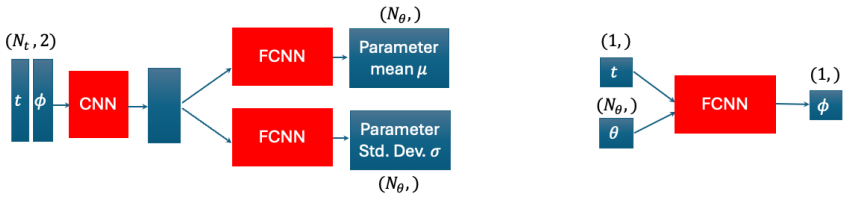
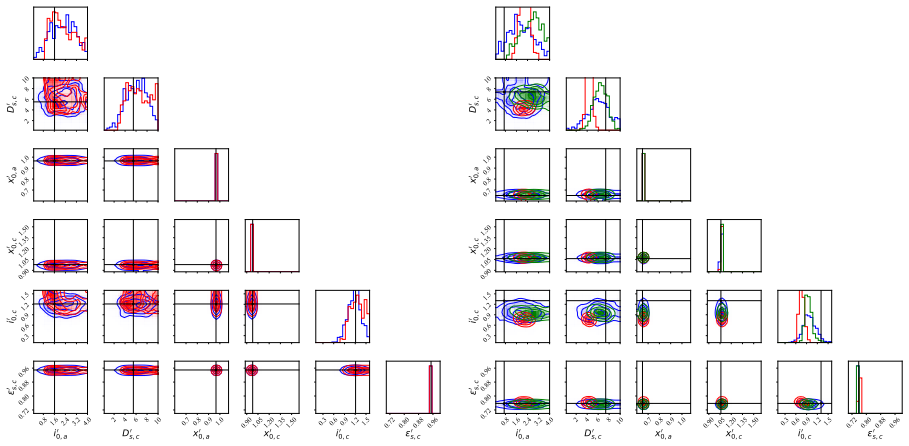
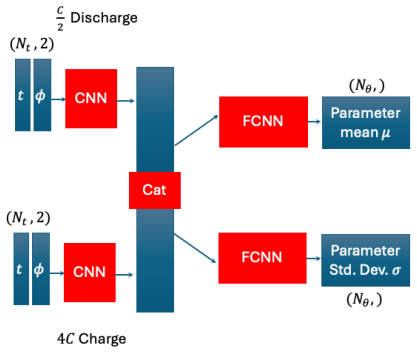
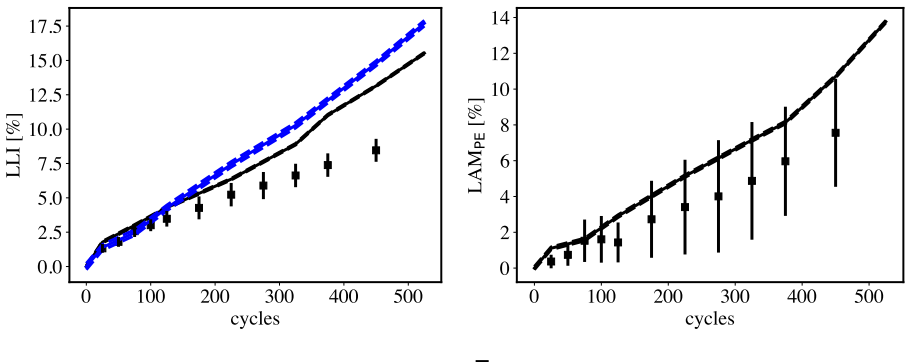
Neural posterior estimation trains a neural network on many simulated voltage curves generated from the physics-based model so that, after training, it directly outputs the full posterior distribution over parameters for any new observed voltage trace. When tested against Bayesian calibration on the same experimental fast-charge dataset, NPE produces parameter estimates that match or exceed accuracy while cutting inference time from minutes to milliseconds. The method additionally supplies local sensitivity maps that link each parameter to particular regions of the voltage response, and the recovered parameters align with independent measurements of loss of lithium inventory and loss of cycl
Load-bearing premise
The neural network trained only on simulated data from the physics-based model generalizes accurately to real experimental voltage curves without substantial distribution shift.
Editorial extensions
If this is right
- Parameter estimation becomes fast enough for real-time diagnostics during battery operation.
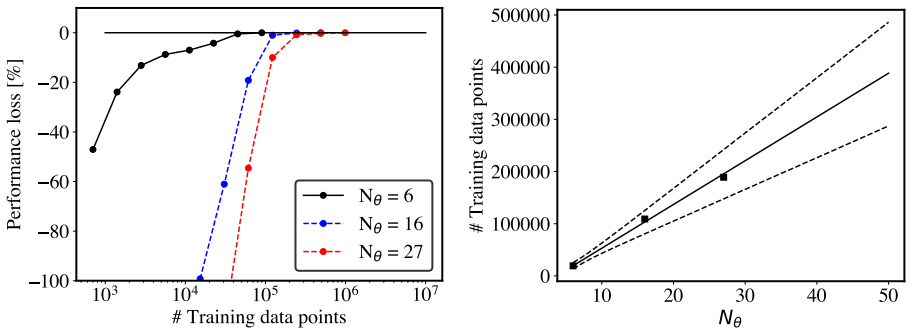
- The approach scales to high-dimensional cases with up to 27 parameters while remaining tractable.
- Local sensitivity information identifies which parts of the voltage curve constrain each parameter.
- Validation against physical degradation measurements confirms the estimates reflect actual cell state.
Reading between the lines
- The same trained network could be reused across many cells or operating conditions once the initial simulation budget is spent.
- Combining NPE outputs with streaming sensor data could support continuous online updating of battery state estimates.
- The interpretability maps may help identify which measurements are most informative for future sensor design.
Signed reviews
Editorial analysis
A structured set of objections, weighed in public.
Referee Report
Summary. The manuscript introduces neural posterior estimation (NPE) as a fully amortized alternative to Bayesian calibration for inferring parameters in physics-based Li-ion battery models from voltage curves. It claims that NPE achieves equal or superior parameter accuracy, reduces inference time from minutes to milliseconds, provides interpretability advantages such as local sensitivity to voltage-curve regions, and is validated on experimental fast-charge data against independent loss-of-lithium-inventory and loss-of-active-material measurements, with open-source code provided.
Significance. If the central generalization claim holds, the work would enable scalable, real-time probabilistic diagnostics for high-dimensional battery models (6–27 parameters), shifting computational cost to offline training while preserving calibration quality; the explicit validation against independent degradation measurements and the open repository are notable strengths that could accelerate adoption in battery research and management systems.
major comments (2)
- [Abstract] Abstract: the claim of equal or superior parameter calibration accuracy is immediately qualified by the statement that NPE 'can lead to higher voltage prediction errors'; without a side-by-side quantitative comparison of voltage reconstruction RMSE or posterior predictive coverage on the experimental dataset, the accuracy assertion remains under-supported.
- [Validation] Validation section: the central generalization assumption—that NPE posteriors trained exclusively on physics-model simulations remain well-calibrated on real experimental fast-charge curves—is not accompanied by an explicit sim-to-real discrepancy metric, domain-adaptation diagnostic, or posterior predictive check on held-out real voltage segments, leaving open the possibility that apparent parameter accuracy reflects model mismatch rather than true inference quality.
minor comments (1)
- [Implementation] The companion repository link is provided; confirming that it contains the exact NPE architecture, training hyperparameters, and simulation data-generation scripts would strengthen reproducibility.
Simulated Author's Rebuttal
We thank the referee for the constructive feedback. We address each major comment point by point below and indicate the planned revisions.
read point-by-point responses
-
Referee: [Abstract] Abstract: the claim of equal or superior parameter calibration accuracy is immediately qualified by the statement that NPE 'can lead to higher voltage prediction errors'; without a side-by-side quantitative comparison of voltage reconstruction RMSE or posterior predictive coverage on the experimental dataset, the accuracy assertion remains under-supported.
Authors: We agree that a direct quantitative comparison on the experimental dataset would strengthen the accuracy claim. In the revised manuscript we will add a table reporting voltage reconstruction RMSE and posterior predictive coverage metrics for both NPE and Bayesian calibration posteriors evaluated on the experimental fast-charge curves. revision: yes
-
Referee: [Validation] Validation section: the central generalization assumption—that NPE posteriors trained exclusively on physics-model simulations remain well-calibrated on real experimental fast-charge curves—is not accompanied by an explicit sim-to-real discrepancy metric, domain-adaptation diagnostic, or posterior predictive check on held-out real voltage segments, leaving open the possibility that apparent parameter accuracy reflects model mismatch rather than true inference quality.
Authors: The current validation relies on independent experimental measurements of loss-of-lithium-inventory and loss-of-active-material, which are obtained outside the voltage-curve fitting process and therefore provide a check against model mismatch. We acknowledge that additional diagnostics would further address the sim-to-real concern. In the revision we will include posterior predictive checks on held-out segments of the experimental voltage curves together with a quantitative sim-to-real discrepancy metric based on residual distributions. revision: yes
Circularity Check
No circularity: NPE trained on independent simulations, validated externally
full rationale
The paper applies standard neural posterior estimation (NPE) to infer Li-ion battery parameters from voltage curves. Training data are generated from the physics-based model via independent forward simulations; the resulting amortized posterior is then applied to experimental data. Parameter accuracy is checked against separate loss-of-lithium-inventory and loss-of-active-material measurements, not against quantities derived from the same fitted voltage segments. No self-definitional equations, fitted-inputs-renamed-as-predictions, or load-bearing self-citations appear in the derivation chain. The central claim therefore remains independent of its own outputs.
Assumptions & free parameters
free parameters (1)
- NPE network architecture and training hyperparameters
assumptions (1)
- domain assumption Physics-based electrochemical model sufficiently captures real battery behavior for training data generation
Cite this review
Pith. "Pith review of Neural posterior estimation for scalable and accurate inverse parameter inference in Li-ion batteries." pith.science (2026). https://pith.science/paper/2604.02520
@misc{pith2026260402520,
  author       = {Pith},
  title        = {Pith review of: Neural posterior estimation for scalable and accurate inverse parameter inference in Li-ion batteries},
  year         = {2026},
  howpublished = {\url{https://pith.science/paper/2604.02520}},
  note         = {Machine review of arXiv:2604.02520}
}
read the original abstract
Diagnosing the internal state of Li-ion batteries is critical for battery research, operation of real-world systems, and prognostic evaluation of remaining lifetime. By using physics-based models to perform probabilistic parameter estimation via Bayesian calibration, diagnostics can account for the uncertainty due to model fitness, data noise, and the observability of any given parameter. However, Bayesian calibration in Li-ion batteries using electrochemical data is computationally intensive even when using a fast surrogate in place of physics-based models, requiring many thousands of model evaluations. A fully amortized alternative is neural posterior estimation (NPE). NPE shifts the computational burden from the parameter estimation step to data generation and model training, reducing the parameter estimation time from minutes to milliseconds, enabling real-time applications. The present work shows that NPE calibrates parameters equally or more accurately than Bayesian calibration, and we demonstrate that the higher computational costs for data generation are tractable even in high-dimensional cases (ranging from 6 to 27 estimated parameters), but the NPE method can lead to higher voltage prediction errors. The NPE method also offers several interpretability advantages over Bayesian calibration, such as local parameter sensitivity to specific regions of the voltage curve. The NPE method is demonstrated using an experimental fast charge dataset, with parameter estimates validated against measurements of loss of lithium inventory and loss of active material. The implementation is made available in a companion repository (https://github.com/NatLabRockies/BatFIT).
Figures


Figures from the paper (9 more)




Lean theorems connected to this paper
-
IndisputableMonolith/Cost/FunctionalEquation.leanwashburn_uniqueness_aczel unclear?
unclearRelation between the paper passage and the cited Recognition theorem.
NPE shifts the computational burden... reducing the parameter estimation time from minutes to milliseconds... q_ϕ(θ|x)=N(μ(x),σ(x)I)
-
IndisputableMonolith/Foundation/RealityFromDistinction.leanreality_from_one_distinction unclear?
unclearRelation between the paper passage and the cited Recognition theorem.
We show with synthetic data that NPE is as accurate as Bayesian calibration... validated against LLI and LAMPE
What do these tags mean?
- matches
- The paper's claim is directly supported by a theorem in the formal canon.
- supports
- The theorem supports part of the paper's argument, but the paper may add assumptions or extra steps.
- extends
- The paper goes beyond the formal theorem; the theorem is a base layer rather than the whole result.
- uses
- The paper appears to rely on the theorem as machinery.
- contradicts
- The paper's claim conflicts with a theorem or certificate in the canon.
- unclear
- Pith found a possible connection, but the passage is too broad, indirect, or ambiguous to say the theorem truly supports the claim.
Reference graph
Works this paper leans on
-
[1]
P. J. Weddle, S. Kim, B.-R. Chen, Z. Yi, P. Gasper, A. M. Colclasure, K. Smith, K. L. Gering, T. R. Tanim, E. J. Dufek, Battery state-of-health diagnostics during fast cycling using physics-informed deep-learning, Journal of Power Sources 585 (2023) 233582
work page 2023
-
[2]
S. Kim, Z. Yi, B.-R. Chen, T. R. Tanim, E. J. Dufek, Rapid failure mode classification and quantification in batteries: A deep learning modeling framework, Energy Storage Materials 45 (2022) 1002–1011
work page 2022
-
[3]
X. Duan, F. Liu, E. Agar, X. Jin, Parameter identification of lithium-ion batteries by coupling electrochemi- cal impedance spectroscopy with a physics-based model, Journal of The Electrochemical Society 169 (2022) 040561
work page 2022
-
[4]
W. Li, I. Demir, D. Cao, D. Jöst, F. Ringbeck, M. Junker, D. U. Sauer, Data-driven systematic parameter identification of an electrochemical model for lithium-ion batteries with artificial intelligence, Energy Storage Materials 44 (2022) 557–570
work page 2022
-
[5]
M. Andersson, M. Streb, J. Y . Ko, V . L. Klass, M. Klett, H. Ekström, M. Johansson, G. Lindbergh, Parametriza- tion of physics-based battery models from input–output data: A review of methodology and current research, Journal of Power Sources 521 (2022) 230859
work page 2022
-
[6]
E. J. Dufek, D. P. Abraham, I. Bloom, B.-R. Chen, P. R. Chinnam, A. M. Colclasure, K. L. Gering, M. Keyser, S. Kim, W. Mai, et al., Developing extreme fast charge battery protocols–A review spanning materials to systems, Journal of Power Sources 526 (2022) 231129
work page 2022
-
[7]
D. Guittet, P. Gasper, M. Shirk, M. Mitchell, M. Gilleran, E. Bonnema, K. Smith, P. Mishra, M. Mann, Levelized cost of charging of extreme fast charging with stationary LMO/LTO batteries, Journal of Energy Storage 82 (2024) 110568
work page 2024
-
[8]
J. M. Reniers, G. Mulder, D. A. Howey, Unlocking extra value from grid batteries using advanced models, Journal of power sources 487 (2021) 229355
work page 2021
Show all 56 references
-
[9]
Zhang, Y
J. Zhang, Y . Zhang, B. Yi, Y . Ren, Q. Jiao, H. Bai, W. Jiang, Z. Song, Discovery learning predicts battery cycle life from minimal experiments, Nature 650 (2026) 110–115
2026
-
[10]
Hassanaly, P
M. Hassanaly, P. J. Weddle, R. N. King, S. De, A. Doostan, C. R. Randall, E. J. Dufek, A. M. Colclasure, K. Smith, PINN surrogate of Li-ion battery models for parameter inference, Part II: Regularization and applica- tion of the pseudo-2D model, Journal of Energy Storage 98 (2...
2024
-
[11]
S. R. Reddy, M. K. Scharrer, F. Pichler, D. Watzenig, G. S. Dulikravich, Accelerating parameter estimation in Doyle–Fuller–Newman model for lithium-ion batteries, COMPEL-The international journal for computation and mathematics in electrical and electronic engineering 38 (2019...
2019
-
[12]
Santhanagopalan, Q
S. Santhanagopalan, Q. Guo, P. Ramadass, R. E. White, Review of models for predicting the cycling performance of lithium ion batteries, Journal of power sources 156 (2006) 620–628
2006
-
[13]
Doyle, T
M. Doyle, T. F. Fuller, J. Newman, Modeling of galvanostatic charge and discharge of the lithium/polymer/insertion cell, J. Electrochem. Soc 140 (1993) 1526
1993
-
[14]
T. F. Fuller, M. Doyle, J. Newman, Relaxation phenomena in lithium-ion-insertion cells, Journal of the Electro- chemical Society 141 (1994) 982
1994
-
[15]
Ramadesigan, K
V . Ramadesigan, K. Chen, N. A. Burns, V . Boovaragavan, R. D. Braatz, V . R. Subramanian, Parameter estimation and capacity fade analysis of lithium-ion batteries using reformulated models, Journal of the Electrochemical society 158 (2011) A1048
2011
-
[16]
H. Yu, H. Zhang, Z. Zhang, S. Yang, State estimation of lithium-ion batteries via physics-machine learning combined methods: A methodological review and future perspectives, ETransportation (2025) 100420
2025
-
[17]
Hassanaly, P
M. Hassanaly, P. J. Weddle, R. N. King, S. De, A. Doostan, C. R. Randall, E. J. Dufek, A. M. Colclasure, K. Smith, PINN surrogate of Li-ion battery models for parameter inference, Part I: Implementation and multi- fidelity hierarchies for the single-particle model, Journal of ...
2024
-
[18]
J. Li, X. Li, X. Yuan, Y . Zhang, Deep learning method for online parameter identification of lithium-ion batteries using electrochemical synthetic data, Energy Storage Materials 72 (2024) 103697
2024
-
[19]
Ko, C.-W
C.-J. Ko, C.-W. Lu, K.-C. Chen, C.-H. Chen, Using partial discharge data to identify highly sensitive electro- chemical parameters of aged lithium-ion batteries, Energy Storage Materials 71 (2024) 103665
2024
-
[20]
Lenzi, J
A. Lenzi, J. Bessac, J. Rudi, M. L. Stein, Neural networks for parameter estimation in intractable models, Computational Statistics & Data Analysis 185 (2023) 107762
2023
-
[21]
Brendel, I
P. Brendel, I. Mele, A. Rosskopf, T. Katrašnik, V . Lorentz, Parametrized physics-informed deep operator net- works for Design of Experiments applied to Lithium-Ion-Battery cells, Journal of Energy Storage 128 (2025) 117055
2025
-
[22]
L. A. Román-Ramírez, J. Marco, Design of experiments applied to lithium-ion batteries: A literature review, Applied Energy 320 (2022) 119305
2022
-
[23]
Z. Wang, X. Zhou, W. Zhang, B. Sun, J. Shi, Q. Huang, Parameter sensitivity analysis and parameter iden- tifiability analysis of electrochemical model under wide discharge rate, Journal of Energy Storage 68 (2023) 107788
2023
-
[24]
R. G. Nascimento, F. A. Viana, M. Corbetta, C. S. Kulkarni, A framework for Li-ion battery prognosis based on hybrid Bayesian physics-informed neural networks, Scientific Reports 13 (2023) 13856
2023
-
[25]
S. Kim, S. Kim, Y . Y . Choi, J.-I. Choi, Bayesian parameter identification in electrochemical model for lithium- ion batteries, Journal of Energy Storage 71 (2023) 108129
2023
-
[26]
Aitio, S
A. Aitio, S. G. Marquis, P. Ascencio, D. Howey, Bayesian parameter estimation applied to the Li-ion battery single particle model with electrolyte dynamics, IFAC-PapersOnLine 53 (2020) 12497–12504
2020
-
[27]
Bills, L
A. Bills, L. Fredericks, V . Sulzer, V . Viswanathan, Massively distributed bayesian analysis of electric aircraft battery degradation, ACS Energy Letters 8 (2023) 3578–3585
2023
-
[28]
Cranmer, J
K. Cranmer, J. Brehmer, G. Louppe, The frontier of simulation-based inference, Proceedings of the National Academy of Sciences 117 (2020) 30055–30062
2020
-
[29]
Deistler, J
M. Deistler, J. Boelts, P. Steinbach, G. Moss, T. Moreau, M. Gloeckler, P. L. Rodrigues, J. Linhart, J. K. Lap- palainen, B. K. Miller, et al., Simulation-Based Inference: A Practical Guide, arXiv preprint arXiv:2508.12939 (2025). 19
2025
-
[30]
M. D. Hoffman, A. Gelman, et al., The No-U-Turn sampler: adaptively setting path lengths in Hamiltonian Monte Carlo, J. Mach. Learn. Res. 15 (2014) 1593–1623
2014
-
[31]
Nemeth, P
C. Nemeth, P. Fearnhead, Stochastic gradient Markov Chain Monte Carlo, Journal of the American Statistical Association 116 (2021) 433–450
2021
-
[32]
Kullback, R
S. Kullback, R. A. Leibler, On information and sufficiency, The annals of mathematical statistics 22 (1951) 79–86
1951
-
[33]
D. M. Blei, A. Kucukelbir, J. D. McAuliffe, Variational inference: A review for statisticians, Journal of the American statistical Association 112 (2017) 859–877
2017
-
[34]
Papamakarios, I
G. Papamakarios, I. Murray, Fastε-free inference of simulation models with bayesian conditional density estimation, Advances in neural information processing systems 29 (2016)
2016
-
[35]
Braman, T
K. Braman, T. Oliver, V . Raman, Bayesian analysis of syngas chemistry models, Combust. Theory Model 17 (2013) 858–887
2013
-
[36]
Hassanaly, J
M. Hassanaly, J. M. Parra-Alvarez, M. J. Rahimi, F. Municchi, H. Sitaraman, Bayesian calibration of bubble size dynamics applied to CO2 gas fermenters, Chemical Engineering Research and Design 215 (2025) 312–328
2025
-
[37]
Wildberger, M
J. Wildberger, M. Dax, S. Buchholz, S. Green, J. H. Macke, B. Schölkopf, Flow matching for scalable simulation-based inference, Advances in Neural Information Processing Systems 36 (2023) 16837–16864
2023
-
[38]
Hassanaly, A
M. Hassanaly, A. Glaws, K. Stengel, R. N. King, Adversarial sampling of unknown and high-dimensional conditional distributions, Journal of Computational Physics 450 (2022) 110853
2022
-
[39]
C. R. Randall, BATMODS-lite: Packaged battery models and material properties [SWR-25-108], 2025. URL: github.com/NatLabRockies/batmods-lite. doi:10.11578/dc.20260114.1
2025 doi
-
[40]
B.-R. Chen, C. M. Walker, S. Kim, M. R. Kunz, T. R. Tanim, E. J. Dufek, Battery aging mode identification across NMC compositions and designs using machine learning, Joule 6 (2022) 2776–2793
2022
-
[41]
Villalobos, J
G. Villalobos, J. Rudi, A. Mang, Neural Networks for Bayesian Inverse Problems Governed by a Nonlinear ODE, arXiv preprint arXiv:2510.14197 (2025)
2025
-
[42]
Papamakarios, E
G. Papamakarios, E. Nalisnick, D. J. Rezende, S. Mohamed, B. Lakshminarayanan, Normalizing flows for probabilistic modeling and inference, Journal of Machine Learning Research 22 (2021) 1–64
2021
-
[43]
D. Phan, N. Pradhan, M. Jankowiak, Composable effects for flexible and accelerated probabilistic programming in NumPyro, arXiv preprint arXiv:1912.11554 (2019)
1912
-
[44]
A. N. Angelopoulos, S. Bates, A gentle introduction to conformal prediction and distribution-free uncertainty quantification, arXiv preprint arXiv:2107.07511 (2021)
2021 arXiv
-
[45]
Flamary, N
R. Flamary, N. Courty, A. Gramfort, M. Z. Alaya, A. Boisbunon, S. Chambon, L. Chapel, A. Corenflos, K. Fa- tras, N. Fournier, L. Gautheron, N. T. Gayraud, H. Janati, A. Rakotomamonjy, I. Redko, A. Rolet, A. Schutz, V . Seguy, D. J. Sutherland, R. Tavenard, A. Tong, T. Vayer, P...
2021
-
[46]
Bonneel, M
N. Bonneel, M. Van De Panne, S. Paris, W. Heidrich, Displacement interpolation using Lagrangian mass trans- port, in: Proceedings of the 2011 SIGGRAPH Asia conference, 2011, pp. 1–12
2011
-
[47]
Perr-Sauer, J
J. Perr-Sauer, J. Ugirumurera, J. Gafur, E. A. Bensen, T. Nguyen, S. Paul, J. Severino, A. Nag, S. Vijayshankar, P. Gasper, et al., Applications of explainable artificial intelligence in renewable energy research, Energy Reports 14 (2025) 2217–2235. 20
2025
-
[48]
S. M. Lundberg, S.-I. Lee, A unified approach to interpreting model predictions, Advances in neural information processing systems 30 (2017)
2017
-
[49]
Shrikumar, P
A. Shrikumar, P. Greenside, A. Kundaje, Learning important features through propagating activation differences, in: International conference on machine learning, PMlR, 2017, pp. 3145–3153
2017
-
[50]
Griesemer, D
S. Griesemer, D. Cao, Z. Cui, C. Osorio, Y . Liu, Active sequential posterior estimation for sample-efficient simulation-based inference, Advances in Neural Information Processing Systems 37 (2024) 127907–127936
2024
-
[51]
H. J. Goldwyn, M. Krock, J. Rudi, D. Getter, J. Bessac, Multidimensional Distributional Neural Network Output Demonstrated in Super-Resolution of Surface Wind Speed, arXiv preprint arXiv:2508.16686 (2025)
2025
-
[52]
Lipman, R
Y . Lipman, R. T. Chen, H. Ben-Hamu, M. Nickel, M. Le, Flow matching for generative modeling, arXiv preprint arXiv:2210.02747 (2022)
2022 arXiv
-
[53]
Sulzer, S
V . Sulzer, S. G. Marquis, R. Timms, M. Robinson, S. J. Chapman, Python Battery Mathematical Modelling (PyBaMM), Journal of Open Research Software 9 (2021) 14. doi:10.5334/jors.309
2021 doi
-
[54]
C. R. Randall, scikit-SUNDAE: Python bindings to SUNDIALS differential algebraic equation solvers [SWR- 24-137], 2024. URL:github.com/NatLabRockies/scikit-sundae. doi:10.11578/dc.20241104.3
2024 doi
-
[55]
A. C. Hindmarsh, P. N. Brown, K. E. Grant, S. L. Lee, R. Serban, D. E. Shumaker, C. S. Woodward, SUNDIALS: Suite of nonlinear and differential/algebraic equation solvers, ACM Transactions on Mathematical Software (TOMS) 31 (2005) 363–396
2005
-
[56]
C. J. Balos, M. Day, L. Esclapez, A. M. Felden, D. J. Gardner, M. Hassanaly, D. R. Reynolds, J. S. Rood, J. M. Sexton, N. T. Wimer, et al., SUNDIALS time integrators for exascale applications with many independent sys- tems of ordinary differential equations, The International...
2025
Reviewed May 13, 2026 · model on record in the stance chip above.
Discussion (0). Continue with ORCID to comment.