Open-flux coronal field traced to within 4–7 degrees
Segmentation method QRaFT turns faint white-light corona images into magnetic field-line maps.

Data Analysis, Statistics and Probability
Methods, software and hardware for physics data analysis: data processing and storage; measurement methodology; statistical and mathematical aspects such as parametrization and uncertainties.
sort pith recommended most recent
Segmentation method QRaFT turns faint white-light corona images into magnetic field-line maps.
Restores the expected young-elderly-CHF order where the standard permutation measure fails.
· “Fuzzy permutation time irreversibility for nonequilibrium analysis of complex system”
A fully differentiable JAX pipeline makes mock galaxy maps cheap enough for simulation-based inference.
· “Fast GPU-Powered and Auto-Differentiable Forward Modeling of IFU Data Cubes”

Glitch masking restores galactic-binary frequencies to 1 ppm; planned gaps still widen black-hole error bars 2-3x.
· “Extraction of gravitational wave signals from LISA data in the presence of artifacts”

Proof-of-concept passed a ten-event mock lensing catalog, flagging every injected lensed system with no manual intervention.
· “LensingFlow: An Automated Workflow for Gravitational Wave Lensing Analyses”
A single description-length criterion unifies fit and complexity and beats systematic overfitting in simple tests.
· “Bayesian symbolic regression: Automated equation discovery from a physicists' perspective”

A web dashboard and Python CLI let anyone browse and analyze the R76 CDMS dataset without legacy software.
· “The Making of a Community Dark Matter Dataset with the National Science Data Fabric”

The new formulas hold for smoothing scales above 20 Mpc per h, enabling growth-rate and amplitude probes.
· “Non-Gaussian Expansion of Minkowski Tensors in Redshift Space”

A stochastic inversion method recovers the true governing terms where SINDy and its Bayesian variant add spurious ones.
· “Discovering Governing Equations in the Presence of Uncertainty”

Review: ML predicts band gaps, HER activity, and synthesis conditions for 2D carbon nitrides.

A rank-16 affine map from the reflection coefficient to the initial field reaches ~7.5e-5 relative L2 error on held-out DPSK patterns.

If true, post-processed tracks carry little motion information, so anomalous-diffusion findings need rechecking.
· “How Easy Is It to Learn Motion Models from Widefield Fluorescence Single Particle Tracks?”

Self-supervised method recovers the single-magnon spectrum of La2NiO4 without labels, using a learnable distortion kernel.
· “Physics-Guided Dual Implicit Neural Representations for Source Separation”

The winning recipe — NuGrid AGB plus TNG supernova yields — points to a steeper IMF and more Type Ia supernovae.
· “A COMPASS to Model Comparison and Simulation-Based Inference in Galactic Chemical Evolution”

Conditional mutual information with kNN estimation recovers ground truth in Gaussian systems and known markers in breast-cancer gene data.
· “Information-theoretic Quantification of High-order Feature Effects in Classification Problems”

A new training rule gives closed-form separating hyperplanes plus an uncertainty band.
· “Classification by Separating Hypersurfaces: An Entropic Approach”

Retraining on centrality-matched background recovers most of the lost performance, study says
· “Investigation of the performance of a GNN-based b-jet tagging method in heavy-ion collisions”

Maximum-likelihood retraining on a model's own data collapses it; a single fresh sample anchors it.
· “Lost in Retraining: Roaming the Parameter Space of Exponential Families Under Closed-Loop Learning”

A 100-cycle simulation of W(CO)6 deposition lands at about 15% tungsten content, matching lab-built nanostructures.
· “Stochastic dynamics simulation of the focused electron beam induced deposition process”

They separate persistence-driven from transition-driven sites even when static wind fits look identical.

New 35Cl and 37Cl radii also fix a differential radius precise enough to anchor laser spectroscopy of chlorine isotopes.

Viscous-layer velocity jumps stay non-Gaussian at every scale, even the largest.
· “Structure functions and flatness of streamwise velocity in a turbulent channel flow”

Thermal neutron capture on 27Al leaves a 1113.6 eV recoil line, a source-free calibration for low-energy detectors.

Training on simulated 2D track images, the net separates rare 12C decays from scattering backgrounds in a planned TPC.
A trained flow passes a joint-distribution test and packs a likelihood into a few megabytes, easing reuse.

Graph networks, transformers, and interpolation-based CNNs each fill a niche; open datasets make them testable.
· “Machine learning for modelling unstructured grid data in computational physics: a review”

Charge-normalized FFT spectra push adversarial ROC AUC to 0.999 at 10 MS/s, where the fixed index falls to 0.751.

Simulation says resolution shifts stay under 0.0005, inside the ~0.001 uncertainty of current measurements.
· “Impact of Tracking Resolutions on φ-Meson Spin Alignment Measurement”

Know where random cross-correlations end; everything beyond is a candidate for a genuine shared signal.
· “Distribution of singular values in large sample cross-covariance matrices”

Trained purely on simulation, it runs live and cuts reconstruction error roughly 30-fold versus neighbor averaging.
· “Reconstructing Time-of-Flight Detector Values of Angular Streaking Using Machine Learning”

Trained on computed spectra, the model transfers to real X-ray and electron energy-loss maps of battery cathodes
· “Revealing Local Structures through Machine-Learning- Fused Multimodal Spectroscopy”

Rule-following enters as a penalty term, and the weight of rules vs. results is left to judges and legislators.

Three cheap tweaks make random feature maps match top chaos forecasters up to 512 dimensions.
· “Learning dynamical systems with hit-and-run random feature maps”

Trained on plain eigenvalue spacings, the classifiers match known boundaries and reproduce scaling exponents from standard methods.

Across 696 Dark Energy Survey objects, size is shared but color and variability track place of origin.

The first hidden layer and the output layer carry enough uncertainty for active learning, at a fraction of the cost.
· “Active and transfer learning with partially Bayesian neural networks for materials and chemicals”

Classical TDI corrupts roughly 400 seconds of data around six one-sample gaps; the new method loses only the gap samples.
· “Robust Bayesian inference with gapped LISA data using all-in-one TDI-infty”

A theorem explains why day-resolution data show power laws while second-resolution streetfights show lognormals.
· “The distribution of violent event and interevent times in conflicts”

Degree lists, spectra and centralities reveal periodicity, memory decay and chaos in temporal networks where node identity is lost.
· “Characterising the dynamics of unlabelled temporal networks”
The single-atom R1 method no longer needs a human to pick fragments or delete ghost atoms between cycles.
A guided single-atom search cuts computer time and misplaced atoms; fragment search only for low-resolution data.
Ensemble and diffusion classifiers keep near-95% accuracy on PM2.5 levels despite a sparse urban monitoring grid.

An adaptive leave-one-out score finds the feature subsets that raise and lower predictive power, revealing when features cooperate.
· “Assessing high-order effects in feature importance via predictability decomposition”

A delayed driver plus a periodic response forcing creates large oscillations neither can produce alone.

Seeing data, model assumptions, and groupings can catch biases that aggregate statistics hide.
· “Toward Ethical Spatial Analysis: Addressing Endogenous Bias Through Visual Analytics”

Unbiased estimators hit 1 mm sea-level accuracy in days instead of a year of supercomputer time.
· “Multifidelity Uncertainty Quantification for Ice Sheet Simulations”

A model-agnostic wrapper gives every location its own prediction interval; bootstrapping caps out near 81%.
Trained on 2.7 million simulated events, it doubles resolution and sharpens the antimatter gravity test.
· “AI Meets Antimatter: Unveiling Antihydrogen Annihilations”

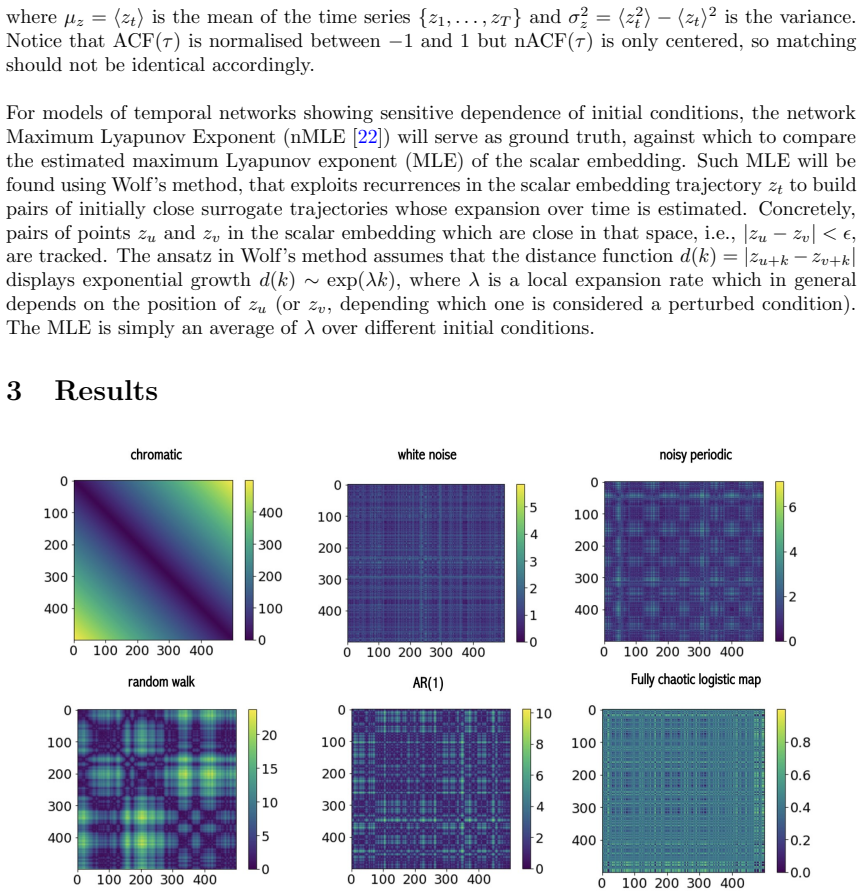
Distance-based PCA and MDS embeddings recover periodicity, memory, change points, and chaos from a network trajectory.
Beyond discrete-subsystem analyses, scanning all partial-information descriptions shows where redundancy and synergy live.
· “Surveying the space of descriptions of a composite system with machine learning”

A full 3-D field map simulation confirms the experiment's expected vacuum sensitivity to axion-photon coupling.
· “An accurate solar axions ray-tracing response of BabyIAXO”
A critical threshold $k_{\mathrm{th}}=\gamma\omega/\sin(\omega\bar{\beta})$ separates growing from fading oscillations; numerics confirm it.

122 years of data tie descending phase to winter and pre-monsoon floods, ascending phase to monsoon.

Laboratory seas with kurtosis near 4 confirm that exceedance probability is just the packet amplitude tail.
· “Rogue Wave Statistics from a Sparse Coherent Structure Decomposition”

Annotated starting points and a subfield map replace the 4,000-paper list.
· “The Living Guide of Machine Learning for Particle Physics”
It estimates how much faster molecules move along one axis even from short, randomly oriented tracks.

Physics-informed attention beats larger models on astrophysical light curves and matches them on milling data.

After the CMIP6 constraint weakens, residual alignment 0.593 recovers HadCRUT5 ECS near 3.00 K.
· “Finite-Response Complementarity in Fluctuation Constraints on Climate Sensitivity”

A training-free, O(1) model predicts clicks on desktop and mobile with 98.1% accuracy while prefetching at a 1.37:1 ratio.

A segmented softplus network trained with Levenberg-Marquardt returns exact gradients, Hessians, and Laplacians.

Nearest-neighbor forecast-error decay gives contraction rates from short recovery responses, without a Jacobian.

A single weak-form regression estimates vol-of-vol, leverage, and mean reversion without option quotes.

Single-bin histogram estimators miss by ~1 kcal/mol; the correct volume term is now explicit.

A doubly block-Toeplitz filter matrix plus SWAP-test inner products removes redundant input prep.
· “Quantum-Efficient Convolution through Sparse Matrix Encoding and Low-Depth Inner Product Circuits”

Weighing alternatives with a physics-motivated focus beats the likelihood-ratio test with no loss of coverage.
· “On Focusing Statistical Power for Searches and Measurements in Particle Physics”

Plaintext hides in a probability landscape; the right permutation restores it, and attackers face an exponential #P wall

Thermodynamically consistent network captures direction-dependent softening that isotropic damage models miss.
· “A Physics-Augmented Machine Learning Constitutive Model for Damage in Solids”

Fitting two merging trend lines to 72 years of local temperatures shows where warming sped up and where it slowed.
· “Change point detection in ERA5 ground temperature time series”

Students recover a physical constant by fitting apparent mass against submerged depth, with Python code included.
First VI ranks which weights drive predictive variance, then HMC samples only those few.

A fast, operator-free route to gas and plasma density maps, still unproven on real fringes.

In both cities, night loops run clockwise upward, day loops anticlockwise downward—time lags set the pattern.

A measurement-and-feedback step lets a two-level engine beat the Carnot bound and run where standard cycles cannot.
· “Information-Assisted Carnot Engine Surpasses Standard Thermodynamic Bounds”

The winning formula pairs two perovskite geometry ratios with LUMO energy, revealing an optimal electronic window.

Fit each window's spectrum to a power law and its slopes and amplitudes recover true causal links despite noise
· “Robust Causal Discovery in Real-World Time Series with Power-Laws”

Preserving the design rather than the code lets analyses be retrained and reparametrized on new data.
The same ~−0.53 scaling for nested communities holds from brains to road grids.

A single information-field model replaces separate reconstructions and returns uncertainties for each observable.
· “Information Field Theory based Event Reconstruction for Cosmic Ray Radio Detectors”

Fisher information selects t = 1/γ; shots drop by up to 50 percent at fixed precision.

Daily Southern Oscillation Index paths show only the 1999–2000 La Niña to 2002–2003 El Niño change near the extreme threshold.
· “Statistics of stochastic entropy for recorded transitions between ENSO states”
