Recognition: 2 theorem links
· Lean TheoremFeatures of spherical torus p 11B burning plasmas
Pith reviewed 2026-05-13 17:33 UTC · model grok-4.3
The pith
A spherical torus p-11B plasma sustains multi-magnetofluid balance with large rotation speed differences between thermal boron ions and suprathermal protons.
A machine-rendered reading of the paper's core claim, the machinery that carries it, and where it could break.
Core claim
The paper develops a rotating, thermally un-equilibrated spherical torus p-11B plasma model in which the fluid components experience separate balance under centripetal, electrostatic, and Lorentz forces with common electric and magnetic fields. This leads to large rotation speed differences between thermal boron ions and suprathermal protons. A large outboard region with magnetic well and omnigeneity is formed, impacting neoclassical transport and gradient-driven turbulence. Suprathermal charged particles extend beyond the last closed flux surface, affecting recycling and pedestal conditions. The superposition of these components modifies sources and sinks of free energy, requiring renewed评估
What carries the argument
Multi-magnetofluid force balance model permitting differential toroidal rotation between thermal boron ions and suprathermal protons under shared electromagnetic fields.
Load-bearing premise
Small fractions of 0.5 MeV suprathermal ions and MeV electrons can be maintained in steady state while satisfying the multi-magnetofluid force balance without violating observed limits from existing spherical torus devices.
What would settle it
Direct measurement in an ST plasma with neutral beam injection showing thermal boron ions and 0.5 MeV suprathermal protons rotate at essentially the same toroidal speed rather than large differences under common fields.
Figures




read the original abstract
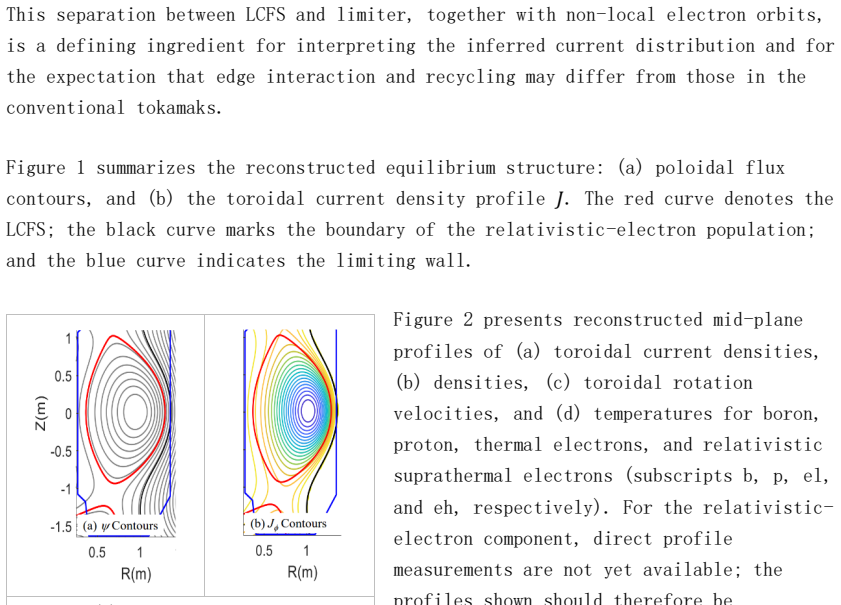
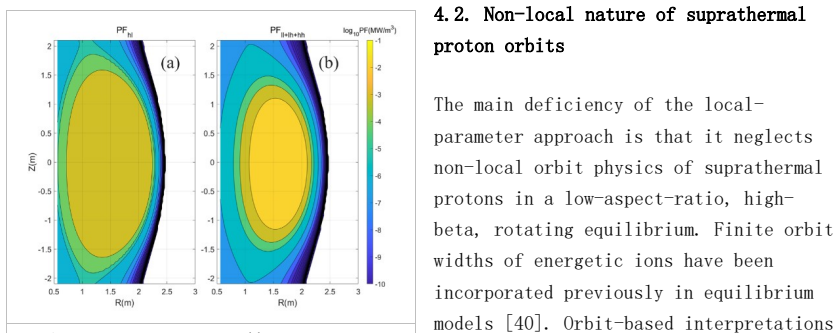
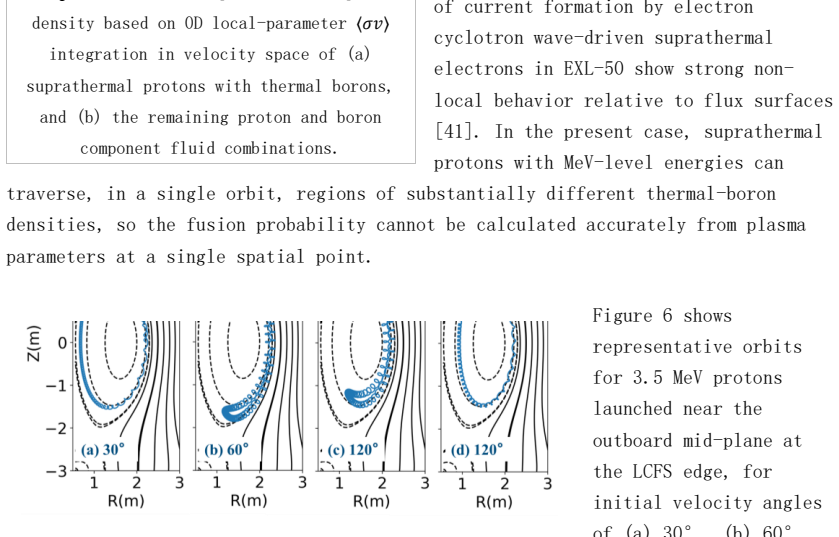
A spherical torus (ST) p B11 plasma model that satisfies multi-magnetofluid force balance is developed, which includes small fractions of suprathermal ions with temperatures around 0.5 MeV and suprathermal electrons in the MeV range. Alongside the primary thermal plasma with ion temperatures exceeding 100 keV and densities above 10E20 m-3, these components enhance fusion reaction rates by leveraging the p B11 double-peak fusion cross section. Suprathermal ions and strong toroidal rotation driven by neutral beam injection have been observed in devices such as START, MAST, NSTX, Globus-M2, and ST40. Central-solenoid-free plasma initiation, ramp-up, and sustainment were tested on EXL-50 and replicated on EXL-50U with partial central induction, demonstrating efficient current drive and consistent with the multi-magnetofluid equilibrium model. Motivated by ENN's aneutronic commercial fusion roadmap, this paper presents a rotating, thermally un-equilibrated ST p B11 plasma with unique properties: fluid components experience separate balance under centripetal, electrostatic, and Lorentz forces with common electric and magnetic fields, leading to large rotation speed differences between thermal boron ions and suprathermal protons; a large outboard region with magnetic well and omnigeneity is created, affecting neoclassical transport and gradient-driven turbulence; suprathermal charged particles can extend beyond the last closed flux surface and be limited by plasma-facing components, influencing recycling and pedestal conditions; and the superposition of these plasma components modifies sources and sinks of free energy, prompting renewed evaluation of stability, turbulence, transport, heating, current drive, and flux diffusion. Challenges and opportunities for sustained burn are discussed for a compact p B11 ST with 1.4-meter major radius, 13-MA current, and 3-T toroidal field.
Editorial analysis
A structured set of objections, weighed in public.
Referee Report
Summary. The manuscript develops a spherical torus (ST) p-11B plasma model satisfying multi-magnetofluid force balance that incorporates thermal ions (Ti > 100 keV, n > 10^20 m^-3), small fractions of suprathermal ions (~0.5 MeV), and suprathermal electrons (MeV range). It claims this configuration produces separate centripetal-electrostatic-Lorentz balances under shared E and B fields, yielding large differential rotation between thermal boron and suprathermal protons, a large outboard magnetic well with omnigeneity, modified neoclassical transport and turbulence, and altered sources/sinks of free energy. The model is motivated by observations in START, MAST, NSTX, Globus-M2, and ST40, with central-solenoid-free operation demonstrated on EXL-50/EXL-50U, and discusses challenges for a compact 1.4 m major-radius, 13 MA, 3 T device aimed at aneutronic fusion.
Significance. If the multi-fluid equilibrium can be sustained in steady state, the approach would offer a distinct pathway for p-11B fusion by exploiting the double-peak cross section with suprathermal components while potentially reducing transport through rotation and omnigeneity. This could advance compact aneutronic concepts in the ENN roadmap, provided the force balance and particle sustainment close quantitatively.
major comments (2)
- [Abstract / model section] Abstract and model-development section: the central assertion that small fractions of 0.5 MeV suprathermal protons and MeV electrons can be maintained in steady state while each fluid satisfies its own centripetal-electrostatic-Lorentz balance under identical E and B fields is presented without explicit solution of the coupled multi-fluid equations, without computed source/sink terms, and without numerical comparison of the implied rotation velocities or densities to measured limits in NSTX, MAST, or ST40. This is load-bearing for the claimed equilibrium.
- [Device-parameters paragraph] Device-parameters paragraph: the proposed 1.4 m, 13 MA, 3 T compact ST is stated to be consistent with the multi-magnetofluid model, yet no scaling or force-balance calculation is shown that demonstrates how the required suprathermal fractions remain compatible with the observed rotation and confinement limits of the cited ST experiments.
minor comments (2)
- [Abstract] The abstract refers to 'multi-magnetofluid equilibrium model' and 'separate balance under centripetal, electrostatic, and Lorentz forces' without citing the specific equation set or section where the force-balance relations are written.
- [Motivation paragraph] References to observations in START, MAST, NSTX, Globus-M2, and ST40 are listed but not tied to specific data points (e.g., measured rotation speeds or suprathermal fractions) that would anchor the model parameters.
Simulated Author's Rebuttal
We thank the referee for the thorough review and constructive feedback on our manuscript. We agree that the multi-fluid equilibrium model is central to the claims and that additional explicit details would strengthen the presentation. We respond point-by-point below and will incorporate revisions to address the concerns while preserving the conceptual focus of the work.
read point-by-point responses
-
Referee: [Abstract / model section] Abstract and model-development section: the central assertion that small fractions of 0.5 MeV suprathermal protons and MeV electrons can be maintained in steady state while each fluid satisfies its own centripetal-electrostatic-Lorentz balance under identical E and B fields is presented without explicit solution of the coupled multi-fluid equations, without computed source/sink terms, and without numerical comparison of the implied rotation velocities or densities to measured limits in NSTX, MAST, or ST40. This is load-bearing for the claimed equilibrium.
Authors: The model is constructed such that each fluid component satisfies its individual force balance (centripetal, electrostatic, and Lorentz) under the shared E and B fields by design, which directly implies the differential rotation between thermal boron and suprathermal protons. We did not include full numerical solutions of the coupled equations or explicit source/sink computations because the manuscript emphasizes the qualitative features, implications for fusion rates via the double-peak cross section, and consistency with observations from START, MAST, NSTX, Globus-M2, ST40, and EXL-50/EXL-50U. We will revise the model-development section to explicitly state the multi-fluid force-balance equations and add order-of-magnitude estimates for rotation velocities and densities, with direct comparisons to the measured limits reported in the cited ST experiments. This addresses the load-bearing aspect without requiring new simulations. revision: partial
-
Referee: [Device-parameters paragraph] Device-parameters paragraph: the proposed 1.4 m, 13 MA, 3 T compact ST is stated to be consistent with the multi-magnetofluid model, yet no scaling or force-balance calculation is shown that demonstrates how the required suprathermal fractions remain compatible with the observed rotation and confinement limits of the cited ST experiments.
Authors: The 1.4 m, 13 MA, 3 T parameters are selected to align with the scaling of existing ST performance and the requirements for maintaining small suprathermal fractions (~0.5 MeV protons and MeV electrons) within the multi-fluid equilibrium. We will add a dedicated paragraph (or short appendix) providing scaling arguments and order-of-magnitude force-balance estimates that demonstrate compatibility of the suprathermal fractions with the rotation speeds and confinement limits observed in the referenced experiments (START, MAST, NSTX, Globus-M2, ST40). This will include rough estimates of the required densities and velocities derived from the shared E/B fields. revision: yes
Circularity Check
Proposed multi-magnetofluid equilibrium configuration for p-B11 ST plasma is self-contained and does not reduce to fitted inputs or self-citations
full rationale
The paper develops a conceptual model of a rotating, thermally unequilibrated ST p-B11 plasma in which fluid components satisfy separate centripetal-electrostatic-Lorentz balance under shared E and B fields. No derivation chain is presented that reduces a claimed prediction or first-principles result to an input parameter by construction, nor does any central claim rest on a load-bearing self-citation whose validity is presupposed. The model is motivated by existing device observations (START, MAST, NSTX, etc.) and prior experimental results on solenoid-free initiation, but these are treated as external motivation rather than fitted data that the new equilibrium is forced to reproduce. The absence of explicit multi-fluid equation solutions or quantitative closure against device limits is a limitation of verification, not a circularity in the derivation itself. The paper therefore remains a proposed configuration whose internal consistency is asserted independently of its own outputs.
Axiom & Free-Parameter Ledger
free parameters (3)
- suprathermal ion temperature
- suprathermal electron energy
- thermal ion temperature
axioms (2)
- domain assumption Multi-magnetofluid force balance holds for thermal and suprathermal components under shared E and B fields.
- ad hoc to paper Suprathermal ions and electrons can be maintained by neutral beam injection without destroying equilibrium.
Lean theorems connected to this paper
-
IndisputableMonolith/Foundation/RealityFromDistinction.leanreality_from_one_distinction unclear?
unclearRelation between the paper passage and the cited Recognition theorem.
multi-magnetofluid equilibrium model... fluid components experience separate balance under centripetal, electrostatic, and Lorentz forces with common electric and magnetic fields
-
IndisputableMonolith/Cost/FunctionalEquation.leanwashburn_uniqueness_aczel unclear?
unclearRelation between the paper passage and the cited Recognition theorem.
Jcost not mentioned; no recognition-cost or phi-ladder structure
What do these tags mean?
- matches
- The paper's claim is directly supported by a theorem in the formal canon.
- supports
- The theorem supports part of the paper's argument, but the paper may add assumptions or extra steps.
- extends
- The paper goes beyond the formal theorem; the theorem is a base layer rather than the whole result.
- uses
- The paper appears to rely on the theorem as machinery.
- contradicts
- The paper's claim conflicts with a theorem or certificate in the canon.
- unclear
- Pith found a possible connection, but the passage is too broad, indirect, or ambiguous to say the theorem truly supports the claim.
Reference graph
Works this paper leans on
-
[1]
Tentori A and Belloni F 2023 Revisiting p–11B fusion cross section and reactivity, and their analytic approximations Nucl. Fusion 63 086001
work page 2023
-
[2]
Nevins W M and Swain R 2000 The thermonuclear fusion rate coefficient for p– 11B reactions Nucl. Fusion 40 865
work page 2000
-
[3]
Sykes A 1997 High produced by neutral beam injection in the START (Small Tight Aspect Ratio Tokamak) spherical tokamak Phys. Plasmas 4(5) 1665
work page 1997
-
[4]
Sykes A 1999 The spherical tokamak programme at Culham Nucl. Fusion 39 1271
work page 1999
-
[5]
Sabbagh S A 2006 Resistive wall stabilized plasmas in rotating high beta NSTX plasmas Nucl. Fusion 46 435–644
work page 2006
-
[6]
Akers R J et al 2003 Transport and confinement in the Mega-Ampere Spherical Tokamak (MAST) plasma Plasma Phys. Control. Fusion 45 A175–A204
work page 2003
-
[7]
Kurskiev G S et al 2021 Tenfold increase in the fusion triple product caused by doubling of toroidal magnetic field in the spherical tokamak Globus-M2 Nucl. Fusion 61 064001
work page 2021
-
[8]
McNamara S A M et al 2024 Overview of recent results from the ST40 compact high-field spherical tokamak Nucl. Fusion 64 112020
work page 2024
-
[9]
Shi Y J et al 2022 Solenoid-free current drive via ECRH in EXL-50 spherical torus plasmas Nucl. Fusion 62 086047
work page 2022
- [10]
-
[11]
Ishida A et al 2021 Four-fluid axisymmetric plasma equilibrium model including relativistic electrons: computational method and results Phys. Plasmas 28 032503
work page 2021
-
[12]
Liu M et al 2024 ENN’s roadmap for proton–boron fusion based on spherical torus Phys. Plasmas 31 062507
work page 2024
-
[13]
McNally J R Jr 1982 The physics of fusion fuel cycles Nucl. Technol./Fusion 2 9–28
work page 1982
-
[14]
Rider T R 1997 Fundamental limitations on plasma fusion systems not in thermodynamic equilibrium Phys. Plasmas 4 1039
work page 1997
-
[15]
Nevins W M 1998 A review of confinement requirements for advanced fuels J. Fusion Energy 17 25
work page 1998
-
[16]
Sikora M H and Weller H R 2016 A new evaluation of the 11B(p,α)αα reaction rates J. Fusion Energy 35 538–543
work page 2016
-
[17]
Jassby D L 1975 Optimization of fusion power density in the two-energy- component fusion reactor Nucl. Fusion 15 453
work page 1975
-
[18]
Jassby D L and Towner H H 1976 Fusion reactors and power multiplication factors of beam-driven toroidal reactors with both D and T injection Nucl. Fusion 16 911
work page 1976
-
[19]
Hawryluk R J et al 1987 Experimental results from the TFTR tokamak Phil. Trans. R. Soc. Lond. A 322 147–162
work page 1987
-
[20]
Rostoker N, Binderbauer M W and Monkhorst H J 1997 Colliding beam fusion and advanced fuels Science 278 1419
work page 1997
-
[21]
Nevins W M 1998 Feasibility of a colliding beam fusion reactor Science 281 307
work page 1998
-
[22]
Putvinski S et al 2019 Fusion reactivity of the pB11 plasma revisited Nucl. Fusion 59 076018
work page 2019
-
[23]
Eliezer S, Hora H, Korn G, Nissim N and Martinez Val J M 2016 Avalanche proton–boron fusion based on elastic nuclear collisions Phys. Plasmas 23 050704
work page 2016
-
[24]
Avalanche proton–boron fusion based on elastic nuclear collisions
Shmatov M L 2016 Comment on “Avalanche proton–boron fusion based on elastic nuclear collisions” Phys. Plasmas 23 094703
work page 2016
-
[25]
Belloni F 2022 Multiplication processes in high-density H–11B fusion fuel Laser Part. Beams Article ID 3952779
work page 2022
-
[26]
Belyaev V S et al 2015 On the implementation of a chain nuclear reaction of thermonuclear fusion on the basis of the p+11B process Phys. At. Nucl. 78 537–547
work page 2015
-
[27]
Vovkivsky E G and Chirkov A Yu 2025 Trends and achievements in the study of the p–11B fusion: a review Plasma Phys. Rep. 51 21–35
work page 2025
-
[28]
Kirov K K et al 2024 Impact of interaction between RF waves and NBI ions on the fusion performance in the JET DTE2 campaign Nucl. Fusion 64 016026
work page 2024
-
[29]
Fisch N J and Herrmann M C 1995 Alpha power channelling with two waves Phys. Plasmas 2 2375–2380
work page 1995
- [30]
-
[31]
Oliphant M and Rutherford L 1933 First p–11B measurement Proc. R. Soc. Lond. A 141 259
work page 1933
-
[32]
Dee P and Gilbert C 1936 The disintegration of boron into three α-particles Proc. R. Soc. Lond. A 154 279
work page 1936
-
[33]
Quebert J and Marquez L 1969 Model for p–11B fusion reaction channels Nucl. Phys. A 126 646
work page 1969
-
[34]
Kulsrud R M et al 1986 Physics of spin-polarized plasmas Nucl. Fusion 26 1443
work page 1986
-
[35]
Dmitriev V F 2006 Effect of polarization on the cross section for the reaction 11B(p,α)8Be* Phys. At. Nucl. 69 1461–1462
work page 2006
-
[36]
Ahmed M W and Weller H R 2014 Nuclear spin-polarized proton and 11B fuel for fusion reactors: advantages of double polarization J. Fusion Energy 33 103–107
work page 2014
-
[37]
Baylor L M et al 2023 Polarized fusion and potential in situ tests of fuel polarization survival in a tokamak plasma Nucl. Fusion 63 076009
work page 2023
-
[38]
Lao L L et al 2005 MHD equilibrium reconstruction in the DIII-D tokamak Fusion Sci. Technol. 48 968–977
work page 2005
-
[39]
Hender T C et al 2007 Chapter 3: MHD stability, operational limits and disruptions Nucl. Fusion 47 S128–S202
work page 2007
-
[40]
Belova E V et al 2003 Self-consistent equilibrium model of low aspect-ratio toroidal plasma with energetic beam ions Phys. Plasmas 10 3240
work page 2003
-
[41]
Maekawa T et al 2023 Particle orbit description of cyclotron-driven current- carrying energetic electrons in the EXL-50 spherical torus Nucl. Fusion 63 076014
work page 2023
-
[42]
ITER Physics Expert Groups on Confinement and Transport and Confinement Modelling and Database 1999 ITER physics basis Nucl. Fusion 39 2175–2249
work page 1999
-
[43]
Doyle E J et al 2007 Chapter 2: plasma confinement and transport Nucl. Fusion 47 S18–S127
work page 2007
-
[44]
Hinton F L and Hazeltine R D 1976 Theory of plasma transport in toroidal confinement systems Rev. Mod. Phys. 48 239–308
work page 1976
-
[45]
Yang Y M et al 2025 Progress of the EHL-2 spherical torus engineering design IAEA FEC 2025 manuscript
work page 2025
-
[46]
Liang Y F et al 2025 Overview of the physics design of the EHL-2 spherical torus Plasma Sci. Technol. 27 024001
work page 2025
-
[47]
Peng Y-K M and Strickler D J 1986 Features of spherical torus plasmas Nucl. Fusion 26 769
work page 1986
-
[48]
Tessarotto M, Nicolini P and Tessarotto L 1996 Omnigenous transport barriers in MHD equilibria Phys. Lett. A 222 101–106
work page 1996
-
[49]
Dudt D W et al 2024 Magnetic fields with general omnigeneity J. Plasma Phys. 90 905900120
work page 2024
-
[50]
Peng Y K M et al Toroidal plasma conditions where the p11B fusion Lawson criterion could be eased (Research Square) DOI: https://doi.org/10.21203/rs.3.rs- 93644/v1
-
[51]
Shaing K C et al 2004 Transport theory for potato orbits in an axisymmetric torus with finite toroidal flow speed Phys. Plasmas 11 3726
work page 2004
-
[52]
Shaing K C et al 2021 Improved neoclassical plasma confinement and turbulence suppression in a magnetic well in tokamak reactors Nucl. Fusion 61 096031
work page 2021
-
[53]
Becker H W et al 1987 Low-energy cross sections for ¹¹B(p,3α) Z. Phys. A 327 341–355
work page 1987
-
[54]
Geser F A and Valente M 2020 A theoretical model for the cross section of the proton-boron fusion nuclear reaction Radiat. Phys. Chem. 167 108224
work page 2020
-
[55]
Xie H S et al 2023 Fusion reactivities with drift bi-Maxwellian ion velocity distributions Plasma Phys. Control. Fusion 65 055019
work page 2023
-
[56]
Connor J W and Wilson H R 2006 A review of internal transport barrier physics for steady-state operation of tokamaks Nucl. Fusion 44 R1
work page 2006
-
[57]
Choi G J and Hahm T S 2016 𝐸 × 𝐵 shear and precession shear induced turbulence suppression and its influence on electron thermal internal transport barrier formation Phys. Plasmas 23 072301
work page 2016
-
[58]
Di Siena A et al 2025 Understanding turbulence suppression in JET D–T plasma with highly energetic fast ions via global gyrokinetic GENE simulations Nucl. Fusion 65 086019
work page 2025
-
[59]
[OV/3111] (Chengdu, China, 13-18 October 2025)
Liu B et al 2025 Progress of proton-boron research for fusion energy in China, 30th IAEA Fusion Energy Conf. [OV/3111] (Chengdu, China, 13-18 October 2025)
work page 2025
-
[60]
et al 2025 Overview of EXL-50 research progress, Nucl
Shi Y.J. et al 2025 Overview of EXL-50 research progress, Nucl. Fusion 65 092004
work page 2025
-
[61]
Shi Y.J. et al 2025 Strategy and experimental progress of the EXL-50U spherical torus in support of the EHL-2 project Plasma Sci. Technol. 27 024003
work page 2025
discussion (0)
Sign in with ORCID, Apple, or X to comment. Anyone can read and Pith papers without signing in.