Information Entropy is a General-Purpose Collective Variable for Enhanced Sampling
Pith reviewed 2026-05-10 18:33 UTC · model grok-4.3
The pith
A local measure of information entropy serves as a general-purpose collective variable for rare-event sampling in atomistic systems.
A machine-rendered reading of the paper's core claim, the machinery that carries it, and where it could break.
Core claim
The central claim is that a local measure of information entropy in atomistic systems functions as a general-purpose collective variable for rare event sampling. Applying well-tempered metadynamics to bias the simulation toward entropy-changing configurations allows blind exploration of potential energy surfaces. This produces unsupervised identification of metastable basins and reaction pathways, including competing channels that standard order parameters cannot access. The method is demonstrated to work across five distinct systems without requiring prior knowledge of the relevant coordinates.
What carries the argument
Local information entropy, deployed as the collective variable inside well-tempered metadynamics to bias sampling toward entropy-altering atomic configurations.
If this is right
- Unsupervised discovery of unanticipated transition mechanisms and intermediates becomes feasible in both molecular and condensed-phase systems.
- The same entropy-based variable applies without modification to conformational sampling, homogeneous nucleation, glass formation, and solid-state phase changes.
- Competing transition channels that remain hidden from conventional order parameters are revealed through the entropy bias.
- Simulations balance the drive for novelty against thermodynamic accessibility by construction of the well-tempered metadynamics protocol.
Where Pith is reading between the lines
- The entropy variable could be combined with other bias methods to handle systems where entropy changes are secondary to other driving forces.
- Because the measure is local and system-agnostic, it may reduce the expertise required to set up sampling for complex materials or biomolecules.
- In long simulations the same bias might uncover non-equilibrium pathways that equilibrium sampling alone would not reach.
Load-bearing premise
Biasing toward entropy-changing configurations will locate all thermodynamically relevant metastable basins and pathways without missing important low-entropy states or needing case-by-case tuning.
What would settle it
A system in which a known, important transition occurs between basins of nearly identical local entropy; the method would then fail to accelerate sampling of that transition or would miss it entirely.
Figures

read the original abstract
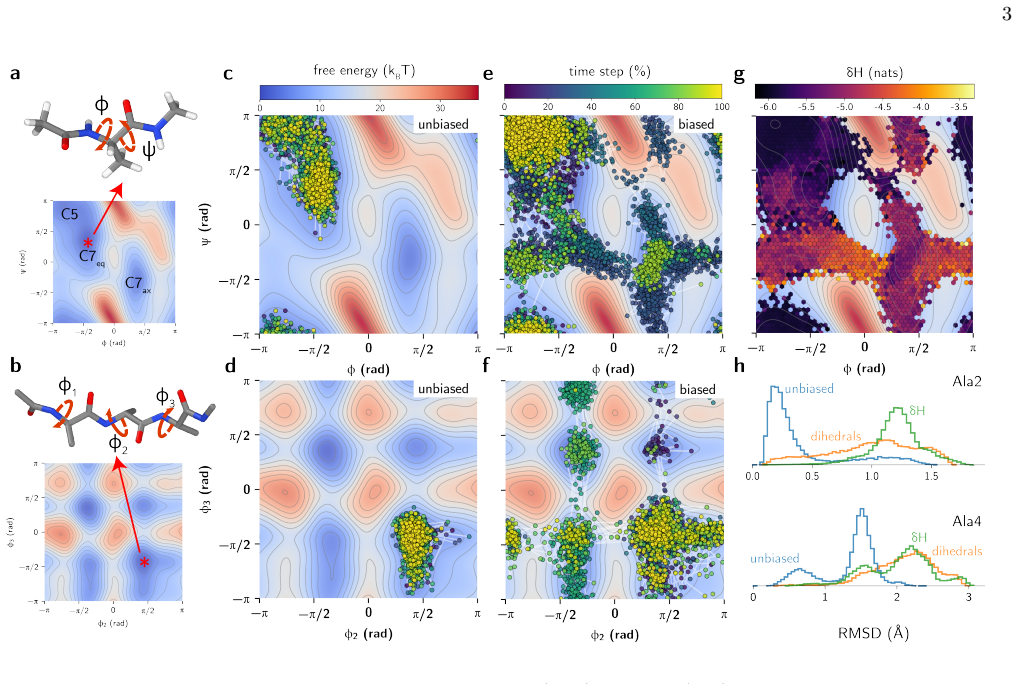
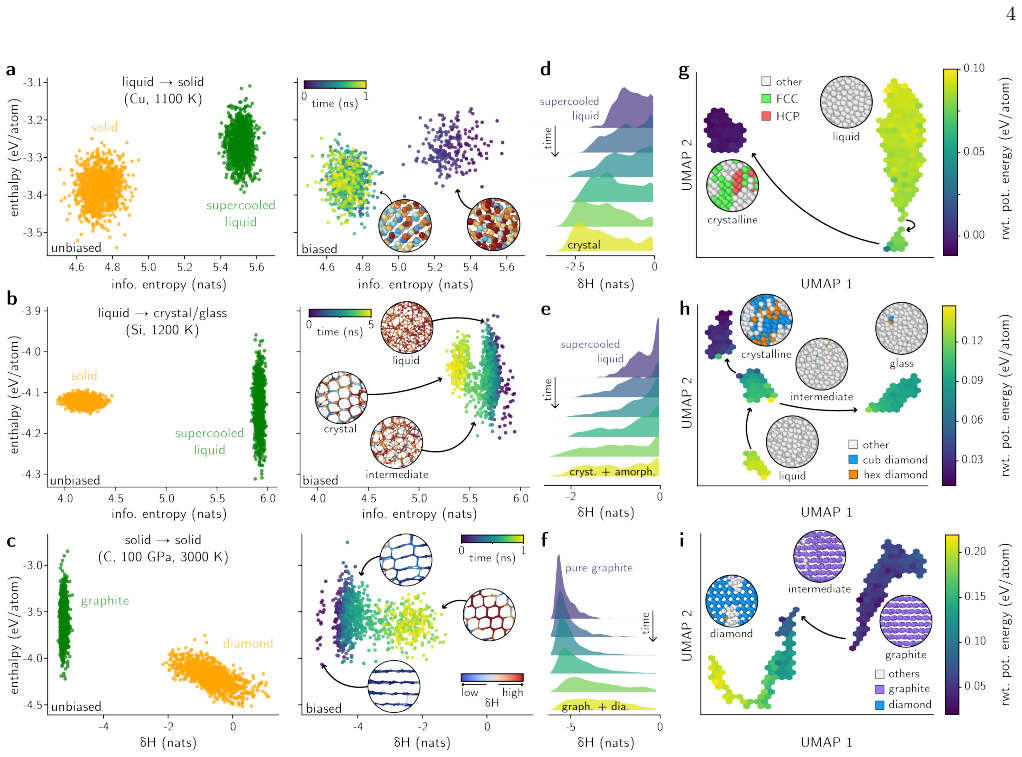
Enhanced sampling methods typically require predefined collective variables (CVs) that presuppose knowledge of reaction coordinates, restricting the discovery of unanticipated transition mechanisms or intermediates. Here, we show that a local measure of information entropy in atomistic systems is a general-purpose CV for rare event sampling across molecular and condensed-phase systems. The method biases simulations toward entropy-changing configurations following a well-tempered metadynamics approach, thus balancing novelty and thermodynamic accessibility. Blind exploration of potential energy surfaces enables unsupervised discovery of metastable basins and reaction pathways, including competing transition channels inaccessible to conventional order parameters. We demonstrate the generality of the method across five systems spanning conformational sampling, homogeneous nucleation, glass formation, and solid-state phase transformations.
Editorial analysis
A structured set of objections, weighed in public.
Referee Report
Summary. The manuscript proposes a local information entropy measure as a general-purpose collective variable (CV) for enhanced sampling of rare events in atomistic systems. It applies well-tempered metadynamics to bias simulations toward entropy-changing configurations, enabling unsupervised discovery of metastable basins and competing reaction pathways. The approach is demonstrated across five systems spanning conformational sampling, homogeneous nucleation, glass formation, and solid-state phase transformations, without presupposing system-specific reaction coordinates.
Significance. If the central claim holds with adequate validation, the work could advance enhanced sampling by offering a transferable CV that facilitates blind exploration of potential energy surfaces in both molecular and condensed-phase systems. The reliance on standard well-tempered metadynamics is a strength, as it avoids introducing additional fitted parameters beyond the entropy estimator itself.
major comments (2)
- [Abstract] Abstract: the assertion of demonstrations across five systems provides no quantitative results, entropy definition details, or validation metrics (e.g., recovered free-energy barriers, success rates in locating known states, or comparison to conventional CVs), leaving the central generality claim with limited evidential support.
- [Methods] CV definition (Methods section): standard local Shannon entropy over neighbor distributions requires at minimum a cutoff radius for the local environment and a discretization/binning scheme; if these choices are not fixed and transferable without per-system optimization, the method reduces to a conventional tuned CV rather than a parameter-free general-purpose one, directly affecting the no-tuning claim.
minor comments (2)
- [Methods] Clarify the exact formula for the local entropy estimator, including how probability distributions are constructed from atomic coordinates.
- [Results] Add explicit discussion of how low-entropy states are ensured not to be missed when biasing toward entropy changes.
Simulated Author's Rebuttal
We thank the referee for the constructive feedback and positive assessment of our manuscript. We address the major comments point by point below, providing clarifications and indicating revisions where we have incorporated the suggestions.
read point-by-point responses
-
Referee: [Abstract] Abstract: the assertion of demonstrations across five systems provides no quantitative results, entropy definition details, or validation metrics (e.g., recovered free-energy barriers, success rates in locating known states, or comparison to conventional CVs), leaving the central generality claim with limited evidential support.
Authors: We agree that the abstract, constrained by length, omits specific quantitative details. The main text, figures, and supplementary information provide extensive validation, including recovered free-energy barriers consistent with literature values, high success rates in locating known metastable states across systems, and comparisons demonstrating superior exploration of competing pathways relative to conventional CVs. We have revised the abstract to include a concise statement highlighting these validation aspects and added a summary table of key metrics in the results section of the revised manuscript. revision: yes
-
Referee: [Methods] CV definition (Methods section): standard local Shannon entropy over neighbor distributions requires at minimum a cutoff radius for the local environment and a discretization/binning scheme; if these choices are not fixed and transferable without per-system optimization, the method reduces to a conventional tuned CV rather than a parameter-free general-purpose one, directly affecting the no-tuning claim.
Authors: The cutoff radius is fixed by the first minimum of the radial distribution function, a standard and transferable choice independent of system-specific tuning. The discretization employs a fixed bin count (30 bins) chosen for statistical reliability across diverse systems. Sensitivity tests in the supplementary information confirm robustness to reasonable variations in these parameters, preserving the discovered basins and pathways. We have expanded the Methods section with explicit details on these fixed choices and the supporting analyses to reinforce the general-purpose character of the CV. revision: yes
Circularity Check
No circularity; derivation applies standard entropy definition to metadynamics without reduction to inputs
full rationale
The paper defines a local information entropy CV from first-principles neighbor distributions (standard Shannon entropy), then applies unmodified well-tempered metadynamics to bias along it. No equation reduces the claimed generality or discovered pathways to a fitted parameter or self-citation by construction. The approach is tested across independent systems with the CV held fixed, making the central result externally falsifiable rather than tautological.
Axiom & Free-Parameter Ledger
axioms (1)
- standard math Well-tempered metadynamics is a valid method for enhanced sampling that balances exploration and thermodynamic accessibility.
Lean theorems connected to this paper
-
IndisputableMonolith/Foundation/BranchSelectionbranch_selection unclear?
unclearRelation between the paper passage and the cited Recognition theorem.
biasing simulations toward entropy-changing configurations following a well-tempered metadynamics approach
What do these tags mean?
- matches
- The paper's claim is directly supported by a theorem in the formal canon.
- supports
- The theorem supports part of the paper's argument, but the paper may add assumptions or extra steps.
- extends
- The paper goes beyond the formal theorem; the theorem is a base layer rather than the whole result.
- uses
- The paper appears to rely on the theorem as machinery.
- contradicts
- The paper's claim conflicts with a theorem or certificate in the canon.
- unclear
- Pith found a possible connection, but the passage is too broad, indirect, or ambiguous to say the theorem truly supports the claim.
Reference graph
Works this paper leans on
-
[1]
Wagner, J., Thompson, M., Dotson, D., Rodr ´ıguez-Guerra, J.et al.openforcefield/openff- forcefields: Version 2.0. 0” sage”.Zenodo(2021)
work page 2021
-
[2]
The Journal of Physical Chemistry B128, 109–116 (2023)
Eastman, P .et al.Openmm 8: molecular dynamics simulation with machine learning potentials. The Journal of Physical Chemistry B128, 109–116 (2023)
work page 2023
-
[3]
F.et al.Pysages: flexible, advanced sampling methods accelerated with gpus
Zubieta Rico, P . F.et al.Pysages: flexible, advanced sampling methods accelerated with gpus. npj Computational Materials10, 35 (2024)
work page 2024
-
[4]
Thompson, A. P .et al.Lammps-a flexible simulation tool for particle-based materials modeling at the atomic, meso, and continuum scales.Computer Physics Communications271, 108171 (2022)
work page 2022
-
[5]
Mishin, Y., Mehl, M. J., Papaconstantopoulos, D. A., Voter, A. F. & Kress, J. D. Structural stability and lattice defects in copper: Ab initio, tight-binding, and embedded-atom calculations.Physical Review B63, 224106 (2001)
work page 2001
-
[6]
Bechelli, S.et al.Free energy of nucleation and interplay between size and composition in cuni systems.The Journal of Physical Chemistry B121, 8558–8563 (2017)
work page 2017
-
[7]
Desgranges, C. & Delhommelle, J. Effect of the composition on the free energy of crystal nucle- ation for cupd nanoalloys.The Journal of Physical Chemistry C120, 27657–27664 (2016)
work page 2016
-
[8]
Stillinger, F. H. & Weber, T. A. Computer simulation of local order in condensed phases of silicon.Physical Review B31, 5262 (1985)
work page 1985
-
[9]
Beaucage, P . & Mousseau, N. Nucleation and crystallization process of silicon using the stillinger-weber potential.Physical Review B71, 094102 (2005)
work page 2005
-
[10]
Empirical interatomic potential for carbon, with applications to amorphous carbon
Tersoff, J. Empirical interatomic potential for carbon, with applications to amorphous carbon. Physical Review Letters61, 2879 (1988)
work page 1988
-
[11]
Fahy, S., Louie, S. G. & Cohen, M. L. Pseudopotential total-energy study of the transition from rhombohedral graphite to diamond.Physical Review B34, 1191 (1986)
work page 1986
-
[12]
Larsen, P . M., Schmidt, S. & Schiøtz, J. Robust structural identification via polyhedral template matching.Modelling and Simulation in Materials Science and Engineering24, 055007 (2016). 9
work page 2016
discussion (0)
Sign in with ORCID, Apple, or X to comment. Anyone can read and Pith papers without signing in.