Recognition: 2 theorem links
· Lean TheoremEffects of Tungsten Radiative Cooling on Impurity, Heat and Momentum Transport in DIII-D Plasmas
Pith reviewed 2026-05-10 17:56 UTC · model grok-4.3
The pith
Tungsten radiative cooling in DIII-D lowers electron temperature, stabilizes TEM turbulence, and doubles toroidal rotation while peaking ion temperature.
A machine-rendered reading of the paper's core claim, the machinery that carries it, and where it could break.
Core claim
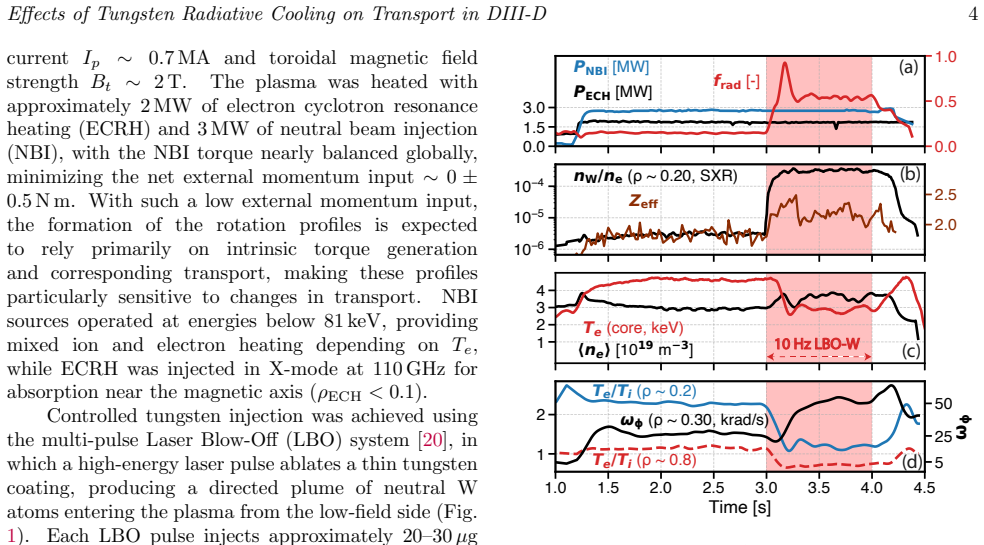
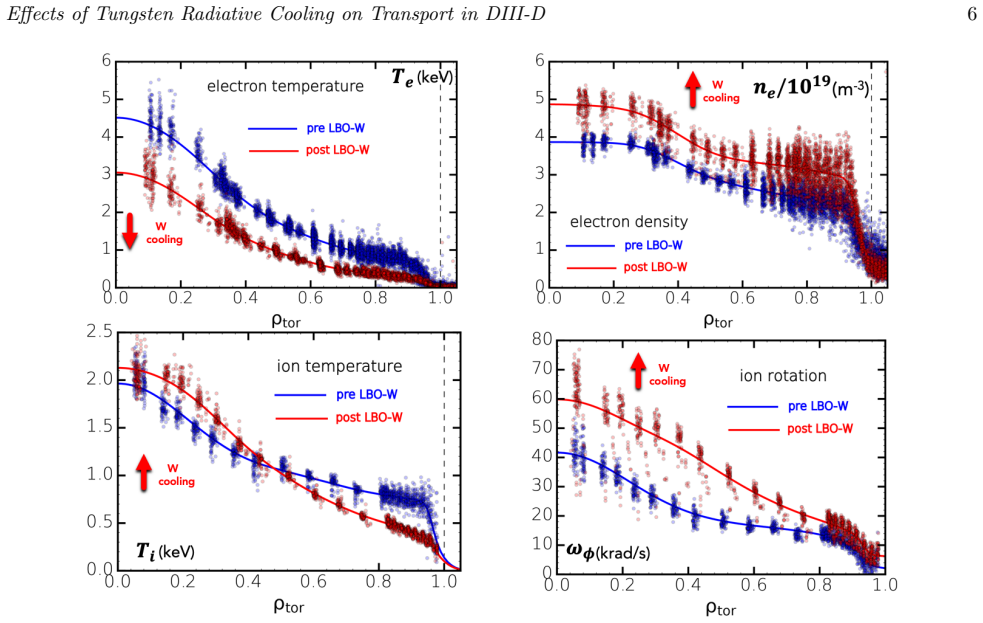
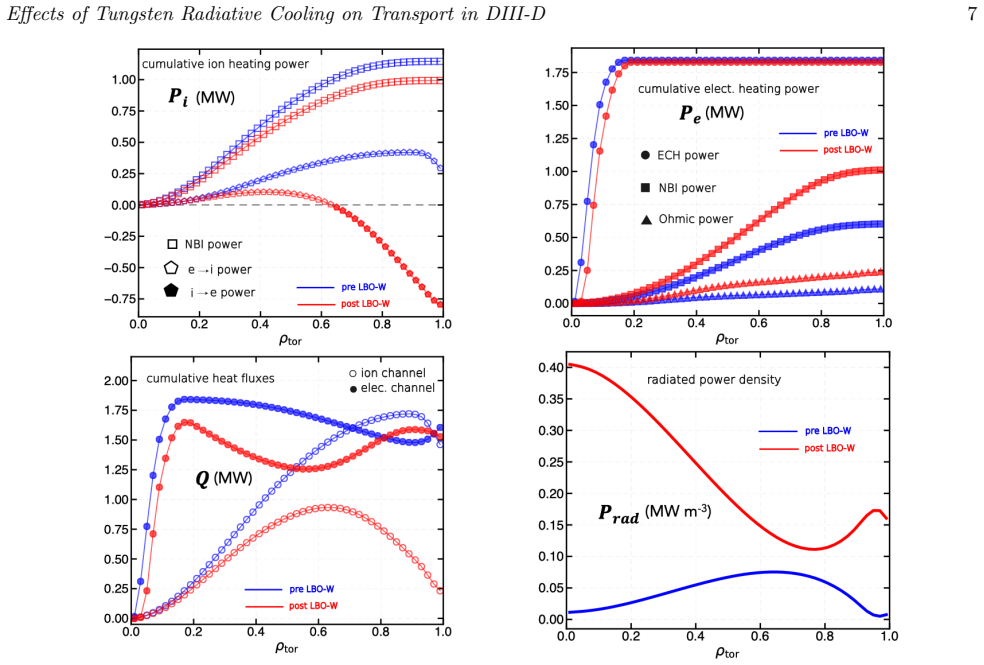
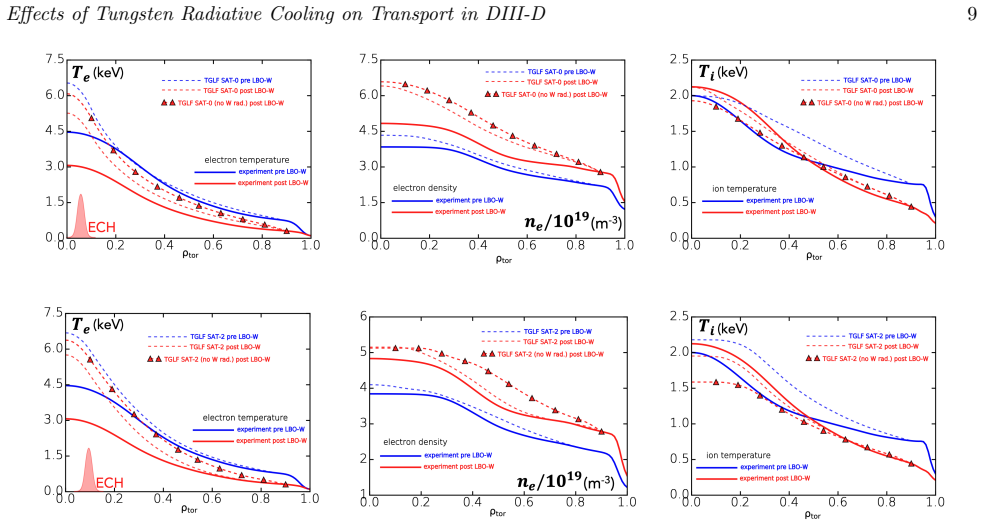
In the DIII-D tokamak, controlled tungsten injection under WEST-like conditions produces a high-radiation regime with core tungsten concentration around 3 times 10 to the minus 4 and radiated power fraction above 0.5. The resulting radiative cooling lowers electron temperature and therefore the ratio T_e over T_i. This ratio reduction stabilizes trapped-electron-mode turbulence, which in turn reduces momentum and ion thermal diffusivities. The lower diffusivities cause the ion temperature to peak and toroidal rotation to increase by a factor of two. Enhanced E times B shear and collisionality in the outer region further suppress ion-scale turbulence, dropping the ion heat flux sharply. Impur
What carries the argument
The reduction in the electron-to-ion temperature ratio (T_e/T_i) caused by tungsten radiative cooling, which stabilizes trapped-electron-mode turbulence and thereby lowers ion thermal and momentum transport coefficients.
If this is right
- Ion temperature profiles become peaked because ion thermal diffusivity falls.
- Toroidal rotation rises by a factor of two as momentum diffusivity decreases.
- Tungsten impurity transport changes from turbulent to neoclassical inward convection, bootstrapping the radiative cooling.
- No radiative collapse occurs despite radiated power fraction above 0.5, owing to ion-electron energy exchange and 1/1 MHD modulation.
- The turbulence stabilization supports preparation for a tungsten wall in DIII-D and informs performance in WEST and future radiating reactors.
Where Pith is reading between the lines
- Tungsten radiation could serve as a passive actuator to control ion-scale turbulence and rotation in reactor-scale plasmas without external momentum input.
- The self-reinforcing inward tungsten convection may appear in other high-Z radiating scenarios and could be tested by varying impurity species.
- Similar T_e/T_i reductions achieved by other means might reproduce the transport changes, offering a route to separate the temperature-ratio effect from impurity-specific transport.
Load-bearing premise
The measured reductions in ion thermal and momentum diffusivities are caused primarily by the TEM stabilization from lowered T_e/T_i rather than by concurrent changes in density profiles, E times B shear, or other plasma parameters.
What would settle it
A plasma in which electron temperature is lowered by a different method (such as added electron heating or different impurity) while holding density gradients, flow shear, and collisionality fixed shows no corresponding drop in ion heat or momentum diffusivity.
Figures






read the original abstract
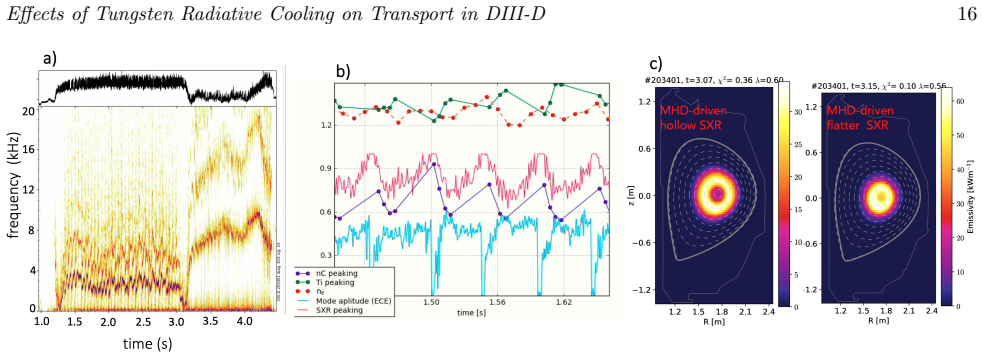
A first-of-its-kind experiment was conducted in the DIII-D tokamak under WEST similarity constraints on plasma shape and core parameters. This work presents a detailed transport study comparing a reference regime dominated by intrinsic carbon radiation and a high-radiation regime resulting from controlled tungsten (W) injection using the Laser Blow-Off system, with a core tungsten concentration $n_{\mathrm{W}}/n_e \sim 3\times 10^{-4}$ and a radiated-power fraction $f_\mathrm{rad}>0.5$. The W-induced radiative cooling lowered the electron temperature, thereby decreasing $T_e/T_i$ and stabilizing trapped-electron-mode (TEM) turbulence. This transition in turbulence regime reduced momentum and ion thermal diffusivities, yielding ion temperature peaking and a factor-of-two increase in toroidal rotation. At the outer plasma region, enhanced $E\timesB$ shear and increased collisionality further suppressed ion-scale turbulence, causing a sharp drop in ion heat flux. Consequently, impurity transport, predominantly turbulent in the low-radiation regime, acquired a strong neoclassical inward W convection during radiative cooling, bootstrapping the cooling cycle. Despite $f_\mathrm{rad}>0.5$, radiative collapse was not observed, likely owing to collisional ion-to-electron energy exchange acting as an electron-energy reservoir, together with $1/1$ MHD activity modulating the radiated power through core impurity neoclassical $T_i$-screening. These results support preparation for a tungsten wall change in DIII-D by elucidating tungsten-induced turbulence stabilization. They also provide key insights for interpreting plasma performance in WEST and are relevant to future reactors expected to operate with radiating tungsten-walled plasmas.
Editorial analysis
A structured set of objections, weighed in public.
Referee Report
Summary. The manuscript presents a DIII-D experiment comparing a reference plasma regime with intrinsic carbon radiation to a high-radiation regime achieved via controlled tungsten injection (core n_W/n_e ~ 3e-4, f_rad > 0.5) under WEST-similarity constraints. It claims that W-induced radiative cooling lowers electron temperature and thus Te/Ti, stabilizing trapped-electron-mode (TEM) turbulence; this reduces ion thermal and momentum diffusivities, producing ion-temperature peaking and a factor-of-two increase in toroidal rotation. At outer radii, enhanced E×B shear and collisionality further suppress turbulence. Impurity transport shifts from turbulent to neoclassical inward W convection, and radiative collapse is avoided via ion-electron energy exchange and 1/1 MHD activity. The results are positioned as preparation for a tungsten wall in DIII-D and relevant to WEST and reactor plasmas.
Significance. If the primary causal link between Te/Ti-driven TEM stabilization and the observed diffusivity reductions holds after quantitative isolation from concurrent profile changes, the work would provide valuable experimental insight into how controlled impurity radiation can improve confinement in tungsten-walled devices. The controlled injection method, direct regime comparison, and discussion of mechanisms preventing collapse add practical relevance for future high-radiation scenarios.
major comments (2)
- [Abstract] Abstract: The central claim attributes the reductions in ion thermal and momentum diffusivities primarily to TEM stabilization from lowered Te/Ti. However, the same paragraph lists concurrent changes (density profile evolution, enhanced E×B shear, increased collisionality) without a quantitative decomposition. Transport analysis yields the diffusivity drops, but the manuscript does not demonstrate that varying only Te/Ti (while holding other parameters fixed) in linear or nonlinear gyrokinetic simulations reproduces the observed reductions; this leaves the turbulence-regime-transition explanation correlative rather than isolated as dominant.
- [Transport and turbulence analysis] Transport and turbulence analysis sections: The power-balance-derived diffusivities and any accompanying stability calculations need explicit parameter scans or sensitivity studies that separate the Te/Ti effect from the listed concurrent changes. Without such isolation, the causal attribution to TEM stabilization cannot be confirmed as the load-bearing mechanism for the reported factor-of-two rotation increase and ion-temperature peaking.
minor comments (2)
- [Abstract] Abstract: The phrase 'first-of-its-kind' should be qualified by explicit comparison to prior tungsten-injection or high-radiation studies in DIII-D or similar devices to clarify the precise novelty.
- [Notation and figures] Notation: The definition and radial extent of the 'outer plasma region' where E×B shear and collisionality effects are invoked should be stated consistently with the profile figures or transport analysis.
Simulated Author's Rebuttal
We thank the referee for the careful review and for recognizing the experiment's relevance to tungsten-walled devices. We address the major comments below by agreeing that quantitative isolation of the Te/Ti effect would strengthen the causal claims. We will incorporate the requested sensitivity studies in the revised manuscript.
read point-by-point responses
-
Referee: [Abstract] Abstract: The central claim attributes the reductions in ion thermal and momentum diffusivities primarily to TEM stabilization from lowered Te/Ti. However, the same paragraph lists concurrent changes (density profile evolution, enhanced E×B shear, increased collisionality) without a quantitative decomposition. Transport analysis yields the diffusivity drops, but the manuscript does not demonstrate that varying only Te/Ti (while holding other parameters fixed) in linear or nonlinear gyrokinetic simulations reproduces the observed reductions; this leaves the turbulence-regime-transition explanation correlative rather than isolated as dominant.
Authors: We agree that the abstract presents the Te/Ti-driven TEM stabilization as the primary mechanism while noting concurrent changes, without explicit isolation. The manuscript's transport analysis derives the diffusivity reductions from power balance and shows reduced TEM growth rates via linear stability calculations in the two regimes. To strengthen the attribution, we will add linear gyrokinetic parameter scans in the revised version that vary only Te/Ti while holding density profiles, E×B shear, and collisionality fixed at the reference values. These scans will be summarized in the abstract and detailed in the transport section to demonstrate that the Te/Ti reduction accounts for the majority of the growth-rate suppression. revision: yes
-
Referee: [Transport and turbulence analysis] Transport and turbulence analysis sections: The power-balance-derived diffusivities and any accompanying stability calculations need explicit parameter scans or sensitivity studies that separate the Te/Ti effect from the listed concurrent changes. Without such isolation, the causal attribution to TEM stabilization cannot be confirmed as the load-bearing mechanism for the reported factor-of-two rotation increase and ion-temperature peaking.
Authors: We concur that the current analysis would benefit from clearer separation of effects to confirm the load-bearing role of Te/Ti-driven TEM stabilization. The manuscript already compares linear growth rates between regimes, attributing the primary reduction to lowered Te/Ti, with secondary suppression from enhanced E×B shear and collisionality at outer radii. In revision we will add explicit sensitivity studies: linear scans isolating Te/Ti, plus quantitative estimates of each parameter's contribution to the diffusivity changes via the transport equations. This will support the reported ion-temperature peaking and rotation increase as primarily resulting from the turbulence-regime transition, while acknowledging the role of the other changes. revision: yes
Circularity Check
No circularity: experimental transport study with independent measurements
full rationale
The paper reports a controlled DIII-D experiment comparing reference carbon-dominated and tungsten-injected high-radiation regimes under WEST similarity constraints. Central claims rest on direct profile measurements, power-balance transport analysis, and standard gyrokinetic modeling of TEM stabilization from observed Te/Ti changes. No derivation step equates a fitted parameter or self-cited result to the target outcome by construction; the turbulence-regime transition is inferred from measured quantities rather than assumed. Self-citations, if present, are not load-bearing for the primary experimental findings. The analysis chain is self-contained against external benchmarks and falsifiable via the reported data.
Axiom & Free-Parameter Ledger
free parameters (1)
- core tungsten concentration
axioms (2)
- domain assumption Trapped-electron-mode turbulence is stabilized when the electron-to-ion temperature ratio decreases
- domain assumption Impurity transport becomes neoclassically dominated under increased collisionality during radiative cooling
Lean theorems connected to this paper
-
Cost/FunctionalEquationwashburn_uniqueness_aczel unclear?
unclearRelation between the paper passage and the cited Recognition theorem.
The W-induced radiative cooling lowered the electron temperature, thereby decreasing Te/Ti and stabilizing trapped-electron-mode (TEM) turbulence. This transition in turbulence regime reduced momentum and ion thermal diffusivities...
-
Foundation/AlexanderDualityalexander_duality_circle_linking unclear?
unclearRelation between the paper passage and the cited Recognition theorem.
At the outer plasma region, enhanced E×B shear and increased collisionality further suppressed ion-scale turbulence...
What do these tags mean?
- matches
- The paper's claim is directly supported by a theorem in the formal canon.
- supports
- The theorem supports part of the paper's argument, but the paper may add assumptions or extra steps.
- extends
- The paper goes beyond the formal theorem; the theorem is a base layer rather than the whole result.
- uses
- The paper appears to rely on the theorem as machinery.
- contradicts
- The paper's claim conflicts with a theorem or certificate in the canon.
- unclear
- Pith found a possible connection, but the passage is too broad, indirect, or ambiguous to say the theorem truly supports the claim.
Reference graph
Works this paper leans on
-
[1]
The new iter baseline, research plan and open r&d issues.Plasma Physics and Controlled Fusion, 67(6):065023, June 2025
A Loarte et al. The new iter baseline, research plan and open r&d issues.Plasma Physics and Controlled Fusion, 67(6):065023, June 2025
2025
-
[2]
Rodriguez-Fernandez et al
P. Rodriguez-Fernandez et al. Overview of the sparc physics basis towards the exploration of burning-plasma regimes in high-field, compact tokamaks.Nuclear Fusion, 62(4):042003, March 2022
2022
-
[3]
A. J. Creely, D. Brunner, R. T. Mumgaard, M. L. Reinke, M. Segal, B. N. Sorbom, and M. J. Greenwald. Sparc as a platform to advance tokamak science.Physics of Plasmas, 30(9), September 2023
2023
-
[4]
Lion et al
J. Lion et al. Stellaris: A high-field quasi-isodynamic stellarator for a prototypical fusion power plant.Fusion Engineering and Design, 214:114868, May 2025
2025
-
[5]
Guttenfelder et al
W. Guttenfelder et al. Predictions of core plasma performance for the infinity two fusion pilot plant. Journal of Plasma Physics, 91(3), March 2025
2025
-
[6]
Observations on the w-transport in the core plasma of jet and asdex upgrade.Plasma Physics and Controlled Fusion, 55(12):124036, November 2013
T P¨ utterich et al. Observations on the w-transport in the core plasma of jet and asdex upgrade.Plasma Physics and Controlled Fusion, 55(12):124036, November 2013
2013
-
[7]
Theory- based integrated modelling of tungsten transport in iter plasmas.Plasma Physics and Controlled Fusion, 67(1):015020, December 2024
D Fajardo, C Angioni, S H Kim, F Koechl, E Fable, A Loarte, A Polevoi, and G Tardini. Theory- based integrated modelling of tungsten transport in iter plasmas.Plasma Physics and Controlled Fusion, 67(1):015020, December 2024
2024
-
[8]
Chapter 1: Asdex upgrade - introduction and overview.Fusion Science and Technology, 44(3):569–577, November 2003
Albrecht Herrmann and Otto Gruber. Chapter 1: Asdex upgrade - introduction and overview.Fusion Science and Technology, 44(3):569–577, November 2003
2003
-
[9]
R. Neu, R. Dux, A. Geier, O. Gruber, A. Kallenbach, K. Krieger, H. Maier, R. Pugno, V. Rohde, and S. Schweizer. Tungsten as plasma-facing material in asdex upgrade.Fusion Engineering and Design, 65(3):367–374, 2003. 1st International Workshop on Innovative Concepts for Plasma - Interactive Components in Fusion Devices
2003
-
[10]
Ten years of w programme in asdex upgrade—challenges and conclusions.Physica Scripta, T138:014038, December 2009
R Neu, V Bobkov, R Dux, J C Fuchs, O Gruber, A Herrmann, A Kallenbach, H Maier, M Mayer, T P¨ utterich, V Rohde, A C C Sips, J Stober, K Sugiyama, and ASDE Upgrade Team. Ten years of w programme in asdex upgrade—challenges and conclusions.Physica Scripta, T138:014038, December 2009
2009
-
[11]
Jet iter-like wall—overview and experimental programme.Physica Scripta, T145:014001, December 2011
G F Matthews, M Beurskens, S Brezinsek, M Groth, E Joffrin, A Loving, M Kear, M-L Mayoral, R Neu, P Prior, V Riccardo, F Rimini, M Rubel, G Sips, E Villedieu, P de Vries, and M L Watkins. Jet iter-like wall—overview and experimental programme.Physica Scripta, T145:014001, December 2011
2011
-
[12]
Luo et al
G.-N. Luo et al. Overview of decade-long development of plasma-facing components at asipp.Nuclear Fusion, 57(6):065001, April 2017
2017
-
[13]
Overview of the kstar experiments toward fusion reactor.Nuclear Fusion, 64(11):112010, August 2024
Won-Ha Ko et al. Overview of the kstar experiments toward fusion reactor.Nuclear Fusion, 64(11):112010, August 2024
2024
-
[14]
Bucalossi et al
J. Bucalossi et al. West full tungsten operation with an iter grade divertor.Nuclear Fusion, 64(11):112022, September 2024
2024
-
[15]
Bourdelle et al
C. Bourdelle et al. West physics basis.Nuclear Fusion, 55(6):063017, May 2015
2015
-
[16]
Richou, M
M. Richou, M. Missirlian, D. Guilhem, M. Lipa, P. Languille, F. Ferlay, F. Gallay, H. Greuner, C. Hernandez, M. Firdaouss, and J. Bucalossi. Design and preliminary thermal validation of the west actively cooled upper divertor.Fusion Engineering and Design, 98–99:1394–1398, October 2015
2015
-
[17]
Holcomb et al
C.T. Holcomb et al. Diii-d research to provide solutions for iter and fusion energy.Nuclear Fusion, 64(11):112003, August 2024
2024
-
[18]
Turco, T
F. Turco, T. Petrie, T. Osborne, C.C. Petty, T.C. Luce, B. Grierson, T. Odstrcil, M.A. Van Zeeland, D. Liu, L. Casali, W. Boyes, S.P. Smith, H. Shen, M. Kostuk, and D. Brennan. The physics basis to integrate an mhd Effects of Tungsten Radiative Cooling on Transport in DIII-D20 stable, high-power hybrid scenario to a cool divertor for steady-state reactor ...
2023
-
[19]
First diii-d-west hybrid scenario similarity experiments for iter-relevant long- pulse operation.Plasma Physics and Controlled Fusion, April 2026
Xavier L Litaudon et al. First diii-d-west hybrid scenario similarity experiments for iter-relevant long- pulse operation.Plasma Physics and Controlled Fusion, April 2026
2026
-
[20]
Tema Biwole, N
A. Tema Biwole, N. T. Howard, T. Odstrˇ cil, J. Hughes, R. Viera, R. Leccacorvi, M. Winkel, K. Augustin, and S. Pierson. A multi-pulse, multi-species laser blow- off system for impurity transport studies on diii-d. Submitted to Review of Scientific Instruments, 2026
2026
-
[21]
Turco, T.C
F. Turco, T.C. Luce, ACC. Sips, C. Greenfield, T. Osborne, T. Odstrcil, J.M. Hanson, A. McLean, and A.W. Hyatt. First tungsten radiation studies in diii-d’s iter baseline demonstration discharges.Nuclear Fusion, 64(7):076063, June 2024
2024
-
[22]
Turco, T.C
F. Turco, T.C. Luce, T. Osborne, T. Odstrcil, J.M. Hanson, A. McLean, and A. Hyatt. Radiation induced non-linear oscillations in iter baseline scenario plasmas in diii-d. Nuclear Fusion, 64(8):086008, June 2024
2024
-
[23]
C Gormezano, A.C.C Sips, T.C Luce, S Ide, A Becoulet, X Litaudon, A Isayama, J Hobirk, M.R Wade, T Oikawa, R Prater, A Zvonkov, B Lloyd, T Suzuki, E Barbato, P Bonoli, C.K Phillips, V Vdovin, E Joffrin, T Casper, J Ferron, D Mazon, D Moreau, R Bundy, C Kessel, A Fukuyama, N Hayashi, F Imbeaux, M Murakami, A.R Polevoi, and H.E. St John. Chapter 6: Steady s...
2007
-
[24]
Petty, J.E
C.C. Petty, J.E. Kinsey, C.T. Holcomb, J.C. DeBoo, E.J. Doyle, J.R. Ferron, A.M. Garofalo, A.W. Hyatt, G.L. Jackson, T.C. Luce, M. Murakami, P.A. Politzer, and H. Reimerdes. High-beta, steady-state hybrid scenario on diii-d.Nuclear Fusion, 56(1):016016, December 2015
2015
-
[25]
Odstrcil, J
M. Odstrcil, J. Mlynar, T. Odstrcil, B. Alper, and A. Murari. Modern numerical methods for plasma tomography optimisation.Nuclear Instruments and Methods in Physics Research Section A: Accelerators, Spectrometers, Detectors and Associated Equipment, 686:156–161, September 2012
2012
-
[26]
Odstrˇ cil, T
T. Odstrˇ cil, T. P¨ utterich, M. Odstrˇ cil, A. Gude, V. Igo- chine, and U. Stroth. Optimized tomography meth- ods for plasma emissivity reconstruction at the asdex upgrade tokamak.Review of Scientific Instruments, 87(12), December 2016
2016
-
[27]
G. M. Staebler, J. E. Kinsey, and R. E. Waltz. Gyro-landau fluid equations for trapped and passing particles.Physics of Plasmas, 12(10), October 2005
2005
-
[28]
Kinetic calculation of neoclassical transport including self-consistent electron and impurity dynamics.Plasma Physics and Controlled Fusion, 50(9):095010, July 2008
E A Belli and J Candy. Kinetic calculation of neoclassical transport including self-consistent electron and impurity dynamics.Plasma Physics and Controlled Fusion, 50(9):095010, July 2008
2008
-
[29]
Pankin, J
A.Y. Pankin, J. Breslau, M. Gorelenkova, R. Andre, B. Grierson, J. Sachdev, M. Goliyad, and G. Perumpilly. Transp integrated modeling code for interpretive and predictive analysis of tokamak plasmas.Computer Physics Communications, 312:109611, July 2025
2025
-
[30]
B. A. Grierson, X. Yuan, M. Gorelenkova, S. Kaye, N. C. Logan, O. Meneghini, S. R. Haskey, J. Buchanan, M. Fitzgerald, S. P. Smith, L. Cui, R. V. Budny, and F. M. Poli. Orchestrating transp simulations for interpretative and predictive tokamak modeling with omfit.Fusion Science and Technology, 74(1–2):101–115, February 2018
2018
-
[31]
Candy, C
J. Candy, C. Holland, R. E. Waltz, M. R. Fahey, and E. Belli. Tokamak profile prediction using direct gyrokinetic and neoclassical simulation.Physics of Plasmas, 16(6), June 2009
2009
-
[32]
Candy, E.A
J. Candy, E.A. Belli, and R.V. Bravenec. A high- accuracy eulerian gyrokinetic solver for collisional plasmas.Journal of Computational Physics, 324:73–93, November 2016
2016
-
[33]
Thome, X.D
K.E. Thome, X.D. Du, B.A. Grierson, G.J. Kramer, C.C. Petty, C. Holland, M. Knolker, G.R. McKee, J. McClenaghan, D.C. Pace, T.L. Rhodes, S.P. Smith, C. Sung, F. Turco, M.A. Van Zeeland, L. Zeng, and Y.B. Zhu. Response of thermal and fast-ion transport to beam ion population, rotation and te/ti in the diii-d steady state hybrid scenario.Nuclear Fusion, 61(...
2021
-
[34]
C. C. Petty, M. R. Wade, J. E. Kinsey, R. J. Groebner, T. C. Luce, and G. M. Staebler. Dependence of heat and particle transport on the ratio of the ion and electron temperatures.Physical Review Letters, 83(18):3661–3664, November 1999
1999
-
[35]
D. R. Ernst, K. H. Burrell, W. Guttenfelder, T. L. Rhodes, A. M. Dimits, R. Bravenec, B. A. Grierson, C. Holland, J. Lohr, A. Marinoni, G. R. McKee, C. C. Petty, J. C. Rost, L. Schmitz, G. Wang, S. Zemedkun, and L. Zeng. Role of density gradient driven trapped electron mode turbulence in the h-mode inner core with electron heating.Physics of Plasmas, 23(5...
2016
-
[36]
Pinsker, M.E
R.I. Pinsker, M.E. Austin, D.R. Ernst, A.M. Garofalo, B.A. Grierson, J.C. Hosea, T.C. Luce, A. Marinoni, G.R. McKee, R.J. Perkins, C.C. Petty, M. Porkolab, J.C. Rost, L. Schmitz, W.M. Solomon, G. Taylor, and F. Turco. Application of ech to the study of transport in iter baseline scenario-like discharges in diii-d.EPJ Web of Conferences, 87:02003, 2015
2015
-
[37]
McKee, K
G. McKee, K. Burrell, R. Fonck, G. Jackson, M. Murakami, G. Staebler, D. Thomas, and P. West. Impurity-induced suppression of core turbulence and transport in the diii- d tokamak.Physical Review Letters, 84(9):1922–1925, February 2000
1922
-
[38]
Angioni, Y
C. Angioni, Y. Camenen, F.J. Casson, E. Fable, R.M. McDermott, A.G. Peeters, and J.E. Rice. Off-diagonal particle and toroidal momentum transport: a survey of experimental, theoretical and modelling aspects. Nuclear Fusion, 52(11):114003, October 2012
2012
-
[39]
C. F. B. Zimmermann, C. Angioni, R. M. McDermott, B. P. Duval, R. Dux, E. Fable, A. Salmi, U. Stroth, T. Tala, G. Tardini, and T. P¨ utterich. Experimental validation of momentum transport theory in the core of h-mode plasmas in the asdex upgrade tokamak.Physics of Plasmas, 31(4), April 2024
2024
-
[40]
Strintzi, A
D. Strintzi, A. G. Peeters, and J. Weiland. The toroidal momentum diffusivity in a tokamak plasma: A comparison of fluid and kinetic calculations.Physics of Plasmas, 15(4), April 2008
2008
-
[41]
Camenen, Y
Y. Camenen, Y. Idomura, S. Jolliet, and A.G. Peeters. Consequences of profile shearing on toroidal momentum transport.Nuclear Fusion, 51(7):073039, June 2011
2011
-
[42]
A. G. Peeters, C. Angioni, and D. Strintzi. Toroidal momentum pinch velocity due to the coriolis drift effect on small scale instabilities in a toroidal plasma.Physical Review Letters, 98(26), June 2007
2007
-
[43]
Effect of electron cyclotron resonance heating (ecrh) on toroidal rotation in asdex upgrade h-mode discharges.Plasma Physics and Controlled Fusion, 53(3):035007, January 2011
R M McDermott, C Angioni, R Dux, A Gude, T P¨ utterich, F Ryter, and G Tardini. Effect of electron cyclotron resonance heating (ecrh) on toroidal rotation in asdex upgrade h-mode discharges.Plasma Physics and Controlled Fusion, 53(3):035007, January 2011
2011
-
[44]
B. A. Grierson, C. Chrystal, S. R. Haskey, W. X. Wang, T. L. Rhodes, G. R. McKee, K. Barada, X. Yuan, M. F. F. Nave, A. Ashourvan, and C. Holland. Main-ion intrinsic toroidal rotation across the itg/tem boundary in diii-d discharges during ohmic and electron cyclotron heating.Physics of Plasmas, 26(4), April 2019
2019
-
[45]
D Fajardo, C Angioni, F J Casson, A R Field, P Maget, and P Manas. Analytical model for the combined effects of rotation and collisionality on neoclassical impurity Effects of Tungsten Radiative Cooling on Transport in DIII-D21 transport.Plasma Physics and Controlled Fusion, 65(3):035021, February 2023
2023
-
[46]
Power requirement for accessing the h-mode in iter.Journal of Physics: Conference Series, 123:012033, July 2008
Y R Martin, T Takizuka, and the ITPA CDBM H-mode Threshold Data Group. Power requirement for accessing the h-mode in iter.Journal of Physics: Conference Series, 123:012033, July 2008
2008
-
[47]
Schmidtmayr, J.W
M. Schmidtmayr, J.W. Hughes, F. Ryter, E. Wolfrum, N. Cao, A.J. Creely, N. Howard, A.E. Hubbard, Y. Lin, M.L. Reinke, J.E. Rice, E.A. Tolman, S. Wukitch, and Y. Ma. Investigation of the critical edge ion heat flux for l-h transitions in alcator c-mod and its dependence onbt.Nuclear Fusion, 58(5):056003, March 2018
2018
-
[48]
Wang, H.Y
H.Q. Wang, H.Y. Guo, T.W. Petrie, A.W. Leonard, D.M. Thomas, and J.G. Watkins. Effects of low-z and high-z impurities on divertor detachment and plasma confinement.Nuclear Materials and Energy, 12:942–947, August 2017
2017
-
[49]
The tokamak monte carlo fast ion module nubeam in the national transport code collaboration library.Computer Physics Communica- tions, 159(3):157–184, June 2004
Alexei Pankin, Douglas McCune, Robert Andre, Glenn Bateman, and Arnold Kritz. The tokamak monte carlo fast ion module nubeam in the national transport code collaboration library.Computer Physics Communica- tions, 159(3):157–184, June 2004
2004
-
[50]
T Abrams, G Sinclair, J H Nichols, E A Unterberg, D C Donovan, J Duran, J D Elder, F Glass, B A Grierson, H Y Guo, T Hall, X Ma, R Maurizio, A G McLean, C Murphy, R Nguyen, D L Rudakov, P C Stangeby, D M Thomas, and S A Zamperini. Design and physics basis for the upcoming diii-d sas-vw campaign to quantify tungsten leakage and transport in a new slot dive...
2021
discussion (0)
Sign in with ORCID, Apple, or X to comment. Anyone can read and Pith papers without signing in.