Recognition: unknown
Measurement of Inclusive Charged-Current bar{ν}_{μ} Scattering on C, CH, Fe, and Pb at langle E_{bar{ν}}rangle sim 6 GeV with MINERvA
Pith reviewed 2026-05-10 17:27 UTC · model grok-4.3
The pith
Antineutrino cross sections on carbon, hydrocarbon, iron and lead disagree with models in their transverse momentum dependence.
A machine-rendered reading of the paper's core claim, the machinery that carries it, and where it could break.
Core claim
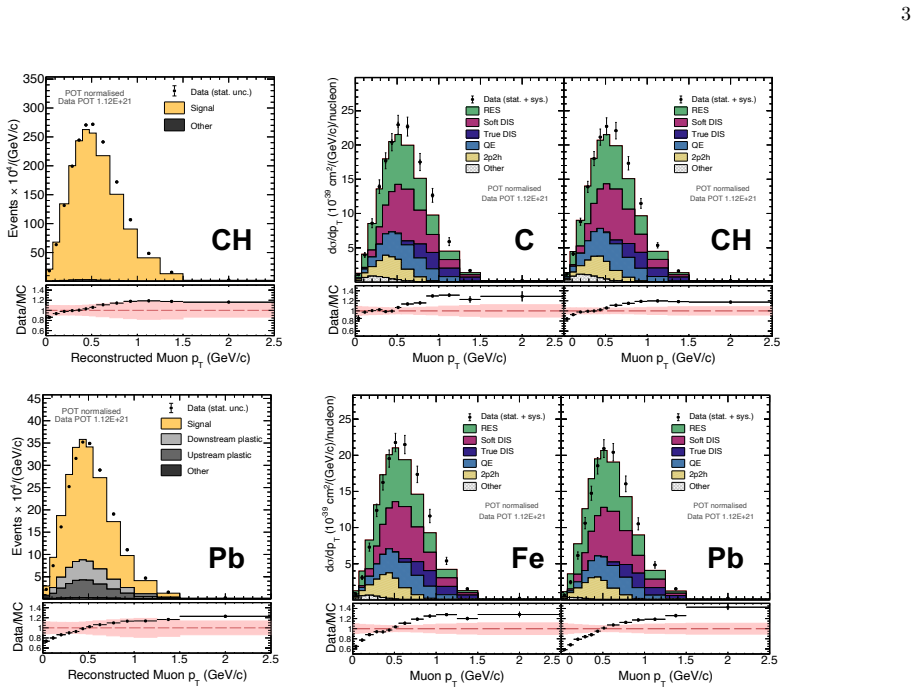
The measurement shows that current neutrino interaction models do not reproduce the observed p_T dependence of inclusive charged-current antineutrino cross sections on iron and lead. The disagreements are largest at low transverse momentum but extend over the entire measured range, demonstrating that nuclear effects remain missing or mis-modeled even in the transition region between resonance production and deep-inelastic scattering.
What carries the argument
Cross section ratios to hydrocarbon as functions of antimuon transverse momentum p_T, which isolate nuclear dependence while reducing flux and detector normalization uncertainties.
If this is right
- Neutrino interaction generators require additional nuclear corrections to describe data on heavy nuclei across the full p_T spectrum.
- The discrepancies affect both the resonance-to-DIS transition and the deep-inelastic regime.
- Absolute cross sections carry 5-10 percent total uncertainty while ratios to hydrocarbon are known to 2-5 percent.
Where Pith is reading between the lines
- These data can be used to test specific implementations of final-state interactions or nucleon binding in heavy nuclei.
- Oscillation experiments that employ iron or lead targets may inherit biases from the same modeling shortcomings.
- Repeating the measurement at different mean beam energies would help separate energy-dependent nuclear effects from interaction-mode effects.
Load-bearing premise
The measurement assumes that beam flux, detector response, and background subtraction are modeled correctly within the stated 5-10 percent uncertainties on absolute cross sections and 2-5 percent on ratios.
What would settle it
A model that includes the nuclear effects missing from current simulations and reproduces the measured low-p_T cross section ratios on lead and iron to within the quoted uncertainties would falsify the claim that those effects are absent.
Figures


read the original abstract
We report MINERvA's first measurement of inclusive charged-current $\bar{\nu}_\mu$ cross sections on carbon, hydrocarbon, iron, and lead, and their ratios to the cross section on hydrocarbon, as functions of the antimuon transverse momentum, $p_{\mathrm{T}}$. Using a wide-band $\bar{\nu}_\mu$ beam with mean energy $\sim 6~\text{GeV}$, these measurements probe all interaction modes, including the transition from resonance production to deep-inelastic scattering. The total uncertainties are typically $5-10\%$ for the absolute cross sections and $2-5\%$ for the ratios. Comparisons with multiple neutrino interaction models reveal significant discrepancies in the $p_{\mathrm{T}}$ dependence, particularly for heavier nuclei. The disagreements are most pronounced at low $p_{\mathrm{T}}$ but extend across the full $p_{\mathrm{T}}$ range, indicating missing or mis-modelled nuclear effects.
Editorial analysis
A structured set of objections, weighed in public.
Referee Report
Summary. The paper reports MINERvA measurements of inclusive charged-current antineutrino-muon cross sections on carbon, hydrocarbon, iron, and lead targets at mean energy ~6 GeV. Cross sections and ratios to the hydrocarbon target are presented versus antimuon transverse momentum p_T. The analysis spans resonance to deep-inelastic regimes. Total uncertainties are given as 5-10% (absolute) and 2-5% (ratios). Model comparisons show discrepancies in p_T dependence, strongest at low p_T for heavier nuclei, interpreted as evidence for missing or mis-modeled nuclear effects.
Significance. If the p_T-dependent uncertainties are shown to be correctly controlled, the multi-target data set supplies a valuable constraint on nuclear effects in few-GeV neutrino scattering. Such measurements directly inform oscillation experiments that rely on accurate modeling of carbon, iron, and lead targets. The observed model-data tension at low p_T provides a concrete benchmark for improving nuclear transport and final-state interaction treatments.
major comments (1)
- The central interpretation—that discrepancies indicate missing nuclear effects—rests on the claim that p_T shape uncertainties are fully captured by the quoted totals and are uncorrelated across targets in the ratios. The manuscript states overall uncertainties of 5-10% (absolute) and 2-5% (ratios) but does not provide explicit propagation or covariance matrices for p_T-dependent contributions (muon reconstruction efficiency varying with target density, low-p_T pion absorption, or acceptance corrections). Without this, residual experimental systematics cannot be ruled out as the source of the reported low-p_T tension for Fe and Pb.
minor comments (2)
- Figure captions and text should explicitly state the binning and unfolding procedure used for the p_T distributions to allow direct comparison with external models.
- The abstract and results section would benefit from a quantitative metric (e.g., per-bin pulls or integrated chi-squared) when describing the model disagreements rather than qualitative statements of 'significant discrepancies'.
Simulated Author's Rebuttal
We thank the referee for the careful and constructive review of our manuscript. We appreciate the positive assessment of the measurement's significance for constraining nuclear effects in neutrino scattering. We address the major comment below and will incorporate the requested clarifications in a revised version.
read point-by-point responses
-
Referee: The central interpretation—that discrepancies indicate missing nuclear effects—rests on the claim that p_T shape uncertainties are fully captured by the quoted totals and are uncorrelated across targets in the ratios. The manuscript states overall uncertainties of 5-10% (absolute) and 2-5% (ratios) but does not provide explicit propagation or covariance matrices for p_T-dependent contributions (muon reconstruction efficiency varying with target density, low-p_T pion absorption, or acceptance corrections). Without this, residual experimental systematics cannot be ruled out as the source of the reported low-p_T tension for Fe and Pb.
Authors: We thank the referee for raising this important point on the treatment of p_T-dependent uncertainties. The quoted totals (5-10% absolute, 2-5% for ratios) are obtained from a full propagation that includes target-dependent muon reconstruction efficiencies, acceptance corrections, and low-p_T pion absorption effects, evaluated via both Monte Carlo and data-driven constraints. Many of these contributions are highly correlated across targets and largely cancel in the ratios, which is why the ratio uncertainties are smaller. We acknowledge, however, that the manuscript does not include an explicit p_T-binned breakdown or covariance matrices for these terms. To address the concern directly, we will add a new appendix that provides the uncertainty components versus p_T for each target, the full covariance matrices for the ratios, and a quantitative demonstration that the residual experimental systematics cannot account for the observed low-p_T discrepancies in Fe and Pb. This addition will make the uncertainty evaluation fully transparent and reinforce the interpretation that the tensions arise from nuclear effects. revision: yes
Circularity Check
No circularity: direct experimental measurement with no derivation chain
full rationale
This is a pure experimental measurement paper reporting inclusive charged-current antineutrino cross sections and ratios on multiple nuclear targets as functions of p_T. The central results are extracted from data with quoted total uncertainties (5-10% absolute, 2-5% ratios); there are no first-principles derivations, fitted parameters renamed as predictions, self-definitional equations, or load-bearing self-citations that reduce the claimed results to the inputs by construction. Model comparisons are external and do not form part of any internal derivation. The paper is self-contained against external benchmarks.
Axiom & Free-Parameter Ledger
Reference graph
Works this paper leans on
-
[1]
Alvarez-Rusoet al., Prog
L. Alvarez-Rusoet al., Prog. Part. Nucl. Phys.100, 1–68 (2018)
2018
-
[2]
Abeet al.(The T2K Collaboration), Phys
K. Abeet al.(The T2K Collaboration), Phys. Rev. D 108, 072011 (2023)
2023
-
[3]
Abubakaret al.(The NOvA Collaboration), Phys
S. Abubakaret al.(The NOvA Collaboration), Phys. Rev. Lett.136, 011802 (2026)
2026
-
[4]
Acciarriet al.(DUNE Collaboration), arXiv:1512.06148
R. Acciarriet al.(The DUNE Collaboration), arXiv preprint (2015), arXiv:1512.06148 [physics.ins-det]
-
[5]
Abeet al.(The Hyper-K Collaboration), arXiv preprint (2011), arXiv:1109.3262 [hep-ex]
K. Abeet al.(The Hyper-K Collaboration), arXiv preprint (2011), arXiv:1109.3262 [hep-ex]
-
[6]
J. A. Formaggio and G. P. Zeller, Rev. Mod. Phys.84, 1307 (2012)
2012
-
[7]
gov/(2026)
The MINERνA Collaboration,https://minerva.fnal. gov/(2026)
2026
-
[8]
Aliagaet al.(The MINERνA Collaboration), Nucl
L. Aliagaet al.(The MINERνA Collaboration), Nucl. Instrum. Methods Phys. Res. A743, 130 (2014)
2014
-
[9]
B. G. Ticeet al.(The MINERvA Collaboration), Phys. Rev. Lett.112, 231801 (2014)
2014
-
[10]
Adamsonet al., Nucl
P. Adamsonet al., Nucl. Instrum. Methods Phys. Res. A 806, 279–306 (2016)
2016
-
[11]
Michaelet al.(The MINOS Collaboration), Nucl
D. Michaelet al.(The MINOS Collaboration), Nucl. In- strum. Methods Phys. Res. A596, 190–228 (2008)
2008
-
[12]
Agostinelliet al., Nucl
S. Agostinelliet al., Nucl. Instrum. Methods Phys. Res. A506, 250 (2003)
2003
-
[13]
Aliagaet al.(The MINERνA Collaboration), Phys
L. Aliagaet al.(The MINERνA Collaboration), Phys. Rev. D94, 092005 (2016)
2016
-
[14]
Altet al.(The NA Collaboration), Eur
C. Altet al.(The NA Collaboration), Eur. Phys. J. C. 49, 897 (2007)
2007
-
[15]
J. M. Paleyet al.(The MIPP Collaboration), Phys. Rev. D90, 032001 (2014)
2014
-
[16]
Zazuetaet al.(The MINERνA Collaboration), Phys
L. Zazuetaet al.(The MINERνA Collaboration), Phys. Rev. D107, 012001 (2023)
2023
-
[17]
Valenciaet al.(The MINERνA Collaboration), Phys
E. Valenciaet al.(The MINERνA Collaboration), Phys. Rev. D100, 092001 (2019)
2019
-
[18]
Ruterborieset al.(The MINERνA Collaboration), Phys
D. Ruterborieset al.(The MINERνA Collaboration), Phys. Rev. D104, 092010 (2021)
2021
-
[19]
Fine,Measurement of the Medium Energy NuMI Flux Using the Low-νand High-νMethods at MINERvA, Ph.D
R. Fine,Measurement of the Medium Energy NuMI Flux Using the Low-νand High-νMethods at MINERvA, Ph.D. thesis, Rochester U. (2020)
2020
-
[20]
Srivastava,Energy Dependence Analysis of Neutrino- Nucleus Interactions in Scintillator for MINERvA, Mas- ter’s thesis, Minnesota U
A. Srivastava,Energy Dependence Analysis of Neutrino- Nucleus Interactions in Scintillator for MINERvA, Mas- ter’s thesis, Minnesota U. (2023)
2023
-
[21]
Andreopouloset al., Nucl
C. Andreopouloset al., Nucl. Instrum. Methods Phys. Res. A614, 87 (2010)
2010
-
[22]
Bercellieet al.(The MINERνA Collaboration), Phys
A. Bercellieet al.(The MINERνA Collaboration), Phys. Rev. Lett.131, 011801 (2023)
2023
-
[23]
Smith and E
R. Smith and E. Moniz, Nucl. Phys. B.43, 605 (1972)
1972
-
[24]
Bodek and J
A. Bodek and J. L. Ritchie, Phys. Rev. D24, 1400 (1981)
1981
-
[25]
Llewellyn Smith, Phys
C. Llewellyn Smith, Phys. Rep.3, 261 (1972)
1972
-
[26]
Nieves, I
J. Nieves, I. R. Simo, and M. J. V. Vacas, Phys. Rev. C 83, 045501 (2011)
2011
-
[27]
R. Gran, J. Nieves, F. Sanchez, and M. J. V. Vacas, Phys. Rev. D88, 113007 (2013)
2013
-
[28]
Rein and L
D. Rein and L. M. Sehgal, Ann. Phys.133, 79 (1981)
1981
-
[29]
Rein and L
D. Rein and L. M. Sehgal, Nucl. Phys. B223, 29 (1983)
1983
-
[30]
Rein and L
D. Rein and L. Sehgal, Phys. Lett. B657, 207 (2007)
2007
-
[31]
Bodek and U
A. Bodek and U. K. Yang, J. Phys. G: Nucl. Part. Phys. 29, 1899 (2003)
2003
-
[32]
Bodek, I
A. Bodek, I. Park, and U. ki Yang, Nucl. Phys. Proc. Suppl.139, 113 (2005)
2005
-
[33]
T. Yang, C. Andreopoulos, H. Gallagher, K. Hofmann, and P. Kehayias, Eur. Phys. J. C63, 1–10 (2009)
2009
-
[34]
Z. Koba, H. Nielsen, and P. Olesen, Nucl. Phys. B40, 317 (1972)
1972
-
[35]
Sj¨ ostrandet al., Comput
T. Sj¨ ostrandet al., Comput. Phys. Commun.135, 238–259 (2001)
2001
-
[36]
Dytman, Acta Phys
S. Dytman, Acta Phys. Pol. B40(2009)
2009
-
[37]
Nieves, J
J. Nieves, J. E. Amaro, and M. Valverde, Phys. Rev. C 70, 055503 (2004)
2004
-
[38]
Model uncertainties for Valencia RPA effect for MINERvA,
R. Gran, “Model uncertainties for Valencia RPA effect for MINERvA,” (2017), arXiv:1705.02932 [hep-ex]
-
[39]
P. A. Rodrigueset al.(The MINERνA Collaboration), Phys. Rev. Lett.116, 071802 (2016)
2016
-
[40]
Granet al.(The MINERνA Collaboration), Phys
R. Granet al.(The MINERνA Collaboration), Phys. Rev. Lett.120, 221805 (2018)
2018
-
[41]
Rodrigues, C
P. Rodrigues, C. Wilkinson, and K. McFarland, Eur. Phys. J. C.76, 474 (2016)
2016
-
[42]
M. A. Ram´ ırezet al.(The MINERνA Collaboration), Phys. Rev. Lett.131, 051801 (2023)
2023
-
[43]
B. Z. Kopeliovich, I. Schmidt, and M. Siddikov, Phys. Rev. D85, 073003 (2012)
2012
-
[44]
Kaidalov, Phys
A. Kaidalov, Phys. Lett. B116, 459 (1982)
1982
-
[45]
Aliagaet al.(The MINERνA Collaboration), Nucl
L. Aliagaet al.(The MINERνA Collaboration), Nucl. Instrum. Methods Phys. Res. A789, 28 (2015)
2015
-
[46]
Elkinset al.(The MINERνA Collaboration), Phys
M. Elkinset al.(The MINERνA Collaboration), Phys. Rev. D100, 052002 (2019)
2019
-
[47]
Akbaret al.(The MINERνA Collaboration), JINST 17, T08013 (2022)
F. Akbaret al.(The MINERνA Collaboration), JINST 17, T08013 (2022)
2022
-
[48]
D’Agostini, Nucl
G. D’Agostini, Nucl. Instrum. Methods Phys. Res., Sect. A362, 487 (1995)
1995
-
[49]
A. Lozanoet al.(The MINERvνA Collaboration), “Mea- surement of charged-currentν µ and ¯νµ cross sections on hydrocarbon in a shallow inelastic scattering region,” (2025), arXiv:2503.20043 [hep-ex]
-
[50]
Data Preservation at MIN- 7 ERvA,
R. Fine, B. Messerly, K. S. McFarland,et al.(The MINERνA Collaboration), “Data Preservation at MIN- 7 ERvA,” (2022), arXiv:2009.04548 [hep-ex]
-
[51]
P. Stowellet al., JINST12, P01016 (2017), arXiv:1612.07393 [hep-ex]
-
[52]
Hayato, L
Y. Hayato, L. Pickering, C. Wret,et al., Eur. Phys. J. Spec. Top.230, 4469 (2021)
2021
-
[53]
Bashyal and others
A. Bashyal and others. (The MINERνA Collaboration), Phys. Rev. D108, 032018 (2023)
2023
-
[54]
Caiet al.(The MINERvνA Collaboration), Nature 614, 48 (2023)
T. Caiet al.(The MINERvνA Collaboration), Nature 614, 48 (2023)
2023
-
[55]
K. M. Graczyk and J. T. Sobczyk, Phys. Rev. D77, 053001 (2008)
2008
-
[56]
Kleykampet al.(The MINERνA Collaboration), Phys
J. Kleykampet al.(The MINERνA Collaboration), Phys. Rev. Lett.130, 161801 (2023)
2023
-
[57]
Betancourtet al., Phys
M. Betancourtet al., Phys. Rep.773-774, 1 (2018)
2018
-
[58]
M. B. Avanziniet al., Phys. Rev. D105, 092004 (2022)
2022
-
[59]
Katori, AIP Conference Proceedings1663, 030001 (2015), arXiv:1304.6014 [nucl-th]
T. Katori, AIP Conference Proceedings1663, 030001 (2015), arXiv:1304.6014 [nucl-th]
-
[60]
Berger and L
C. Berger and L. M. Sehgal, Phys. Rev. D76, 113004 (2007)
2007
-
[61]
Berger and L
C. Berger and L. M. Sehgal, Phys. Rev. D79, 053003 (2009)
2009
-
[62]
Tena-Vidal, Andreopoulos,et al.(The GENIE Collab- oration), Phys
J. Tena-Vidal, Andreopoulos,et al.(The GENIE Collab- oration), Phys. Rev. D104, 072009 (2021)
2021
-
[63]
Benhar, A
O. Benhar, A. Fabrocini, S. Fantoni, and I. Sick, Nucl. Phys. A579, 493 (1994)
1994
-
[64]
C. Juszczak, J. A. Nowak, and J. T. Sobczyk, Nucl. Phys. B, Proc. Suppl.159, 211 (2006), arXiv:hep- ph/0512365 [hep-ph]. 8 SUPPLEMENT AL MA TERIAL TABLE Supp. I: Upstream (US) and downstream (DS) per-material normalisation scale factors and their statistical and systematic uncertainties. Material Region Scale factor Stat. unc. Syst. unc. C US 1.029 0.005 ...
discussion (0)
Sign in with ORCID, Apple, or X to comment. Anyone can read and Pith papers without signing in.