SPAMoE: Spectrum-Aware Hybrid Operator Framework for Full-Waveform Inversion
Pith reviewed 2026-05-10 17:30 UTC · model grok-4.3
The pith
SPAMoE uses spectrum-aware routing to cut errors in learning-based full-waveform inversion by 44 percent.
A machine-rendered reading of the paper's core claim, the machinery that carries it, and where it could break.
Core claim
SPAMoE combines a Spectral-Preserving DINO Encoder, which enforces a lower bound on the high-to-low frequency energy ratio, with a Spectral Decomposition and Routing mechanism that dynamically assigns bands to a Mixture-of-Experts ensemble of FNO, MNO, and LNO operators, thereby reducing reconstruction error on standard full-waveform inversion benchmarks.
What carries the argument
The Spectral Decomposition and Routing mechanism that assigns frequency bands to an MoE ensemble of Fourier, multi-wavelet, and local neural operators, backed by the energy-ratio constraint in the DINO encoder.
If this is right
- Average MAE across the ten OpenFWI sub-datasets drops 44.4 percent relative to the strongest reported baseline.
- Multi-scale geological structures become easier to resolve because high-frequency collapse is prevented before operator application.
- The same hybrid routing pattern can be applied to other inverse problems that involve entangled frequency content.
Where Pith is reading between the lines
- The routing logic could be ported to other wave-based inverse tasks such as medical ultrasound tomography.
- Real-time seismic monitoring pipelines might adopt the MoE decomposition to handle streaming data with changing frequency content.
- Field-data experiments would be needed to check whether the synthetic gains hold when noise statistics differ from the OpenFWI training distribution.
Load-bearing premise
Frequency entanglement is the dominant bottleneck in prior CNNs and single-paradigm operators, and separating bands through the proposed encoder and MoE routing will reliably improve results across varied geological settings.
What would settle it
A controlled test on a new synthetic or field dataset in which SPAMoE fails to beat the best OpenFWI baseline by a comparable margin or in which the encoded high-frequency energy ratio drops below the claimed bound.
Figures


read the original abstract
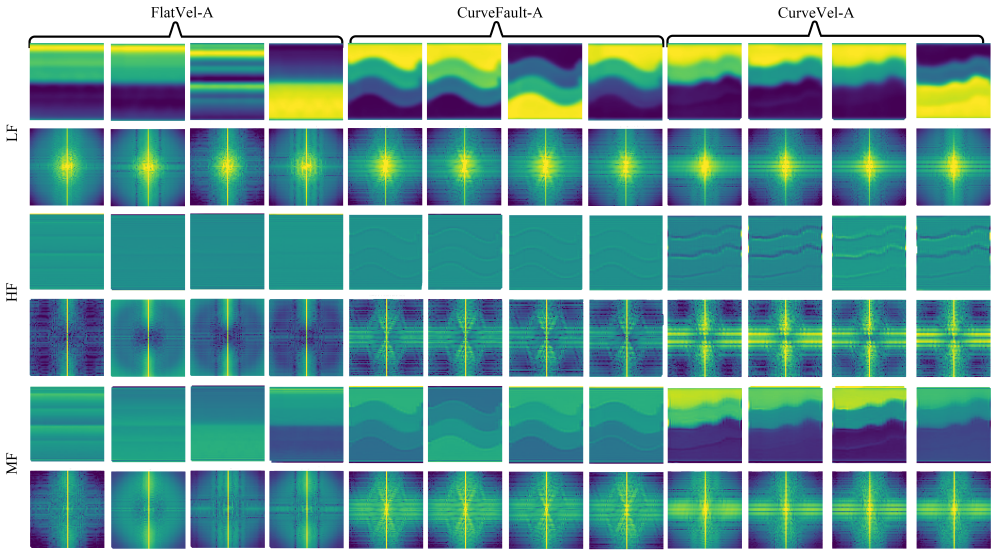
Full-waveform inversion (FWI) is pivotal for reconstructing high-resolution subsurface velocity models but remains computationally intensive and ill-posed. While deep learning approaches promise efficiency, existing Convolutional Neural Networks (CNNs) and single-paradigm Neural Operators (NOs) struggle with one fundamental issue: frequency entanglement of multi-scale geological features. To address this challenge, we propose Spectral-Preserving Adaptive MoE (SPAMoE), a novel spectrum-aware framework for solving inverse problems with complex multi-scale structures. Our approach introduces a Spectral-Preserving DINO Encoder that enforces a lower bound on the high-to-low frequency energy ratio of the encoded representation, mitigating high-frequency collapse and stabilizing subsequent frequency-domain modeling. Furthermore, we design a novel Spectral Decomposition and Routing mechanism that dynamically assigns frequency bands to a Mixture-of-Experts (MoE) ensemble comprising FNO, MNO, and LNO. On the ten OpenFWI sub-datasets, experiments show that SPAMoE reduces the average MAE by 44.4% relative to the best officially reported OpenFWI baseline, thereby establishing a new architectural framework for learning-based full-waveform inversion. Our code and data are available at https://github.com/zhenyuwang12366/SPAMoE
Editorial analysis
A structured set of objections, weighed in public.
Referee Report
Summary. The paper proposes SPAMoE, a spectrum-aware hybrid operator framework for full-waveform inversion (FWI). It introduces a Spectral-Preserving DINO Encoder that enforces a lower bound on the high-to-low frequency energy ratio of encoded representations to mitigate high-frequency collapse, along with a Spectral Decomposition and Routing mechanism that dynamically assigns frequency bands to a Mixture-of-Experts ensemble consisting of FNO, MNO, and LNO operators. Experiments on the ten OpenFWI sub-datasets report that SPAMoE reduces average MAE by 44.4% relative to the best officially reported baseline, positioning the method as a new architectural framework for learning-based FWI. Code and data are released.
Significance. If the performance gains prove robust and attributable to the spectrum-aware components (rather than capacity increases or baseline differences), the work could meaningfully advance learning-based FWI by targeting frequency entanglement in multi-scale geological structures. The open-sourcing of code and data is a clear strength for reproducibility and follow-on work.
major comments (3)
- [Abstract] Abstract: The central claim of a 44.4% average MAE reduction on the ten OpenFWI sub-datasets is stated without details on baseline implementations, data splits, statistical significance, variance across runs, or ablation controls. This makes it impossible to determine whether the improvement stems from the proposed Spectral-Preserving DINO Encoder and frequency-band routing or from other factors.
- [Spectral-Preserving DINO Encoder] Spectral-Preserving DINO Encoder section: The lower-bound enforcement on the high-to-low frequency energy ratio is claimed to prevent representational collapse, but no ablation removing or varying this term is described, nor is there analysis showing that the ratio is actively constrained rather than trivially satisfied. Without this, the term's contribution to the headline result cannot be isolated.
- [Experiments] Experiments section: No expert-utilization statistics, routing histograms, or per-band allocation analysis are provided to verify that the Spectral Decomposition and Routing mechanism meaningfully distributes frequency bands across the FNO/MNO/LNO experts instead of collapsing to a single dominant operator. This directly affects whether the hybrid MoE design is load-bearing for the reported gains.
minor comments (2)
- [Abstract] The title refers to a 'Spectrum-Aware Hybrid Operator Framework' while the abstract defines SPAMoE as 'Spectral-Preserving Adaptive MoE'; a brief note reconciling the two phrasings would improve clarity.
- [Abstract] The abstract mentions 'frequency entanglement of multi-scale geological features' as the core limitation of prior CNNs and single-paradigm NOs; a short literature pointer or equation illustrating this entanglement would help readers unfamiliar with FWI.
Simulated Author's Rebuttal
We thank the referee for the constructive and detailed feedback on our manuscript. We address each major comment point by point below, providing our responses and indicating the revisions we will make to the manuscript.
read point-by-point responses
-
Referee: [Abstract] Abstract: The central claim of a 44.4% average MAE reduction on the ten OpenFWI sub-datasets is stated without details on baseline implementations, data splits, statistical significance, variance across runs, or ablation controls. This makes it impossible to determine whether the improvement stems from the proposed Spectral-Preserving DINO Encoder and frequency-band routing or from other factors.
Authors: We agree that the abstract is concise and would benefit from additional context for clarity. The reported 44.4% MAE reduction is computed against the best officially reported baselines from the OpenFWI benchmark, with complete details on data splits, baseline implementations, and experimental protocols provided in the Experiments section. We will revise the abstract to explicitly note the use of officially reported OpenFWI baselines and to direct readers to the Experiments section for implementation details, data splits, ablation studies, and any available statistical analysis. We will also add results from multiple runs with standard deviations to the revised Experiments section to address variance and robustness. revision: partial
-
Referee: [Spectral-Preserving DINO Encoder] Spectral-Preserving DINO Encoder section: The lower-bound enforcement on the high-to-low frequency energy ratio is claimed to prevent representational collapse, but no ablation removing or varying this term is described, nor is there analysis showing that the ratio is actively constrained rather than trivially satisfied. Without this, the term's contribution to the headline result cannot be isolated.
Authors: We acknowledge that an explicit ablation and constraint analysis would better isolate the contribution of the spectral-preserving term. The current manuscript motivates the lower-bound enforcement theoretically in the Spectral-Preserving DINO Encoder section and demonstrates its effect indirectly via performance gains. In the revised version, we will add an ablation study that removes or varies the lower-bound term, along with analysis (e.g., plots of the high-to-low frequency energy ratio during training) to confirm that the ratio is actively constrained rather than trivially satisfied. revision: yes
-
Referee: [Experiments] Experiments section: No expert-utilization statistics, routing histograms, or per-band allocation analysis are provided to verify that the Spectral Decomposition and Routing mechanism meaningfully distributes frequency bands across the FNO/MNO/LNO experts instead of collapsing to a single dominant operator. This directly affects whether the hybrid MoE design is load-bearing for the reported gains.
Authors: We agree that verifying the dynamic routing behavior is essential to substantiate the hybrid MoE design. While the manuscript describes the Spectral Decomposition and Routing mechanism and reports overall performance improvements, we will expand the Experiments section to include expert-utilization statistics, routing histograms, and per-band allocation analysis. These additions will demonstrate that frequency bands are meaningfully distributed across the FNO, MNO, and LNO experts rather than collapsing to a dominant operator. revision: yes
Circularity Check
No significant circularity: empirical gains measured on external OpenFWI benchmarks
full rationale
The paper proposes SPAMoE with a Spectral-Preserving DINO Encoder enforcing a high-to-low frequency energy ratio lower bound and a frequency-band MoE routing across FNO/MNO/LNO experts. Its headline result is the 44.4% average MAE reduction on the ten OpenFWI sub-datasets relative to the best reported baseline. No derivation chain, equations, or self-citations are shown that reduce this performance gain or the architectural choices to quantities defined inside the model by construction. The improvements are presented as experimental outcomes against independent external data, not as tautological predictions or renamed fitted inputs. The framework is therefore self-contained against external benchmarks.
Axiom & Free-Parameter Ledger
free parameters (1)
- frequency-band thresholds and routing gates
axioms (2)
- domain assumption Neural operators can approximate solutions to the wave equation in FWI
- ad hoc to paper Enforcing a lower bound on high-to-low frequency energy ratio prevents representational collapse
invented entities (2)
-
Spectral-Preserving DINO Encoder
no independent evidence
-
Spectral Decomposition and Routing mechanism
no independent evidence
discussion (0)
Sign in with ORCID, Apple, or X to comment. Anyone can read and Pith papers without signing in.