Rhythm as an ordered phase of sound: how musical meter emerges in a statistical mechanical model
Pith reviewed 2026-05-10 17:00 UTC · model grok-4.3
The pith
Musical meter emerges as an ordered phase when a model balances human preferences for repetition against variety in an effective free energy.
A machine-rendered reading of the paper's core claim, the machinery that carries it, and where it could break.
Core claim
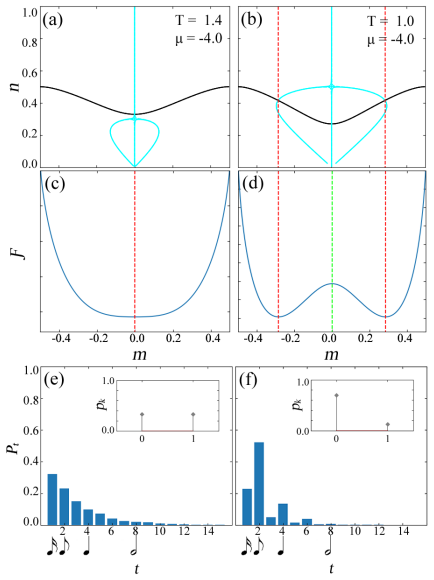
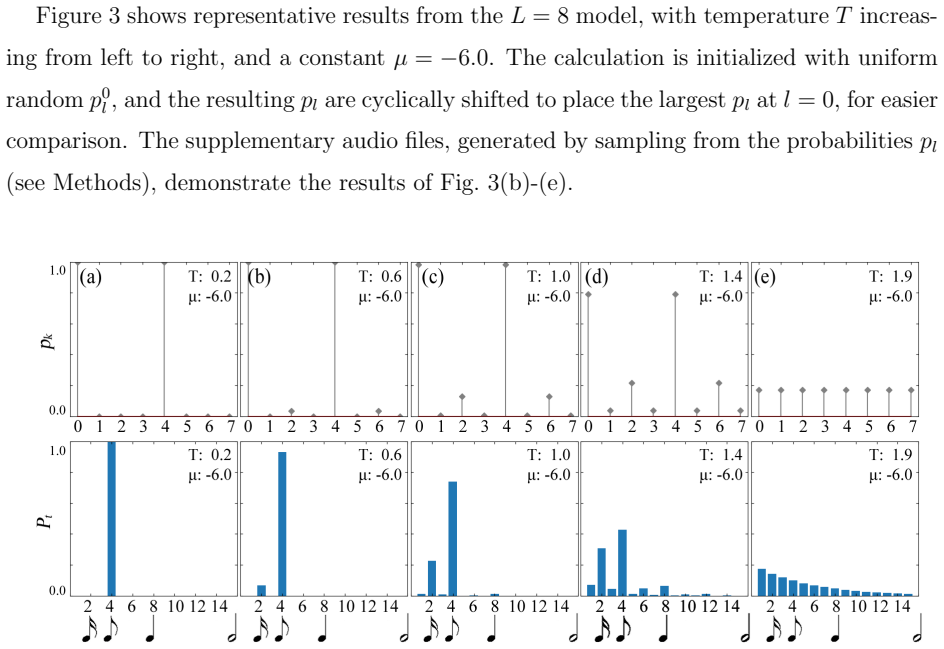
By mapping competing psychological preferences onto energy and entropy contributions, the model defines an effective free energy minimized in the grand canonical ensemble. Mean-field calculations of this free energy yield phase transitions from temporally disordered events to ordered rhythmic patterns. These ordered states reproduce key characteristics of musical meter, and their statistical properties align well with those observed in compositions by Bach.
What carries the argument
Effective free energy in the grand canonical ensemble, with repetition as an energy term and variety as an entropy term, whose mean-field minimization produces phase transitions to rhythmic order.
If this is right
- The ordered phases correspond to common meters and rhythmic features found in actual music.
- Rhythmic order can be generated directly from the minimization without additional cultural rules.
- Small shifts in the balance between repetition and variety can trigger abrupt changes in rhythmic structure.
- The model supplies a quantitative method for producing new rhythms consistent with observed musical patterns.
Where Pith is reading between the lines
- The same free-energy construction might be applied to model rhythmic preferences in non-Western traditions or historical style changes by adjusting the relative weights.
- Direct psychological experiments that measure perceived naturalness for different degrees of repetition could test whether human judgments track the model's phase boundaries.
- The approach could extend to other ordered temporal sequences, such as metrical patterns in poetry or periodic movement in dance.
Load-bearing premise
The specific energy and entropy terms chosen for the effective free energy accurately capture human psychological preferences for repetition versus variety without further empirical calibration.
What would settle it
A large corpus of listener preference data or additional musical datasets whose rhythmic statistics fall outside the model's predicted ranges for any choice of the free-energy parameters.
Figures


read the original abstract
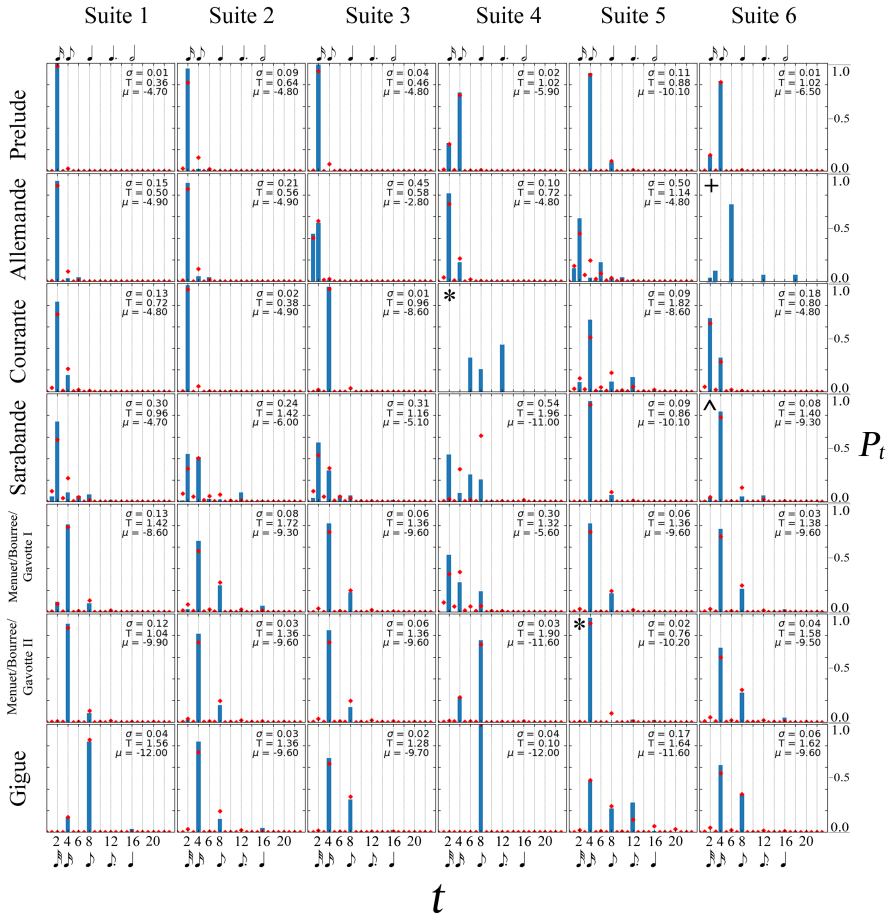
We develop a model of musical rhythm and meter based on optimizing the trade-off between human psychological preferences for perceiving repeated patterns in time with a desire for variety and complexity. By mapping these competing preferences onto analogous quantities in statistical physics, we define an effective free energy which is minimized in the grand canonical ensemble. Using a mean field approximation, we observe phase transitions in the model from disordered events in time to orderings that closely reproduce those seen in music. We then compare the range of rhythmic characteristics predicted by the model to a dataset drawn from compositions by Johann Sebastian Bach, finding generally good quantitative agreement. The results provide a new lens through which to study musical rhythm, and a method for generatively producing rhythms.
Editorial analysis
A structured set of objections, weighed in public.
Referee Report
Summary. The manuscript develops a statistical mechanical model of musical rhythm and meter by mapping human psychological preferences for repetition versus variety onto an effective free energy functional, which is then minimized in the grand canonical ensemble. A mean-field approximation is used to identify phase transitions from disordered temporal events to ordered states that reproduce musical meter patterns, followed by a quantitative comparison to rhythmic features extracted from compositions by J. S. Bach, with the claim of generally good agreement.
Significance. If the mapping from psychological preferences to the free-energy terms can be independently validated, the work offers a fresh physics-based perspective on the emergence of musical order as a phase transition, with potential implications for generative rhythm models and interdisciplinary studies of perception. The approach is conceptually innovative in treating meter as an ordered phase, but its significance is currently limited by the absence of explicit model equations and validation details that would allow assessment of robustness.
major comments (3)
- [Abstract and model section] Abstract and model definition: the central claims of phase transitions and quantitative agreement with Bach data are asserted without providing the explicit form of the effective free energy, the mean-field self-consistency equations, the fitting procedure for any parameters, or the precise metrics used for the data comparison. This prevents verification of whether the observed orderings follow from the minimization or are imposed by construction.
- [Model definition] The effective free energy is constructed directly from the repetition-favoring energy term and variety-favoring entropy term that encode the target psychological preferences; any emergent ordered phases are therefore shaped by the same functional choices the model seeks to explain. This creates a circularity that must be addressed by showing the phase diagram is robust to reasonable variations in the functional forms or by providing independent psychological calibration data.
- [Comparison to Bach data] The manuscript reports a single free parameter yet claims generally good quantitative agreement with Bach rhythms; without the explicit comparison procedure or sensitivity analysis (e.g., how the agreement metric changes when the repetition-variety trade-off is varied), it is unclear whether the match is a genuine prediction or an artifact of parameter choice.
Simulated Author's Rebuttal
We thank the referee for their thoughtful review and constructive suggestions. We appreciate the recognition of the conceptual innovation in treating meter as an ordered phase. Below, we address each major comment point by point, indicating the revisions we will make to the manuscript.
read point-by-point responses
-
Referee: [Abstract and model section] Abstract and model definition: the central claims of phase transitions and quantitative agreement with Bach data are asserted without providing the explicit form of the effective free energy, the mean-field self-consistency equations, the fitting procedure for any parameters, or the precise metrics used for the data comparison. This prevents verification of whether the observed orderings follow from the minimization or are imposed by construction.
Authors: We agree that the manuscript would benefit from greater explicitness in these areas. In the revised version, we will expand the model section to include the explicit mathematical form of the effective free energy functional, derive the mean-field self-consistency equations in detail, describe the procedure for fitting the single free parameter, and specify the quantitative metrics (such as pattern frequency distributions and correlation measures) used for comparing model predictions to the Bach dataset. This will allow readers to verify the emergence of the ordered phases directly from the minimization. revision: yes
-
Referee: [Model definition] The effective free energy is constructed directly from the repetition-favoring energy term and variety-favoring entropy term that encode the target psychological preferences; any emergent ordered phases are therefore shaped by the same functional choices the model seeks to explain. This creates a circularity that must be addressed by showing the phase diagram is robust to reasonable variations in the functional forms or by providing independent psychological calibration data.
Authors: We acknowledge the concern regarding potential circularity in the model construction. The energy and entropy terms are indeed motivated by psychological preferences documented in the literature on music perception. To mitigate this, we will add an analysis demonstrating the robustness of the phase transitions and ordered states to reasonable variations in the functional forms of the repetition and variety terms. While independent psychological calibration data for the specific parameters is not currently available in our study, the robustness check will help establish that the emergent meter patterns are not solely an artifact of the chosen forms. revision: partial
-
Referee: [Comparison to Bach data] The manuscript reports a single free parameter yet claims generally good quantitative agreement with Bach rhythms; without the explicit comparison procedure or sensitivity analysis (e.g., how the agreement metric changes when the repetition-variety trade-off is varied), it is unclear whether the match is a genuine prediction or an artifact of parameter choice.
Authors: We will revise the comparison section to provide a detailed description of the procedure used to compare the model's rhythmic characteristics with the Bach compositions, including how the single free parameter is selected (e.g., via optimization against a subset of the data or based on prior literature). Additionally, we will include a sensitivity analysis showing how the agreement metrics vary with changes in the repetition-variety trade-off parameter, thereby clarifying that the agreement reflects genuine predictive power rather than parameter tuning alone. revision: yes
Circularity Check
Effective free energy defined by mapping target psychological preferences, so observed musical orderings emerge by construction from the input ansatz.
specific steps
-
self definitional
[Abstract]
"We develop a model of musical rhythm and meter based on optimizing the trade-off between human psychological preferences for perceiving repeated patterns in time with a desire for variety and complexity. By mapping these competing preferences onto analogous quantities in statistical physics, we define an effective free energy which is minimized in the grand canonical ensemble. Using a mean field approximation, we observe phase transitions in the model from disordered events in time to orderings that closely reproduce those seen in music."
The effective free energy is defined by directly mapping the psychological preferences (repetition-favoring energy term, variety-favoring entropy term) that the model seeks to explain. The subsequent minimization and phase transitions therefore produce orderings shaped by those same preferences by construction; the match to musical meter is not an independent derivation but a re-expression of the input mapping.
full rationale
The derivation begins by explicitly constructing the effective free energy from the very human preferences for repetition versus variety that the model is intended to explain. Minimization then yields phase transitions whose rhythmic characteristics are reported to match music. Because the functional forms encode the target behavior directly and no independent psychological calibration or external validation is invoked, the quantitative agreement with Bach data reduces to the initial mapping rather than an independent prediction. This is partial circularity (score 6) rather than total, as the mean-field calculation itself is non-trivial.
Axiom & Free-Parameter Ledger
free parameters (1)
- repetition and variety trade-off parameters
axioms (2)
- domain assumption Human preferences for repeated temporal patterns versus variety can be represented by additive energy and entropy contributions in an effective free energy.
- domain assumption A mean-field approximation is sufficient to locate the phase transition between disordered and ordered rhythmic states.
Reference graph
Works this paper leans on
-
[1]
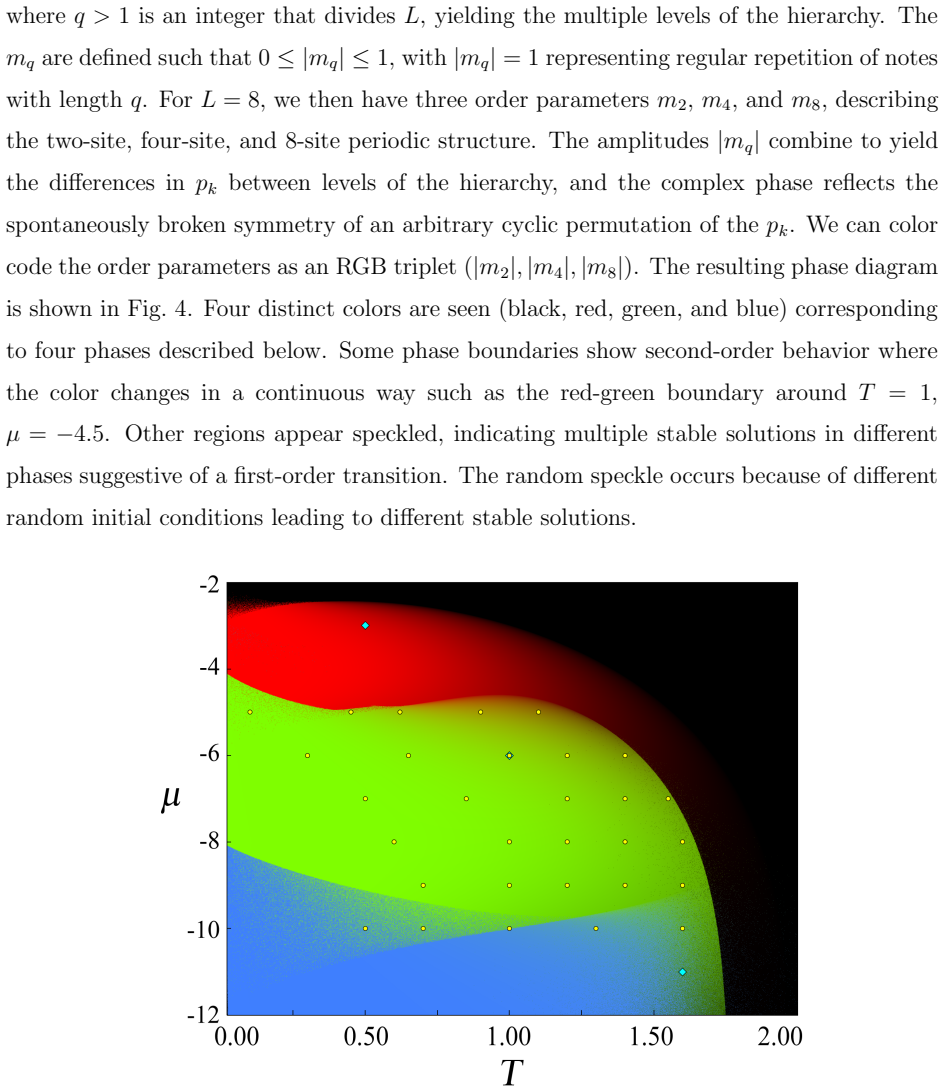
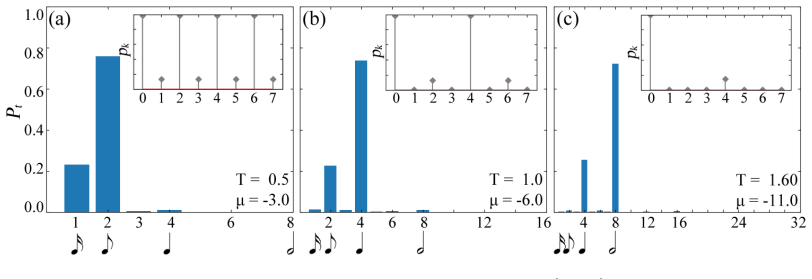
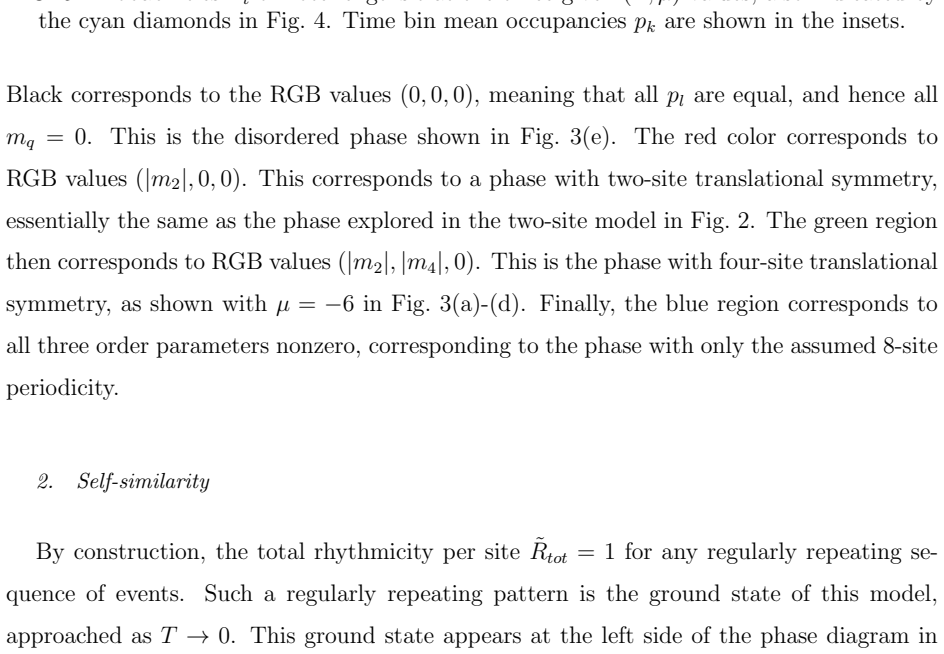
Phase diagram for the 8-site model We explore the results of the 8-site model by constructing a phase diagram as a function ofµandT. Over a grid of values spanning ranges inµandT, we calculatep l using the iterative method described above, starting from uniform random initial conditions. The resultingp l are found to be symmetric by translation of 1, 2, 4...
-
[2]
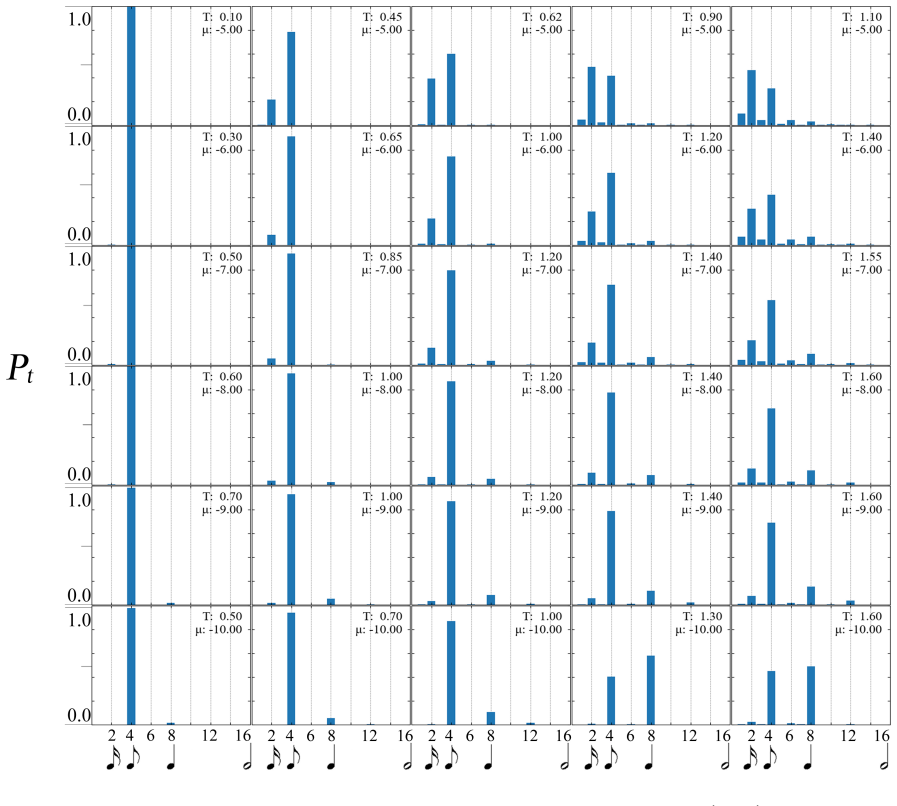
Self-similarity By construction, the total rhythmicity per site ˜Rtot = 1 for any regularly repeating se- quence of events. Such a regularly repeating pattern is the ground state of this model, approached asT→0. This ground state appears at the left side of the phase diagram in Fig. 4. Asµbecomes more negative, the regular repetition of the ground state i...
-
[3]
W. E. Benjamin, Music perception1, 355 (1984)
work page 1984
-
[4]
H. C. Longuet-Higgins and C. S. Lee, Perception11, 115 (1982)
work page 1982
-
[5]
F. Lerdahl and R. S. Jackendoff,A Generative Theory of Tonal Music, reissue, with a new preface(MIT press, 1996)
work page 1996
-
[6]
London,Hearing in time: Psychological aspects of musical meter(Oxford University Press, 2012)
J. London,Hearing in time: Psychological aspects of musical meter(Oxford University Press, 2012)
work page 2012
-
[7]
W. A. Sethares,Rhythm and transforms(2007) pp. 1–336
work page 2007
-
[8]
M. J. Steedman, Perception6, 555 (1977)
work page 1977
-
[9]
D.-J. Povel and P. Essens, Music Perception: An Interdisciplinary Journal2, 411 (1985)
work page 1985
- [10]
-
[11]
Desain, Music Perception: An Interdisciplinary Journal9, 439 (1992)
P. Desain, Music Perception: An Interdisciplinary Journal9, 439 (1992)
work page 1992
-
[12]
E. W. Large and J. F. Kolen, Connection Science6, 177 (1994)
work page 1994
-
[13]
A. Ravignani, B. Thompson, M. Lumaca, and M. Grube, Frontiers in Computational Neuro- science12(2018)
work page 2018
- [14]
-
[15]
M. L. Serafine, N. Glassman, and C. Overbeeke, Music Perception6, 397 (1989)
work page 1989
- [16]
-
[17]
P. E. Keller and D. K. Burnham, Music Perception22, 629 (2005)
work page 2005
-
[18]
E. W. Large and C. Palmer, Cognitive science26, 1 (2002)
work page 2002
- [19]
- [20]
-
[21]
N. Jacoby, R. Polak, J. A. Grahn, D. J. Cameron, K. M. Lee, R. Godoy, E. A. Undurraga, T. Huanca, T. Thalwitzer, N. Doumbia, D. Goldberg, E. H. Margulis, P. C. Wong, L. Jure, 29 M. Rocamora, S. Fujii, P. E. Savage, J. Ajimi, R. Konno, S. Oishi, K. Jakubowski, A. Holzapfel, E. Mungan, E. Kaya, P. Rao, M. A. Rohit, S. Alladi, B. Tarr, M. Anglada-Tort, P. M....
work page 2024
-
[22]
E. E. Hannon and S. P. Johnson, Cognitive Psychology50, 354 (2005)
work page 2005
-
[23]
Berezovsky, Science Advances5, 10.1126/sciadv.aav8490 (2019)
J. Berezovsky, Science Advances5, 10.1126/sciadv.aav8490 (2019)
-
[24]
H. Din and J. Berezovsky, PLoS ONE18, 10.1371/journal.pone.0280227 (2023)
- [25]
-
[26]
R. Buechele, A. Cooke, and J. Berezovsky, Empirical Musicology Review19, 118 (2024)
work page 2024
-
[27]
J. E. Youngblood, Journal of Music Theory2, 24 (1958)
work page 1958
- [28]
- [29]
-
[30]
I. D. Colley and R. T. Dean, PLoS ONE14, 10.1371/JOURNAL.PONE.0216088 (2019)
-
[31]
D. J. Levitin, P. Chordia, and V. Menon, Proceedings of the National Academy of Sciences of the United States of America109, 10.1073/pnas.1113828109 (2012)
-
[32]
L. Liu, J. Wei, H. Zhang, J. Xin, and J. Huang, PLoS ONE8, 10.1371/journal.pone.0058710 (2013)
-
[33]
C. Palmer and C. L. Krumhansl, Journal of Experimental Psychology: Human Perception and Performance16, 728 (1990)
work page 1990
-
[34]
Temperley,Music and probability(MIT Press, 2007) p
D. Temperley,Music and probability(MIT Press, 2007) p. 244
work page 2007
- [35]
-
[36]
Huron,Sweet anticipation: Music and the psychology of expectation(MIT press, 2008)
D. Huron,Sweet anticipation: Music and the psychology of expectation(MIT press, 2008)
work page 2008
-
[37]
L. H. Marckx and T. Saks, ProQuest Dissertations and Theses (1998)
work page 1998
-
[38]
J. T. Harlow, ProQuest Dissertations and Theses (1993). 30
work page 1993
discussion (0)
Sign in with ORCID, Apple, or X to comment. Anyone can read and Pith papers without signing in.