A seeing measurement device for the PoET solar telescope
Pith reviewed 2026-05-10 15:49 UTC · model grok-4.3
The pith
We built and validated a dedicated solar seeing monitor that uses scintillation to measure daytime atmospheric turbulence at Paranal for the PoET telescope.
A machine-rendered reading of the paper's core claim, the machinery that carries it, and where it could break.
Core claim
We have developed and implemented a dedicated solar seeing monitor for daytime deployment at Paranal, Chile, where PoET will operate. The instrument exploits the quantitative relationship between seeing and scintillation established in 1993, using the Sun as an extended bright source and non-telescopic optics. Commissioning and initial on-sky validation results demonstrate its readiness to support selection of optimal apertures between 1 and 55 arcseconds for PoET's spatially resolved solar spectroscopy.
What carries the argument
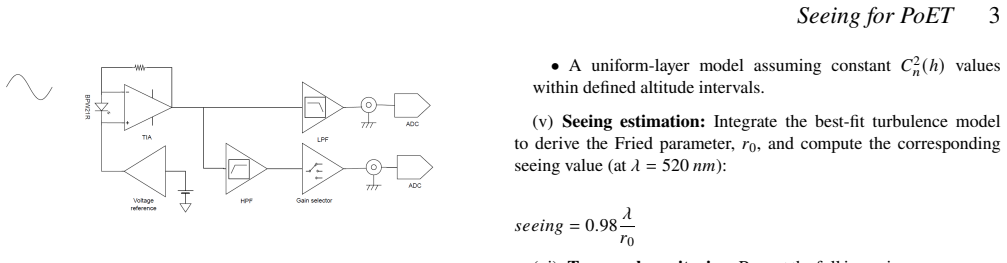
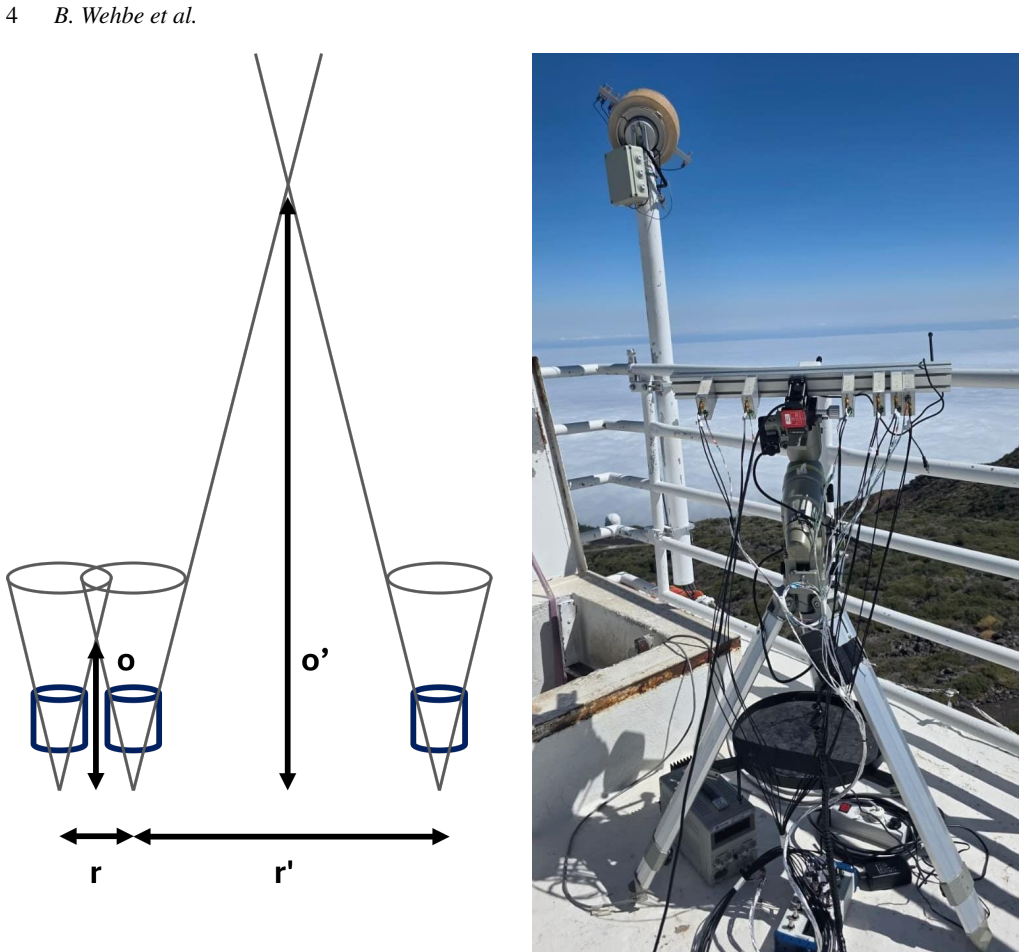
The solar seeing monitor, a compact non-telescopic instrument that converts measured solar scintillation intensity fluctuations into seeing estimates via the 1993 seeing-scintillation relation.
If this is right
- The monitor supplies the seeing data needed to select the optimal 1-55 arcsecond aperture for each PoET observation.
- It enables reliable characterization of daytime atmospheric turbulence at Paranal for solar-proxy studies of stellar noise.
- Validated performance supports PoET's goal of feeding clean solar spectra into ESPRESSO for ultra-high-precision radial-velocity work.
- The device provides a practical, low-cost tool for ongoing daytime seeing monitoring at the PoET site.
Where Pith is reading between the lines
- Similar scintillation-based monitors could be replicated at other solar observatories to improve daytime site characterization.
- Long-term data from the monitor might reveal seasonal or diurnal patterns in Paranal daytime seeing that affect solar spectroscopy planning.
- Integration with real-time control systems could allow PoET to adjust aperture size dynamically as seeing changes.
Load-bearing premise
The 1993 quantitative relationship between seeing and scintillation applies accurately to this instrument configuration and Paranal daytime conditions without significant unaccounted systematics.
What would settle it
Independent daytime seeing measurements at Paranal that consistently disagree with simultaneous readings from this monitor would show the assumed scintillation-to-seeing conversion does not hold for the site or hardware.
Figures



read the original abstract
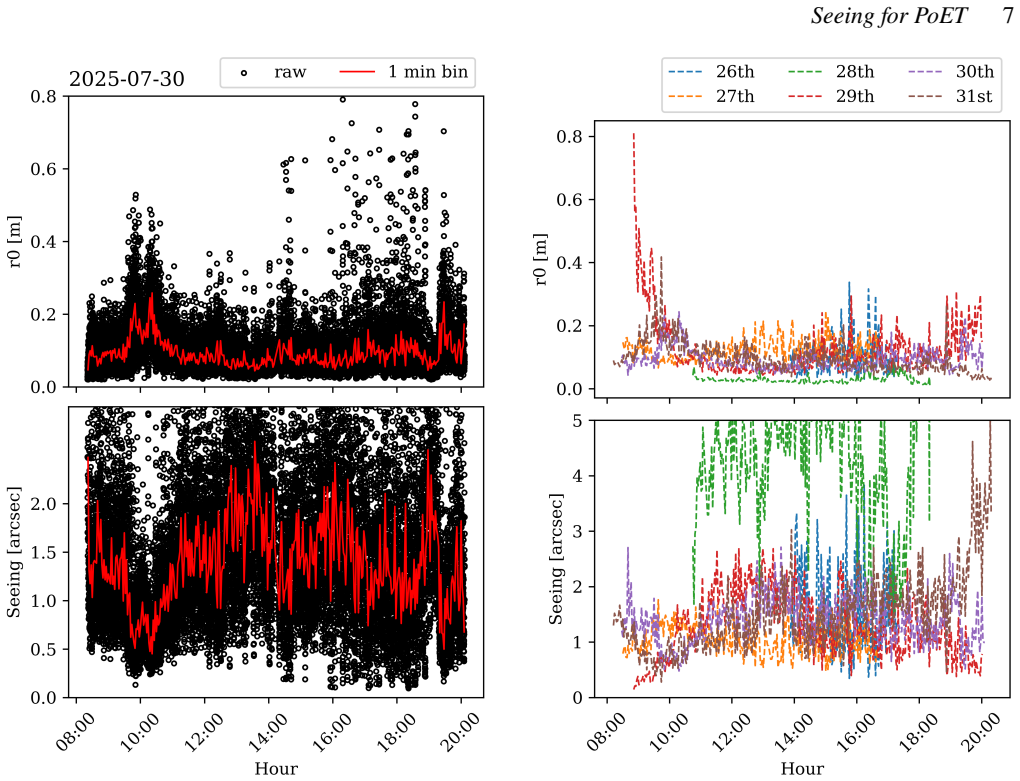
Atmospheric seeing arises from stochastic fluctuations in the refractive index of the Earth's atmosphere, producing random variations in the apparent direction of incoming light from astronomical sources. Scintillation refers to the associated intensity fluctuations induced by these refractive index inhomogeneities. A quantitative relationship between seeing and scintillation was established in 1993, enabling daytime seeing measurements by exploiting the Sun as an extended, bright source and using non-telescopic instrumentation. PoET, the Paranal solar ESPRESSO Telescope, will feed the Echelle SPectrograph for Rocky Exoplanets and Stable Spectroscopic Observations, ESPRESSO, at the European Southern Observatory (ESO) Very Large Telescope (VLT). By using the Sun as a proxy for solar-type stars, PoET will facilitate detailed investigations of the physical processes that drive stellar noise in ultra-high-precision radial-velocity measurements for exoplanet studies. The instrument is capable of targeting any region on the solar disk and acquiring spatially resolved spectra over areas ranging from 1 to 55 arcseconds. Accurate characterization of daytime atmospheric seeing is therefore essential for selecting the optimal observing aperture and ensuring the scientific performance of PoET. To support this requirement, we have developed and implemented a dedicated solar seeing monitor for daytime deployment at Paranal, Chile, where PoET will operate. In this work, we describe the instrument design and present the results from commissioning and initial on-sky validation.
Editorial analysis
A structured set of objections, weighed in public.
Referee Report
Summary. The manuscript describes the design and implementation of a dedicated solar seeing monitor for the PoET solar telescope at Paranal, Chile. It exploits the quantitative relationship between seeing and scintillation established in 1993, using the Sun as an extended source for daytime measurements, and reports results from instrument commissioning and initial on-sky validation to support aperture selection for PoET's high-precision radial-velocity observations.
Significance. If the on-sky validation holds with demonstrated accuracy, the instrument would provide a practical, non-telescopic tool for routine daytime seeing characterization at a premier site, directly enabling optimized observing strategies for PoET and similar solar telescopes. The work fills a specific operational gap for solar astronomy at Paranal.
major comments (2)
- [On-sky validation] On-sky validation section: The central claim of successful commissioning and validation rests on the direct transfer of the 1993 seeing-scintillation relation to the monitor's pupil geometry, wavelength band, integration time, and Paranal daytime boundary-layer conditions. No independent cross-check (e.g., simultaneous comparison with a co-located DIMM or MASS) is described to isolate potential systematics, which is load-bearing for asserting that the device delivers accurate seeing values for PoET aperture selection.
- [Abstract and results] Results presentation: The abstract asserts quantitative commissioning and validation outcomes, yet the provided summary supplies no error bars, statistical metrics, comparison values, or exclusion criteria. This omission prevents verification that the measured scintillation-to-seeing conversion performs as required under the target conditions.
minor comments (2)
- [Instrument design] Clarify the exact pupil diameter, filter bandpass, and sampling cadence of the monitor in the instrument design section to allow readers to assess compatibility with the 1993 assumptions.
- The manuscript would benefit from a short table summarizing key performance metrics (e.g., seeing range, precision, comparison residuals) from the on-sky tests.
Simulated Author's Rebuttal
We thank the referee for the constructive and detailed comments, which help clarify the strengths and limitations of our work. We address each major point below and propose targeted revisions to improve the manuscript.
read point-by-point responses
-
Referee: [On-sky validation] On-sky validation section: The central claim of successful commissioning and validation rests on the direct transfer of the 1993 seeing-scintillation relation to the monitor's pupil geometry, wavelength band, integration time, and Paranal daytime boundary-layer conditions. No independent cross-check (e.g., simultaneous comparison with a co-located DIMM or MASS) is described to isolate potential systematics, which is load-bearing for asserting that the device delivers accurate seeing values for PoET aperture selection.
Authors: We acknowledge that the validation relies on transferring the 1993 relation without an independent cross-check against DIMM or MASS. Simultaneous observations with those instruments were not feasible during the initial commissioning due to site scheduling and resource constraints. In the revised version, we will expand the on-sky validation section with a new subsection explicitly discussing the assumptions in the transfer (pupil geometry, wavelength band, integration time, and daytime boundary-layer specifics), potential systematics, and quantitative uncertainty estimates from the available data. We will also clarify how these affect the reliability for PoET aperture selection. revision: partial
-
Referee: [Abstract and results] Results presentation: The abstract asserts quantitative commissioning and validation outcomes, yet the provided summary supplies no error bars, statistical metrics, comparison values, or exclusion criteria. This omission prevents verification that the measured scintillation-to-seeing conversion performs as required under the target conditions.
Authors: We agree that the abstract should include quantitative details for transparency. We will revise the abstract to report key commissioning and validation metrics, including measured seeing ranges with uncertainties, relevant statistical measures, and any comparison or exclusion criteria applied to the data. These will be drawn directly from the results section to allow readers to evaluate the scintillation-to-seeing conversion performance. revision: yes
- We do not have simultaneous DIMM or MASS data for an independent cross-check and cannot add such a comparison without new observations.
Circularity Check
No circularity; instrument paper uses external 1993 relation and reports independent commissioning data.
full rationale
The manuscript is an instrument description and validation report. It cites the 1993 seeing-scintillation relation as an established external result (not derived or fitted here) to convert scintillation measurements to seeing values. No equations, parameters, or predictions within the paper reduce to self-definitions, self-citations, or fitted inputs by construction. Commissioning and on-sky results serve as external benchmarks rather than tautological outputs. The derivation chain is therefore self-contained with no load-bearing circular steps.
Axiom & Free-Parameter Ledger
axioms (1)
- domain assumption A quantitative relationship between seeing and scintillation was established in 1993
Reference graph
Works this paper leans on
-
[1]
4853 ofSociety of Photo- Optical Instrumentation Engineers (SPIE) Conference Series, pp
The1-meterSwedishsolartelescope,inInnovative Telescopes and Instrumentation for Solar Astrophysics, vol. 4853 ofSociety of Photo- Optical Instrumentation Engineers (SPIE) Conference Series, pp. 341–350. ed. Schroeder, D. J., 2000.Astronomical optics. Seykora, E. J., 1993. Solar Scintillation and the Monitoring of Solar Seeing, Sol. Phys.,145(2), 389–397. ...
work page 2000
-
[2]
Seeing measurements with autonomous, short-baseline shadow bandrangers,inGround-based and Airborne Telescopes III,vol.7733of Society of Photo-Optical Instrumentation Engineers (SPIE) Confer- ence Series, p. 77334L. Thompson, S. J., Queloz, D., Baraffe, I., Brake, M., Dolgopolov, A., Fisher, M., Fleury, M., Geelhoed, J., Hall, R., González Hernández, J. I....
work page 2016
discussion (0)
Sign in with ORCID, Apple, or X to comment. Anyone can read and Pith papers without signing in.