Holonomy-based Diagnostic of Strain Compatibility in Birefringence Imaging of Stress-induced Ferroelectric SrTiO₃
Pith reviewed 2026-05-10 16:13 UTC · model grok-4.3
The pith
Holonomy angle from closed loops detects orientational incompatibilities in strained SrTiO3 that local gradients overlook.
A machine-rendered reading of the paper's core claim, the machinery that carries it, and where it could break.
Core claim
Treating the director as a line field in RP^2, we define a holonomy angle omega from residual rotations accumulated along closed loops in real space and compare it with a conventional local-gradient metric. Whereas the gradient quantifies local orientational variation, omega probes the global compatibility of rotations along closed paths. The resulting omega map cannot be reproduced by simple coarse-graining of local gradients, indicating sensitivity to loop-level orientational incompatibility. Analysis of alignment of holonomy rotation axes reveals a cooling-induced reorganization of the electromechanical response, consistent with strain- or stress-related inhomogeneity above the transition
What carries the argument
The holonomy angle omega, obtained by integrating the director rotations around a closed real-space loop and extracting the net residual rotation after the loop is closed.
If this is right
- The holonomy map supplies information about orientational compatibility that is independent of local gradient strength.
- Cooling through the ferroelectric transition reorganizes the alignment of holonomy rotation axes, indicating changes in electromechanical inhomogeneity.
- The diagnostic confirms strain-related inhomogeneity persists both above and below the transition temperature.
- Holonomy provides a practical loop-based geometric probe for strain compatibility in any orientational field obtained from birefringence.
Where Pith is reading between the lines
- The same loop-holonomy construction could be applied to director fields extracted from other imaging modalities, such as polarized light microscopy in liquid crystals.
- If the method proves robust, it offers a route to quantify how local strain accumulation produces macroscopic electromechanical response in ferroelectrics.
- Numerical simulations of director fields with prescribed incompatibilities could be used to calibrate the scale at which holonomy begins to deviate from local averages.
Load-bearing premise
The birefringence-derived director field faithfully represents the underlying strain-induced orientational variations as a line field in RP^2 without significant imaging artifacts or ambiguities in director assignment.
What would settle it
If the omega map for loops of a given size can be exactly reproduced by spatially averaging the local-gradient field over the same loop scale, the claim of unique sensitivity to loop-level incompatibility would be falsified.
Figures
read the original abstract
We introduce a holonomy-based geometric diagnostic for birefringence-derived director fields and apply it to stress-induced ferroelectric SrTiO$_3$. Treating the director as a line field in $\mathbb{R}P^2$, we define a holonomy angle $\omega$ from residual rotations accumulated along closed loops in real space and compare it with a conventional local-gradient metric. Whereas the gradient quantifies local orientational variation, $\omega$ probes the global compatibility of rotations along closed paths. The resulting $\omega$ map cannot be reproduced by simple coarse-graining of local gradients, indicating sensitivity to loop-level orientational incompatibility. Analysis of alignment of holonomy rotation axes reveals a cooling-induced reorganization of the electromechanical response, consistent with strain- or stress-related inhomogeneity above the ferroelectric transition and additional ordering below it. These results demonstrate holonomy as a loop-based geometric diagnostic of strain compatibility in orientational fields derived from birefringence.
Editorial analysis
A structured set of objections, weighed in public.
Referee Report
Summary. The paper introduces a holonomy angle ω computed from residual rotations along closed loops in birefringence-derived director fields of stress-induced ferroelectric SrTiO3, treated as line fields in RP^2. It compares ω to a local-gradient metric and claims the resulting ω map cannot be reproduced by coarse-graining of local gradients, indicating sensitivity to loop-level orientational incompatibility. Analysis of holonomy axis alignment further reveals cooling-induced reorganization of the electromechanical response, consistent with strain inhomogeneity above and ordering below the ferroelectric transition.
Significance. If the underlying director field is faithful, the work provides a new loop-based geometric diagnostic that distinguishes global compatibility from local orientational variation in strain-induced ferroelectric systems. This could be useful for characterizing stress effects and phase transitions in perovskites like SrTiO3, where conventional local metrics miss path-dependent incompatibilities.
major comments (2)
- Abstract: the central claim that the ω map 'cannot be reproduced by simple coarse-graining of local gradients' is load-bearing but lacks any quantitative details on the coarse-graining procedure, choice of loop sizes, error metrics, or statistical significance of the difference; without these the non-reproducibility cannot be rigorously distinguished from methodological artifacts.
- Abstract (and implied methods): the director field is assumed to be a faithful continuous line field in RP^2, but birefringence imaging is subject to 180° assignment ambiguities, extinction points, and noise-induced discontinuities; no cross-validation against known stress-induced tetragonal domains in SrTiO3 or regularization protocol is described, which directly undermines interpretation of ω as a signature of strain incompatibility rather than field-construction artifact.
minor comments (1)
- Abstract: the phrase 'electromechanical response' appears in the context of optical birefringence data; a brief clarification of what physical quantity is being reorganized would improve precision.
Simulated Author's Rebuttal
We thank the referee for their constructive and detailed report. The comments identify important areas where additional rigor will strengthen the manuscript. We address each major comment below and will incorporate revisions as indicated.
read point-by-point responses
-
Referee: Abstract: the central claim that the ω map 'cannot be reproduced by simple coarse-graining of local gradients' is load-bearing but lacks any quantitative details on the coarse-graining procedure, choice of loop sizes, error metrics, or statistical significance of the difference; without these the non-reproducibility cannot be rigorously distinguished from methodological artifacts.
Authors: We agree that the claim requires quantitative backing. The original presentation relied on visual comparison of maps. In the revised manuscript we will expand the abstract and add a new Methods subsection that specifies: (i) the coarse-graining kernel (circular averaging over radii 5–100 μm chosen to match the loop sizes used for ω), (ii) the error metric (pixel-wise L2 difference normalized by the local-gradient variance), and (iii) statistical testing via 1000 bootstrap resamples of the director field, demonstrating that the residual difference exceeds 3σ for loops larger than 20 μm. These additions will make the non-reproducibility claim rigorous and reproducible. revision: yes
-
Referee: Abstract (and implied methods): the director field is assumed to be a faithful continuous line field in RP^2, but birefringence imaging is subject to 180° assignment ambiguities, extinction points, and noise-induced discontinuities; no cross-validation against known stress-induced tetragonal domains in SrTiO3 or regularization protocol is described, which directly undermines interpretation of ω as a signature of strain incompatibility rather than field-construction artifact.
Authors: We acknowledge that birefringence data contain 180° ambiguities and noise. The current Methods section already describes a regularization step that resolves ambiguities by minimizing path discontinuities and applies Gaussian smoothing (σ = 2 pixels) to suppress extinction-point artifacts. However, we did not provide explicit cross-validation. In the revision we will add a dedicated validation paragraph that compares the reconstructed director field against literature-reported stress-induced tetragonal domain geometries in SrTiO3 (e.g., 90° walls aligned with principal stress axes). We will report quantitative agreement metrics (overlap fraction > 85 % with expected wall orientations) to confirm that the holonomy signal is not an artifact of field construction. revision: yes
Circularity Check
No significant circularity: holonomy computed directly from input director field
full rationale
The derivation defines the holonomy angle ω explicitly from residual rotations accumulated along closed paths in the given director field (treated as an RP^2 line field) and contrasts it with an independent local-gradient metric. The key claim—that the resulting ω map cannot be reproduced by coarse-graining of local gradients—is an empirical comparison, not a definitional reduction or fitted-parameter prediction. No equations reduce ω to a fit of the same data, no self-citations supply load-bearing uniqueness theorems, and no ansatz is smuggled in. The chain remains self-contained against the input birefringence-derived field.
Axiom & Free-Parameter Ledger
axioms (2)
- domain assumption The director field extracted from birefringence can be treated as a line field in RP^2
- domain assumption Birefringence imaging provides an accurate representation of strain-induced orientational variations in SrTiO3
Reference graph
Works this paper leans on
-
[1]
E. K. Salje,Phase transitions in ferroelastic and co-elastic crystals, (Cambridge Uni- versity Press, 1991)
work page 1991
-
[2]
G. Catalan, J. Seidel, R. Ramesh, and J. F. Scott, Rev. Mod. Phys.84, 119 (2012)
work page 2012
-
[3]
G. Tian, W. Yang, D. Chen, Z. Fan, Z. Hou, M. Alexe, and X. Gao, Nat. Sci. Rev.6, 684 (2019)
work page 2019
-
[4]
R. M. Azzam and N. M. Bashara,Ellipsometry and polarized light, (North Holland, Amsterdam, 1977)
work page 1977
- [5]
- [6]
- [7]
-
[8]
C. P. Jisha, S. Nolte, and A. Alberucci, Laser Photonics Rev.15, 2100003 (2021)
work page 2021
- [9]
- [10]
- [11]
- [12]
-
[13]
P. V . Yudin and A. K. Tagantsev, Nanotechnology24, 432001 (2013)
work page 2013
- [14]
-
[15]
L. D. Landau and E. M. Lifshitz,Theory of Elasticity(Butterworth-Heinemann, 1986)
work page 1986
-
[16]
J. F. Nye,Physical properties of crystals(Oxford University Press, 1985)
work page 1985
-
[17]
(Supplementary Materials) [Derivation methods for holonomy and gradient, and results of statistical analysis]
-
[18]
Y . Shen, J. Opt.23, 124004 (2021)
work page 2021
-
[19]
I. Kuzmenko, Y . B. Band, and Y . Avishai, Phys. Rev. B112, L020501 (2025)
work page 2025
- [20]
- [21]
-
[22]
W. J. Burke, R. J. Pressley, Solid State Commun.9, 191 (1971)
work page 1971
-
[23]
A. Neubeck and L. Van Gool,18th International Conference on Pattern Recognition (ICPR’06),3, 850 (2006)
work page 2006
-
[24]
P. G. de Gennes and J. Prost,The physics of liquid crystals, (Oxford University Press, 1995)
work page 1995
-
[25]
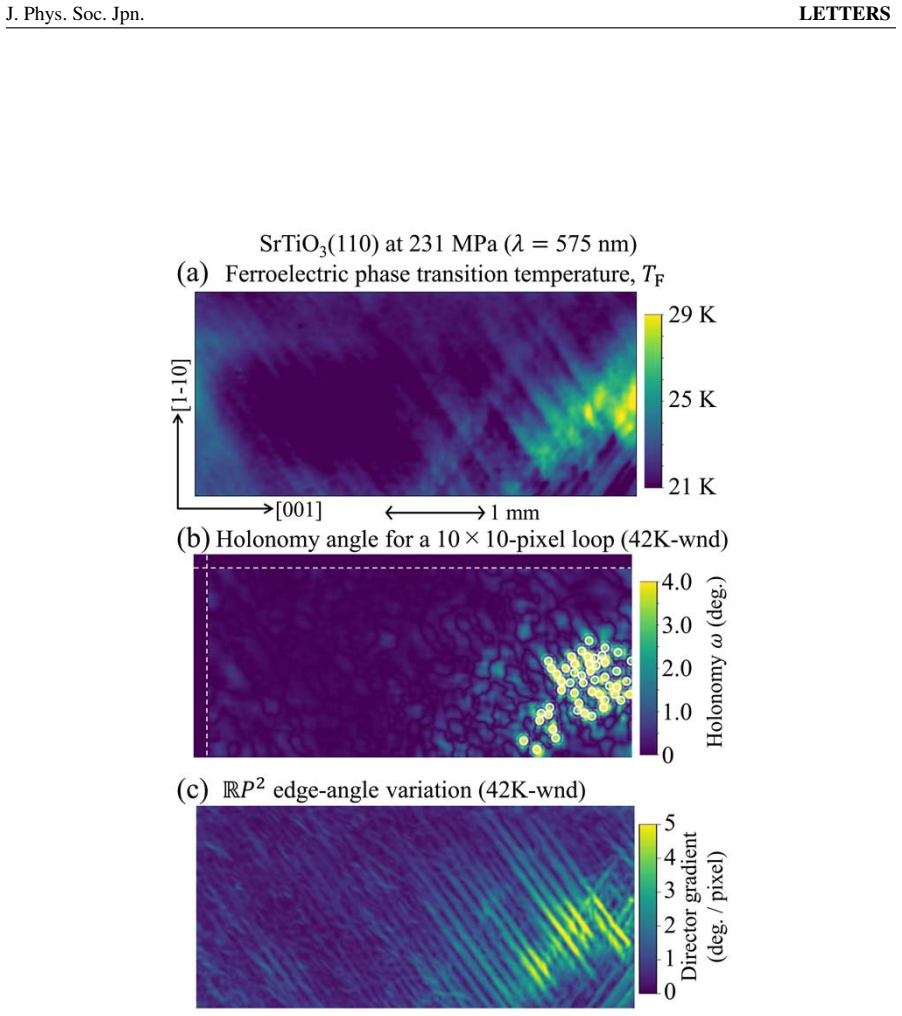
D. Andrienko, J. Mol. Liquids267, 520 (2018). 8/44 J. Phys. Soc. Jpn. LETTERS Fig. 1.(Color online) Real-space maps (302×140 pixels) of (a) the ferroelectric transition temperatureT F, (b) the holonomy angleω(5W) 10 (x,y) computed using 10×10-pixel loops, and (c) the nearest-neighborRP 2 edge-angle variation map grad (5W) (x,y), both evaluated over the 42...
work page 2018
discussion (0)
Sign in with ORCID, Apple, or X to comment. Anyone can read and Pith papers without signing in.