Recognition: unknown
Mortality of ultra-thin LGADs and PiN diodes from high energy deposition
Pith reviewed 2026-05-10 14:51 UTC · model grok-4.3
The pith
Ultra-thin LGADs and PiN diodes develop distinct mortality categories when exposed to high-energy particle beams after pre-irradiation.
A machine-rendered reading of the paper's core claim, the machinery that carries it, and where it could break.
Core claim
Several mortality categories were observed, defined by different electrical and mechanical damage signatures. This furthers our understanding of permanent radiation damage of silicon devices, crucial towards mitigating Single Event Burnout and other damage mechanisms to safely operate future detectors.
What carries the argument
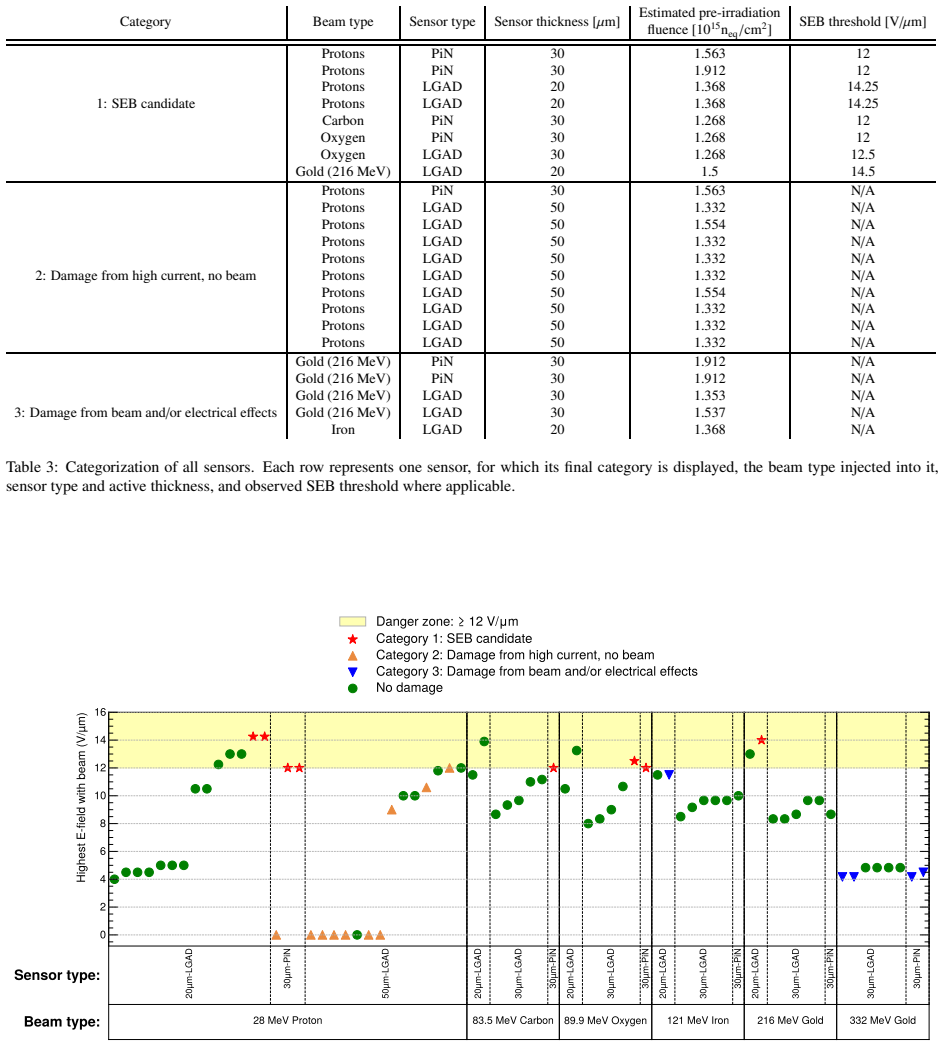
Mortality categories classified by distinct electrical and mechanical damage signatures observed after pre-irradiation up to 1.5 times 10 to the 15 n_eq per square centimeter and exposure to high-energy deposition.
If this is right
- Bias voltage limits derived from minimum ionizing particle studies may require adjustment when higher energy deposition occurs.
- Different particle species produce identifiable damage patterns that can guide targeted mitigation in detector design.
- Pre-irradiation to 1.5 times 10 to the 15 n_eq per square centimeter influences which mortality categories appear in 20-50 micrometer thick devices.
- Classifying these failure modes supports safer long-term operation of silicon timing detectors in intense radiation fields.
Where Pith is reading between the lines
- The same categories could appear in other thin silicon sensors used in space or nuclear environments and might be mapped by varying ion species.
- Integrating the damage signatures into radiation environment simulations could improve lifetime predictions for collider detectors.
- Follow-up tests with mixed beams that better reproduce collider conditions would test whether additional mortality types emerge.
Load-bearing premise
The specific beam conditions and pre-irradiation levels at the accelerator produce damage mechanisms representative of the full energy spectrum and particle mix in actual high-energy collider experiments.
What would settle it
An experiment exposing identical pre-irradiated devices to a particle beam whose energy spectrum and mix match those of a high-energy collider and finding only a single damage signature or no permanent mortality would show the categories are not general.
Figures





read the original abstract
Low Gain Avalanche Diodes are prime candidates for high-resolution timing applications in High Energy Physics, Nuclear science, and several other fields. Operating these devices in high-radiation environments presents various hazards, including the risk of their permanent degradation or destruction caused by effects such as Single Event Burnout. Studies using minimum ionizing particles found a greatly reduced Single Event Burnout risk by operating below a bias voltage corresponding to an average electric field of 12 V/$\mu$m - however, as high energy particle colliders produce a wide energy spectrum of radiation, it is crucial to understand this phenomenon and other possible damage mechanisms at energy deposition levels greater than those of minimum ionizing particles. This was achieved by pre-irradiating LGADs and PiN diodes with active thicknesses of 20, 30, and 50 $\mu$m up to 1.5 $\times$ 10$^{15}$ $\mathrm{n_{eq}/cm^2}$, and exposing them to beams of protons and heavy ions (C, O, Fe, Au) at the BNL Tandem van de Graaff accelerator. Several mortality categories were observed, defined by different electrical and mechanical damage signatures. This furthers our understanding of permanent radiation damage of silicon devices, crucial towards mitigating Single Event Burnout and other damage mechanisms to safely operate future detectors.
Editorial analysis
A structured set of objections, weighed in public.
Referee Report
Summary. The manuscript reports an experimental investigation of permanent damage in ultra-thin (20–50 μm) LGADs and PiN diodes. Devices were pre-irradiated to fluences up to 1.5 × 10^15 n_eq/cm² and then exposed to proton and heavy-ion (C, O, Fe, Au) beams at the BNL Tandem van de Graaff accelerator to induce high energy deposition. The authors identify several distinct mortality categories based on electrical and mechanical failure signatures and argue that these observations advance understanding of radiation damage mechanisms, including those relevant to Single Event Burnout, for future high-energy physics detectors.
Significance. If the reported damage categories are reproducible and the test conditions are shown to map onto collider radiation fields, the work could contribute useful empirical data toward radiation-hardness strategies for timing detectors. The experimental choice of controlled high-LET ions is a reasonable way to probe non-minimum-ionizing energy deposition. However, the absence of quantitative metrics, error bars, or statistical support for the claimed categories substantially reduces the immediate significance of the results.
major comments (2)
- [Abstract] Abstract and results sections: the central claim that 'several mortality categories were observed' is presented without any quantitative data, error bars, sample sizes, or statistical analysis. This absence makes it impossible to assess the robustness or reproducibility of the reported damage signatures.
- [Introduction] Introduction and discussion: the claim that the observed signatures are relevant to mitigating SEB in future collider detectors rests on the unverified assumption that BNL Tandem MeV-scale ion beams produce damage physics representative of the mixed GeV–TeV hadron field at HL-LHC. No LET spectra, dE/dx comparisons, or Monte Carlo (FLUKA/Geant4) validation against collider fluences is provided, which is load-bearing for the extrapolation.
minor comments (2)
- Clarify the exact definition and measurement protocol for each mortality category (e.g., leakage current thresholds, mechanical fracture criteria) in the methods or results section.
- Include a table or figure summarizing the number of devices tested per thickness, fluence, and beam species together with the observed failure rates.
Simulated Author's Rebuttal
We thank the referee for the constructive and detailed feedback on our manuscript. We have addressed each major comment below and revised the manuscript to improve clarity, quantitative support, and the discussion of applicability to collider environments.
read point-by-point responses
-
Referee: [Abstract] Abstract and results sections: the central claim that 'several mortality categories were observed' is presented without any quantitative data, error bars, sample sizes, or statistical analysis. This absence makes it impossible to assess the robustness or reproducibility of the reported damage signatures.
Authors: We agree that the abstract and results sections would be strengthened by explicit quantitative information. In the revised manuscript we have added the total number of devices tested (typically 6–12 per ion species and fluence point), error bars on breakdown voltage and leakage current measurements, and a statistical summary of the observed failure modes. A new table in the results section lists each mortality category together with the fraction of devices exhibiting that signature and the associated uncertainties. These additions allow readers to evaluate reproducibility directly from the data. revision: yes
-
Referee: [Introduction] Introduction and discussion: the claim that the observed signatures are relevant to mitigating SEB in future collider detectors rests on the unverified assumption that BNL Tandem MeV-scale ion beams produce damage physics representative of the mixed GeV–TeV hadron field at HL-LHC. No LET spectra, dE/dx comparisons, or Monte Carlo (FLUKA/Geant4) validation against collider fluences is provided, which is load-bearing for the extrapolation.
Authors: The referee correctly notes that a full Monte Carlo validation of the entire HL-LHC radiation field lies outside the scope of this focused experimental study. We have nevertheless added a dedicated paragraph in the discussion that compares the LET range accessed by the C, O, Fe, and Au ions (approximately 1–120 MeV cm²/mg) with the high-dE/dx tail of the energy-deposition spectrum obtained from published Geant4 and FLUKA simulations of HL-LHC conditions. This comparison shows that the heavy-ion beams probe the extreme local energy depositions relevant to SEB-like mechanisms. We have also revised the introduction and conclusions to frame the work as an investigation of high-energy-deposition damage mechanisms rather than a direct simulation of the full collider environment, thereby clarifying the intended scope of the extrapolation. revision: partial
Circularity Check
No circularity: purely observational experimental report
full rationale
The paper reports direct experimental observations of damage signatures in pre-irradiated LGADs and PiN diodes exposed to specific BNL Tandem beams. No mathematical derivations, fitted models, predictions, or first-principles results are claimed or present in the abstract or described methodology. Mortality categories are defined empirically from measured electrical and mechanical effects, with no reduction of outputs to inputs by construction, no self-citation chains supporting a derivation, and no ansatz or uniqueness theorems invoked. The central claim rests on empirical data collection rather than any analytical chain that could be circular.
Axiom & Free-Parameter Ledger
axioms (1)
- domain assumption Standard models of single-event effects and radiation damage in silicon detectors hold under the tested conditions.
Forward citations
Cited by 1 Pith paper
-
Systematic Investigation of Acceptor Removal in HPK LGADs with Modified Gain Layers
Carbon implantation in the gain layer of HPK LGADs provides a clear improvement in radiation tolerance after proton and neutron irradiation, unlike oxygen-related modifications or boron-phosphorus compensation.
Reference graph
Works this paper leans on
-
[1]
Pellegrini, P
G. Pellegrini, P. Fernández-Martínez, M. Baselga, C. Fleta, D. Flores, V Greco, S. Hidalgo, I. Mandi´c, G. Kram- berger, D. Quirion, and M. Ullan. Technology developments and first measurements of Low Gain Avalanche Detectors (LGAD) for high energy physics applications.Nuclear Instruments and Methods in Physics Research Section A: Accelerators, Spectromet...
2014
-
[2]
Cartiglia, R
N. Cartiglia, R. Arcidiacono, M. Costa, M. Ferrero, G. Gioachin, M. Mandurrino, L. Menzio, F. Siviero, V . Sola, and M. Tornago. 4D tracking: present status and perspectives.Nuclear Instruments and Methods in Physics Research Section A: Accelerators, Spectrometers, Detectors and Associated Equipment, 1040:167228, 2022
2022
-
[3]
Technical report, CERN, Geneva, 2020
Technical Design Report: A High-Granularity Timing Detector for the ATLAS Phase-II Upgrade. Technical report, CERN, Geneva, 2020
2020
-
[4]
A MIP Timing Detector for the CMS Phase-2 Upgrade
Collaboration CMS. A MIP Timing Detector for the CMS Phase-2 Upgrade. Technical report, CERN, Geneva, 2019
2019
-
[5]
The IDEA detector concept for FCC-ee, 2025
The IDEA Study Group. The IDEA detector concept for FCC-ee, 2025
2025
-
[6]
Holmes, Sergo Jindariani, Kiley E
Charles Bell, Daniele Calzolari, Christian Carli, Karri Folan Di Petrillo, Micah Hillman, Tova R. Holmes, Sergo Jindariani, Kiley E. Kennedy, Ka Hei Martin Kwok, Anton Lechner, Lawrence Lee, Thomas Madlener, Federico Meloni, Isobel Ojalvo, Priscilla Pani, Rose Powers, Benjamin Rosser, Leo Rozanov, Kyriacos Skoufaris, Elise Sledge, Alexander Tuna, and Junj...
2025
-
[7]
Juska Pekkanen. ALLEGRO FCC-ee detector concept & Noble liquid calorimetry.Nuclear Instruments and Methods in Physics Research Section A: Accelerators, Spectrometers, Detectors and Associated Equipment, 1069:169921, 2024
2024
-
[8]
Shyam Kumar. Tracking performances of the ePIC detector at the Electron-Ion Collider.Nuclear Instruments and Methods in Physics Research Section A: Accelerators, Spectrometers, Detectors and Associated Equipment, 1069:169922, 2024. 13
2024
-
[9]
et al Kramberger
G. et al Kramberger. Radiation effects in Low Gain Avalanche Detectors after hadron irradiations.Journal of Instrumentation, 10(07):P07006, jul 2015
2015
-
[10]
Beresford et al
L.A. Beresford et al. Destructive breakdown studies of irradiated LGADs at beam tests for the ATLAS HGTD. Journal of Instrumentation, 18(07):P07030, jul 2023
2023
-
[11]
First study of single-event burnout in very-thin planar silicon sensors.Frontiers in Physics, V olume 13 - 2025, 2025
Marco Ferrero, Roberta Arcidiacono, Nicolò Cartiglia, Leonardo Lanteri, Luca Menzio, Arianna Morozzi, Francesco Moscatelli, Roberto Mulargia, Federico Siviero, Robert White, and Valentina Sola. First study of single-event burnout in very-thin planar silicon sensors.Frontiers in Physics, V olume 13 - 2025, 2025
2025
-
[12]
G H Johnson, J H Hohl, R D Schrimpf, and K F Galloway. Simulating single-event burnout of n-channel power mosfet’s.IEEE Transactions on Electron Devices (Institute of Electrical and Electronics Engineers); (United States), 40:5, 05 1993
1993
-
[13]
J. R. Schwank, M. R. Shaneyfelt, and D. M. Fleetwood. Single-Event Burnout of Power MOSFETs: Dependence on Ion Linear Energy Transfer and Applied Bias.IEEE Transactions on Nuclear Science, 40(6):1925–1931, 1993
1925
-
[14]
Dachs and J
H. Dachs and J. L. Titus. Ion Species and Energy Dependence of Single-Event Burnout in Power MOSFETs. IEEE Transactions on Nuclear Science, 43(6):2944–2950, 1996
1996
-
[15]
Waskiewicz and J
K. Waskiewicz and J. R. Schwank. Single-Event Burnout Thresholds and Safe Operating Area of Power MOS- FETs.IEEE Transactions on Nuclear Science, 45(6):2584–2590, 1998
1998
-
[16]
https://www.bnl.gov/tandem/
The Tandem van de GraaffFacility at BNL. https://www.bnl.gov/tandem/. Accessed: 2026-02-02
2026
-
[17]
Thieberger
P. Thieberger. The Brookhaven double MP facility: Recent developments and plans for the future.Nuclear Instruments and Methods in Physics Research, 220(1):45–53, 1984
1984
-
[18]
A. E. Waskiewicz, J. W. Groninger, V . H. Strahan, and D. M. Long. Burnout of Power MOS Transistors with Heavy Ions of Californium-252.IEEE Transactions on Nuclear Science, 33(6):1710–1713, 1986
1986
-
[19]
V . Sola. Systematic study of heavily irradiated LGAD stability using the Fermilab Test Beam Facility. In Workshop on pico-second timing detectors for Physics, 2021
2021
-
[20]
Development of a technology for the fabrication of Low-Gain Avalanche Diodes at BNL.Nuclear Inst
Gabriele Giacomini, Wei Chen, Francesco Lanni, and Alessandro Tricoli. Development of a technology for the fabrication of Low-Gain Avalanche Diodes at BNL.Nuclear Inst. andMethods in Physics Research, A, V olume 934, 2019
2019
-
[21]
Rhode Island Nuclear Science Center, n.d
National Organization of Test, Research and Training Reactors. Rhode Island Nuclear Science Center, n.d. Accessed: 2026-04-10, https://www.trtr.org/rinsc/
2026
-
[22]
Radiation Damage in Silicon Detector Devices
Frank Hartmann."Radiation Damage in Silicon Detector Devices", "Evolution of Silicon Sensor Technology in Particle Physics: Basics and Applications", pages 177–214. Springer Nature Switzerland, Cham, 2024
2024
-
[23]
History of the seu test facilitiy, n.d
BNL Tandem van de Graaff. History of the seu test facilitiy, n.d. Accessed: 2026-04-10, https://www.bnl.gov/tandem/files/pdf/seu.pdf
2026
-
[24]
LGAD mortality triggered by highly ionizing particles
SR-NIEL. Electronic stopping power and ionizing dose calculators for protons and ions, n.d. Accessed: 2026- 04-02, https://www.sr-niel.org/index.php/sr-niel-web-calculators/electronic-stopping-power-ionizing-dose- calculator-for-protons-and-ions/electronic-stopping-power-and-ionizing-dose-calculators-for-protons-ions. 14 Acknowledgements The authors wish ...
2026
discussion (0)
Sign in with ORCID, Apple, or X to comment. Anyone can read and Pith papers without signing in.