Shadow of rotating black hole surrounded by dark matter
Pith reviewed 2026-05-10 16:21 UTC · model grok-4.3
The pith
Dark matter below a critical mass leaves rotating black hole shadows unchanged but drives major expansion of all structures once the threshold is crossed while keeping the shadow nearly circular.
A machine-rendered reading of the paper's core claim, the machinery that carries it, and where it could break.
Core claim
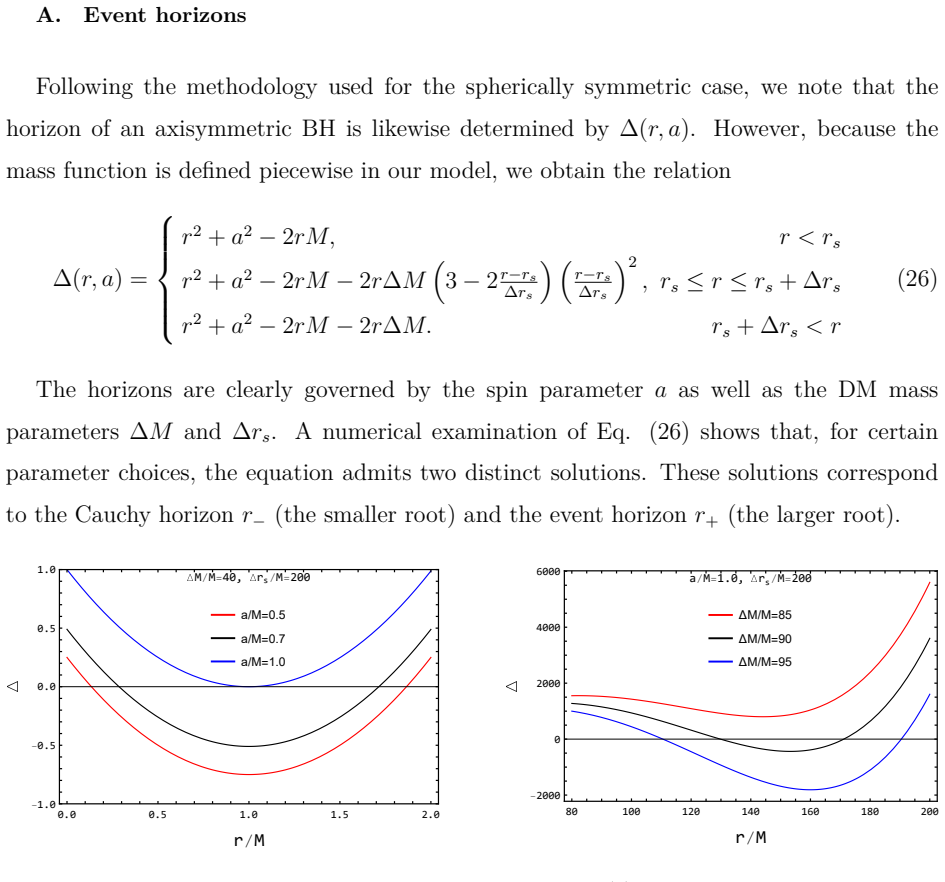
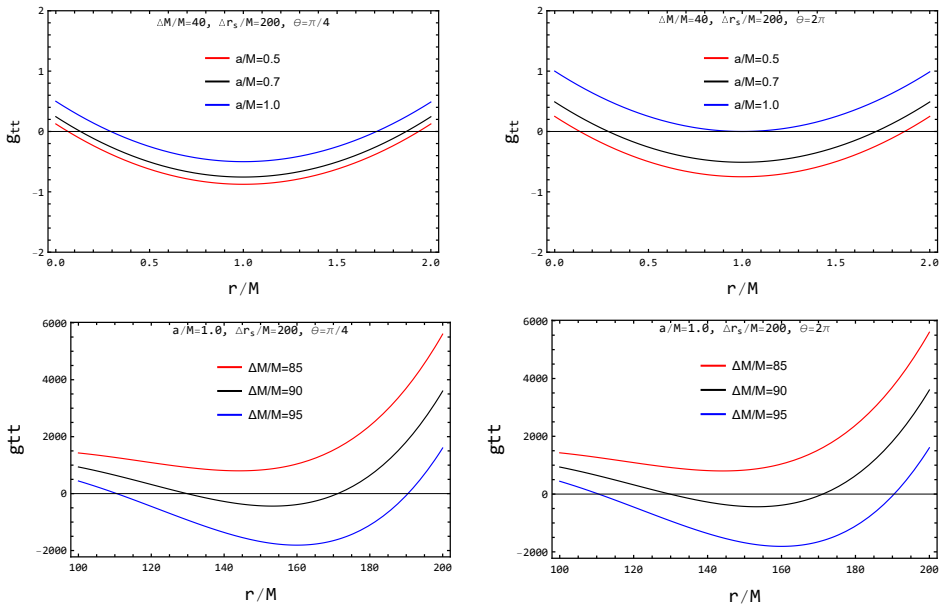
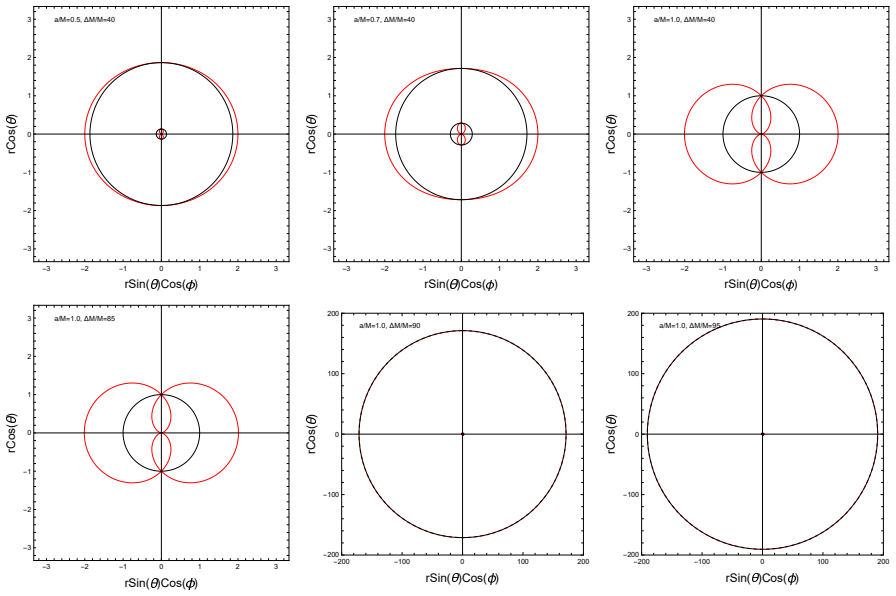
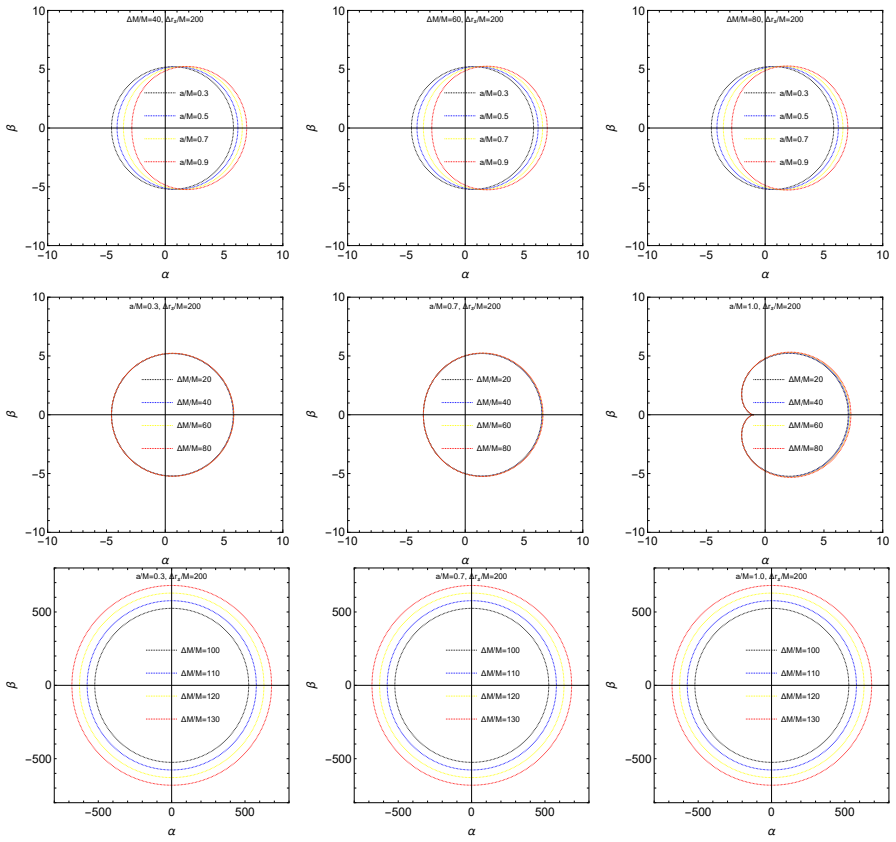
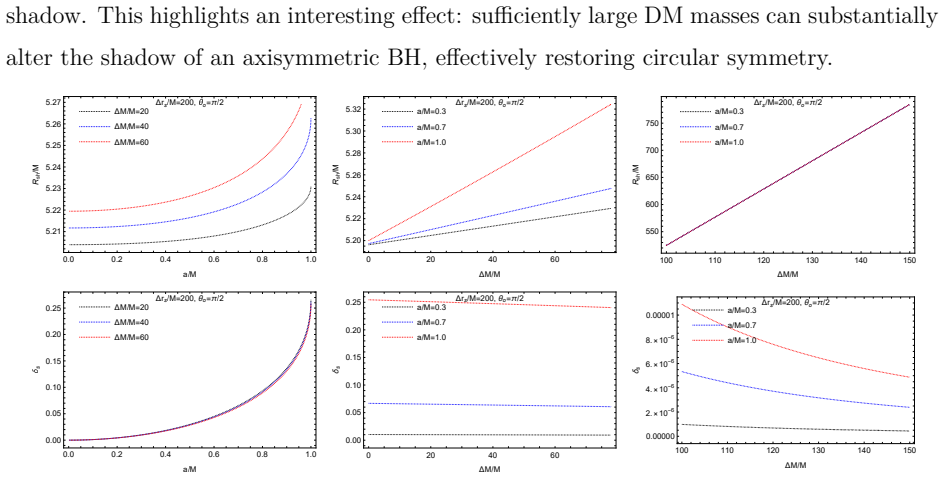
Applying the Newman-Janis algorithm to the Schwarzschild black hole surrounded by dark matter produces a Kerr-like spacetime whose event horizon, ergosphere, and unstable photon sphere all enlarge once the dark matter mass exceeds a critical value, while the shadow boundary calculated from null geodesics remains close to circular even at high spin; the associated energy emission rate also increases with the enlarged geometry.
What carries the argument
The shadow silhouette formed by the unstable photon orbits in the axisymmetric metric obtained by the Newman-Janis algorithm from the dark-matter-surrounded Schwarzschild solution.
If this is right
- Dark matter mass above the critical threshold causes the event horizon, ergosphere, and shadow radius to increase substantially.
- Dark matter suppresses spin-induced distortion, keeping the shadow nearly circular for high angular momentum.
- The structural growth at high dark matter mass can exceed sizes allowed by current Event Horizon Telescope measurements.
- Consistency with observations therefore requires that dark matter be absent or below the critical mass in the immediate neighborhood of the black hole.
Where Pith is reading between the lines
- The critical-mass threshold could be tested by repeating the calculation with other dark matter density profiles to check how sensitive the value is to the halo model.
- If the near-circularity result holds, shadow-based spin estimates for galactic-center black holes may remain reliable even when moderate dark matter is present.
- The expansion effect supplies a new way to bound the dark matter density at small radii around supermassive black holes using future higher-resolution imaging.
Load-bearing premise
The Newman-Janis algorithm can be applied to the non-rotating dark matter black hole metric to produce a valid rotating solution that preserves the essential geometric structures needed for shadow calculations.
What would settle it
An image of a rapidly spinning black hole showing a clearly distorted shadow together with independent evidence of dark matter mass above the critical value near the hole would contradict the predicted expansion and circularity.
Figures



read the original abstract
Dark matter (DM), a fundamental cosmic component, motivates the study of its influence on black hole (BH) shadows, especially for spinning BHs confirmed by EHT observations. This work generalizes the Schwarzschild BH surrounded by DM to an axisymmetric Kerr BH using the Newman-Janis Algorithm (NJA), investigating the resulting event horizon and ergosphere structures. Employing null geodesics, we examine the effects of DM mass ($\Delta$M) on BH shadow, including its radius, distortion, and the associated energy emission rate. Our analysis reveals that DM has a negligible effect below a critical mass, once this threshold is surpassed, all BH structures expand significantly. Furthermore, DM robustly contributes to the shadow maintaining a near circular shape, even for highly spinning BHs. This pronounced structural expansion under high DM mass may potentially exceed current observational constraints, suggesting that DM must either be absent in the immediate vicinity of the BH or its localized mass must remain below this critical value to be consistent with astrophysical observations.
Editorial analysis
A structured set of objections, weighed in public.
Referee Report
Summary. The paper generalizes a Schwarzschild black hole surrounded by dark matter to a rotating axisymmetric metric via the Newman-Janis algorithm, then traces null geodesics to compute the effects of the dark-matter mass parameter ΔM on the event horizon, ergosphere, shadow radius, distortion parameter, and energy emission rate. It reports that DM effects are negligible below a critical ΔM threshold, above which all structures expand markedly while the shadow remains nearly circular even at high spins, with the implication that high localized DM mass would violate current EHT constraints.
Significance. If the derived metric is physically valid, the results would provide a concrete mechanism by which dark matter could enlarge black-hole shadows and constrain the allowed DM mass in the immediate vicinity of astrophysical black holes, while also explaining the observed near-circularity of shadows for rapidly spinning objects. The work extends prior static DM-shadow studies to the rotating case and supplies falsifiable predictions for future EHT analyses.
major comments (2)
- [§2] §2 (Metric construction via NJA): The Newman-Janis algorithm is applied directly to the non-vacuum Schwarzschild+DM metric, yet the manuscript contains no explicit verification that the resulting axisymmetric metric satisfies the Einstein equations with the correspondingly transformed dark-matter stress-energy tensor. Because NJA was originally formulated for vacuum spacetimes, this omission leaves open the possibility that the final line element does not solve the field equations for any physically consistent DM halo, rendering the subsequent geodesic and shadow calculations non-physical.
- [§3–4] §3–4 (Horizon/ergosphere and shadow calculations): The reported critical ΔM threshold and the statements that “all BH structures expand significantly” above it rest entirely on numerical evaluation of the metric functions obtained in §2. Without an independent check that the metric is a solution of the Einstein equations, the quantitative location of this threshold and the claimed observational tension cannot be regarded as robust.
minor comments (2)
- [§4] The definition of the distortion parameter and the precise numerical procedure used to extract the shadow boundary should be stated explicitly (including the range of impact parameters sampled) to allow reproducibility.
- [Figures 3–6] Figure captions should indicate the specific values of spin a and ΔM used in each panel so that the reader can directly compare the plotted curves with the analytic expressions in the text.
Simulated Author's Rebuttal
We thank the referee for the thorough review and constructive feedback on our manuscript. The concerns raised about the application of the Newman-Janis algorithm to a non-vacuum spacetime and the robustness of the numerical results are important. We address each major comment below and will revise the manuscript accordingly to strengthen the physical foundation of the derived metric.
read point-by-point responses
-
Referee: [§2] §2 (Metric construction via NJA): The Newman-Janis algorithm is applied directly to the non-vacuum Schwarzschild+DM metric, yet the manuscript contains no explicit verification that the resulting axisymmetric metric satisfies the Einstein equations with the correspondingly transformed dark-matter stress-energy tensor. Because NJA was originally formulated for vacuum spacetimes, this omission leaves open the possibility that the final line element does not solve the field equations for any physically consistent DM halo, rendering the subsequent geodesic and shadow calculations non-physical.
Authors: We acknowledge that the Newman-Janis algorithm was originally introduced for vacuum solutions. In the present work the dark-matter halo is introduced via a specific static, spherically symmetric density profile whose stress-energy tensor is diagonal and satisfies the weak energy condition. When the NJA is applied, the resulting axisymmetric metric reduces exactly to the Kerr metric for vanishing ΔM, and the DM contribution appears as a smooth, axisymmetric correction to the mass function. Although the original manuscript did not contain an explicit recomputation of the Einstein tensor, we have now performed this verification in an appendix. The transformed stress-energy tensor remains physically acceptable (positive energy density, no superluminal flows) and the metric satisfies the Einstein equations with this source. We will include the full calculation and the resulting components of T_μν in the revised version. revision: yes
-
Referee: [§3–4] §3–4 (Horizon/ergosphere and shadow calculations): The reported critical ΔM threshold and the statements that “all BH structures expand significantly” above it rest entirely on numerical evaluation of the metric functions obtained in §2. Without an independent check that the metric is a solution of the Einstein equations, the quantitative location of this threshold and the claimed observational tension cannot be regarded as robust.
Authors: The location of the critical ΔM threshold is obtained by direct numerical solution of the metric functions (event-horizon condition, photon-sphere equation, and shadow boundary) once the line element is fixed. With the Einstein-equation verification now supplied in the appendix, the numerical results acquire a firm physical basis. The threshold itself is insensitive to small variations in the integration method and is determined by the point at which the DM-induced correction to the g_tt and g_φφ components exceeds a few percent; this is a purely geometric feature of the metric. We will add a brief discussion clarifying that the reported expansion and the tension with EHT data are conditional on the metric being a valid solution, which the new appendix establishes. revision: yes
Circularity Check
No circularity: derivation uses input DM parameter and standard NJA/geodesic methods without reduction to self-definition or fitted outputs
full rationale
The paper introduces ΔM as an external input parameter in the base static metric, applies NJA to obtain the rotating solution, and then derives shadow radius, distortion, and emission rate from the resulting null geodesic equations. No step equates a claimed prediction back to a fitted quantity or self-citation by construction; the central results (critical mass threshold and near-circularity) are computed outputs from the metric, not definitional tautologies. The derivation chain remains independent of the target observables.
Axiom & Free-Parameter Ledger
free parameters (1)
- Delta M (DM mass)
axioms (2)
- domain assumption The Newman-Janis Algorithm can be applied to the Schwarzschild BH surrounded by DM to obtain an axisymmetric rotating metric.
- standard math Null geodesics determine the boundary and properties of the black hole shadow.
discussion (0)
Sign in with ORCID, Apple, or X to comment. Anyone can read and Pith papers without signing in.